AI Answer Evaluation Platform Live Now. Try Free Answer Evaluation Now
T.C. Das (Tarak Chandra Das)
Tarak Chandra Das (often cited as T.C. Das) was a pioneering Indian cultural anthropologist whose rigorous ethnographic work in the early to mid‐20th century laid important foundations for Indian anthropology.
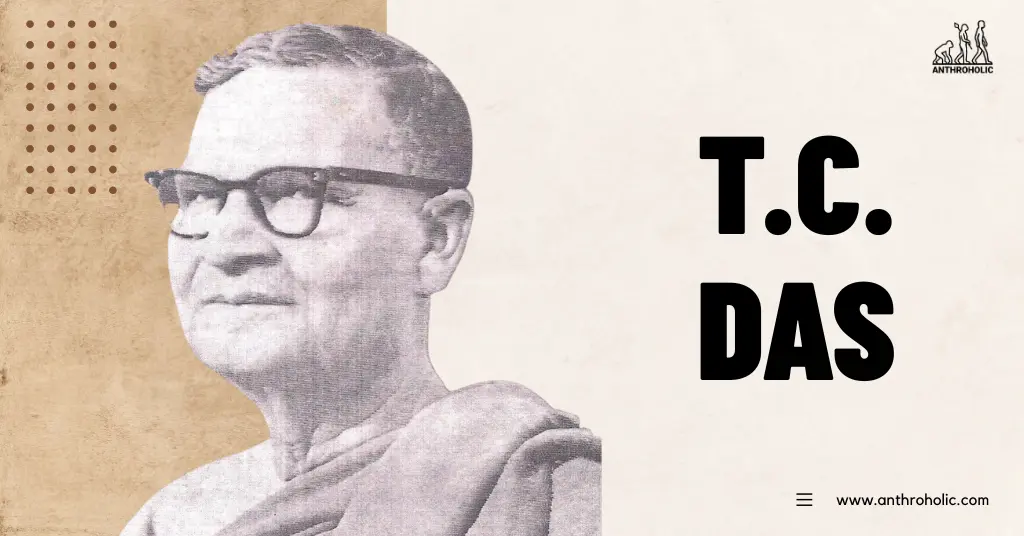
Born in January 1898 in what is today Bangladesh, and passing away in July 1964, Das became a key figure in the formative years of the discipline in India: he joined the newly instituted Department of Anthropology at the University of Calcutta in 1921, remained associated with it for decades, and conducted landmark fieldwork among tribal communities, especially the Purum Kukis of Manipur, as well as a path-breaking anthropological investigation of the Bengal famine of 1943.
His work is notable for combining meticulous empirical field-observation, genealogical and kinship analysis, and applied concerns particularly in relation to tribal welfare and social change. Despite his contributions, Das’s name has often remained under-recognised in later histories of Indian anthropology
Early Life & Education
Tarak Chandra Das was born in 1898 in Bengal (present-day Bangladesh) into a middle-class Bengali family during the late colonial period. Growing up in a region that was intellectually vibrant and politically active, Das was deeply influenced by the Bengal Renaissance and the growing nationalist discourse that emphasized self-knowledge and the scientific study of Indian society. These formative influences shaped his later anthropological orientation a synthesis of Western methodological rigor and Indian socio-cultural insight.
Das completed his early education in Bengal, excelling in humanities and social sciences. He went on to join the University of Calcutta, which was then emerging as one of the foremost centers for anthropological teaching and research under the guidance of pioneering scholars such as L.K. Ananthakrishna Iyer, H.L. Risley, and later S.C. Roy.
He pursued higher studies in Anthropology at the University of Calcutta, becoming part of the department soon after its establishment in 1921, under the leadership of L.K. Ananthakrishna Iyer and S.C. Roy. Das was among the first generation of formally trained Indian anthropologists, and his early training emphasized ethnographic fieldwork, physical anthropology, and social analysis.
He later earned his Doctorate (Ph.D.) from the University of Calcutta, focusing on tribal ethnography. His doctoral research on the Purum tribe of Manipur later published as “The Purums: An Old Kuki Tribe of Manipur” (1945) became a landmark in Indian ethnology for its exhaustive treatment of kinship and social organization.
During his early career, T.C. Das was also influenced by global anthropological developments, particularly Bronisław Malinowski’s functionalism and A.R. Radcliffe-Brown’s structural-functional approach, which he integrated with indigenous contexts. His education reflected a rare balance of colonial academic training and a nationalist urge to indigenize anthropology in India.
By the mid-1930s, he was appointed as a lecturer and later a reader in Anthropology at Calcutta University, where he played a major role in shaping the curriculum, field training practices, and mentoring future Indian anthropologists, including N.K. Bose and S.C. Sinha.
Major Works & Contributions
T.C. Das occupies a seminal place in Indian anthropology for his pioneering blend of theoretical depth, methodological precision, and applied social engagement. His works reflect a deep concern for human welfare, especially among tribal and marginalized populations, and mark the transition of anthropology in India from descriptive ethnography to analytical and policy-relevant research.
A. Landmark Ethnographic Work – “The Purums: An Old Kuki Tribe of Manipur” (1945)
This monograph remains T.C. Das’s most celebrated and enduring contribution. Based on long-term participant observation and genealogical method, the study presents a meticulous account of the kinship, marriage system, clan organization, and customary law of the Purum tribe.
- Das employed statistical, diagrammatic, and genealogical tools innovative for his time to analyze the circulation of women, kinship alliances, and descent systems.
- The work also explored the social structure and political leadership among the Purums, making it one of the earliest functional analyses of an Indian tribe.
- Scholars like N.K. Bose and D.N. Majumdar later acknowledged it as a “classic in Indian ethnography”, comparing its methodological precision to the field studies of Malinowski and Evans-Pritchard.
B. Applied Anthropology and Famine Studies – “The Bengal Famine (1943): An Anthropological Study” (1949)
Another major achievement of Das was his anthropological documentation of the Bengal Famine of 1943 a devastating event that caused millions of deaths. His field investigation, conducted across affected rural Bengal, recorded first-hand accounts, social disintegration, migration patterns, and the collapse of village economy.
- The study was revolutionary in showing how anthropological methods could illuminate socio-economic crises beyond tribal or isolated contexts.
- Das highlighted the human cost of colonial policies, particularly the failures in food distribution and governance, making his work both academic and politically charged.
- It is now regarded as one of the first instances of “applied anthropology” in India, preceding similar welfare-oriented research by decades.
C. Foundational Role in Indian Anthropology
- Das contributed extensively to the University of Calcutta’s Anthropology Department, helping develop syllabi, fieldwork traditions, and a network of regional ethnographic studies.
- His writings on tribal development, cultural change, and race relations influenced the evolution of anthropology from colonial administration to post-Independence nation-building.
- He co-edited academic bulletins and contributed essays to Man in India, Eastern Anthropologist, and Bulletin of the Department of Anthropology (Calcutta University).
D. Methodological Innovations
- Pioneered the genealogical method in Indian ethnography to map kin relations with scientific precision.
- Advocated holistic fieldwork, integrating ecological, cultural, and psychological perspectives.
- Emphasized interdisciplinary collaboration between anthropology, sociology, and economics to address real-world issues especially evident in his famine study.
E. Selected Major Publications
- The Purums: An Old Kuki Tribe of Manipur (1945)
- Anthropological Studies on the Bengal Famine, 1943 (1949)
- Kinship Organization in Tribal India (unpublished lectures, Calcutta University archives)
- Numerous articles in Man in India and Bulletin of the Department of Anthropology (1930s–1950s)
F. Legacy in Research Themes
T.C. Das’s work inspired generations of Indian anthropologists to explore:
- Tribal kinship and structure (followed by N.K. Bose and Surajit Sinha)
- Applied anthropology in famine, health, and rural development
- Ethical fieldwork and empathy towards the marginalized a hallmark of Das’s approach
4. Role in Indian and World Anthropology
T.C. Das stands as one of the pioneers of Indian anthropology’s indigenization, bridging Western theory and Indian socio-cultural reality. His contributions mark a turning point in both academic anthropology and applied social research, situating him among the early architects who gave Indian anthropology its distinctive intellectual identity.
A. Role in the Institutional Growth of Indian Anthropology
- University of Calcutta as the Nucleus – T.C. Das was among the earliest faculty members in the Department of Anthropology, University of Calcutta, which became the cradle of anthropological training in India. Under his guidance, the department evolved from colonial ethnology toward scientific, field-based social anthropology.
- Mentorship and Teaching Legacy – He trained several future stalwarts of Indian anthropology, including N.K. Bose, Surajit Chandra Sinha, and B.K. Roy Burman, emphasizing the importance of field immersion and ethical engagement. His students recalled him as a meticulous fieldworker and a demanding but inspiring teacher who insisted on “living the life of the people studied.”
- Advocacy for an Indian School of Anthropology – Das argued that Indian anthropologists should not merely imitate Western models but reinterpret them in Indian contexts. His insistence on contextualizing functionalism within Indian cultural realities anticipated the later debates on indigenization of anthropology.
B. Contribution to Applied and Policy Anthropology
- Through his study of the Bengal Famine (1943), Das showed that anthropology could serve policy, planning, and humanitarian relief, not just cultural description.
- His famine study directly influenced the Government of Bengal’s relief programs, marking one of the first uses of ethnographic data in postcolonial policymaking.
- Das’s approach foreshadowed what would later be known as “development anthropology”, linking cultural understanding with economic and administrative reform.
C. Recognition in Global Anthropology
- His Purum monograph drew attention from international scholars such as A.R. Radcliffe-Brown, Meyer Fortes, and Bronisław Malinowski, who recognized its empirical rigor and theoretical clarity.
- The Purum study was later cited in comparative kinship analyses (e.g., Claude Lévi-Strauss’s early kinship discussions and David Mandelbaum’s works).
- Das demonstrated that Indian fieldwork could meet global standards of anthropological scholarship, thereby validating Indian ethnography on the world stage.
D. Integration of Fieldwork and Nation-Building
- Post-Independence, Das urged anthropologists to engage with rural reconstruction, tribal welfare, and social reform viewing anthropology as a tool for social justice.
- He served on committees of the Anthropological Survey of India and consulted for welfare departments, helping design field training for government officers dealing with tribal populations.
- His synthesis of academic research and applied welfare remains a model for socially responsible anthropology.
E. Role in Establishing a Humanistic and Ethical Tradition
T.C. Das was deeply concerned with the ethics of fieldwork. His famine documentation and tribal research avoided voyeurism and emphasized empathy, dignity, and reflexivity long before these became formal anthropological concerns in the West. He insisted that “the anthropologist must see suffering not as data, but as a call to conscience.”
Critical Evaluation
T.C. Das’s work stands at a unique intersection of methodological excellence, humanistic empathy, and applied relevance. Yet, his scholarship though pioneering has often been underrepresented in mainstream anthropological discourse. This section evaluates his contributions critically, balancing achievements with limitations and situating his intellectual position within 20th-century anthropology.
A. Strengths and Enduring Merits
- Methodological Rigor and Innovation
- Das’s ethnographic study of the Purum tribe (1945) remains one of the earliest Indian works to employ genealogical, statistical, and diagrammatic tools systematically.
- His fieldwork methodology anticipated later developments in structural and network analysis, showing exceptional attention to detail and kinship linkage.
- He was among the first Indian scholars to insist that fieldwork must involve linguistic proficiency, cultural participation, and long-term observation standards now integral to anthropological training.
- Applied Vision and Social Concern
- His Bengal Famine (1943) research transformed anthropology from an ivory-tower pursuit into a socially engaged discipline.
- By documenting human suffering, moral collapse, and the erosion of community bonds, Das proved that anthropology could diagnose structural inequities in colonial governance.
- His work prefigured later trends in development and disaster anthropology, earning him posthumous recognition as a forerunner of applied anthropology in India.
- Humanistic Orientation
- Unlike the detached empiricism of some of his contemporaries, Das’s ethnography exuded a moral commitment to the studied communities.
- He refused to treat the poor or the tribal as mere “subjects,” instead portraying them as agents with dignity and resilience.
- This ethical vision places him closer to modern interpretive and reflexive anthropology than to colonial ethnography.
- Integration of Indian and Western Thought
- Das skillfully adapted Western theoretical frames (functionalism, diffusionism) to Indian realities without intellectual subservience.
- His comparative insight linking Indian kinship with universal structural patterns made him a bridge between Western theory and Indian ethnography.
B. Limitations and Critiques
- Theoretical Ambiguity
- While rich in data, his works lacked sustained theoretical articulation. Later anthropologists (e.g., N.K. Bose, Surajit Sinha) provided more explicit frameworks for cultural dynamics.
- Das’s writings rarely ventured into the macro-comparative or symbolic domains that gained prominence after the 1950s.
- Under-Publication and Limited Global Circulation
- Much of his scholarship remained confined to departmental bulletins or unpublished reports, curbing his international visibility.
- The Bengal famine study, though path-breaking, never achieved the global impact it deserved because it wasn’t widely disseminated or reprinted.
- Overemphasis on Empiricism
- Critics argue that his strong empirical orientation sometimes came at the cost of interpretive analysis or theoretical innovation.
- He was cautious in generalizing findings, preferring micro-level detail over broader models a strength scientifically, but a weakness for theory building.
- Neglect in Post-Colonial Narratives
- Post-Independence anthropology tended to valorize figures like N.K. Bose, S.C. Sinha, and Verrier Elwin. As a result, T.C. Das’s pioneering status faded in institutional memory despite his seniority.
- Only recent historians of anthropology, such as Abhijit Guha (2015), have revived appreciation for his contributions.
C. Scholarly Appraisal
| Scholar | View on T.C. Das |
|---|---|
| N.K. Bose | Praised The Purums as a methodological landmark in Indian ethnography. |
| D.N. Majumdar | Cited Das’s famine work as a “rare human document in Indian social research.” |
| Abhijit Guha (2015) | Reframed Das as the “forgotten humanist of Indian anthropology.” |
| R.K. Mukherjee (1968) | Noted that Das’s synthesis of empathy and empiricism was “ahead of its time.” |
Conclusion & Legacy
Tarak Chandra Das’s life and work represent a defining bridge between colonial-era ethnography and postcolonial Indian anthropology. Through his rigorous fieldwork, methodological innovation, and moral vision, Das transformed anthropology in India from a descriptive study of “tribal others” into a discipline of human understanding and social responsibility.
References
- Das, T.C. (1945). The Purums: An Old Kuki Tribe of Manipur. University of Calcutta Press, Calcutta.
WorldCat Listing - Das, T.C. (1949). The Bengal Famine (1943): An Anthropological Study. Bulletin of the Department of Anthropology, University of Calcutta.
Frontier Weekly overview - Guha, Abhijit (2015). “Rediscovering Tarak Chandra Das: The Forgotten Humanist of Indian Anthropology.”
Abhijit Guha’s blog, VU Anthropology - Majumdar, D.N. (1950). “The Place of T.C. Das in Indian Anthropology.” The Eastern Anthropologist, Vol. 3(1).
- University of Calcutta – Department of Anthropology. Institutional archives and centenary notes on early faculty (including T.C. Das).
https://www.caluniv.ac.in/academic/Anthropology.html - Bhattacharya, R.K. (1992). Anthropology in India: Retrospect and Prospect. Anthropological Survey of India, Calcutta.
- Mukherjee, R.K. (1968). History of Indian Anthropology: The Formative Phase. Indian Anthropological Society, Calcutta.
- Sinha, S.C. (1970). “Fieldwork and its Traditions in Indian Anthropology.” Man in India, Vol. 50(2).
- Indian Anthropological Society. Bulletin Archives (1930–1955) — includes fieldwork reports and obituaries referencing T.C. Das.
https://www.indiananthropologicalsociety.org/ - Frontier Weekly (2020). “Tarak Chandra Das: Pioneer Indian Anthropologist.”
https://frontierweekly.com/views/may-20/27-5-20-Tarak%20Chandra%20Das.html

Related Posts