AI Answer Evaluation Platform Live Now. Try Free Answer Evaluation Now
Semantics
Have you ever stopped to think about how a specific sound like the word “apple” can instantly trigger a mental image of a crisp, red fruit in your mind? That invisible bridge between a symbol and its meaning is the heart of Semantics.
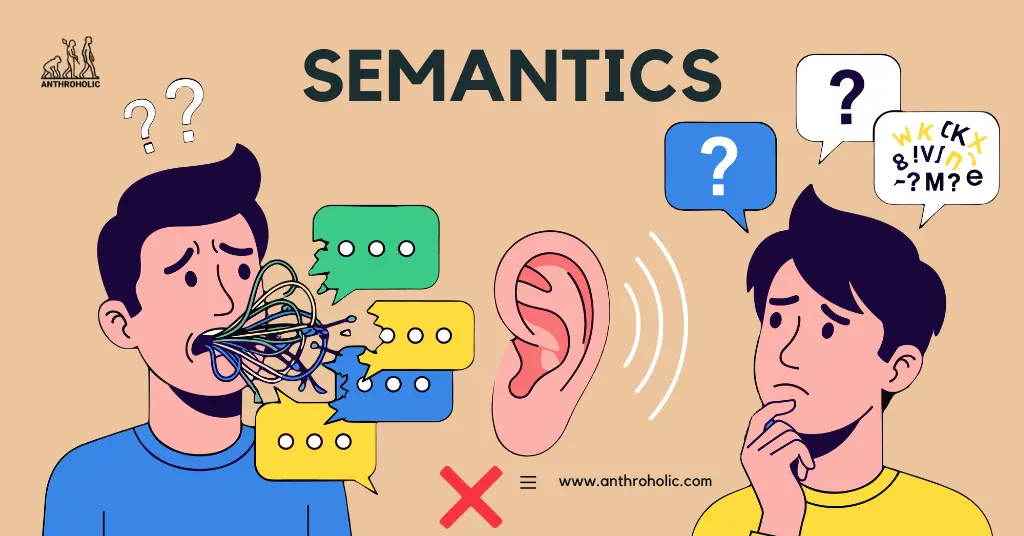
In the field of anthropology, semantics is much more than just a branch of linguistics. it is the study of how human beings organize their reality. It explores how we categorize the world, how we express abstract concepts like “love” or “justice,” and how the meanings of words can shift over time as our cultures evolve.
What is Semantics?
Semantics is the systematic study of meaning in language. While grammar (syntax) tells us how to put words together in a sentence, semantics tells us what those words actually stand for.
Anthropologists are particularly interested in how meaning is shared across a community. If we don’t agree on what a word means, communication breaks down. Therefore, semantics is the “social glue” that allows us to share thoughts and coordinate our lives.
The Two Layers of Meaning
To understand how a word works, we have to look at it from two different angles: Denotation and Connotation.
Denotation is the literal, “dictionary” definition of a word. For example, the denotation of the word “home” is simply a place where one lives.
Connotation, on the other hand, is the emotional and cultural baggage that comes with the word. For most people, “home” connotes feelings of warmth, safety, and family. While the denotation of a word is usually stable, its connotations can change wildly depending on your culture and personal experiences.
How Our Minds Organize Meaning
How do we store thousands of words in our heads without getting confused? Our brains use a few clever organizational tricks:
1. Semantic Fields
We don’t store words in a random list. Instead, we group them into “fields” or clusters of related concepts. For example, if I say “doctor,” your brain automatically primes related words like “hospital,” “medicine,” and “health.” Anthropologists study these fields to see what a culture values. A culture with fifty different words for “snow” has a very different semantic field for weather than one that only has two.
2. Relationships Between Words
We also define words by how they relate to one another.
- Synonyms: Words with similar meanings (e.g., big and large).
- Antonyms: Words with opposite meanings (e.g., hot and cold).
- Hyponyms: Words that are “sub-categories” of a larger group. For example, rose and tulip are hyponyms of the word flower.
Semantics and Culture: The Lexical Gap
One of the most fascinating parts of semantics is the Lexical Gap. This happens when one language has a specific word for a concept that another language can only describe with a long sentence.
Take the Japanese word Tsundoku it refers to the act of buying books and letting them pile up without reading them. English doesn’t have a single word for this, but we certainly recognize the feeling! These gaps tell us a lot about the unique “flavor” of a culture and what its people pay attention to in their daily lives.
Semantic Change: Why Words Move
Meaning is never static. As society changes, our words move to keep up. This is known as Semantic Shift.
- Broadening: A word’s meaning expands. For example, “business” used to mean “the state of being busy,” but now refers to commercial work.
- Narrowing: A word’s meaning gets more specific. “Meat” used to mean any kind of food (think of “sweetmeats”), but now it only refers to animal flesh.
- Pejoration: A word takes on a negative meaning over time.
- Amelioration: A word takes on a more positive meaning over time (like how “nice” used to mean “ignorant” in the 14th century!).
Significance in Anthropology
For those studying anthropology or preparing for the UPSC, semantics is a key tool for “reading” a culture.
- Ethnosemantics: This sub-field studies how different ethnic groups categorize their world, from kinship terms to types of plants.
- Power Dynamics: Semantics can be used to control narratives. The difference between calling someone a “freedom fighter” versus a “rebel” is a purely semantic choice that carries massive political weight.
- Cultural History: By tracking how the meaning of words like “family” or “marriage” has shifted over 200 years, we can map the history of human social evolution.
“The limits of my language mean the limits of my world.” Ludwig Wittgenstein
Conclusion
Semantics is the study of the invisible threads that connect our voices to our thoughts. It reveals that language is not just a list of labels, but a complex, ever-changing map of the human experience. By understanding semantics, we don’t just learn how to speak better; we learn how to see the world through the eyes of others.
Frequently Asked Questions (FAQs)
1. What is the difference between Semantics and Pragmatics? Semantics focuses on the literal meaning of words and sentences. Pragmatics looks at how the context changes that meaning. For example, if someone says “It’s cold in here,” the semantic meaning is a statement about the temperature. The pragmatic meaning might be a request for you to close the window.
2. Can a word have a meaning if there is no physical object for it? Yes. We have words for abstract concepts (like “truth”), imaginary things (like “unicorns”), and even things that don’t exist yet. Semantics is about mental concepts, not just physical objects.
3. Why do some words have multiple meanings? This is called Polysemy. It usually happens because a word’s original meaning was applied metaphorically to something new. For example, the “foot” of a person and the “foot” of a mountain.
4. How does AI understand semantics? Modern AI uses “vector semantics.” It converts words into numbers and maps them in a massive digital space. Words that are used in similar contexts (like “cat” and “dog”) are placed close together in this mathematical map.
References
- Bréal, M. (1897). Essai de Sémantique (The first formal study of semantics).
- Hurford, J. R., Heasley, B., & Smith, M. B. (2007). Semantics: A Coursebook. Cambridge University Press. https://doi.org/10.1017/CBO9780511841200
- Lyons, J. (1977). Semantics. Cambridge University Press. https://www.cambridge.org/core/books/semantics/B9E721EF9429C23F53F27A520B6A371C
- Saeed, J. I. (2015). Semantics. Wiley-Blackwell.

Related Posts