AI Answer Evaluation Platform Live Now. Try Free Answer Evaluation Now

Genetic Equilibrium
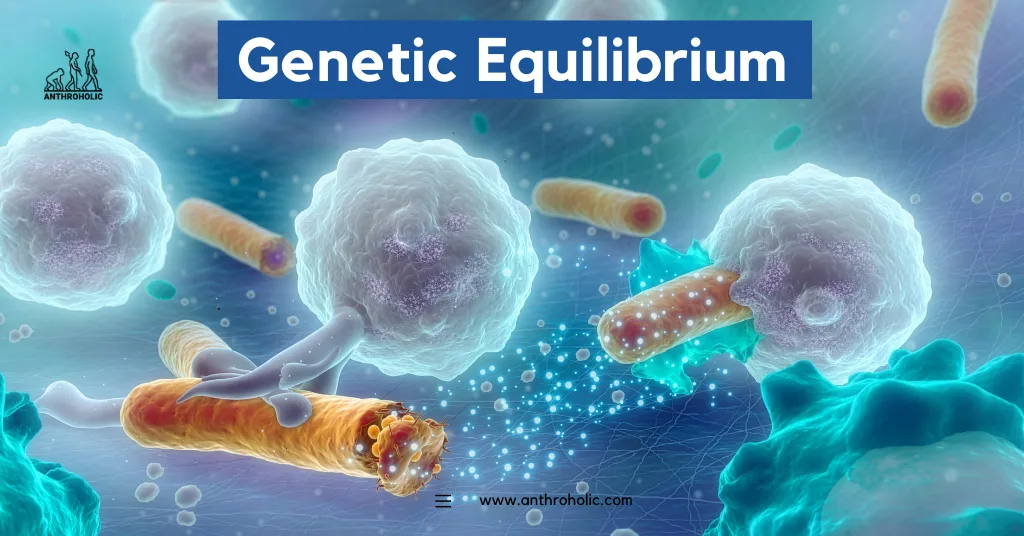
What if we could press pause on the relentless march of evolution? Imagine a moment where a population’s genetic diversity remains perfectly stable, generation after generation. This hypothetical state of stillness is the core concept of Genetic Equilibrium, a fundamental idea in population genetics that serves as the baseline for understanding evolutionary change.
For anthropology students and enthusiasts, grasping this concept isn’t just an academic exercise; it’s the key to unlocking how human populations have diversified and adapted over millennia.
Defining Genetic Equilibrium: The Hardy-Weinberg Null Hypothesis
Genetic Equilibrium describes a theoretical condition where the frequency of alleles and genotypes in a sexually reproducing population remains constant from one generation to the next. In simpler terms, the genetic makeup of the population is not changing; it is in a state of perfect balance.
The Hardy-Weinberg Principle (HWP)
The mathematical framework that formalizes Genetic Equilibrium was independently developed in 1908 by English mathematician G. H. Hardy and German physician Wilhelm Weinberg. This principle posits that under specific, highly restrictive conditions, allele and genotype frequencies will remain constant.
The HWP is expressed by the binomial expansion:
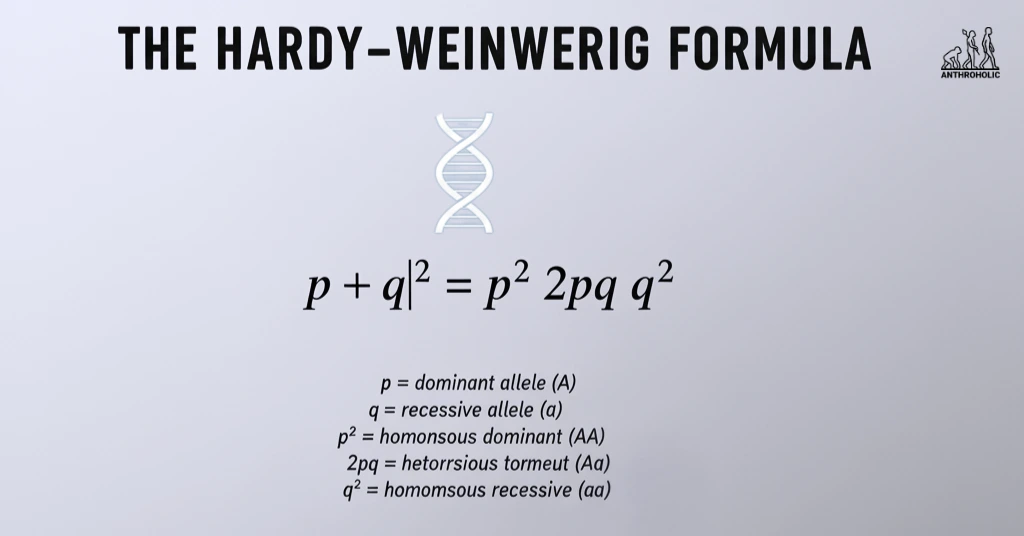
“The Hardy-Weinberg Principle is less about what is happening in a population and more about what isn’t. It provides the essential theoretical yardstick—the baseline of ‘no evolution’—against which the reality of ongoing evolutionary change is measured.”
Significance of Genetic Equilibrium in Anthropology
From an anthropological perspective, genetic equilibrium is not merely an abstract concept it is a benchmark for evaluating whether a human population is undergoing evolutionary change. According to one source:
“The science of population genetics is an integral component of biological anthropology in understanding human evolution and … divergence of human groups.”
By assessing whether and why populations depart from equilibrium, anthropologists can infer the action of forces such as migration, drift, selection, or non-random mating, all of which shape human genetic diversity and structure.
Assumptions Underlying Genetic Equilibrium
For a population to be in genetic equilibrium, several stringent assumptions must hold. These include:
- Random mating (panmixis)
- No mutation introducing new alleles
- No gene flow (immigration/emigration)
- No natural selection acting on the locus in question
- An infinitely large population (i.e., negligible genetic drift)
- Diploid organisms with sexual reproduction and non-overlapping generations
How Genetic Equilibrium is Tested and Calculated
In the classroom or in the field, one uses the HWE equation to compute expected genotype frequencies and then compares them to observed data. If observed ≈ expected, then equilibrium is indicated; otherwise, violation of one or more assumptions is inferred.
Bullet Points: Steps to perform HWE test
- Calculate allele frequencies p and q from observed genotype counts.
- Compute expected genotype frequencies (p², 2pq, q²).
- Compare observed vs expected using a chi-square test (or exact test).
- Interpret differences: if significant, equilibrium is rejected.
Why Populations Deviate from Genetic Equilibrium
Deviations from equilibrium are biologically informative. They point to forces that cause evolutionary change. Key evolutionary mechanisms include:
- Natural selection — favours certain alleles, leading to frequency changes.
- Genetic drift — especially in small populations, random allele frequency shifts.
- Gene flow (migration) — introduces new alleles or swaps gene pools between populations.
- Mutation — new alleles arise, altering allele frequencies over time.
- Non-random mating / inbreeding — changes genotype structure without necessarily altering allele frequencies.
Case Study: Lactase Persistence
The ability to digest lactose into adulthood (lactase persistence) is a classic anthropological example of an evolutionary change that demonstrates a departure from Genetic Equilibrium.
- The Locus: The ability is controlled primarily by a regulatory sequence near the LCT gene. The ancestral, non-persistent allele is dominant globally.
- Selection Pressure: The domestication of cattle and the consumption of milk in certain human populations (like those in Northern Europe and parts of Africa) introduced a powerful selection pressure.
- Deviation: In these populations, individuals with the persistent allele (who could utilize milk as a nutritional source) had a higher survival and reproductive rate. Calculating the and values shows that the persistent allele is far more frequent than expected under equilibrium, confirming that Natural Selection is actively at play.
According to a 2017 study by Ségurel and Bon, the frequency of the persistence allele in populations like the Masai is a direct result of strong selective pressure, highlighting how Gene Flow and Selection have rapidly altered human gene pools in the last 10,000 years, pushing them far from theoretical equilibrium.
Non-Random Mating: A Special Case
While the other four forces directly change allele frequencies , non-random mating primarily changes genotype frequencies . For instance, a common practice in many human societies is inbreeding (mating with close relatives), which increases the frequency of homozygous genotypes and decreases the frequency of heterozygotes , even though the overall allele frequencies in the population remain the same. This can bring otherwise rare recessive diseases (like certain metabolic disorders) to the forefront.
Conclusion: The Dynamic State of Humanity
Genetic Equilibrium is the ghost in the machine of evolution the silent, unchanging standard that proves the loud, constant movement of life. In the context of human anthropology, the Hardy-Weinberg Principle is an indispensable tool, allowing researchers to measure, quantify, and ultimately explain the evolutionary forces that have molded our species. From the unique adaptations allowing us to thrive in extreme environments to the broad genetic tapestry woven by historical migrations, every aspect of human microevolution represents a departure from this theoretical balance. By understanding the conditions required for equilibrium, we gain profound insight into the dynamic and ever-changing reality of human diversity and evolution.
Frequently Asked Questions (FAQs)
Q1: Is the Hardy-Weinberg Principle a law of nature?
A: No, the Hardy-Weinberg Principle is not a law of nature like gravity; it is a mathematical model or a theoretical null hypothesis. Real-world populations, especially human populations, virtually never meet the five required conditions (no mutation, no gene flow, etc.), meaning that they are virtually always in a state of evolution, or a departure from HWP equilibrium.
Q2: What is the difference between Gene Flow and Genetic Drift?
A: Gene Flow is the transfer of alleles between populations due to migration, which tends to make populations more genetically similar (homogenous).Genetic Drift is the random fluctuation of allele frequencies due to chance events, primarily impacting small populations and typically leading to a loss of genetic variation within the population.
Q3: Why is Genetic Equilibrium important to study if it never truly occurs?
A: It is crucial because it provides the essential baseline or standard against which all evolutionary change is measured. By comparing a real population’s allele and genotype frequencies to the expected HWP values, anthropologists can statistically determine which evolutionary forces (selection, drift, etc.) are at work and how quickly they are causing evolution.
Q4: How is non-random mating different from natural selection?
A: Natural Selection is differential reproductive success based on fitness (survival advantage of a genotype), which changes the allele frequencies over time. Non-random Mating (like inbreeding or assortative mating) is mate choice based on phenotype/genotype, which changes only the genotype frequencies (the ratio of homozygotes to heterozygotes) but does not change the overall frequency of the alleles in the gene pool.
References
- Andrews, C. A. (2010). The Hardy–Weinberg Principle. Nature Education Knowledge, 3(10), 65. Retrieved from https://www.nature.com/scitable/knowledge/library/the-hardy-weinberg-principle-13235724/
- Bosco, F., Castro, D., & Briones, M. R. S. (2012). Neutral and stable equilibria of genetic systems and the Hardy–Weinberg principle: Limitations of the chi-square test and advantages of auto-correlation functions of allele frequencies. arXiv preprint. https://arxiv.org/abs/1208.2612
- “Hardy–Weinberg Equilibrium in Large-Scale Genomic Data.” (2020). PLoS Genetics, 16(3), e1008635. https://pmc.ncbi.nlm.nih.gov/articles/PMC7083100/
- Khan Academy. (n.d.). Mechanisms of Evolution / Hardy–Weinberg Equilibrium. Retrieved from https://www.khanacademy.org/science/ap-biology/natural-selection/hardy-weinberg-equilibrium/a/hardy-weinberg-mechanisms-of-evolution
- Stanford Encyclopedia of Philosophy. (2006). Population Genetics. Retrieved from https://plato.stanford.edu/entries/population-genetics/
- Biology LibreTexts. (2024). 19.1B: Population Genetics. Retrieved from https://bio.libretexts.org/Bookshelves/Introductory_and_General_Biology/General_Biology_(Boundless)/19%3A_The_Evolution_of_Populations/19.01%3A_Population_Evolution/19.1B%3A_Population_Genetics

Related Posts