
AI Answer Evaluation Platform Live Now. Try Free Answer Evaluation Now

Oculesics
In the vast landscape of anthropological study, few elements of human interaction are as potent yet as frequently misunderstood as the gaze. Oculesics, a sub-field of Kinesics, is the study of eye behavior, eye contact, and eye-related non-verbal communication. While the physiological act of seeing is universal, the social “grammar” of how we use our eyes is strictly dictated by cultural heritage.
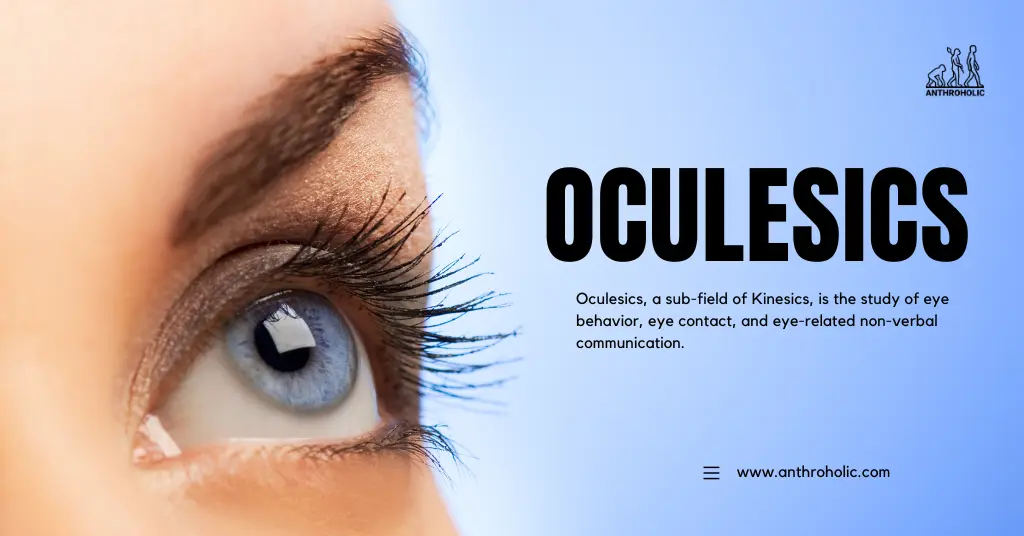
For an anthropologist or a UPSC aspirant, mastering oculesics is essential to understanding how trust, authority, and social cohesion are negotiated across borders.
The Anthropological Significance of Oculesics
Anthropologists view oculesics as a primary gateway for understanding a culture’s Social Hierarchy and Value Systems. The eyes do not just “see”; they signal intent, regulate the flow of conversation, and establish the boundaries of intimacy. Because eye behavior is often subconscious, it serves as one of the most honest indicators of cultural conditioning.
In many Western contexts, “looking someone in the eye” is synonymous with honesty. However, in a globalized framework, this is a narrow interpretation. The meaning of a gaze is highly contextual and shifts based on the relationship between the communicators.
High-Intensity vs. Low-Intensity Gaze
Cultural groups are often categorized by their “gaze profile.” These profiles dictate the frequency, duration, and intensity of eye contact deemed appropriate in social settings.
High-Intensity/Contact Cultures
In cultures characterized by high contact such as those in the Middle East, Mediterranean Europe, and Latin America prolonged eye contact is the norm.
- Function: It establishes sincerity and interpersonal “warmth.”
- Perception: In these regions, avoiding eye contact can be interpreted as a sign of being “shifty,” untrustworthy, or disinterested. In some Arab cultures, an intense gaze between men is a method of gauging the “true heart” of the interlocutor.
Low-Intensity/Avoidance Cultures
In many East Asian (Japan, China, Korea) and Indigenous African or Native American cultures, direct eye contact is often minimized.
- Function: It signals respect for hierarchy, humility, and the preservation of social “space.”
- Perception: In a Japanese classroom, for instance, a student may look at the teacher’s neck or the floor to demonstrate focused attention and deference. Direct, unwavering eye contact from a subordinate to a superior might be perceived as a challenge or an act of aggression.
Key Functions of Eye Behavior
To understand oculesics deeply, we must categorize the specific roles the eyes play during an intercultural exchange:
- Regulating Interaction: The eyes act as a “traffic signal.” We look at a person to signal they should start speaking and look away to signal we are finishing our thought.
- Monitoring Feedback: Speakers use the eyes to check if their audience is confused, bored, or in agreement.
- Establishing Dominance: A “staring contest” or an unblinking gaze is a universal sign of a power struggle or an attempt to assert authority.
- Expressing Intimacy: Pupil dilation and “eye-narrowing” are involuntary responses to attraction or suspicion, respectively.
Pull Quote: “Oculesics proves that the eyes are not just the windows to the soul, but the mirrors of our cultural upbringing. What one culture sees as ‘confidence,’ another sees as ‘insolence’.”
Oculesics and Gender Dynamics
Anthropological research frequently highlights that eye contact is not only culture-bound but gender-bound. In several conservative societies, oculesic norms are strictly bifurcated by sex. For example, in traditional Middle Eastern or South Asian rural contexts, a woman making direct eye contact with an unrelated man may be viewed as immodest or provocative.
Conversely, in Western corporate cultures, women are often encouraged to maintain firm eye contact to project “leadership presence,” showcasing how oculesics can be used to navigate or challenge traditional gender roles.
The “Respectful Aversion” in Healthcare (2025)
A 2025 study in Australian urban hospitals examined communication between Western-trained doctors and patients from Aboriginal backgrounds. The doctors often noted in their files that patients were “withdrawn” or “untruthful” because they avoided eye contact during diagnoses.
Anthropological intervention revealed that for these Aboriginal patients, looking an authority figure in the eye was a breach of traditional etiquette. By adjusting their own oculesic behavior looking at the medical charts or the patient’s shoulder rather than the eyes doctors were able to build significantly higher levels of trust and patient compliance.
The Danger of “Pragmatic Failure”
When two different oculesic systems meet, the result is often Pragmatic Failure a breakdown in communication where the literal words are understood, but the social intent is misjudged.
| Culture A (High Contact) | Culture B (Low Contact) | Interaction Outcome |
| Views gaze as “Honesty” | Views gaze as “Aggression” | Culture B feels threatened/bullied. |
| Views gaze avoidance as “Suspicious” | Views gaze avoidance as “Respect” | Culture A feels the other is lying. |
Conclusion
Oculesics serves as a vital reminder that communication is a multisensory experience. In the field of anthropology, recognizing that “the eyes have their own language” allows for a more empathetic and accurate analysis of human behavior. Whether for administrative success in diverse regions or for academic excellence in social sciences, understanding the subtle shifts of the gaze is the key to unlocking true intercultural competence.
Final Thought: In the silence of a gaze, an entire cultural history is spoken; the challenge of the global citizen is to learn how to listen with their own eyes.
Frequently Asked Questions (FAQs)
Q1: What is the difference between Oculesics and Kinesics?
Answer: Kinesics is the broad study of all body movements (posture, gestures, facial expressions). Oculesics is a specialized sub-category of kinesics that focuses exclusively on eye-related behaviors.
Q2: Does pupil dilation fall under the study of Oculesics?
Answer: Yes. While pupil dilation is an involuntary physiological response (often linked to arousal or interest), anthropologists study how different cultures interpret these physiological “micro-signals” in social settings.
Q3: Is direct eye contact a universal sign of honesty?
Answer: No. This is a common ethnocentric misconception. In many cultures throughout Asia, Africa, and Latin America, avoiding eye contact is a sign of respect, truthfulness, and humility.
Q4: How does oculesics affect digital communication?
Answer: With the rise of video conferencing, “eye contact” has become a technological challenge. Because cameras and screens are in different positions, users often experience a lack of oculesic connection, leading to “Zoom fatigue” and a perceived loss of empathy.
Q5: Can you “over-eye contact” in Western cultures?
Answer: Yes. Even in high-contact Western cultures, a gaze that lasts too long (usually over 7–10 seconds without blinking or looking away) is perceived as a “stare,” which triggers a “fight-or-flight” response in the listener.
Q6: Why should UPSC aspirants study Oculesics?
Answer: For the interview stage and for Paper-I (Anthropology), understanding oculesics helps in analyzing tribal-state relations and improving personal administrative communication skills in diverse districts.
References
- Argyle, M., & Cook, M. (1976). Gaze and Mutual Gaze. Cambridge University Press. https://www.cambridge.org/core/books/gaze-and-mutual-gaze/76B077A9773B1B977536F3D3C6A2E9F1
- Hall, E. T. (1966). The Hidden Dimension. Doubleday. https://www.anchorbooks.com/book/the-hidden-dimension/9780385084765/
- Knapp, M. L., Hall, J. A., & Horgan, T. G. (2013). Nonverbal Communication in Human Interaction. Cengage Learning. https://www.cengage.com/c/nonverbal-communication-in-human-interaction-8e-knapp/9781133311591/
- Matsumoto, D., & Hwang, H. C. (2024). Nonverbal Communication: Science and Applications. SAGE Publications. https://us.sagepub.com/en-us/nam/nonverbal-communication/book235437
- Samovar, L. A., Porter, R. E., McDaniel, E. R., & Roy, C. S. (2025). Communication Between Cultures. Cengage Learning. https://www.cengage.com/c/communication-between-cultures-9e-samovar/9781285444628/

Related Posts