AI Answer Evaluation Platform Live Now. Try Free Answer Evaluation Now
Rhetoric and Public Speaking
From the high-stakes debates of the ancient Greek agora to the carefully curated viral clips of 21st-century digital activists, the ability to sway an audience through speech remains one of the most potent tools in the human repertoire. While often dismissed as “mere words,” rhetoric is the invisible architecture of social order. In anthropology, the study of Rhetoric and Public Speaking transcends the search for “eloquence”; it is a deep investigation into how language is used to construct authority, negotiate identity, and perform culture.
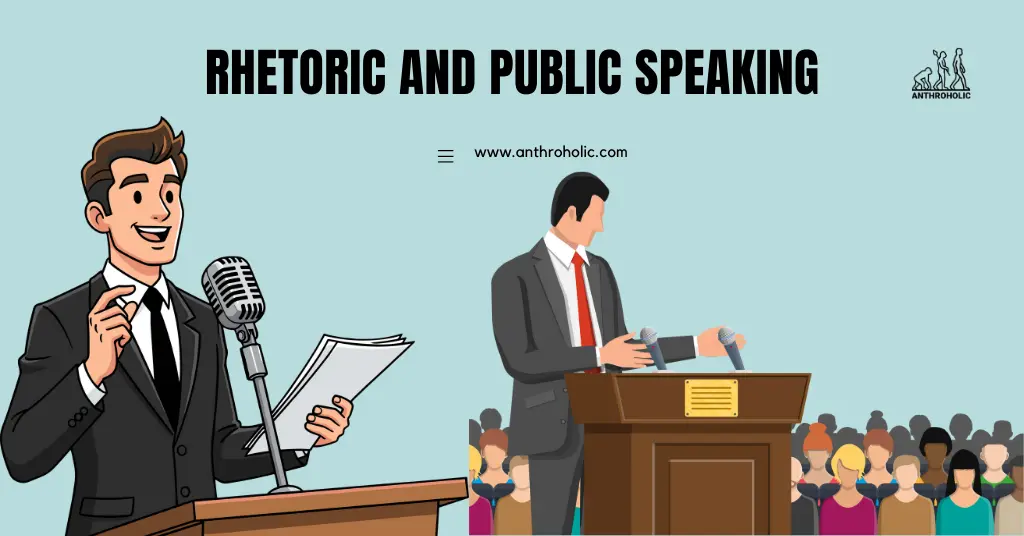
As we navigate the complexities of 2026, the field of Media Linguistics has become inseparable from public speaking. The way a leader speaks to a crowd today is instantly digitized, remixed, and scrutinized by global audiences, making the anthropological lens more critical than ever for students and UPSC aspirants seeking to understand the “theater of power.”
Rhetoric as Ritual
Anthropologists do not view public speaking as a static skill, but as a Cultural Performance. Influenced by the work of Victor Turner, rhetoric is seen as a “social drama” that occurs in liminal spaces—moments of transition where the speaker has the power to redefine the group’s reality.
Public Speaking as “Social Ritual”
In many societies, a public address is more than information sharing; it is a ritual that reinforces hierarchy. Whether it is a village elder in a Polynesian fono or a Prime Minister in a parliament, the speaker must adhere to specific “linguistic protocols.” These protocols signal to the audience that the speaker is a legitimate authority.
Performance and the “Restoration of Behavior”
Richard Schechner and Victor Turner posited that all public speaking involves a “restoration of behavior.” The speaker adopts a persona, using gestures, tone, and vocabulary that are recognizable to the culture. This performance creates a shared experience, binding the audience together through what anthropologists call communitas—a state of collective unity and heightened emotion.
From the Agora to the Algorithm
The foundations of public speaking are often traced to the Western classical tradition, but a comparative anthropological approach reveals a much broader spectrum of persuasive arts.
The Aristotelian Triad: A Universal Base?
Aristotle’s Rhetoric identified three “modes of persuasion” that remain central to any analysis of public speech:
- Ethos (Credibility): The perceived character and authority of the speaker.
- Logos (Logic): The internal consistency and factual strength of the argument.
- Pathos (Emotion): The ability to tap into the audience’s feelings and values.
While these terms are Greek, the concepts are cross-cultural. However, modern rhetoric has shifted its emphasis. According to recent research in Media Linguistics, the “Digital Era” of 2025-2026 has seen a massive surge in Pathos-dominant discourse, where emotional resonance often outpaces logical rigor in virtual public squares.
Western vs. Indigenous Styles
Anthropology challenges the Eurocentric view that “rhetoric” is synonymous with Western-style debate. Comparative Rhetoric investigates how different cultures argue.
| Feature | Western Rhetoric | Indigenous/Non-Western Rhetoric |
| Structure | Linear, point-by-point | Cyclical, narrative-heavy |
| Logic | Syllogistic (Deductive) | Metaphorical, ancestral-based |
| Truth | Absolute/Scientific | Contextual/Experiential |
| Goal | Persuasion/Win | Harmony/Social Cohesion |
Media Linguistics and Public Speaking in 2026
The intersection of public speaking and Media Linguistics is where the most significant shifts are occurring today. In the digital age, a “speech” is no longer a one-time event; it is a Media Text that lives forever in the digital cloud.
The Rise of “Digital Orality”
We are currently witnessing a return to “Orality” through digital platforms. Speakers now utilize “slanguage”—a blend of slang and standardized language—to sound more authentic and “relatable” to younger demographics. This is not a decline in standards, but a sophisticated linguistic adaptation to the medium.
AI and the Algorithmic Speaker
By 2026, AI-powered tools are routinely used to “optimize” speeches for specific demographics. Anthropologists are currently debating the impact of Algorithmic Rhetoric. When a speech is written by an AI to trigger maximum engagement from a specific “echo chamber,” the human element of ethical responsibility (Ethos) is fundamentally altered.
“The speaker of 2026 is a hybrid of man and machine. The rhetoric is no longer just about the voice; it is about the metadata.” Dr. Elena Dobrosklonskaya, “Media Linguistics,” 2024.
Case Study: Hostile Rhetoric and Voter Trust (2025)
A compelling real-world example of rhetoric’s anthropological impact can be seen in a 2025 study of the Malawi general elections. Researchers analyzed the “hostile rhetoric” used by major candidates during televised addresses and social media broadcasts.
The findings were striking: in regions where candidates used high levels of negative campaigning focusing on personal attacks rather than policy there was a marked decrease in public trust in democratic institutions. From an anthropological perspective, this “ugly rhetoric” broke the ritual contract between the leader and the led, transforming a unifying “social drama” into a fragmenting “conflict ritual.”
Conclusion
Rhetoric and public speaking are not merely academic subjects; they are the heart of human sociality. By analyzing these practices through anthropology and Media Linguistics, we gain the tools to see through the “framing” of modern messages. For the UPSC aspirant, mastering the nuances of rhetoric is not just about clearing an interview it is about understanding the very fabric of governance and social influence.
In a world of deepfakes and algorithmic echo chambers, the ability to speak—and listen critically is the ultimate anthropological literacy.
Frequently Asked Questions (FAQs)
1. What is the difference between Rhetoric and Oratory?
While often used interchangeably, Rhetoric refers to the theory and art of persuasion, whereas Oratory refers to the practice and performance of formal public speaking.
2. How does “Media Linguistics” relate to public speaking?Media Linguistics studies how language adapts to media formats. In public speaking, this means analyzing how a speech is structured differently for a live audience versus a 30-second viral clip or a podcast.
3. Why is the “liminal” stage of a speech important in anthropology?
According to Victor Turner, the “liminal” stage is the middle part of a ritual where the audience is most open to change. A successful public speaker uses this phase to shift the audience’s perspective and “incorporate” them into a new way of thinking.
4. Can AI-generated speeches have “Ethos”?
This is a major debate in 2026. While AI can simulate the appearance of credibility, anthropologists argue that true Ethos requires human accountability and a shared social history, which machines lack.
References
- Amakoh, K. (2025). Ugly campaigns hurt voter trust: The impact of hostile rhetoric in multiethnic societies. Michigan State University. https://polisci.msu.edu/news-events/news/ugly-campaigns1125.html
- Aristotle. (n.d.). Rhetoric. (W. Rhys Roberts, Trans.). [Suggested Internal Link: Anthroholic/Classical-Greek-Philosophy]
- Dobrosklonskaya, E. N. (2024). Media Linguistics: A New Paradigm for Language Study in the Digital Age. Academic Press.
- Schechner, R. (2025). The Future of Performance: Anthropology and the Digital Turn. Routledge.
- Tindale, C. W. (2021). The Anthropology of Argument: Cultural Foundations of Rhetoric and Reason. Routledge. https://journals.openedition.org/aad/8277
- Turner, V. (1982). From Ritual to Theatre: The Human Seriousness of Play. PAJ Publications.

Related Posts