AI Answer Evaluation Platform Live Now. Try Free Answer Evaluation Now

Anthropology Optional Question Papers for UPSC IAS
- Last Updated:
Short answer: UPSC publishes every year’s Anthropology Optional question papers free on its website. This page gives Paper I and Paper II PDFs from 2009 to 2025, the questions from 2009 to 2024, links to the official 2024–2026 papers on upsc.gov.in, and a topic-wise analysis of 2015–2024. Each paper has eight questions in two sections, carries 250 marks and lasts three hours; questions 1 and 5 are compulsory [1].
Original Anthropology Optional Question Papers for UPSC CSE IAS from 2009 to Present Year for Free available in PDF format. Download Now by clicking the links Below.

All of the PDF files on this page are strictly for educational purposes. Please don’t make them commercial and only use them to advance your knowledge. Please be considerate of our labour of love. Our goal is to offer free study materials to all aspirants since we believe that everyone should have access to a free education. For this reason, we have combined all of the materials in one location.
Anthropology Optional Paper I PDF Download
- Anthropology Optional Paper I 2025
- Anthropology Optional Paper I 2024
- Anthropology Optional Paper I 2023
- Anthropology Optional Paper I 2022
- Anthropology Optional Paper I 2021
- Anthropology Optional Paper I 2020
- Anthropology Optional Paper I 2019
- Anthropology Optional Paper I 2018
- Anthropology Optional Paper I 2017
- Anthropology Optional Paper I 2016
- Anthropology Optional Paper I 2015
- Anthropology Optional Paper I 2014
- Anthropology Optional Paper I 2013
- Anthropology Optional Paper I 2012
- Anthropology Optional Paper I 2011
- Anthropology Optional Paper I 2010
- Anthropology Optional Paper I 2009

Suggested: Anthropology Optional Syllabus UPSC IAS Mains (Topic Wise)
Anthropology Optional Paper II PDF Download
- Anthropology Optional Paper II 2025
- Anthropology Optional Paper II 2024
- Anthropology Optional Paper II 2023
- Anthropology Optional Paper II 2022
- Anthropology Optional Paper II 2021
- Anthropology Optional Paper II 2020
- Anthropology Optional Paper II 2019
- Anthropology Optional Paper II 2018
- Anthropology Optional Paper II 2017
- Anthropology Optional Paper II 2016
- Anthropology Optional Paper II 2015
- Anthropology Optional Paper II 2014
- Anthropology Optional Paper II 2013
- Anthropology Optional Paper II 2012
- Anthropology Optional Paper II 2011
- Anthropology Optional Paper II 2010
- Anthropology Optional Paper II 2009
Official papers on the UPSC website (2024–2026)
UPSC’s website has been redesigned, and the older links to its papers no longer work. These are the official Anthropology papers we found on the current site [1]:
| Year | Paper I | Paper II |
|---|---|---|
| 2026 | Paper I 2026 (UPSC) | Paper II 2026 (UPSC) |
| 2025 | Paper I 2025 (UPSC) | Paper II 2025 (UPSC) |
| 2024 | Paper I 2024 (UPSC) | Paper II 2024 (UPSC) |
UPSC Anthropology Optional Previous Papers
2024 Anthropology Paper 1 Questions
खण्ड-A / SECTION-A
1. निम्नलिखित प्रत्येक पर लगभग 150 शब्दों में टिप्पणी लिखिए :
Write notes on the following in about 150 words each:
(a) संस्कृति की विशेषताएँ
Attributes of culture
(b) हड़प्पाकालीन समुद्री व्यापार
Harappan maritime trade
(c) परिहार एवं परिहास संबंधों पर समालोचनात्मक दृष्टिकोण
Critical perspective on avoidance and joking relationship
(d) घातक और उपघातक जीन
Lethal and sublethal genes
(e) स्वास्थ्य और बीमारी में हीमोग्लोबिन
Hemoglobin in health and disease
2. (a) शास्त्रीय विकासवाद के आलोचनात्मक विकास के रूप में ऐतिहासिक विशिष्टतावाद पर चर्चा कीजिए।
Discuss historical particularism as a critical development to the classical evolutionism.
(b) मेहरगढ़ के विशेष संदर्भ में खाद्य उत्पादन और पशुओं को पालतू बनाने के साक्ष्यों का वर्णन कीजिए। इसके महत्त्व पर प्रकाश डालिए।
Describe the evidences of food production and domestication of animals with special reference to Mehrgarh. Throw light on its significance.
(c) जीवन-शैली से जुड़ी बीमारियों और मानव स्वास्थ्य पर उनके प्रभाव पर आलोचनात्मक टिप्पणी कीजिए।
Critically comment on the lifestyle diseases and their impact on human health.
3. (a) गुणसूत्री-रचना से आपका क्या तात्पर्य है? इसका विश्लेषण मनुष्य में गुणसूत्र विपथन के निदान में किस प्रकार सहायता करता है?
What is meant by karyotype? How does its analysis help in diagnosis of the chromosomal aberrations in man?
(b) शहरीकरण को परिभाषित कीजिए तथा भारत में परिवार पर इसके प्रभाव की सोदाहरण विवेचना कीजिए।
Define urbanization and discuss its impact on family in India with examples.
(c) मानवशास्त्रीय अनुसंधान में क्षेत्रीय कार्य-पद्धति में समकालीन चुनौतियों की विवेचना कीजिए।
Discuss the contemporary challenges in fieldwork method in anthropological research.
4. (a) रुथ बेनेडिक्ट द्वारा देखी गई अमरीका की दक्षिण-पश्चिम की संस्कृतियों में मनोवैज्ञानिक प्रकारों की विशेषताओं पर समालोचनात्मक चर्चा कीजिए।
Critically discuss the characteristics of the psychological types in the cultures of the American South-West as observed by Ruth Benedict.
(b) उपयुक्त उदाहरणों के साथ भारतीय पुरापाषाणिक संस्कृतियों की एश्यूलियन और ओल्डोवन परंपराओं की चर्चा कीजिए।
Discuss the Acheulian and Oldowan traditions of Indian Paleolithic cultures with suitable illustrations.
(c) आनुवंशिक परामर्श क्या है? इसमें सम्मिलित विभिन्न चरणों की संक्षेप में चर्चा कीजिए।
What is genetic counselling? Briefly discuss various steps involved in it.
खण्ड-B / SECTION-B
5. निम्नलिखित प्रत्येक पर लगभग 150 शब्दों में टिप्पणी लिखिए :
Write notes on the following in about 150 words each:
(a) कालानुक्रमिक आयु-निर्धारण
Chronometric dating
(b) कूला की सांस्कृतिक प्रासंगिकता
Cultural relevance of the Kula
(c) वंशागतित्व और इसका अनुमान
Heritability and its estimation
(d) राजनीतिक संगठन के प्राधिकार और स्वरूप
Authority and forms of political organization
(e) मनुष्य में एकल-जीन उत्परिवर्तन विकार
Single-gene mutation disorders in man
6. (a) होमो इरेक्टस के भौगोलिक वितरण की विवेचना कीजिए। इसकी भौतिक विशेषताओं के दृष्टिगत, मानव विकासक्रम रेखा में इसका उपयुक्त स्थान कहाँ होगा?
Discuss the geographical distribution of Homo erectus. Taking into account its physical features, where does it fit in human evolutionary line?
(b) उपयुक्त उदाहरणों के साथ फोरेंसिक मानव-विज्ञान के अनुप्रयोगों पर चर्चा कीजिए।
Discuss the applications of forensic anthropology with suitable examples.
(c) लेवी-स्ट्रॉस सिम्शी आस्दीवाल मिथक को कैसे देखते हैं? मिथकों के अध्ययन की रोशनी में लेवी-स्ट्रॉस के संरचनावाद के सिद्धान्त की आलोचनात्मक विवेचना कीजिए।
How does Lévi-Strauss look at the Tsimshian myth of Asdiwal? Critically discuss Lévi-Strauss’ theory of structuralism in the light of his study of mythologies.
7. (a) ज़ाकू डेरीडा के उत्तर-आधुनिकतावादी कार्यों के आलोक में ‘विखंडन’ की धारणा की आलोचनात्मक व्याख्या कीजिए।
Critically explain the notion of ‘deconstruction’ in the light of the postmodern works of Jacques Derrida.
(b) बहुघटकीय विशेषक क्या है? अपने उत्तर को उपयुक्त मानवीय उदाहरणों से स्पष्ट कीजिए।
What is a multifactorial trait? Illustrate your answer with suitable human examples.
(c) अध्ययन समूह के चुनाव में विभिन्न प्रतिचयन तकनीकों की प्रयोज्यता की विवेचना कीजिए।
Discuss the applicability of various sampling techniques in selecting the study group.
8. (a) सामाजिक असमानता की निरन्तरता के आधार स्वरूप सामाजिक स्तरीकरण की अवधारणा का आलोचनात्मक
परीक्षण कीजिए।
Examine critically the concept of social stratification as a basis for sustaining social inequality.
(b) मनुष्य में ABO और Rh रक्त समूहों के आनुवंशिकी और वंशानुक्रम विन्यासों का वर्णन कीजिए।
Describe the genetics and inheritance patterns of the ABO and Rh blood groups in man.
(c) मानव विकास में जैविक और सांस्कृतिक कारकों के सहक्रियात्मक प्रभाव की आलोचनात्मक चर्चा कीजिए।
Critically discuss the synergistic effect of biological and cultural factors in human evolution.
2024 Anthropology Paper 2 Questions
खण्ड-A / SECTION-A
Q1. निम्नलिखित प्रत्येक पर लगभग 150 शब्दों में लघु टिप्पणियाँ लिखिए :
Write short notes on the following in about 150 words each:
(a) ग्रामीण अर्थव्यवस्था का अंकरूपण
Digitisation of rural economy
(b) राज्य समाजों की उत्पत्ति
Origin of State Societies
(c) सीरो-मालाबार ईसाई
Syro-Malabar Christians
(d) झारखण्ड की कारीगर जनजातियाँ
Artisan tribes of Jharkhand
(e) जनजातीय बच्चों में वृद्धिरोध एवं वेस्टिंग के कारण
Causes of stunting and wasting among tribal children
Q2. (a) विशेष रूप से कमज़ोर जनजातीय समूहों (पीवीटीजी) के लिए सरकार द्वारा हाल ही में शुरू की गई कल्याणकारी योजनाओं की आलोचनात्मक विवेचना कीजिए । समीक्षा कीजिए किपीवीटीजी को त्रुटिवश आदिम जनजातीय समूह (पीटीजी) क्यों कहा जाता था।
Critically discuss the recent welfare measures initiated by the Government for the Particularly Vulnerable Tribal Groups (PVTGs). Comment why PVTGs were erroneously called Primitive Tribal Groups (PTGs).
(b) पेसा अधिनियम कैसे स्थानीय स्वशासन को सशक्त बना रहा है और महिलाओं की राजनीतिक भागीदारी को प्रभावित कर रहा है ?
How is PESA Act empowering local self-governance and impacting women’s political participation ?
(c) स्वायत्तता बनाए रखने हेतु भारतीय मानवशास्त्रियों द्वारा निभाई गई आलोचनात्मक भूमिका के परिपेक्ष्य में भारतीय मानवशास्त्र के औपनिवेशिक इतिहास का विखंडन कीजिए ।
Deconstruct the colonial history of Indian Anthropology highlighting the critical role played by the Indian Anthropologists in sustaining its autonomy.
Q3. (a) राखी गढ़ी से प्राप्त साक्ष्यों और हड़प्पा सभ्यता से इसके संबंधों का समालोचनात्मक विवरण दीजिए ।
Critically describe evidences from Rakhi Garhi and its linkages to Harappan civilization.
(b) ग्रामीण भारत में सामाजिक परिवर्तन पर एम.एन. श्रीनिवास और एल.पी. विद्यार्थी के दृष्टिकोणों की तुलना और अंतर प्रस्तुत कीजिए ।
Compare and contrast the approaches of M.N. Srinivas and L.P. Vidyarthi to social change in village India.
(c) भारत में जनजातीय समुदायों की भूमि हस्तांतरण और अधिकारों के वंचन पर 1878 से 2006
तक की वन नीतियों के प्रभाव का परीक्षण कीजिए ।
Examine the impact of Forest Policies from 1878 to 2006 on land alienation and deprivation of rights of tribal communities in India.
Q4. (a) एआई और आनुवंशिक अनुसंधान में वर्तमान की प्रगति के कारण जैविक और सामाजिक-सांस्कृतिक मानवशास्त्र की नैतिक चिंताएँ क्या हैं?
What are the ethical concerns in biological and socio-cultural anthropology because of recent advances in AI and genetic research?
(b) जनजातीय सक्रियतावादी और स्वतंत्रता सेनानी बिरसा मुंडा के जीवन इतिहास पर एक निबंध लिखिए । जनजातीय समाज पर उनके बलिदान का क्या प्रभाव पड़ा ?
Write an essay on the life history of tribal activist and freedom fighter Birsa Munda. What was the impact of his sacrifice on tribal society?
(c) अगले 50 वर्षों में भारत की बदलती जनसंख्या गतिशीलता की जनसांख्यिकीय चुनौतियाँ क्या हैं?
What are the demographic challenges of India’s changing population dynamics in the next 50 years?
खण्ड-B / SECTION-B
Q5. निम्नलिखित प्रत्येक पर लगभग 150 शब्दों में लघु टिप्पणियाँ लिखिए :
Write short notes on the following in about 150 words each :
(a) बी.के. रॉय बर्मन की ‘बफर जोन’ की अवधारणा
B.K. Roy Burman’s concept of ‘Buffer Zone’
(b) स्वदेशी और जनजातीय लोगों पर आईएलओ के सम्मेलन संख्या 169 (1989) का वर्णन कीजिए । क्या भारत इस पर हस्ताक्षरकर्ता है ?
Describe ILO’s Convention No. 169 (1989) on Indigenous and Tribal people. Is India a signatory to it?
(c) आपातानी की कृषि पद्धतियाँ
Agricultural practices of the Apatani
(d) छठी अनुसूची क्षेत्रों की प्रस्थिति
Status of Sixth Schedule Areas
(e) पिछड़े वर्गों के लिए संवैधानिक सुरक्षा के उपाय
Constitutional Safeguards for Backward Classes
Q6. (a) प्राकृतिक संसाधनों के संरक्षक आदिवासी हैं, लेकिन वे सबसे अधिक वंचित हैं । समालोचनात्मक व्याख्या कीजिए कि जलवायु परिवर्तन भविष्य में उनकी उत्तरजीविता को कैसे प्रभावित करेगा ।
Custodians of natural resources are the tribals, but they are the most deprived. Critically examine how climate change will impact their survival in future.
(b) मानवशास्त्रीय परिप्रेक्ष्य से धर्मनिरपेक्षता, धार्मिकता, धार्मिक कट्टरवाद और आध्यात्मिकतावाद के बीच अंतर को स्पष्ट कीजिए ।
Elucidate the difference between secularism, religiosity, religious fundamentalism and spiritualism from an anthropological perspective.
(c) लोधा जनजाति को अपराधमुक्त स्थिति में लाने के लिए पी. के. भौमिक के योगदान की विवेचना कीजिए ।
Discuss the contribution of P.K. Bhowmick in decriminalising the status of the Lodha tribe.
Q7. (a) कोविड-19 महामारी से निष्कर्ष निकालते हुए समाज के हाशिए पर रहने वाले वर्गों के लिसमग्र स्वास्थ्य के मौजूदा प्रतिमानों का आलोचनात्मक परीक्षण कीजिए ।
Critically examine existing paradigms of holistic health for the marginalised sections of society drawing inferences from COVID-19 pandemic.
(b) भारत में जाति व्यवस्था की उत्पत्ति के सिद्धांतों और इसकी आलोचना की विवेचना कीजिए । जाति, वर्ग तथा नस्ल में अन्तर स्पष्ट कीजिए ।
Discuss the theories on origin of caste system and its criticism in India. Differentiate between caste, class and race.
(c) मानवशास्त्रीय दृष्टिकोण से नृजातीय-राष्ट्रवाद के पुनरुत्थान पर प्रकाश डालिए ।
Elucidate the resurgence of ethno-nationalism from an anthropological lens.
Q8. (a) उपयुक्त उदाहरणों के साथ दक्षिण भारत के महत्त्वपूर्ण पुरापाषाणकालीन स्थलों का वर्णन
कीजिए । दक्षिण भारतीय पुरापाषाण संस्कृतियों का क्या महत्त्व है।
Describe the important Paleolithic sites from South India with suitable examples. What is the significance of South Indian Paleolithic cultures?
(b) ‘धर्मतंत्रीय राज्य’ का धर्मनिरपेक्ष, उदारवादी, लोकतांत्रिक राज्य से अंतर स्पष्ट कीजिए । अपने उत्तर को जनजातीय और समसामयिक समाजों से उदाहरणों सहित स्पष्ट कीजिए ।
Distinguish a ‘Theocratic State’ from a secular, liberal, democratic state. Illustrate your answer with examples from tribal and contemporary societies.
(c) खनन के विशेष संदर्भ में जनजातीय समुदायों पर पड़े आर्थिक, सामाजिक और विकासात्मक प्रभावों की विवेचना कीजिए।
Discuss the economic, social and developmental impacts on tribal communities with special reference to mining.
2023 Anthropology Paper 1 Questions
खंड A / SECTION A
Q1. निम्नलिखित पर लगभग 150 शब्दों में टिप्पणियाँ लिखिए:
(Write notes on the following in about 150 words each)
(a) सामाजिक तथा सांस्कृतिक मानवविज्ञान का विस्तार एवं प्रासंगिकता
Scope and relevance of Social and Cultural Anthropology
(b) लौह-युग का सांस्कृतिक प्रभाव
Cultural impact of Iron Age
(c) नस्ल तथा नृजातीयता
Race and Ethnicity
(d) प्रथागत कानून एवं पर्यावरणीय संरक्षण
Customary laws and Environmental conservation
(e) जीन प्रकटन
Gene expression
Q2.(a) दक्षिण तथा पूर्वी अफ्रीका से खोजी गई प्रमुख ऑस्ट्रालोपिथेकस प्रजातियों की विवेचना कीजिए। टाउन शिशु की खोज, शारीरिक लक्षण एवं महत्व का वर्णन कीजिए।
Discuss major species of Australopithecus discovered from South and East Africa. Describe the discovery, physical features and significance of Taung baby.
(b) भारत के विशेष संदर्भ में उपलब्ध साक्ष्यों के आलोक में पुरापाषाण पर्यावरण की विवेचना कीजिए।
Discuss the Paleolithic environment in light of available evidence with special reference to India.
(c) विभिन्न प्रकार के कुपोषण को स्पष्ट कीजिए। उपयुक्त उदाहरणों सहित प्रोटीन-कैलोरी कुपोषण का विवरण प्रस्तुत कीजिए।
Elucidate the different forms of malnutrition. Describe protein-calorie malnutrition with suitable examples.
Q3. (a) मानवीकरण प्रक्रिया क्या होती है? उपयुक्त उदाहरणों एवं चित्रों की सहायता से मानव उद्विकास की प्रमुख प्रवृत्तियों की विवेचना कीजिए।
What is hominization process? Discuss the major trends in human evolution with the help of suitable examples and illustrations.
(b) क्लिफर्ड गीर्ज ने धर्म को किस तरह देखा? धर्म के अध्ययन में मानवशास्त्रीय तथा मनोवैज्ञानिक दृष्टिकोणों में अंतर स्पष्ट कीजिए।
How did Clifford Geertz look at religion? Differentiate between anthropological and psychological approaches to the study of religion.
(c) मानव वृद्धि के अध्ययन में मिश्रित-अनुदैर्ध्य प्रविध क्या होती है? इसके गुण एवं दोषों की विवेचना कीजिए।
What is mixed-longitudinal method of studying human growth? Discuss its merits and demerits.
Q4. (a) भारत में परंपरागत समाजों की सामाजिक एकजुटता को सुदृढ़ बनाने हेतु विवाह अधिनियमों की भूमिका की विवेचना कीजिए।
Discuss the role of marriage regulations in traditional societies in India for strengthening social solidarity.
(b) कंकालीय अवशेषों पर आधारित व्यक्तिगत पहचान की विभिन्न प्रविधियों की विवेचना कीजिए।
Discuss various methods of personal identification based on skeletal remains.
(c) भारत के विशेष संदर्भ में प्रमुख मध्यपाषाणकालीन स्थलों की पहचान कीजिए तथा इनके प्रकार-प्रौद्योगिकी लक्षणों का विवरण प्रस्तुत कीजिए।
Identify the major Mesolithic sites and describe the typo-technological features with special reference to India.
खंड B | SECTION B
Q5. निम्नलिखित पर लगभग 150 शब्दों (प्रत्येक) में टिप्पणियाँ लिखिए:
Write notes on the following in about 150 words each:
(a) बहुजीनी वंशागति
Polygenic Inheritance
(b) राखीगढ़ी का प्रागैतिहासिक महत्व
Prehistoric significance of Rakhigarhi
(c) भाषाकालक्रमविज्ञान
Glottochronology
(d) रजोन्मुक्ति के लक्षण
Menopausal symptoms
(e) विलियम ऑगबर्न एवं सांस्कृतिक अंतराल
William Ogburn and Cultural Lag
Q6.(a) ब्रॉनिस्लॉ मालिनोवस्की तथा मार्गरेट मीड के क्षेत्रीय कार्य से संबंधित विवादों की समालोचनात्मक विवेचना कीजिए।
Critically discuss the controversies related to fieldwork of Bronislaw Malinowski and Margaret Mead.
(b) देशज समुदायों की आर्थिक व्यवस्थाओं पर वैश्वीकरण के प्रभाव की विवेचना कीजिए।
Discuss the impact of globalization on the economic systems of indigenous communities.
(c) वर्तमान परिदृश्य में डीएनए प्रौद्योगिकी के व्यावहारिक अनुप्रयोगों का विवरण प्रस्तुत कीजिए।
Describe the practical applications of DNA technology in the current scenario.
Q7.(a) गुणात्मक डेटा विश्लेषण की विभिन्न प्रविधियों का विवरण प्रस्तुत कीजिए। गुणात्मक विश्लेषण में प्रयुक्त होने वाले कुछ लोकप्रिय कंप्यूटर सॉफ्टवेयरों का उल्लेख कीजिए।
Describe various methods of qualitative data analysis. Highlight some popular computer software used in qualitative analysis.
(b) किसी जनसमूह के आनुवंशिक संतुलन में बने रहने हेतु किन धारणाओं का पूरा होना आवश्यक है? आनुवंशिक संतुलन के महत्व को स्पष्ट कीजिए।
What assumptions must be met for a population to be in genetic equilibrium? Explain the importance of genetic equilibrium.
(c) राष्ट्रीय चरित्र अध्ययनों के राजनीतिक एवं विधि-तंत्रीय पक्षों की विवेचना कीजिए। ऐसे अध्ययनों की समसामयिक प्रासंगिकता को स्पष्ट कीजिए।
Discuss political and methodological aspects of national character studies. Elucidate the contemporary relevance of such studies.
Q8.(a) अर्जुन अप्पादुरै द्वारा प्रतिपादित वैश्विक सांस्कृतिक अर्थव्यवस्था की अवधारणा का समालोचनात्मक परीक्षण कीजिए।
Critically examine Arjun Appadurai’s conceptualization of global cultural economy.
(b) गुणसूत्रों की संरचनात्मक विकृतियों के कारकों का उपयुक्त उदाहरणों सहित विवरण प्रस्तुत कीजिए।
Describe the causes of structural abnormalities of chromosomes with suitable examples.
(c) नातेदारी अध्ययनों में ए. एल. क्रोएबर के योगदान की समालोचनात्मक विवेचना कीजिए।
Critically discuss A.L. Kroeber’s contribution to kinship studies.
2023 Anthropology Paper 2 Questions
खण्ड-A / SECTION-A
Q1.निम्नलिखित प्रत्येक पर लगभग 150 शब्दों में लघु टिप्पणी लिखिए :
Write short notes on the following in about 150 words each:
(a) भौतिक संस्कृति और पुरातत्त्व
Material culture and archaeology
(b) पुरुषार्थ और आश्रम के बीच अंतरापृष्ठ
Interface between Purushartha and Ashrama
(c) जजमानी व्यवस्था निरन्तरता एवं परिवर्तन
Jajmani system: continuity and change
(d) उत्तराखण्ड की प्रागैतिहासिक शैल कला
Prehistoric rock arts from Uttarakhand
(e) धार्मिक बहुलवाद और सामाजिक एकजुटता
Religious pluralism and social solidarity
Q2.(a) “जनजाति पिछड़े हिन्दू हैं।” जी० एस० घुर्ये के योगदान के सन्दर्भ में आलोचनात्मक टिप्पणी कीजिए।
“Tribes are backward Hindus.” Critically comment with reference to the contributions of G. S. Ghurye
(b) “सिन्धु घाटी बड़ी सभ्यता की पहली बसाहट थी।” समालोचनात्मक टिप्पणी कीजिए।
“Indus Valley was the first settlement of the big civilization.” Comment critically.
(c) जैन धर्म के मूल सिद्धान्तों और भारतीय समाज पर इसके प्रभाव की चर्चा कीजिए।
Discuss the basic tenets of Jainism and its impact on Indian society.
Q3(a) “संस्कृतिकरण एक संस्कृति-बद्ध अवधारणा है।” सामाजिक परिवर्तन का अध्ययन करने के लिए सैद्धान्तिक रूपरेखा विकसित करने में इस अवधारणा की सामर्थ्य और सीमा का आकलन करने के लिए आलोचनात्मक टिप्पणी कीजिए।
“Sanskritization is a culture-bound concept.” Critically comment to assess the strength and limitation of this concept in developing a theoretical framework to study social change.
(b) क्या मध्यपाषाण संस्कृति स्थानबद्ध जीवनशैली की ओर पहला कदम था? उपयुक्त उदाहरण देते हुए अपने उत्तर की व्याख्या कीजिए।
Was Mesolithic culture the first step towards sedentary way of life? Illustrate your answer by citing suitable examples.
(c) समकालीन जनजातीय समाजों पर आधुनिक लोकतांत्रिक संस्थाओं के प्रभाव का आलोचनात्मक परीक्षण कीजिए।उपयुक्त नृवंशविज्ञान-सम्बन्धी उदाहरणों को देकर स्पष्ट कीजिए।
Critically examine the impact of modern democratic institutions on contemporary tribal societies. Illustrate with suitable ethnographic examples.
Q4.(a) विशेष रूप से कमजोर जनजातीय समूहों द्वारा सामना की जाने वाली समस्याओं और उनके विकास के लिए विशेष कार्यक्रमों के निर्माण में प्रमुख चुनौतियों पर प्रकाश डालिए।
Elucidate the problems faced by Particularly Vulnerable Tribal Groups and the major challenges in the formulation of special programmes for their development.
(b) भारत के लोगों के वर्गीकरण के लिए रिसले और सरकार के दृष्टिकोणों की आलोचनात्मक तुलना कीजिए।
Critically compare Risley’s and Sarkar’s approaches to the classification of peoples of India.
(c) क्या जाति गतिशीलता एक हाल ही की परिघटना है?इंडोलॉजिकल तथा आनुभविक (एम्पिरिकल) संदर्भ के प्रकाश में चर्चा कीजिए।
Discuss in the light of Indological and Empirical context.Is caste mobility a recent phenomenon?
खण्ड-B / SECTION-B
Q5.निम्नलिखित प्रत्येक पर लगभग 150 शब्दों में लघु टिप्पणी लिखिए :
Write short notes on the following in about 150 words each:
(a) अनुसूचित क्षेत्र
Scheduled areas
(b) रामापिथेकस-सिवापिथेकस वाद-विवाद
Ramapithecus-Sivapithecus debate
(c) छोटे गणतंत्र के रूप में गाँव
Village as little republic
(d) द्रविड़ भाषाएँ और उनके उपसमूह
Dravidian languages and their subgroups
(e) कर्म और पुनर्जन्म
Karma and Rebirth
Q6.(a) क्या जाति का विनाश सम्भव है?भारतीय राज्य द्वारा उठाए गए विभिन्न सक्रिय उपायों के आलोक में जाति व्यवस्था के भविष्य पर चर्चा कीजिए।
Is annihilation of caste possible?Discuss the future of caste system in the light of various proactive measures taken by the Indian State.
(b) जातीय पहचान और जातीयता के बीच अन्तर करते हुए जनजातीय क्षेत्रों में जातीय संघर्ष के लिए जिम्मेदार कारकों पर चर्चा कीजिए।
Distinguishing between ethnic identity and ethnicity, discuss the factors responsible for ethnic conflict in tribal areas.
(c) “शिवालिक तलछट विभिन्न प्रकार के नियोजीन जीवाश्म प्राइमेट्स दिखाते हैं।” आलोचनात्मक परीक्षण कीजिए।
“Siwalik deposits show a variety of Neogene fossil primates.”Critically examine.
Q7.(a) औपनिवेशिक और उत्तर-औपनिवेशिक काल में भारत की जनजातीय नीतियों के बदलते क्षेत्रों को स्पष्ट कीजिए।
Elucidate the shifting terrains of India’s tribal policies in colonial and post-colonial periods.
(b) पनबिजली नदी बाँध परियोजनाओं के कारण आदिवासी समुदायों के विस्थापन ने स्थानीय सन्दर्भ में महिलाओं को कैसे प्रभावित किया है, इसका आलोचनात्मक परीक्षण कीजिए।उपयुक्त नृवंशविज्ञान-सम्बन्धी उदाहरणों के साथ समझाइए।
Critically examine how the displacement of tribal communities due to hydroelectric river dam projects has affected the women in local context. Illustrate with suitable ethnographic examples.
(c) राष्ट्र निर्माण में मानवविज्ञान की भूमिका को स्पष्ट कीजिए।उपयुक्त उदाहरणों के साथ समझाइए।
Elucidate the role of anthropology in nation building. Illustrate with suitable examples.
Q8.(a) भारत के विभिन्न भौगोलिक क्षेत्रों में जनजातियों के वितरण की विवेचना कीजिए।इन क्षेत्रों के जनजातीय समाजों की विशिष्ट संस्थागत विशेषताओं की पहचान कीजिए।
Discuss the distribution of tribes in different geographical regions of India. Identify the distinct institutional features of tribal societies of these regions.
(b) भारतीय मानवविज्ञान में एस० सी० रॉय के योगदान का समालोचनात्मक मूल्यांकन कीजिए।
Critically evaluate the contributions of S. C. Roy to Indian anthropology.
(c) अन्य पिछड़ा वर्ग की पहचान कैसे की जाती है? महत्त्वपूर्ण विशेषताओं की गणना करते हुए उनके सामाजिक और आर्थिक जीवन में हाल के परिवर्तनों को स्पष्ट कीजिए।
How are Other Backward Classes identified? Enumerating the important features, elucidate the recent changes in their social and economic life.
2022 Anthropology Paper 1 Questions
खंड – A / SECTION A
1. निम्नलिखित पर लगभग 150 शब्दों में टिप्पणियां लिखिए:
(Write notes on the following in about 150 words each)
(a) औपचारिकतावादी और मूलवादी दृष्टिकोणों के बीच वाद-विवाद
Debate between formalist and substantivist approaches
(b) भारतीय उपमहाद्वीप में मध्यपाषाण शैल कला
Mesolithic rock art in the Indian subcontinen
(c) सामाजिक स्थिति, भूमिका और संस्था पर रैडक्लिफ-ब्राउन के विचार
Radcliffe-Brown’s ideas on status, role, and institution
(d) आनुवंशिक परामर्श में वंशवृक्ष विश्लेषण
Pedigree analysis in genetic counselling
(e) सहभागी ग्रामीण मूल्यांकन और सहभागी अधिगम एवं कार्य
Participatory Rural Appraisal (PRA) and Participatory Learning and Action (PLA)
2. (a) “नृविज्ञान हर देश-काल में मानवजाति का व्यवस्थित, वस्तुनिष्ठ एवं समग्र अध्ययन है।” इस कथन की व्याख्या करें।
“Anthropology is the systematic, objective, and holistic study of humankind in all times and places.” Elaborate.
(b) प्राइमेट सामाजिक संगठन के विभिन्न स्वरूपों की चर्चा करें।
Discuss different forms of primate social organization.
(c) भारतीय पुरापाषाण उद्योग में टाइपो-तकनीकी समस्याओं की चर्चा करें।
Discuss the typo-technological problems in the Indian Paleolithic industry with reference to environmental hypotheses.
3. (a)वंश के नियम मातृवंशीय समाज में निवास के सिद्धांतों का खंडन कैसे करते हैं? उदाहरण सहित व्याख्या करें।
Discuss how the rules of descent contradict the principles of residence in a matrilineal society, mentioning suitable examples.
(b) भारतीय सूक्ष्म पाषाण उद्योग में पशुपालन के साक्ष्य प्रस्तुत करें।
Enumerate the evidence of animal domestication in the Indian microlithic industry.
(c) “क्या हमें अभी भी ‘उत्कृष्ट’ और ‘प्रगतिशील’ नियंडरथल के बीच अंतर करना चाहिए?” इस पर चर्चा करें।
Should we still distinguish between ‘classic’ and ‘progressive’ Neanderthals? Discuss the controversy surrounding Neanderthal’s position in human evolution.
खंड – B (SECTION B)
5.(a) संतुलित और क्षणिक आनुवंशिक बहुरूपता
Balanced and transient genetic polymorphism
(b) मानव रोगों में आनुवंशिक छाप
Genetic imprinting in human diseases
(c) मानव जन्मपूर्व विकास के चरण
Stages of human pre-natal development
(d) भूतसाधक ओझा, जादूगरी ओझा, और रोगहारी ओझा
Shaman, sorcerer, and medicine man
(e) कुटुंब और घरेलू समूह
Household and domestic group
6.(a) विभिन्न प्रकार की राजनीतिक व्यवस्थाओं में सामाजिक नियंत्रण की प्रक्रियाओं की व्याख्या करें।
Discuss the mechanism of social control in different kinds of political systems.
(b) क्या जीवनशैली से जुड़ी बीमारियों का बोझ बढ़ रहा है? उदाहरण सहित चर्चा करें।
Is the burden of lifestyle diseases on the rise? Justify your answer with suitable examples.
(c)नव महिलाओं में रजोधर्म आयु में गिरावट के कारणों का समालोचनात्मक मूल्यांकन करें।
Critically evaluate the reasons for the reduction in age at menarche in human females over successive generations.
7.(a) मानव विविधता के निर्माण में उत्क्रांतिवादी शक्तियों की भूमिका की चर्चा करें।
Discuss the role of evolutionary forces in creating human diversity.
(b) नृविज्ञान में क्षेत्रीय कार्य परंपरा के ऐतिहासिक विकास की चर्चा करें।
Write the historical development of fieldwork tradition in anthropology till recent times.
(c) सांस्कतिक उत्क्रांति के संदर्भ में लेस्ली व्हाइट, जूलियन स्टीवर्ड, और मार्शल सैलिन्स के दृष्टिकोणों की तुलना करें।
Discuss the approaches of Leslie White, Julian Steward, and Marshall Sahlins in the light of cultural evolution.
8.(a) समसामयिक जनसंख्या समस्याओं की विवेचना करें।
Discuss contemporary population problems in the light of various socio-cultural demographic theories.
(b) रक्त समूह प्रणालियों को परिभाषित करें और HLA प्रणाली की तुलना लाल कोशिका प्रतिजनों पर आधारित प्रणालियों से करें।
Define blood group systems. How is the HLA system different from those based on red cell antigens?
(c)मानव शरीर के मानवशास्त्रीय ज्ञान का उपयोग मानव उपयोग के उपकरणों और वस्तुओं को डिजाइन करने में कैसे किया जा सकता है?
Discuss how anthropological knowledge of the human body may be used in designing equipment and articles of human use.
2022 Anthropology Paper 2 Questions
खण्ड-A / SECTION-A
Q1.निम्नलिखित प्रत्येक पर लगभग 150 शब्दों में लघु टिप्पणी लिखिए :
Write short notes on the following in about 150 words each:
(a) कश्मीर के गर्तवासी
Pit-dwellers of Kashmir
(b) वर्ण एवं बुद्धधर्म
Varna and Buddhism
(c) धर्म बनाम रिलिजन
Dharma versus Religion
(d) भारत में भाषाई अल्पसंख्यकों हेतु परिरक्षण
Safeguards for linguistic minorities in India
(e) पश्चिमीकरण एवं आधुनिकीकरण
Westernisation and Modernisation
Q2.(a) भारतीय मानवशास्त्र में इरावती कर्वे के योगदान का उल्लेख कीजिए। उनके साहित्यिक योगदान का विशेष उल्लेख कीजिए।
Illustrate the contribution of Irawati Karve to Indian Anthropology. Make a special mention of her literary contribution.
(b) नर्मदा मानव को होमो इरेक्टस संवर्ग से हटाने के तर्क क्या है?
What are the arguments for excluding Narmada Man from Homo erectus category?
(c) भारतीय जाति व्यवस्था के उद्भव पर डॉ० बी० आर० अम्बेडकर के तार्किक विचारों का समालोचनात्मक विवरण प्रस्तुत कीजिए।
Critically describe Dr. B. R. Ambedkar’s argument on the origin of Indian caste system.
Q3 (a) उत्तर-पूर्व भारत के विशेष संदर्भ में भारतीय महापाषाण परम्परा का आलोचनात्मक मूल्यांकन कीजिए। Make a critical appraisal of Megalithic tradition in India with special reference to North-East India.
(b) भारतीय ग्रामों के अध्ययन में एस० सी० दूबे के योगदान का मूल्यांकन कीजिए।
Assess the contributions of S. C. Dube in Indian village studies.
(c) सर हर्बर्ट होप रिज़ले द्वारा भारतीय जनसंख्या के वर्गीकरण में चयनित प्रविधियों का वर्णन कीजिए। रिज़ले के वर्गीकरण के विरुद्ध समालोचनाएँ क्या हैं?
Describe the methods adopted by Sir Herbert Hope Risley in classifying Indian populations. What are the criticisms against Risley’s classification?
Q4. (a) “वैश्वीकरण ने जहाँ एक तरफ अवसर प्रदान किया वहीं वह दूसरी तरफ भारतीय गाँवों के लिए चुनौती बन गया।” व्याख्या कीजिए।
“Globalisation, on one hand has provided opportunities and on the other hand thrown challenges to Indian villages.” Elucidate.
(b) गुजरात के आद्य-इतिहास का संक्षिप्त विवरण प्रस्तुत कीजिए। गुजरात आद्य-इतिहास के अन्तर्राष्ट्रीय व्यापार में महत्त्व की विवेचना कीजिए।
Describe briefly the proto-history of Gujarat. Discuss the significance of Gujarat proto-history in international trade.
(c) भारत में ‘ईसाइयत के स्वदेशीकरण’ का समालोचनात्मक परीक्षण कीजिए।
Critically examine ‘Indigenisation of Christianity’ in India.
खण्ड-B / SECTION-B
Q5.निम्नलिखित प्रत्येक पर लगभग 150 शब्दों में लघु टिप्पणी लिखिए :
Write short notes on the following in about 150 words each:
(a) राष्ट्रीय एकीकरण में क्षेत्रवाद एक अवसर एवं जोखिम
Regionalism as an opportunity and threat to national integration
(b) जनजातीय खेतिहर मजदूरों के मुद्दे
Issues of tribal agricultural labourers
(c) यायावर एवं अर्ध-यायावर समूहों की प्रमुख समस्याएँ
Major problems of nomadic and semi-nomadic groups
(d) पाँचवीं अनुसूची क्षेत्रों में राज्यपाल की भूमिका
Role of the Governor in the Fifth Schedule areas
(e) ऑस्ट्रोएशियाटिक भाषाएँ
Austroasiatic languages
Q6. (a) एकीकृत जनजातीय विकास परियोजनाओं (आइ० टी० डी० पी०) के उद्देश्यों की विवेचना कीजिए। इन उद्देश्यों को कहाँ तक प्राप्त किया जा चुका है?
Discuss the objectives of Integrated Tribal Development Projects (ITDPs). How far have these objectives been achieved?
(b) पेसा (पी० ई० एस० ए०) के अन्तर्गत पारम्परिक ‘जनजातीय परिषदों’ के संचालन की तुलना ‘ग्राम सभाओं’ से कीजिए।
Compare the functioning of traditional ‘Tribal Council’ with that of ‘Gram Sabha’ under PESA.
(c) ब्रिटिश नीतियों ने जनजातियों के प्रमुख संसाधनों को कैसे प्रभावित किया है? स्पष्ट कीजिए।
Explain how British policies impacted the major resources of the tribals.
Q7 (a) जनजातीय समाजों पर जी० एस० घुर्ये तथा वेरियर एल्विन के दृष्टिकोणों की विवेचना कीजिए। भारतीय जनजातीय समाजों के प्रति भारत सरकार की नीतियाँ क्या हैं?
Discuss the views of G. S. Ghurye and Verrier Elwin on the approach towards tribal populations. What are the policies of the Government of India towards Indian tribal populations?
(b) भारत में अनुसूचित जाति एवं अनुसूचित जनजातियों के मुद्दों एवं इनके समाधानों की विवेचना कीजिए। Discuss the issues and solutions related to the Scheduled Caste and the Scheduled Tribe populations in India.
(c) जनजातीय एवं गैर-जनजातीय समाजों में सम्पर्क द्वारा उत्पन्न सामाजिक एवं धार्मिक परिणामों को स्पष्ट कीजिए। Explain the social and religious consequences of contact between tribal and non-tribal populations.
Q8 (a) उत्तर-पूर्व एवं मध्य भारत में जनजातीय आन्दोलनों के स्वरूप की तुलना कीजिए। इन क्षेत्रों में निवर्तमान जनजातीय आन्दोलनों की वर्तमान स्थिति का संक्षिप्त उल्लेख कीजिए।
Compare the nature of tribal movements between North-East and Central India. Briefly mention the current status of existing tribal movements in these areas.
(b) विकास पर मानवशास्त्रीय दृष्टिकोण का संक्षिप्त विवरण दीजिए। भारत के ग्रामीण विकास में मानवशास्त्रियों ने कैसे योगदान दिया है?
Briefly describe the anthropological perspective on development. How have anthropologists contributed in India’s rural development?
(c) झूम कृषि के संदर्भ में आजीविका प्रसंग एवं पर्यावरणीय अवक्रमण के मध्य कैसे संतुलन बनाया जा सकता है? How can a balance be struck between livelihood concern and environmental degradation in the context of shifting cultivation?
2021 Anthropology Paper 1 Questions
खण्ड-A / SECTION-A
Q1.निम्नलिखित पर लगभग 150 शब्दों (प्रत्येक) में टिप्पणियाँ लिखिए :
Write notes on the following in about 150 words each:
(a) सर्वात्मवाद (जीववाद) एवं नितल पारिस्थितिकी
Animism and Deep Ecology
(b) विवाह नियम एवं वैवाहिक बंधन (एलायंस) सिद्धांत
Marriage Regulations and Alliance Theory
(c) ऐतिहासिक विशिष्टतावाद एवं फ्रांज़ बोआस
Historical Particularism and Franz Boas
(d) “जैव-सांस्कृतिक दृष्टिकोण जैविक नृविज्ञान की पहचान है।” स्पष्ट कीजिए।
“The bio-cultural approach is the hallmark of Biological Anthropology.” Explain.
(e) थर्मोल्यूमिनेसेंस (टी.एल.) तिथि-निर्धारण
Thermoluminescence (TL) dating
2.(a) होमो इरेक्टस की शारीरिक और सांस्कृतिक विशेषताएँ क्या हैं? इसकी फाइलोजेनेटिक स्थिति की विवेचना कीजिए।
What are the physical and cultural characteristics of Homo erectus? Discuss its phylogenetic status.
(b) एक उपयुक्त उदाहरण के साथ क्लिफोर्ड गीर्ट्ज़ के “ठोस विवरण” की अवधारणा को स्पष्ट कीजिए।
Elucidate the concept of “thick description” of Clifford Geertz with a suitable example.
(c) प्रारंभिक कृषि संस्कृतियों और निकट पूर्व के नवपाषाण काल की विशेषताओं का वर्णन कीजिए।
Describe the features of early farming cultures and Neolithic of the Near East.
3.(a) साधारण समाजों के राजनीतिक संगठन शक्ति, सत्ता और वैधता कैसे स्थापित करते हैं?
How do political organisations of simple societies establish power, authority and legitimacy?
(b) सूक्ष्म और स्थूल उत्क्रांति के आनुवंशिक तंत्र की व्याख्या कीजिए।
Explain the genetic mechanisms of micro and macro evolution.
(c) मध्ययुगीनकालीन यूरोप की विभिन्न परंपराओं की मुख्य विशेषताओं की चर्चा कीजिए।
Discuss the salient features of different traditions of European Mesolithic.
4.(a)नृविज्ञान के दायरे को विस्तारपूर्वक प्रस्तुत कीजिए और अन्य सामाजिक विज्ञानों के क्षेत्र में इसकी विशिष्टता को स्पष्ट कीजिए।
Elaborate the scope of anthropology and elucidate its uniqueness in the field of other social sciences.
(b) भाषायी नृविज्ञान की प्रमुख शाखाओं को उल्लेख कीजिए तथा सामाजिक और सांस्कृतिक परिप्रेक्ष्य में भाषा के प्रयोग का अध्ययन करें।
Mention the major branches of linguistic anthropology and discuss language use in social and cultural settings.
(c) “गुणसूत्रीय विचलन मानव शरीर और मस्तिष्क पर कहर बरपा सकते हैं।” उपयुक्त उदाहरणों सहित स्पष्ट कीजिए।
“Chromosomal aberrations can play havoc with the human body and mind.” Explain with suitable examples.
खण्ड-B / SECTION-B
Q5. निम्नलिखित पर लगभग 150 शब्दों (प्रत्येक) में टिप्पणी लिखिए:
Write notes on the following in about 150 words each:
(a) मानव किशोर वृद्धि में उछाल
Human adolescent growth spurt
(b) सीधी खड़ी मुद्रा के नुकसान और लाभ
The losses and gains of erect posture
(c) क्या नस्ल एक वैध और जैविक रूप से सार्थक अवधारणा है?
Is race a valid and biologically meaningful concept?
(d) वंश समूह
Descent Groups
(e) निर्वाह के तरीके
Modes of Subsistence
Q6.(a) पारिस्थितिकी अनुकूलन क्या है? अधिक ऊँचाई और ठंडी जलवायु के लिए अनुकूलित प्रतिक्रियाओं पर चर्चा कीजिए।
What is acclimatization? Discuss adaptive responses to high altitude and cold climate.
(b) विवादित पितृत्व के मामलों को कैसे सुलझाया जाता है? हाल ही की तकनीकों पर चर्चा कीजिए।
How are the cases of disputed paternity solved? Discuss the recent techniques.
(c) लुईस मॉर्गन के परिवार के वर्गीकरण का समीक्षात्मक मूल्यांकन कीजिए।
Critically evaluate Lewis Morgan’s classification of family.
Q7. (a) उपयुक्त उदाहरणों के साथ विभिन्न प्रकार के सामाजिक स्तरीकरण का आलोचनात्मक मूल्यांकन कीजिए। Critically evaluate different types of social stratifications with suitable examples.
(b) उर्वरता और प्रजनन-क्षमता के जैव-सामाजिक निर्धारकों की चर्चा कीजिए। Discuss the bio-social determinants of fertility and fecundity.
(c) मानवमिति क्या है? किसी व्यक्ति की पोषण स्थिति और खेल क्षमता का आकलन करने में इसकी भूमिका की चर्चा कीजिए।
What is Anthropometry? Discuss its role in assessing the nutritional status and sports capability of a person.
Q8. (a) मानवशास्त्रीय अनुसंधान के संचालन में डेटा संग्रह के विभिन्न साधनों की चर्चा कीजिए।
Discuss various tools of data collection in conducting anthropological research.
(b) वयोवृद्धि के शरीर-क्रियात्मक और विकासवादी सिद्धांतों पर चर्चा कीजिए। Discuss the physiological and evolutionary theories of aging.
(c) लेवी-स्ट्रॉस द्वारा प्रस्तावित नातेदारी के संरचनात्मक विश्लेषण की व्याख्या कीजिए।
Explain the structural analysis of kinship as proposed by Lévi-Strauss.
2021 Anthropology Paper 2 Questions
खण्ड-A / SECTION-A
Q1.निम्नलिखित प्रत्येक पर लगभग 150 शब्दों में लघु टिप्पणी लिखिए :
Write short notes on the following in about 150 words each:
(a) आज के परिवेश में पुरुषार्थ और न्यायसंगत जीवन
Purushartha and righteous living today
(b) जनजाति-जाति सातत्य की प्रासंगिकता
Relevance of tribe-caste continuum
(c) हड़प्पन मोहरें
Harappan seals
(d) जाति और सामाजिक पूँजी
Caste and social capital
(e) गुटबंदी और ग्रामीण भारत में राजनीति
Factionalism and politics in rural India
Q2 (a) सिन्धु घाटी सभ्यता की उत्पत्ति का समीक्षात्मक वर्णन कीजिए।पूर्व-हड़प्पन स्थलों से इसकी देशज उत्पत्ति के प्रमाणों का उल्लेख कीजिए।
Mention the evidences of its endogenous origin from the pre-Harappan sites. Critically discuss the origin of Indus Valley Civilization.
(b) भारत में उच्च पुरापाषाण संस्कृति के विस्तार और विशेषताओं का वर्णन कीजिए।
Give the distribution and characteristic features of Upper Paleolithic culture in India
(c) रामापिथीकस की आकृति-संबंधी विशेषताओं और जातिवृत्तीय स्थान का वर्णन कीजिए।
Discuss the morphological features and phylogenetic position of Ramapithecus.
Q3 (a) प्राकृतिक संसाधनों के सतत उपयोग पर प्रकृति-मानव-अलौकिक आत्मा संकुल अवधारणा के प्रभाव का उपयुक्त उदाहरण के साथ वर्णन कीजिए।
Explain the impact of the concept of nature-man-spirit complex on sustainable use of natural resources with suitable examples.
(b) जनजातीय जीवन में प्रथानुगत विधि की भूमिका को प्रमुखता देने पर एस० सी० राय के योगदानों का परीक्षण कीजिए।
Examine the contributions of S. C. Roy in highlighting the role of customary laws in tribal life.
(c) जनजातीय संस्कृति एवं अस्मिता पर ईसाईयत के प्रभाव का समीक्षात्मक मूल्यांकन कीजिए।
Critically assess the impact of Christianity on tribal culture and identity.
Q4 (a) जनजातीय समुदायों और भारतीय सभ्यता में उनके स्थान को समझने में एन० के० बोस के योगदानों का वर्णन कीजिए।
Discuss the contributions of N. K. Bose in understanding tribal communities and their place in Indian civilization.
(b) ग्रामीण भारत में परम्परागत शक्ति सोपान को परिवर्तित करने में पंचायती राज संस्थानों की भूमिका का वर्णन कीजिए।
Discuss the role of Panchayati Raj Institutions in transforming traditional power hierarchy in rural India.
(c) अनुसूचित जनजातियों को शैक्षणिक दक्षता प्राप्त करने में आने वाली समस्याओं और चुनौतियों को स्पष्ट कीजिए।
Elucidate the problems and challenges in educational attainment of the Scheduled Tribes.
खण्ड-B / SECTION-B
Q5 निम्नलिखित प्रत्येक पर लगभग 150 शब्दों में लघु टिप्पणी लिखिए :
Write short notes on the following in about 150 words each:
(a) शहरीकरण और जनजातीय संस्थाएँ
Urbanization and tribal institutions
(b) पारम्परिक संचार माध्यम और सामाजिक जागरूकता
Ethnic media and social awareness
(c) सांस्कृतिक बहुरूपता एवं बहुसंस्कृतिवाद
Cultural diversity and multiculturalism
(d) जनजाति की अवधारणा एवं भारतीय जनगणना
Concept of tribe and Indian census
(e) पहचान और वंचितकरण की राजनीति
Politics of recognition and deprivation
Q6 (a) भारत के जनजातीय लोगों की आजीविका और संस्कृति पर वन अधिकार अधिनियम (2006) के प्रभाव का वर्णन कीजिए।
Discuss the impact of the Forest Rights Act (2006) on the livelihood and culture of tribal people in India.
(b) जनजातीय भारत में कुपोषण के उत्तरदायी कारकों का परीक्षण कीजिए और समस्या के समाधान हेतु हस्तक्षेपों को बताइए।
Examine the factors responsible for malnutrition in tribal India and suggest interventions required to overcome the problem.
(c) भारतीय जनसंख्या में जनन क्षमता को प्रभावित करने वाले कारकों का उल्लेख कीजिए।
Delineate the factors influencing fertility in Indian population.
Q7 (a) जनजातीय सामाजिक संगठन पर आनुक्रमिक भूमि अधिग्रहण अधिनियमों के प्रभाव की व्याख्या कीजिए।
Explain the impact of successive Land Acquisition Acts on tribal social organization.
(b) भारत में विकास परियोजनाओं के कारण विस्थापित जनजातियों को पुनर्वासित एवं पुनःस्थापित करने में आई समस्याओं का वर्णन कीजिए।
Discuss the problems involved in rehabilitation and resettlement of tribals displaced due to development projects in India.
(c) जनजातीय महिलाओं के सशक्तिकरण में गैर-सरकारी संगठनों के हस्तक्षेपों का वर्णन कीजिए।
Discuss the interventions made by the Non-Governmental Organizations for empowering tribal women.
Q8 (a) परीक्षण कीजिए कि कृषिक समाज की अर्थव्यवस्था में संरचनात्मक परिवर्तन, पारम्परिक सामाजिक संबंधों को कैसे प्रभावित कर रहा है।
Examine how structural transformation in economy is affecting traditional social relationships in agrarian society.
(b) भारत में धार्मिक अल्पसंख्यकों के लिए संवैधानिक सुरक्षा का उल्लेख
Delineate the constitutional safeguard for religious minorities in India.
(c) उत्तर-पूर्व भारत के विशेष संदर्भ में जनजातीय अशांति के कारणों को चिह्नित कीजिए।
Identify the causes of tribal unrest with special reference to North-East India.
2020 Anthropology Paper 1 Questions
खण्ड-A / SECTION-A
Q1.निम्नलिखित पर लगभग 150 शब्दों (प्रत्येक) में टिप्पणियाँ लिखिए:
Write notes on the following in about 150 words each :
(a) नटूफ़ी संस्कृति
Natufian culture
(b) सापीर-वोर्फ परिकल्पना
Sapir-Whorf hypothesis
(c) मानव अधिकार एवं सांस्कृतिक सापेक्षवाद
(Cultural relativism) Human rights and Cultural relativism
(d) विक्टर टर्नर और लिमिनेलिटी
(Liminality) Victor Turner and Liminality
(e) जेन गुडऑल का प्राइमेट (Primate) व्यवहार को समझने में योगदान
Jane Goodall’s contributions in studying primate behaviour
Q2.(a) आधुनिक होमो सेपियन्स के उद्भव एवं वितरण संबंधी विवादात्मक सिद्धांतों का समालोचनात्मक मूल्यांकन कीजिए।
Critically evaluate the contesting theories of the emergence and dispersal of modern Homo Sapiens.
(b) इर्विंग गोफमैन की कुल संस्थानों संबंधी अवधारणा की विवेचना कीजिए और समकालीन समाज के लिए इसकी प्रासंगिकता पर चर्चा कीजिए।
Discuss Erving Goffman’s concept of total institutions and its relevance in contemporary society.
(c) निम्न पुरापाषाण और मध्य पुरापाषाण काल की संस्कृतियों के बीच उचित उदाहरणों द्वारा भेद कीजिए।
Differentiate between Lower Palaeolithic culture and Middle Palaeolithic culture with suitable examples
Q3. (a) विवाह और परिवार संरचना की सार्वभौमिकता पर नारीवादी आंदोलन के प्रभाव की व्याख्या कीजिए।
Explain the impact of feminist movement on universality of marriage and family structure.
(b) खाद्य उत्पादन और स्थानबद्धता में वृद्धि के कारण जनसांख्यिकीय (डेमोग्राफिक) और महामारी-विज्ञानीय परिणामों का समालोचनात्मक परीक्षण कीजिए।
Critically examine the demographic and epidemiological consequences with rise in food production and sedentism.
(c) कैसे डार्विन और डार्विन के बाद दिए गए विकास के सिद्धांतों की परिणति विकास के संश्लेषी सिद्धांत में हुई, स्पष्ट कीजिए।
Elucidate how Darwin and Post-Darwin theories of evolution resulted in the development of Synthetic theory of evolution.
Q4. (a) व्यक्तित्व एवं संस्कृति के अध्ययन के लिए विभिन्न नृवैज्ञानिक उपागमों की विवेचना कीजिए। Discuss various anthropological approaches to the study of personality and culture.
(b) गैर-मानव प्राइमेटों के बीच विभिन्न प्रकार के चलन प्रतिरूपों को उदाहरणों सहित स्पष्ट कीजिए। Illustrate with examples the various types of locomotion patterns among the non-human primates.
(c) शक्तिरण (Construct of power) कैसे प्रदर्शन उपभोग की धारणा से संलग्न है और वितरण न्याय पर इसका क्या प्रभाव है?
How is the construct of power linked to the notion of conspicuous consumption and its impact on distributive justice ?
खण्ड-B / SECTION-B
Q5. निम्नलिखित पर लगभग 150 शब्दों (प्रत्येक) में टिप्पणियाँ लिखिए:
Write notes on the following in about 150 words each :
(a) प्रजातिवाद और सुजनन-विज्ञान (Eugenics)
Racism and Eugenics
(b) आनुवंशिक विचलन
Genetic drift
(c) अनुभवजन्य नृजाति-वर्णन
Experiential Ethnography
(d) नीतिशास्त्र और आनुवंशिक अभियांत्रिकी
Ethics and Genetic engineering
(e) जीर्णता
Senescence
Q6. (a) मानव वृद्धि में लौकिक (सेक्युलर) प्रवृत्ति सकारात्मक, नकारात्मक अथवा तटस्थ हो सकता है। उदाहरणों सहित स्पष्ट कीजिए।
Secular trends in human growth can be positive, negative or neutral. Illustrate with examples.
(b) देशज जनसंख्याओं पर संक्रामक रोगों के प्रभाव का वर्णन कीजिए।
Describe the impact of infectious diseases on indigenous populations.
(c) लिंग गुणसूत्रों में संख्यात्मक विपथन कैसे आनुवंशिक विकारों के कारण हो सकते हैं ?
How may numerical aberrations in sex chromosomes lead to genetic disorders ?
Q7. (a) भाषा प्रयोग में विभिन्नताएँ कैसे सामाजिक असमानता से संबंधित हैं, व्याख्या कीजिए।
Explain how variations in language usage is related to social inequality.
(b) चरम जलवायु घटनाओं के प्रति जैव-सांस्कृतिक अनुक्रियाओं का वर्णन कीजिए।
Describe the biocultural responses to extreme climatic events.
(c) समष्टियों में विवाह के नियम कैसे जीन कोश को प्रभावित करते हैं ?
How do marriage rules impact the gene pool of populations ?
Q8. (a) नृविज्ञान की मूल शाखाओं की सहक्रियाशीलता से विषय के समग्र स्वरूप को कैसे पुनर्जीवित किया जा सकता है ? How can synergising the core branches of anthropology reinvigorate the holistic spirit of the discipline ?
(b) मानव कल्याण में मानव जीनोमी शोध के क्या अनुप्रयोग हैं ? What are the applications of human genomic research in human welfare ?
(c) नृविज्ञानी मूल अवतरणों में कालजयी (क्लासिक् ल) से लेकर समसामयिक लेखनों में आँकड़ों की व्याख्या एवं प्रस्तुतीकरण के कारण कैसे परिवर्तन आए हैं ?
How have interpretation and presentation of data changed from classical to contemporary writings in anthropological texts?
2020 Anthropology Paper 2 Questions
खण्ड ‘A’ SECTION ‘A’
Q1 निम्नलिखित प्रत्येक पर लगभग 150 शब्दों में लघु टिप्पणियाँ लिखिए :
Write short notes on the following in about 150 words each:
(a) भारतीय पुरातत्त्वत्विज्ञान में रॉबर्ट ब्रूस फूट का योगदान
Contribution of Robert Bruce Foote to Indian Archaeology
(b) ‘आर्य’ आक्रमण पर वादविवाद
Debates on ‘Aryan’ invasion
(c) भारतीय नृविज्ञान में के. एस. सिंह का योगदान
Contribution of K. S. Singh to Indian Anthropology
(d) द्रविड़ भाषायें
Dravidian languages
(e) ‘खाप’ पंचायत
‘Khap’ Panchayat
Q2 (a) भारतीय समाज पर इस्लाम के प्रभाव की विवेचना कीजिए ।
Discuss the impact of Islam on Indian Society.
(b) भारत में पुरातत्त्वीय नृविज्ञान में व्ही. एन. मिश्र के योगदान की विवेचना कीजिए ।
Discuss the contribution of V. N. Misra to Archaeological Anthropology in India.
(c) भारतीय जनजातियों के भाषाई वर्गीकरण पर प्रकाश डालिए ।
Elucidate the linguistic classification of Indian tribes.
Q3(a) भारत में वर्ण व्यवस्था के अभिलक्षणों का विवेचन कीजिए ।
Discuss the characteristics of caste system in India.
(b)अतीत की पुनर्रचना में भारतीय उदाहरणों को उद्धृत करते हुए नृजाति पुरातत्त्व-विज्ञान के महत्त्व की विवेचना कीजिए ।
Discuss the importance of Ethnoarchaeology in reconstructing the Past citing Indian examples
(c) भारत में जनजातीय लोगों पर हिंदुत्व के प्रभाव की व्याख्या कीजिए
Explain the impact of Hinduism on Tribal people of India.
Q4(a) भारत में जाति हिंसा के कारणों की उपयुक्त उदाहरणों सहित व्याख्या कीजिए
Explain the reasons of caste violence in India with suitable examples.
(b) भारतीय ग्रामों पर भूमण्डलीकरण के प्रभाव की विवेचना कीजिए ।
Discuss the impact of Globalization on Indian villages.
(c) भारतीय संविधान की 6ठी अनुसूची के अन्तर्गत प्रावधानों का वर्णन कीजिए ।
Describe the provisions under 6th Schedule of Indian constitution.
SECTION ‘B’ खण्ड ‘B’
Q5 निम्नलिखित प्रत्येक पर लगभग 150 शब्दों में लघु टिप्पणियाँ लिखिए :
Write short notes on the following in about 150 words each:
(a) संस्कृतीकरण की संकल्पना
Concept of Sanskritisation
(b)’नर्मदा’ मानव
‘Narmada’ Man
(c) ‘प्रबल’ जाति की संकल्पना
Concept of ‘Dominant’ caste
(d) भारत के भाषाई अल्पसंख्यक
Linguistic minorities in India
(e) नृजातीयता की संकल्पना
Concept of Ethnicity
6Q.(a) भारत में धार्मिक अल्पसंख्यकों की सामाजिक एवं राजनीतिक समस्यायें क्या हैं ?
What are the Social and Political problems of religious minorities in India?
(b) भारत में जनजातीय अनुसंधान संस्थानों के प्रकार्यों का वर्णन कीजिए ।
Describe the functions of Tribal Research Institutes in India.
(c) भारत के जनजातीय लोगों के मध्य बेरोज़गारी उपशमन में नौकरी में आरक्षण के प्रभाव की विवेचना कीजिए । Discuss the effect of job reservation in alleviating unemployment among the tribal people of India.
Q7.(a) भारत में जनजातीय लोगों के मध्य विकास-उत्प्रेरित विस्थापन के प्रभाव की उपयुक्त उदाहरणों सहित व्याख्या कीजिए ।
Explain the impact of development-induced displacement among the tribal people in India with suitable examples.
(b) भारत में ‘नवपाषाण संस्कृति’ की अभिलाक्षणिक विशेषताओं की विवेचना कीजिए ।
Discuss the characteristic features of ‘Neolithic culture’ in India.
(c) अनुसूचित जातियों हेतु संवैधानिक सुरक्षणों के कार्यान्वयन की दशा का समालोचनात्मक मूल्यांकन कीजिए । Critically evaluate the state of implementation of the constitutional safeguards for the scheduled castes.
Q8.(a) भारत में, नृजातीय परिप्रेक्ष में, प्रादेशिकता तथा स्वायत्तता की मांग का विवेचन कश्मीर / नागालैण्ड/बोडोलैण्ड/गोरखालैण्ड में हुए आंदोलन के संदर्भ में कीजिए ।
Discuss the regionalism and demand for autonomy in India from Anthropological perspective with respect to Kashmir/Nagaland/Bodoland/Gorkhaland agitation.
(b)भारत के जनजातीय लोगों के बीच भूमि संक्रामण की समस्याओं पर प्रकाश डालिए ।
Elucidate the problems of land alienation among the tribals of India.
(c ) मीण भारत के विभिन्न बस्ती संरूपों का वर्णन कीजिए ।
Describe the different settlement patterns in rural India.
2019 Anthropology Paper 1 Questions
खण्ड अ SECTION A
Q1. निम्नलिखित पर लगभग 150 शब्दों (प्रत्येक) में टिप्पणियाँ लिखिए :
Write notes on the following in about 150 words each
(a) भाषाविज्ञान और सामाजिक-सांस्कृतिक नृविज्ञान के बीच संबंध
The relationship between Linguistics and Social-Cultural Anthropology
(b) सांस्कृतिक सापेक्षवाद
Cultural Relativism
(c) भारत में पशुचारिता
Pastoralism in India
(d) सांस्कृतिक भौतिकवाद
Cultural Materialism
(e) सापेक्ष काल-निर्धारण प्रणालियाँ
Relative Dating Methods
Q2. (a) द्विपदता और उचित संस्थिति के विकासीय महत्त्व की विवेचना कीजिए।
Discuss the evolutionary significance of bipedalism and erect posture.
(b) रेडक्लिफ-ब्राउन और लेवी-स्ट्रॉस ने सामाजिक संरचना के रूप में नातेदारी का अध्ययन कैसे किया था?
How did Radcliffe-Brown and Levi-Strauss study kinship in terms of social structure?
(c) भारत से उदाहरणों के साथ, मध्यपाषाण संस्कृति एवं संबंधित शैल कला (रॉक आर्ट) को सुस्पष्ट कीजिए।
Elucidate Mesolithic culture and associated rock art with examples from India.
Q3. (a) किन्हीं तीन प्रमुख उपागमों के अनुसार सामाजिक स्तरीकरण की विवेचना कीजिए।
Discuss social stratification according to any three major approaches.
(b) “यूरोपीय लोग निएन्डरथलों के अधिक करीब हैं।” मानवजाति के अफ्रीकी उद्भव की दृष्टि से समालोचनात्मक रूप से इस पर चर्चा कीजिए।
“Europeans are closer to Neanderthals.” Critically discuss in view of the African origin of humankind.
(c) यूरोप की उत्तर पुरापाषाण संस्कृति में प्रमुख परंपराओं पर संक्षेप में विवेचना कीजिए।
Discuss briefly the major traditions in the Upper Palaeolithic culture of Europe.
Q4. (a) प्रजाति वर्गीकरण के लिए आमतौर पर उपयोग किए जाने वाले कार्य-भौतिक (सोमेटोस्कोपिक) एवं आकृतििक (मॉर्फोमेट्रिक) लक्षणों के संदर्भ में, समालोचनात्मक टिप्पणियाँ कीजिए कि क्या ‘प्रजाति’ एक मान्य संकल्पना है या नहीं।
With reference to the somatoscopic and morphometric characteristics generally used for racial classification, critically comment whether ‘race’ is a valid concept or not.
(b) धर्म पर नृवैज्ञानिक उपागमों की समालोचनात्मक व्याख्या कीजिए।
Critically explain the anthropological approaches to religion.
(c) अल्पकालिक और संतुलित आनुवंशिक बहुरूपता के बीच विभेद कीजिए। मानव समष्टियों से उपयुक्त उदाहरणों के साथ अपने उत्तर को सुस्पष्ट कीजिए।
Differentiate between transient and balanced genetic polymorphism. Illustrate your answer with suitable examples from human populations.
खण्ड ब SECTION B
Q5. निम्नलिखित पर लगभग 150 शब्दों (प्रत्येक) में टिप्पणियाँ लिखिए : Write notes on the following in about 150 words each :
(a) अनुकूल प्राईमेट विकिरण
Adaptive primate radiation
(b) विकास में उत्परिवर्तन के निहितार्थ
Implications of mutation in evolution
(c) ओल्डुवाई गोर्ज
Olduvai Gorge
(d) आननी पुनर्निर्माण (फेशियल रिकंस्ट्रक्शन) में नृवैज्ञानिक निविष्ट (इनपुट)
Anthropological inputs in facial reconstruction
(e) मानव संवृद्धि को प्रभावित करने वाले आनुवंशिक-पर्यावरणीय कारक
Genetics-environmental factors affecting human growth
Q6. (a) नृविज्ञान में विक्टर टर्नर एवं क्लिफर्ड गीर्ट्ज के योगदानों का समालोचनात्मक परीक्षण कीजिए।
Examine critically the contributions of Victor Turner and Clifford Geertz in anthropology.
(b) “मानव अनुकूलन हमेशा जैव-सांस्कृतिक प्रकृति के होते हैं।” अति-ऊँचाई की जलवायु में मानव अनुकूलन के संदर्भ में, विवेचना कीजिए।
“Human adaptations are always bio-cultural in nature.” Discuss with reference to human adaptation to high-altitude climate.
(c) मानव संवृद्धि का अध्ययन करने की विधियों पर उनके गुणों एवं अवगुणों के साथ चर्चा कीजिए। Discuss the methods of studying human growth with their merits and demerits.
Q7. (a) चर्चा कीजिए कि देशज लोग वैश्वीकरण का मुकाबला किस प्रकार करते हैं।
Discuss how indigenous people encounter globalization.
(b) “अनुप्रयुक्त मानव आनुवंशिकी अब मानव जीवन के हर क्षेत्र को स्पर्श करने लगी है।” आण्विक नृविज्ञान में हाल की प्रगतियों के प्रकाश में इस पर चर्चा कीजिए।
“Applied human genetics has come to touch every sphere of human life.” Discuss in light of recent advances in molecular anthropology.
(c) नृवैज्ञानिक ज्ञान उत्पन्न करने में सहभागी प्रेक्षण का मूल्यांकन कीजिए।
Evaluate participant observation in producing anthropological knowledge.
Q8. (a) पुरातात्विक संदर्भ में भारत की महापाषाणयुगीन संस्कृति के उदाहरणों के साथ विवेचना कीजिए।
Discuss with examples the Megalithic culture of India in the archaeological context.
(b) बहुप्रजता और जननक्षमता के बीच संबंध के प्रकाश में जननक्षमता को प्रभावित करने वाले जैव-सांस्कृतिक कारकों पर चर्चा कीजिए।
Discuss the bio-cultural factors influencing fertility in light of the relationship between fecundity and fertility.
(c) नृवैज्ञानिक अध्ययनों में एक अनुसंधान विधि के रूप में घटनाविज्ञान की विवेचना कीजिए।
Discuss phenomenology as a research method in anthropological studies.
2019 Anthropology Paper 2 Questions
खण्ड ‘A’ SECTION ‘A’
Q1 निम्नलिखित प्रत्येक पर लगभग 150 शब्दों में लघु टिप्पणियाँ लिखिए :
Write short notes on the following in about 150 words each:
(a)रामापिथेकस की जातिवृत्तीय स्थिति एवं आकृतिक विशेषतायें
Phylogenetic position and morphological features of Ramapithecus.
(b) समसामयिक जनजातीय समुदायों की आखेटक गतिविधियों का नृजातीय पुरातात्विक विश्लेषण Ethno-archaeological analysis of hunting activities of contemporary tribal communities.
(c) भारत में तिब्बती-बर्मी (Tibeto-Burman) भाषा समूहों का वितरण
Distribution of Tibeto-Burman group of languages in India.
(d) वर्ण व्यवस्था के औचित्यन में कर्म और पुनर्जन्म के सिद्धान्त का प्रयोग ।
Use of doctrine of Karma and rebirth in justifying the Varna system.
(e) जजमानी प्रथा और समसामयिक बाज़ार अर्थव्यवस्था ।
The Jajmani system and contemporary market economy.
Q2(a) सोन (Soan) परम्परा के विशेष सन्दर्भ में पुरापाषाणिक संस्कृति का वर्णन कीजिए । भारतीय पुरापाषाण युग के वर्णन करने की समस्याओं को निदर्शित कीजिए ।
Describe the Palaeolithic culture with special reference to Soanian tradition.Indicate the problems of describing the Indian Palaeolithic.
(b)भारतीय स्वतंत्रता आन्दोलन में जनजातीय लोगों का क्या योगदान रहा है ?
What has been the contribution of tribal people to the Indian Independence movement?
(c) भारत की जनजातीय जनसंख्या पर बौद्ध धर्म के प्रभाव का वर्णन कीजिए ।
Describe the impact of Buddhism on the tribal populations of India.
Q3 (a) हड़प्पा संस्कृति के पुरातात्विक साक्ष्यों के आधार पर किस प्रकार के समाज को परिकल्पित कर सकते हैं ? What kind of society may be reconstructed from the archaeological evidences of Harappan culture ?
(b) भारतीय ग्रामों के सामाजिक जीवन पर मीडिया के प्रभाव की विवेचना कीजिए ।
Discuss the impact of media on the social life of Indian villages.
(c) जनजातीय कल्याणार्थ मौजूदा योजनाओं एवं कार्यक्रमों का समालोचनात्मक मूल्यांकन कीजिए ।
Critically assess the existing plans and programmes meant for tribal welfare.
Q4 (a) भारत में प्रजाति एवं जाति के विश्लेषणार्थ ईरावती कर्वे और बी. एस. गुहा के योगदानों का एक विवरण दीजिए।
Give an account of the contributions of Iravati Karve and B. S. Guha to the analysis of race and caste in India.
(b) वनवासी जनजातियों के पर्यावरण एवं आजीविका पर विकास परियोजनाओं के क्या प्रभाव हुए हैं ?
What has been the impact of development projects on the environment and livelihood of forest-dwelling tribes ?
(c) विशेषतः सुभेद्य जनजातीय समूहों (निवर्तमान पी.टी.जी.) के लिए बनाये गए कुछ विशेष कार्यक्रमों की पहचान कीजिए ।
Identify some special programmes for particularly vulnerable Tribal Groups (erstwhile PTGs).
SECTION ‘B’ खण्ड ‘B’
Q5 निम्नलिखित प्रत्येक पर संक्षिप्त टिप्पणियाँ लगभग 150 शब्दों में लिखिए :
Write short notes on the following in about 150 words each:
(a) नृजातीयता एवं प्रादेशिकतावाद ।
Ethnicity and regionalism.
(b)ग्रामीण समाज में सामाजिक समावेशन के सुसाध्यक रूप में पंचायती राज ।
Panchayati Raj as a facilitator of social inclusion in rural society.
(C)साम्प्रदायिकता की नृविज्ञानात्मक व्याख्या ।
Anthropological understanding of communalism
(d) जनजातीय शिक्षा से जुड़े मुद्दे ।
Issues relating to tribal education.
(e) भारत में नवपाषाण स्थलों का वितरण ।
Distribution of Neolithic sites in India.
Q6(a) भारत में ग्राम अध्ययनों से जो उत्पन्न सैद्धान्तिक संकल्पनायें हैं उन की पहचान कीजिए ।
Identify the theoretical concepts that have emerged out of village studies in India.
(b) जनजातीय विकास में गैर-सरकारी संगठनों (NGOs) की भूमिका की समालोचनात्मक विवेचना कीजिए । Critically discuss the role of NGOs in tribal development.
(c)भारतीय ग्रामों के आर्थिक एवं सामाजिक आयामों पर औद्योगीकरण के प्रभाव का वर्णन कीजिए ।
Describe the impact of industrialization on the economic and social aspects of India’s villages.
Q7(a) लघु और वृहद् परम्पराओं के तत्त्व सामाजिक / राजनैतिक / धार्मिक आन्दोलनों के आविर्भाव में संघटित कैसे हो जाते हैं, इस विषय को स्पष्ट करने हेतु कोई एक उदाहरण देते हुए विवेचना कीजिए ।
Discuss how the elements of Little and Great Traditions combine in the emergence of social/political/religious movements, giving any one example to illustrate the issue.
(b) भारत में नृविज्ञान के विकास में औपनिवेशिक प्रशासन की भूमिका के बारे में लिखिए ।
Write about the role of colonial administration in the development of Anthropology in India.
(c) भारत के चरवाहा समुदायों को कौन सी महत्वपूर्ण समस्याओं का सामना करना पड़ता है ?
What are the salient issues faced by pastoral communities in India?
Q8(a)उचित उदाहरणों सहित विवेचना कीजिए ।
Discuss with suitable examples.
(b) उपयुक्त उदाहरणों सहित विवेचना कीजिए कि जनजातीय असन्तोष कैसे जनजातियों और राष्ट्र-राज्य के मध्य असंयोजन से आविर्भावित रूप में समझा जा सकता है।
Discuss with appropriate examples how tribal unrest may be understood as emerging out of an incompatibility between tribes and the nation-state.
(c) भारत में अनुसूचित जातियों के उद्धारण पर गैर-हिन्दू धर्मों का प्रभाव क्या रहा है ? भारतीय जनजातियों के हितों की रक्षा के लिए संवैधानिक रक्षोपाय क्या हैं ?
What has been the impact of non-Hindu religions on the emancipation of Schedule Castes in India? What are the constitutional safeguards to protect the interests of the Indian tribes ?
2018 Anthropology Paper 1 Questions
खण्ड अ SECTION A
Q1. निम्नलिखित पर लगभग 150 शब्दों (प्रत्येक) में टिप्पणियाँ लिखिए :
Write notes on the following in about 150 words each
(a) नृविज्ञान की प्रासंगिकता
The Relevance of Anthropology
(b) विज्ञान और जादू में अन्तर
Difference between Science and Magic
(c) हड़प्पा संस्कृति की शहर योजना
Town Planning of Harappan Culture
(d) नातेदारी की शब्दावली
Kinship Terminology
(e) जनजातीय समाज में जीवन-साथी प्राप्त करने के तरीके
Ways of Acquiring Mate in Tribal Society
Q2. (a) मानव को संस्कृति निर्माण के लिए सक्षम बनाने वाले जैविक (शारीरिक) परिवर्तनों की व्याख्या कीजिए। Explain the biological changes that made human beings capable of making culture.
(b) जनजातीय समाज में परम्परागत कानून कैसे काम करता है? इसके विभिन्न स्रोतों की चर्चा कीजिए।
How does customary law function in the tribal society? Discuss its different sources.
(c) राष्ट्रीय चरित्र अध्ययन से आप क्या समझते है? संकल्पना को स्पष्ट कीजिए।
What do you understand by the National Character Study? Illustrate the concept.
Q3. (a) नृजाति वर्णन को परिभाषित कीजिए तथा नृजातीय अध्ययनों का एक संक्षिप्त इतिहास प्रस्तुत कीजिए। Define ethnography and present a brief history of ethnographic studies.
(b) नवपाषाण संस्कृति के अन्न (खाद्य) उत्पादन के परिणामों का विवरण दीजिए।
Give an account of the consequences of food production of Neolithic culture.
(c) समाजशास्त्रीय परीक्षण कीजिए कि भाषा की बनावट एवं सामग्री संस्कृति से प्रभावित होती है।
Critically examine that the structure and content of language are influenced by culture.
Q4. (a) केस (व्यक्ति) अध्ययन विधि एक सामाजिक परिघटना को समझने में कैसे सहायक होती है? उपयुक्त उदाहरण के साथ स्पष्ट कीजिए।
How is case study method helpful in understanding a social phenomena? Explain with suitable example.
(b) होमो इरेक्टस से संबंधित संस्कृति का वर्णन कीजिए।
Describe the culture related to Homo erectus.
(c) शिकार और एकत्रित करने की अर्थव्यवस्था के अभिलक्षणों को लिखिए।
Write the characteristics of hunting and gathering economy
खण्ड ब SECTION B
Q5. निम्नलिखित पर लगभग 150 शब्दों (प्रत्येक) में टिप्पणियाँ लिखिए :
Write notes on the following in about 150 words each
(a) गॉर्डन चाइल्ड का सांस्कृतिक विकास का सिद्धांत
Gordon Childe’s Theory of Cultural Evolution
(b) उन्नत आणविक नृविज्ञान तकनीकें
Advanced Molecular Anthropology Techniques
(c) जीनों को श्रेणीबद्ध कीजिए जो मानव उत्तरजीविता को प्रभावित करते हैं।
Categorize Genes that influence Human Survival.
(d) प्रजाति एक मिथक है। इसकी वर्तमान प्रासंगिकता का औचित्य साबित कीजिए।
Race is a Myth. Justify its Present Day Relevance.
(e) विकासशील एवं विकसित देशों में वयोवृद्ध एवं जीर्णता (बुढ़ापे) के मुद्दे
Issues of Elderly and Senescence in Developing and Developed Countries.
Q6. (a) जीन आवृत्तियों में मानव विविधता के तंत्रों की व्याख्या कीजिए।
Explain the mechanisms of human variation in gene frequencies.
(b) क्या एलेन और बर्गमैन के नियम मानव समष्टियों पर लागू होते हैं? उदाहरणों के साथ स्पष्ट कीजिए।
Do Allen’s rule and Bergmann’s rule hold for human populations? Explain with examples.
(c) समसामयिक समाज पर लौह प्रौद्योगिकी के आविष्कार के प्रभाव की व्याख्या कीजिए।
Explain the impact of discovery of iron technology on contemporary society.
Q7. (a) अलिंगसूत्रों (ऑटोसोम्स) की संरचनात्मक विसंगतियों के तंत्रों का रेखाचित्र द्वारा वर्णन कीजिए।
Describe the mechanisms for structural anomalies of autosomes with diagrams.
(b) रेडियोकार्बन तिथि-निर्धारण के सिद्धांतों का वर्णन कीजिए। इसकी सीमाओं का उल्लेख कीजिए।
Describe the principles of radiocarbon dating. Mention its limitations.
(c) मानव समष्टियों में रोगों के विकास और अस्वस्थता के प्रमुख कारणों का वर्णन कीजिए।
Narrate evolution of disease and major causes of ill health in human populations.
Q8. (a) अनुकूलन, अनुकूलनशीलता और पर्यंकुलन में उदाहरणों के द्वारा अन्तर स्पष्ट कीजिए।
Distinguish between adaptation, adaptability and acclimatization with examples.
(b) बहुप्रजता को परिभाषित कीजिए और भारतीय आबादी में बहुप्रजता को प्रभावित करने वाले प्रमुख कारकों की व्याख्या कीजिए।
Define fecundity and explain major factors affecting fecundity in Indian populations.
(c) पुरातात्विक नृविज्ञान के अध्ययन में उपयोग होने वाली क्षेत्र विधियों का विवरण दीजिए।
Give an account of the field methods used in the study of Archaeological Anthropology.
2018 Anthropology Paper 2 Questions
खण्ड ‘A’ SECTION ‘A’
Q1 निम्नलिखित प्रत्येक पर लगभग 150 शब्दों में लघु टिप्पणियाँ लिखिए :
Write short notes on the following in about 150 words each:
(a) अण्डमान द्वीपों के जनजातियों की विशिष्ट सांस्कृतिक विशेषतायें
Distinctive cultural features of tribes of Andaman islands
(b) पुरुषार्थ के परोक्ष तत्त्वज्ञान
Philosophy behind Purusharthas
(c) संकटापन्न (इन्डेन्जर्ड) भाषाएं
Endangered Languages
(d) गैर-हिन्दू समुदायों में अन्य पिछड़ा वर्ग (ओ.बी.सी.)
OBCs among non-Hindu communities
(e)नृजाति-पुरातत्त्व विज्ञान एक शोध योजना के रूप में
Ethnoarchaeology as a research strategy
Q2 (a) भारतीय सभ्यता को आदिवासी संस्कृतियों का योगदान
Explain the contribution of tribal cultures to Indian civilization.
(b) शिवापिथेकस की प्रमुख विशेषताओं का वर्णन कीजिए ।
Describe the salient features of Sivapithecus.
(c) ग्रामीण गाँवों पर बाज़ार अर्थव्यवस्था के प्रभाव की विवेचना कीजिए
Discuss the impact of market economy on rural villages.
Q3 (a) भारत के मध्यपाषाण संस्कृति की क्षेत्रीय विभिन्नताओं का परीक्षण कीजिए
Examine the regional variations of mesolithic cultures of India.
(b) भारत में, जाति व्यवस्था के भविष्य का, ऐतिहासिक एवं समकालीन प्रमाणों के आधार पर विवेचना कीजिए
Based on historical and contemporary evidences discuss the future of caste system in India.
(c) भारतीय गाँवों को ‘लघु गणतंत्र’ (लिटिल रिपब्लिक्स) समझा जा सकता है के संबंध में औपनिवेशिक प्रशासकों के दृष्टिकोण का परीक्षण कीजिए ।
Examine the colonial administrators’ view that Indian villages can be considered as ‘little republics’.
Q4 (a) भारतीय समाज पर बौद्ध धर्म एवं जैन धर्म के प्रभावों की व्याख्या कीजिए ।
Explain the impact of Buddhism and Jainism on Indian society.
(b) भारत में जनसंख्या वृद्धि को प्रभावित करने वाले विभिन्न कारक क्या हैं?
विवेचना कीजिए
What are the various factors influencing population growth in India?
Discuss.
(c) जाति सामाजिक स्तरीकरण नहीं है, बल्कि एक अनुक्रम व्यवस्था है।
विवेचना कीजिए ।
Discuss the view that caste is not social stratification, but a system of hierarchy.
खण्ड ‘B’SECTION ‘B’
Q5 निम्नलिखित पर संक्षिप्त टिप्पणियाँ लिखिए, जो प्रत्येक लगभग 150 शब्दों में हो :
Write short notes on the following in about 150 words each:
(a) युवा शयनगृह एक संस्था के रूप में
Youth dormitory as an institution
(b) जनजाति एवं अनुसूचित जनजाति
Tribe and scheduled tribe
(c) कृषिक सामाजिक संरचना
Agrarian social structure
(d) ग्रामीण क्षेत्रों में पंचायती राज संस्थाओं का प्रभाव
The impact of Panchayati Raj institutions in rural areas
(e) आधुनिकीकरण
Modernization
Q6. (a) विभिन्न मानवशास्त्रियों द्वारा दिए गए आदिवासियों के आर्थिक प्ररूप-वर्गीकरण में सादृश्य एवं विषमता दर्शाएं ।
Compare and contrast the economic typology of tribes given by different anthropologists.
(b) भारत में, आदिवासी संस्कृतियों के अध्ययन में, एस. सी. राय के योगदान की विवेचना कीजिए
Discuss the contribution of S. C. Roy in the study of tribal cultures in India.
(c) 1894 के भूमि अधिग्रहण अधिनियम से, 2013 के भूमि अधिग्रहण एवं पुनर्वास अधिनियमों में जो प्रगति हुई है, उसका परीक्षण कीजिए
Examine the advancement made in the land acquisition and rehabilitation Act of 2013 over the land acquisition Act of 1894.
Q7. (a) भारत में पवित्र संकुलों के अध्ययन में माखन झा एवं बी. एन. सरस्वती के योगदानों का समालोचनात्मक परीक्षण कीजिए ।
Critically examine the contributions of Makhan Jha and B. N. Saraswati to the study of sacred complexes in India.
(b) भारत के विभिन्न भागों में जनजातीय समुदायों के बीच अशांति परिणामी विभिन्न कारकों की विवेचना कीजिए
Discuss the various factors resulting in tribal unrest in various parts of India.
(c) 1996 के PESA अधिनियम के प्रमुख लक्षणों की विवेचना कीजिए एवं इसकी तुलना VI अनुसूची के लक्षणों से कीजिए ।
Discuss the salient features of PESA Act of 1996 and attempt a comparison with the features of the VI Schedule.
Q8. (a) मानवविज्ञान की क्षमताओं एवं कमियों, की भूमिका का परीक्षण आदिवासी एवं ग्रामीण विकास के संदर्भ में कीजिए।
Examine the strengths and weaknesses of anthropology in the context of its role in tribal and rural development.
(b) वर्तमान परिस्थिति में जनजाति-जाति सातत्यक की सार्थकता की व्याख्या कीजिए
Explain the significance of tribe-caste continuum in the present context.
(c) ‘2006 के वन अधिकार अधिनियम के मान्यता’ की सार्थकता एवं कार्यान्वयन की विवेचना कीजिए ।
Discuss the significance and implementation of ‘Recognition of Forest Right’s Act 2006’.
2017 Anthropology Paper 1 Questions
खण्ड-अ / SECTION-A
Q1.निम्नलिखित पर टिप्पणियाँ लिखिए, जो प्रत्येक लगभग 150 शब्दों में हो :
Write notes on the following in about 150 words each :
(a) उभयपक्षीय और द्विपक्षीय वंशानुक्रम
Bilineal and bilateral descents
(b) धर्म और जादू-टोना के बीच अंतर
Difference between religion and magic
(c) संरचनात्मक-प्रकार्यवाद के मूल सिद्धांत
Basic tenets of structural-functionalism
(d) अवाचिक संप्रेषण
Non-verbal communication
(e) प्रश्नावली
Questionnaire
Q2.(a) नृविज्ञान में संस्कृति की संकल्पना के विकास की विवेचना कीजिए।
Discuss the development of the concept of culture in Anthropology.
(b) बंधुतावाची शब्दावली के निर्धारकों पर प्रकाश डालिए।
Elucidate the determinants of Kinship terminology.
(c) भारत के जनजातीय समाजों में अधिमान्य विवाह के विभिन्न रूपों की उपयुक्त उदाहरणों सहित विवेचना कीजिए।
Discuss the different forms of preferential marriage with suitable examples from tribal societies in India.
Q3.(a) जनजातीय समाजों में धर्म के विभिन्न परम्परागत रूपों की विवेचना कीजिए।
Discuss the different traditional forms of religion in tribal societies.
(b) बैंड के विशिष्ट लक्षणों का उपयुक्त उदाहरणों सहित उल्लेख कीजिए।
Mention the characteristic features of a band with suitable examples.
(c) विनिमय प्रणाली के विभिन्न रूपों की उचित उदाहरणों की सहायता से व्याख्या कीजिए।
With the help of appropriate examples, explain the various forms of the exchange system.
Q4.(a) रूथ बेनेडिक्ट के संस्कृति-प्रतिरूपों की विवेचना कीजिए। Explain Ruth Benedict’s patterns of culture.
(b) नृवैज्ञानिक क्षेत्र-कार्य विधियों के मूल अभिलक्षणों पर प्रकाश डालिए। Elucidate the basic characteristics of anthropological fieldwork methods.
(c) नव-विकासवाद (नियो-इवोल्यूशनिज्म) के स्टीवार्डियन मत की समीक्षात्मक जाँच कीजिए।
Critically examine the Stewardian view of neo-evolutionism
खण्ड-ब / SECTION-B
Q5. निम्नलिखित पर टिप्पणियाँ लिखिए, जो प्रत्येक लगभग 150 शब्दों में हो : Write notes on the following in about 150 words each:
(a) हार्डी-वाइनबर्ग नियम
Hardy-Weinberg law
(b) मध्यपाषाण संस्कृति के मुख्य लक्षण
Salient features of Mesolithic culture
(c) प्रजाति की संकल्पना
Concept of race
(d) प्रथम रजोदर्शन पर आयु
Age at menarche
(e) सुविधान और उपस्कर रूपांकन
Anthropology and designing of equipments
Q6 (a) नृविज्ञान की परिभाषा दीजिए। नृविज्ञान की प्रमुख शाखाओं का वर्णन करते हुए किसी एक शाखा को सुपरिभाषित कीजिए।
Define Anthropology. Describe the major branches of Anthropology elaborating on any one branch.
(b) मनुष्य एवं कपियों के शारीरिक लक्षणों का तुलनात्मक विवरण दीजिए। उनके विकासीय महत्व की विवेचना कीजिए।
Bring out the comparative anatomical features of man and apes. Discuss their evolutionary significance.
(c) काल-निर्धारण प्रणालियाँ क्या हैं? एक परम विधि और एक सापेक्षिक विधि की सविस्तार विवेचना कीजिए।
What are dating methods? Discuss one absolute method and one relative method in detail.
Q7 (a) मनुष्य के आनुवंशिक अध्ययन में प्रयुक्त होने वाली विभिन्न विधियों का संक्षेप में वर्णन कीजिए।
Briefly describe the various methods used in the genetic study of man.
(b) उच्च तुंगता प्रतिबलों के प्रति अनुक्रियाओं और पर्यंकुलन की विवेचना कीजिए।
Discuss the responses and acclimatization to high altitude stresses.
(c) जननक्षमता (प्रजनन-शक्ति) और मृत्यु-दर को प्रभावित करने वाले जैविक एवं सामाजिक-पारिस्थितिक कारकों का वर्णन कीजिए।
Describe the biological and socio-ecological factors affecting fertility and mortality.
Q8. (a) वैयक्तिक पहचान की विधियाँ कौन-कौन सी हैं? आपराधिक जाँच-पड़तालों में वैयक्तिक पहचान कैसे सहायता करती है, इसकी समीक्षात्मक जाँच कीजिए।
What are the methods of personal identification? Critically examine how personal identification helps in criminal investigations.
(b) वृद्धि के अध्ययन में प्रयुक्त विभिन्न विधियों का वर्णन उनके गुणों और दोषों को स्पष्ट करते हुए कीजिए। Describe the various methods of studying growth highlighting their merits and demerits.
(c) शेल्डन की कायप्ररूपण (सोमेटोटाइपिंग) विधि की विवेचना कीजिए।
Discuss Sheldon’s method of somatotyping.
2017 Anthropology Paper 2 Questions
खण्ड ‘A’ / SECTION ‘A’
Q1 निम्नलिखित पर संक्षिप्त टिप्पणियाँ लिखिए, जो प्रत्येक लगभग 150 शब्दों में हो :
Write short notes on the following in about 150 words each:
(a) दक्षिण भारत की नवपाषाण संस्कृतियाँ ।
Neolithic cultures of South India.
(b) भारत में आस्ट्रो-एशियाई भाषायी समूह ।
Austro-asiatic linguistic groups in India.
(c) वर्णाश्रम एवं ऋण की संकल्पना ।
Varnashram and the concept of Rina.
(d) नृजाति-पुरातत्त्व विज्ञान (इथनो-आरकियोलोजी) ।
Ethno-archaeology.
(e) प्रकृति-मानव-आत्मा सम्मिश्र ।
Nature-man-spirit complex.
Q2 (a) भारतीय समाज को समझने में निर्मल कुमार बोस के योगदान की विवेचना कीजिए ।
Discuss the contribution of Nirmal Kumar Bose to the understanding of Indian society
(b) डेक्कन की ताम्रपाषाण (चालकोलिथिक) संस्कृतियों के प्रमुख लक्षणों का वर्णन कीजिए
Describe the salient features of chalcolithic cultures of the Deccan.
(c) अनुसूचित जातियों के संवैधानिक सुरक्षणों की समालोचनात्मक विवेचना कीजिए ।
Critically discuss the constitutional safeguards for the Scheduled Castes
Q3 (a) जजमानी प्रथा पर बाज़ार अर्थव्यवस्था के प्रभाव की विवेचना कीजिए ।
Discuss the impact of market economy on the Jajmani system.
(b) रामापिथेकस के प्रमुख लक्षणों का वर्णन कीजिए ।
Describe the salient features of Ramapithecus.
(c) भारत में मुस्लमानों की सामाजिक, राजनैतिक एवं आर्थिक स्थिति की विवेचना कीजिए ।
Discuss the social, political and economic status of Muslims in India.
Q4 (a) भारतीय समाज के आर्थिक एवं सांस्कृतिक रूपांतरणों को बौद्ध धर्म ने किस प्रकार प्रभावित किया, व्याख्या कीजिए
Explain how Buddhism influenced the economic and cultural transformations of Indian society.
(b) हडप्पन सभ्यता के व्यापार एवं धर्म के विभिन्न पक्षों का वर्णन कीजिए ।
Describe various aspects of trade and religion of Harappan civilization.
(c) सामाजिक परिवर्तन में मीडिया के प्रभावों की एक साधन के रूप में विवेचना कीजिए
Discuss the impact of media as an instrument of social change.
खण्ड ‘B’SECTION ‘B’
Q5 निम्नलिखित पर संक्षिप्त टिप्पणियाँ लिखिए, जो प्रत्येक लगभग 150 शब्दों में हो :
Write short notes on the following in about 150 words each:
(a) जनजातीय समुदायों में ऋणग्रस्तता
Indebtedness among tribal communities.
(b) नृजातीयता एवं आंचलिकता
Ethnicity and regionalism.
(c) अन्य पिछड़ा वर्ग
Other Backward Class.
(d) विशेषतः सुभेद्य जनजातीय समूह (पहले पी.टी.जी. जाने जाते थे) ।
Particularly Vulnerable Tribal Groups (earlier known as PTG).
(e) भारतीय जनजातियों पर ईसाई धर्म का प्रभाव ।
Impact of Christianity on Indian tribes.
Q6 (a) जनजातीय समुदायों के स्वास्थ्य एवं पोषण की स्थिति पर विस्थापन के प्रभाव का वर्णन कीजिए ।
Describe the impact of displacement on the health and nutritional status of tribal communities
(b) जनजातीय उप-योजना के उद्गमन, प्रमुख लक्षणों एवं परिसीमन की व्याख्या कीजिए
Discuss the emergence, salient features and limitations of Tribal sub-plan.
(c) भारत के किसी भी एक ग्राम के नृवैज्ञानिक अध्ययन का समालोचनात्मक मूल्यांकन कीजिए ।
Give a critical evaluation of any one anthropological village study in India.
Q7 (a) ‘जनजाति’ (‘ट्राइब’) पद (जैसा कि भारत में प्रयुक्त होता. है) का समालोचनात्मक मूल्यांकन कुछ अन्य देशों में प्रयुक्त ‘देशज’ (‘इंडीजेनस’) पद की तुलना में कीजिए ।
Critically evaluate the term ‘tribe’ (as used in India) as compared to the term ‘indigenous’ in some other countries.
(b) भारतीय ग्रामीण महिलाओं के सशक्तिकरण में पंचायती राज संस्थान के प्रभावों की चर्चा कीजिए
Discuss the impact of Panchayati Raj institution on the empowerment of rural women in India.
(c) बारहवीं (XII) पंचवर्षीय योजना के अन्तर्गत किसी एक जनजातीय विकास योजना का आलोचनात्मक मूल्यांकन कीजिए।इसके सुधार के लिए आप अपना सुझाव दीजिए
Give a critical appraisal of any one tribal development programme during XIIth Five-Year plan.
Give your suggestions for any improvement in the programme.
Q8 (a) भारत में लिंग-अनुपात में असंतुलन के कारणों पर अपना मूल्यांकन दीजिए ।
Give your assessment of the reasons for the imbalance in the sex-ratio in India
(b) भारतीय पुरातत्त्व को समझने में कला एवं दस्तकारी परम्पराओं की प्रासंगिकता की व्याख्या करें ।
Discuss the relevance of art and craft traditions in the understanding of Indian archaeology.
(c) जनजातीय समुदायों के जीविकोपार्जन में, आर्थिक एवं पारिस्थितिक कारकों के कारण, हुई क्षति को समझने में नृविज्ञान के योगदान की चर्चा कीजिए ।
Discuss the contribution of anthropology in understanding the loss of livelihood of tribal communities due to economic and ecological factors.
2016 Anthropology Paper 1 Questions
खण्ड अ SECTION A
Q1.निम्नलिखित पर टिप्पणियाँ लिखिए जो प्रत्येक लगभग 150 शब्दों में होनी चाहिए
Write notes on the following in about 150 words each :
(a) सामाजिक नृविज्ञान और समाजशास्त्र के बीच भिन्नताएँ
Differences between Social Anthropology and Sociology
(b) सांस्कृतिक सापेक्षवाद
Cultural Relativism
(c) वंश और कुल
Lineage and Clan
(d) गण-चिह्नवाद (टोटमवाद)
Totemism
(e) प्रकार्यवाद
Functionalism
Q2. (a) ताम्रपाषाणयुगीन संस्कृतियों के प्रमुख अभिलक्षणों का निरूपण कीजिए।
Delineate the salient features of Chalcolithic cultures.
(b) भारत में शहरीकरण और नारी अधिकारवादी आंदोलनों के परिवार पर हुए प्रभावों पर चर्चा कीजिए।
Discuss the impact of urbanization and feminist movements on family in India.
(c) गीर्ट्ज के अनुसार, मुर्गा लड़ना किस प्रकार बाली की संस्कृति के पक्षों का उद्घाटन करता है?
According to Geertz, how does the cock-fight reveal aspects of Balinese culture?
Q3. (a) वंशानुक्रम और गठबंधन विधियों के प्रमुख बिन्दुओं का वर्णन कीजिए।
Describe the cardinal points of descent and alliance theories.
(b) सरल समाजों में, विभिन्न सामाजिक नियंत्रण प्रक्रियाओं (मैकेनिज्म) पर चर्चा कीजिए।
Discuss different social control mechanisms in simple societies.
(c) धर्म के प्रति विभिन्न नृवैज्ञानिक उपागमों का समालोचनात्मक परीक्षण कीजिए।
Critically examine different Anthropological approaches to Religion.
Q4. (a) सरल समाजों में उत्पादन, वितरण और विनिमय का संचालन करने वाले सिद्धांतों की चर्चा कीजिए।
Discuss the principles governing production, distribution and exchange in simple societies.
(b) बंधुता के लेवी-स्ट्रॉस के संरचनात्मक विश्लेषण में, द्विचर प्रतियोगियों और विनिमय की संकल्पनाएँ किस प्रकार दिखाई पड़ती हैं ?
How do the concepts of binary opposites and exchange figure in Levi-Strauss’ structural analysis of kinship ?
(c) नृविज्ञान में क्षेत्र कार्य की परंपरा के विकास का वर्णन कीजिए।
Describe the evolution of fieldwork tradition in Anthropology.
खण्ड ब SECTION B
Q5. निम्नलिखित पर लगभग 150 शब्दों में टिप्पणियाँ लिखिए
Write notes on the following in about 150 words each :
(a) आर.एच. रक्त समूह
Rh-Blood Group
(b) रोडेशियाई मानव
Rhodesian Man
(c) भारत की नवपाषाणयुगीन संस्कृतियाँ
Neolithic Cultures of India
(d) प्रजनन शक्ति और बहुप्रजता (फिक्डिटी)
Fertility and Fecundity
(e) न्यायिक (फॉरेंसिक) नृविज्ञान
Forensic Anthropology
Q6. (a) मानव विकास में, जैविक और सांस्कृतिक कारकों को स्पष्ट कीजिए।
Elucidate the biological and cultural factors in human evolution.
(b) प्रजातियों के विरचन में आनुवंशिकता और पर्यावरण की भूमिका को स्पष्ट कीजिए।
Explain the role of heredity and environment in the formation of races.
(c) मानवों में संवृद्धि और विकास को प्रभावित करने वाले विभिन्न कारकों पर चर्चा कीजिए।
Discuss different factors affecting growth and development in human beings.
Q7. (a) मेंडेल सिद्धांतों और मानव समष्टियों पर उनके अनुप्रयोगों पर समालोचनात्मक चर्चा कीजिए।
Critically discuss the Mendelian principles and their application to human populations.
(b) आनुवंशिक विकारों के लिए, परिक्षण (स्क्रीनिंग) और उपबोधन के महत्व को स्पष्ट कीजिए।
Explain the significance of screening and counselling for genetic disorders.
(c) संक्रामक और गैर-संक्रामक रोगों के अध्ययन में ज्ञानपदिक नृविज्ञान की परिधि (क्षेत्र) का वर्णन कीजिए। Describe the scope of Epidemiological Anthropology in the study of infectious and non-infectious diseases.
Q8. (a) सुरक्षा संबंधी और अन्य उपकरणों का डिजाइन तैयार करने में नृविज्ञान की भूमिका का वर्णन कीजिए।
Describe the role of Anthropology in designing defence and other equipments.
(b) विभिन्न परिवेशों के प्रति मानवों के जैव-सांस्कृतिक अनुकूलनों में आनुवंशिक तथा गैर-आनुवंशिक कारकों पर चर्चा कीजिए।
Discuss the genetic and non-genetic factors in the bio-cultural adaptations of human beings to different environments.
(c) ऊर्ध्व संस्थिति (इरेक्ट पोस्चर) के कारण पैदा हुए कंकालीय परिवर्तनों को और उनके निहितार्थों को, स्पष्ट कीजिए। Explain the skeletal changes due to erect posture and their implications.
2016 Anthropology Paper 2 Questions
खण्ड-A / SECTION-A
Q1 निम्नलिखित पर लिखिए, जो प्रत्येक लगभग 150 शब्दों में हो :
Write on the following in about 150 words each:
(a) बेलन घाटी से प्राप्त मध्यपाषाण उपलब्धियों का महत्त्व
Significance of Mesolithic findings from Belan Valley
(b) भारतीय जनसमुदाय में भाषिक तत्त्व
Linguistic elements in Indian population
(c) समकालीन भारतीय राजनीति में जाति की प्रासंगिकता
Relevance of caste in contemporary Indian politics
(d) भारतीय समाज पर जैनवाद का प्रभाव
Impact of Jainism on Indian society
(e) भारत में आखेटक-संग्रहण परम्पराओं की उत्तरजीविता के नृजाति-पुरातात्त्विक प्रमाण
Ethno-archaeological evidences for the survival of hunting-gathering traditions in India
Q2 (a) भारत के जनजाति-नृविज्ञान में क्रिस्टोफ वॉन फ्यूरर-हाइमेन्डॉर्फ के योगदान के बारे में लिखिए।
Write about the contribution made by Christoph von Fürer-Haimendorf to tribal anthropology in India.
(b) ‘नर्मदा मानव’ के प्रमुख लक्षणों का चित्रण कीजिए तथा इसके जातिवृत्तिक महत्त्व का परीक्षण कीजिए। Delineate the salient characteristics of ‘Narmada Man’ and examine its phylogenetic
significance.
(c) भारतीय जनजातियों की सांस्कृतिक विविधता ने किस प्रकार से अपनी बहुल परम्पराओं को संवर्धित किया है,विवेचना कीजिए।
Discuss how cultural diversity of Indian tribes has enriched its plural traditions.
Q3 (a) भारत में जाति व्यवस्था के संरचनात्मक एवं सांस्कृतिक सिद्धान्तों का परीक्षण कीजिए।
Examine the structural and cultural theories of caste system in India.
(b) भारत में ‘नेग्रीटो समस्या’ का आलोचनात्मक मूल्यांकन कीजिए।
Give a critical assessment of Negrito Problem’ in India.
(c) भारतीय ग्राम अधिवास के परम्परागत प्रतिरूपों का वर्णन कीजिए।
Describe the traditional patterns of settlement of Indian villages.
Q4 (a) अविभाजित पंजाब से प्राप्त ताम्रपाषाणीय संस्कृति के कंकालीय अवशेषों का विस्तृत मूल्यांकन कीजिए। Give a detailed appraisal of skeletal remains from Chalcolithic culture of undivided Punjab
(b) जनजाति-वर्ण सांतत्यक प्रक्रम, संस्कृतिकरण से कैसे भिन्न है?टिप्पण प्रस्तुत कीजिए।
How is process of tribe-caste continuum different from Sanskritization?
(c) भारतीय जनजातियों के अध्ययन में एल० पी० विद्यार्थी तथा डी० एन० मजूमदार के योगदान की तुलना कीजिए। Compare the contribution of L. P. Vidyarthi and D. N. Majumdar to the study of Indian tribes.
खण्ड-B / SECTION-B
Q5 निम्नलिखित पर लिखिए, जो प्रत्येक लगभग 150 शब्दों में हो :
Write on the following in about 150 words each:
(a) भारतीय जनजातियों में स्वायत्तता की माँग में क्षेत्रवाद की भूमिका
The role that regionalism plays in demand for autonomy among Indian tribes
(b) भारतीय जनजातियों की जैव आनुवंशिक विविधता
Bio-genetic variability of Indian tribes
(c) झारखण्ड के अनुसूचित जनजाति जनसमुदाय पर उद्योगीकरण का प्रभाव
Impact of industrialization on scheduled tribe population of Jharkhand
(d) जनजाति, एक औपनिवेशिक संरचना के रूप में
Tribe as a colonial construct
(e) नृजातीय एवं राजनैतिक आन्दोलनों की नृविज्ञानी व्याख्या
Anthropological interpretation of ethnic and political movements
Q6 (a) सामाजिक तंत्र के रूप में भारतीय ग्राम की उपयुक्त उदाहरणों सहित व्याख्या कीजिए।
Explain Indian village as a social system with suitable examples.
(b) वैश्वीकरण के संदर्भ में लघु तथा बृहद् परम्परा के पारस्परिक प्रभाव की प्रकृति का परीक्षण कीजिए।
Examine the nature of interplay of little and great traditions in the context of globalization
(c) ‘वन अधिकार मान्यता अधिनियम, 2006’ के क्रियान्वयन में अनुसूचित जनजातियों को जिन कठिनाइयों का सामना करना पड़ा, उनका वर्णन कीजिए।
Explain the difficulties experienced by scheduled tribes with regard to implementation of the ‘Recognition of Forestt Rights Act, 2006’.
Q7 (a) भारत में अनुसूचित जातियों के शोषण के लिए उत्तरदायी कारकों का परीक्षण कीजिए।
Examine the factors responsible for the exploitation of scheduled castes in India
(b) भारत में अनुसूचित जनजातियों पर इस्लाम के प्रभाव की विवेचना कीजिए।
Discuss the impact of Islam on scheduled tribes of India.
(c) जनजातियों के सामाजिक रूपान्तरण प्रक्रम को विविध जनजाति विकास कार्यक्रमों एवं योजनाओं ने किस प्रकार प्रभावित किया, वर्णन कीजिए।
Describe how various tribal development programmes and plans have impacted the process of social transformation among tribes.
Q8 (a) भारत के संविधान में पाँचवीं तथा छठी अनुसूची के तहत अनुसूचित जनजातियों के लिए प्रदान किए गए विभिन्न प्रावधानों का विस्तार से वर्णन कीजिए।
Write in detail various provisions provided by the Constitution of India for the scheduled tribes under Vth and VIth Schedules.
(b) मध्य भारत की अनुसूचित जनजातियों के रूपान्तरण में एन० जी० ओ० तथा धर्मप्रचारकों की भूमिका का समालोचनात्मक परीक्षण कीजिए।
Critically examine the role of NGOs and missionaries in transformation of scheduled tribes in Central India.
(c) ग्रामीण विकास में नृविज्ञानी ज्ञान तथा प्रविधियाँ कैसे उपयोगी होती हैं, वर्णन कीजिए।
Describe how anthropological knowledge and methods are useful in rural development.
2015 Anthropology Paper 1 Questions
खण्ड-अ / SECTION-A
Q. 1 निम्नलिखित पर टिप्पणियाँ लिखिए, जो प्रत्येक लगभग 150 शब्दों में होनी चाहिए
Write notes on the following in about 150 words each :-
(a) पुरातात्वीय नृविज्ञान।
Archaeological Anthropology.
(b) समाज और संस्कृति।
Society and Culture.
(c) अगम्यगमन (इन्सेस्ट) निषेध।
Incest Taboos.
(d) बागवानी।
Horticulture.
(e) ऐतिहासिक विशिष्टकारणवाद (पर्टिकुलरिज़्म)।
Historical Particularism.
Q. 2 (a) मानव विकास में जैविक और सांस्कृतिक कारकों को स्पष्ट कीजिये।
Elucidate the biological and cultural factors in Human Evolution.
(b) मॉर्गन ने विवाह, परिवार और सामाजिक-राजनीतिक संगठन के विकास को किस प्रकार समझाया था, और अन्य विकासवादी उसके स्पष्टीकरण से किस प्रकार असहमत थे ?
How did Morgan explain the evolution of marriage, family and Socio-Political organization, and how did other evolutionists disagree with his explanation ?
(c) संस्कृति परिवर्तन के स्पष्टीकरणों के रूप में वितरणवाद (डिफ्यूजनिज़्म) और विकासवाद (इवोल्यूशनिज़्म) एक दूसरे से किस प्रकार भिन्न हैं ?
How do diffusionism and evolutionism differ as explanations of Culture Change ?
Q. 3(a) ‘परिवार’ की परिभाषा कीजिए और परिवार की सर्वव्यापकता का समालोचनात्मक परीक्षण कीजिये।
Define family and critically examine the universality of family.
(b) दुर्खीम की तुलना में ‘पवित्र’ और ‘लौकिक’ की संकल्पनाओं के बीच, कुलचिह्न (टोटेम) की भूमिका पर फोकस करते हुए, आप किस प्रकार संबंध स्थापित करते हैं ?
How do you relate the concepts of ‘Sacred’ and ‘Profane’ in Durkheim’s theory of religion with a focus on the role of totem ?
(c) नृविज्ञान में ‘आधुनिकोत्तरवाद’ के आधारिक अभिलक्षणों को स्पष्ट कीजिये।
Explain the basic features of ‘Postmodernism’ in Anthropology.
Q.4 (a) आदिम समाजों के अध्ययन में, आर्थिक नियमों की अनुप्रयोग्यता (एप्लिकेबिलिटी) पर रुढ़िवादियों पर (फॉर्मलिस्ट) और सारभूतवादियों (सब्सटेंटिविस्ट) के विचारों का समालोचनात्मक परीक्षण कीजिये।
Critically examine the Formalists’ and Substantivists’ views on the applicability of economic laws in the study of primitive societies.
(b) व्यवहारपरक (एमिक) और व्यवहारपरक (एटिक) के बीच अंतर को स्पष्ट कीजिये, और यह भी बताइए कि यह अंतर किस प्रकार भाषा के अध्ययन से व्युत्पन्न होता है ?
Explain the difference between emic and etic, and how does the difference derive from the study of language ?
(c) वह क्या है, जिसने गीर्ट्ज के व्याख्यात्मक नृविज्ञान को टर्नर के प्रतीकात्मक नृविज्ञान से भिन्न बना दिया था ? उनमें से प्रत्येक का ‘प्रतीक’ और ‘प्रतीकात्मक’ शब्दों से क्या अभिप्राय है ?
What made Geertz’s Interpretive Anthropology distinct from Turner’s Symbolic Anthropology ? What does each of them mean by the terms ‘Symbol’ and ‘Symbolic’ ?
खण्ड-ब SECTION-B
Q. 5 निम्नलिखित में से प्रत्येक पर लगभग 150 शब्दों में टिप्पणी लिखिये :
Write notes on the following in about 150 words each :-
(a) पुरापाषाण संस्कृति।
Palaeolithic culture.
(b) डाउन का संलक्षण।
Down’s Syndrome.
(c) संवृद्धि का अध्ययन करने की अनुदैर्ध्य विधि।
Longitudinal method of studying growth.
(d) रजोनिवृत्ति और उसका परिणाम।
Menopause and its impact.
(e) आयुर्विज्ञान में डी.एन.ए. प्रौद्योगिकी।
DNA technology in Medicine.
Q.6 (a) ‘होमो इरेक्टस’ के प्रमुख अभिलक्षणों और भौगोलिक वितरण का वर्णन कीजिये।
Describe the salient characteristics and geographical distribution of Homo erectus.
(b) विकास को समझने में, विकास की डार्विन की थ्योरी का समालोचनात्मक परीक्षण कीजिये।
Critically examine Darwin’s theory of evolution in understanding evolution.
(c) मनुष्य में गुणसूत्री विपथनों पर, उदाहरणों के साथ स्पष्ट करते हुए चर्चा कीजिये।
Discuss chromosomal aberrations in man illustrating with examples.
Q. 7(a) मानवमितीय (एंथ्रोपोमेट्रिक) कायप्ररूप (सोमेटोटाइप) क्या होता है ? कायप्ररूपण की हीथ और कार्टर की विधि का वर्णन कीजिये।
What is an anthropometric somatotype ? Describe Heath and Carter’s method of somatotyping.
(b) मनुष्य में, शीत जलवायु पर शरीरक्रियात्मक अनुक्रियाओं और पर्यंकुलन (एक्लिमेटाइजेशन) का समालोचनात्मक परीक्षण कीजिये।
Critically examine the physiological responses and acclimatization to cold climate in Man.
(c) खिलाड़ियों के चयन और अनुवीक्षण में नृविज्ञान की भूमिका को सविस्तार स्पष्ट कीजिये।
Elucidate the role of Anthropology in selection and monitoring of sports persons.
Q. 8(a) “न्यायिक विज्ञान (फोरेंसिक साइंस) आपराधिक अन्वेषणों में मदद दे सकता है।” चर्चा कीजिये।
Forensic Science can help in criminal investigations. Discuss.
(b) आनुवंशिक बहुरूपता (जेनेटिक पॉलीमोर्फिज्म) की परिभाषा कीजिये। उपयुक्त उदाहरण प्रस्तुत करते हुए, इसके प्रकारों को सविस्तार बताइये।
Define genetic polymorphism. Give details of its types with suitable examples.
(c) आप प्रतिरक्षा-आनुवंशिकी (इम्यूनोजेनेटिक्स) से क्या समझते हैं ? उपयुक्त उदाहरणों सहित इसको स्पष्ट कीजिये।
What do you understand by Immunogenetics ? Explain with suitable examples.
2015 Anthropology Paper 2 Questions
खण्ड-A / SECTION-A
Q1 निम्नलिखित पर संक्षिप्त टिप्पणियाँ लिखिए, जो प्रत्येक लगभग 150 शब्दों में हो :
Write short notes on the following in about 150 words each: 10×5=50
(a) आज के समय में जनजातीय पंचशील की प्रासंगिकता
Relevance of tribal Panchsheel today
(b) भारतीय सभ्यता के एक आयाम के रूप में पवित्र संकुल
Sacred complex as a dimension of Indian civilization
(c) दक्षिण भारतीय पुरापाषाण (पैलिओलिथ)
South Indian Paleoliths
(d) पंचायती राज संस्थाएँ तथा सामाजिक परिवर्तन
Panchayati Raj Institutions and Social Change
(e) संसाधनों पर अधिकार और जनजातीय अशांति
Rights over resources and tribal unrest
Q2 (a) मीडिया तथा संचार प्रौद्योगिकी के सामाजिक प्रभावों का परीक्षण कीजिए।
Examine the social implications of media and communication technology.
(b) भारतीय जनसंख्या के नृजातीय एवं भाषाई वर्गीकरण के क्लासिकी प्रतिरूपों का संक्षिप्त विवरण प्रस्तुत कीजिए।आज के समय में इसकी प्रांसगिकता की विवेचना कीजिए
Briefly describe the classical models of ethnic and linguistic classification of Indian population.Discuss its relevance today.
(c) भारत में धार्मिक अल्पसंख्यकों के सामने आने वाली समस्याओं की विवेचना कीजिए।
Discuss the problems faced by religious minorities in India.
Q3 (a) चर्चा कीजिए कि भारत में सांविधानिक उपबंधों में जनजातीय क्षेत्रों में भूमि अन्यसंक्रामण (एलिॲनेशन) की समस्या से निपटने के लिए किस प्रकार अंतर्निर्मित यांत्रिकत्व हैं।
Discuss how constitutional provisions in India have built-in mechanisms for dealing with the problem of land alienation in tribal areas.
(b) मध्य भारत में जनजातीय महिलाओं की प्रस्थिति पर हिन्दू धर्म के प्रभाव की विवेचना कीजिए।
Discuss the impact of Hinduism on the status of tribal women in Central India.
(c) शिवालिक पहाड़ों से मिले पुरानृवैज्ञानिक जीवाश्मों का विवरण लिखिए। पुरानृवैज्ञानिक ज्ञान में शिवालिक जीवाश्मों के योगदान का परीक्षण कीजिए।
Describe the paleoanthropological fossil finds from Siwalik hills.Examine the contribution of Siwalik fossils to paleoanthropological knowledge.
Q4(a) “भारत की बहु-धार्मिक एवं बहु-नृजातीय राज्य-व्यवस्था में सांप्रदायिकता की संकल्पना और उसकी प्रासंगिकता का समालोचनात्मक परीक्षण कीजिए।
“Critically examine the concept of communalism and its relevance for multi-religious and multiethnic polity of India.
(b) जनजातीय विकास के लिए योजना निर्माण में नृविज्ञान की भूमिका का विस्तारपूर्वक परीक्षण कीजिए। Examine in detail the role of anthropology in planning for tribal development.
(c) “यू० एस० ए० में ‘अफरमेटिव ऐक्शन’ और भारत में अनुसूचित जनजातियों के लिए ‘संरक्षात्मक भेदभाव (प्रोटेक्टिव डिस्क्रिमिनेशन)’ की समालोचनात्मक तुलना कीजिए।
Critically compare ‘Affirmative Action’ of USA and Protective Discrimination’ for Scheduled Tribes in India.
खण्ड-B / SECTION-B
Q5 निम्नलिखित पर संक्षिप्त टिप्पणियाँ लिखिए, जो प्रत्येक लगभग 150 शब्दों में हो :
Write short notes on the following in about 150 words each:
(a) मध्य भारत की प्रागैतिहासिक शैलकला
Prehistoric Rock Art of Central India
(b) इस्लाम और मातृवंशिता (मैट्रिलिनी)
Islam and Matriliny
(c) झूम कृषकों के सामाजिक-आर्थिक अभिलक्षण
Socioeconomic characteristics of shifting cultivators
(d) जनजातियों पर एल्विन-घुर्ये वाद-विवाद
Elwin-Ghurye Debate on Tribes
(e) पाँचवें अनुसूची क्षेत्रों में राज्यपाल की भूमिका
Role of Governor in Fifth Schedule Areas
Q6 (a) भारतीय सामाजिक व्यवस्था को समझने में ग्राम अध्ययनों के योगदान का परीक्षण कीजिए।
Examine the contribution of village studies towards the understanding of Indian social system.
(b) भारत में ग्रामीण अर्थव्यवस्था पर वैश्वीकरण के प्रभाव की विवेचना कीजिए।
Discuss the impact of globalization on village economy in India
(c) भारत में हड़प्पा सभ्यता स्थलों के महत्त्व की विवेचना कीजिए।
Discuss the significance of Harappan Civilization sites from India.
Q7(a) “हाल ही में जनजातीय मुख्यक्षेत्र में चल रहे विकासात्मक कार्यों में व्यवधान डालने के आरोप में गैर-सरकारी ” ,”संस्थाओं की आलोचना हुई है! समालोचनात्मक टिप्पणी लिखिए। “
“Recently non-government organizations have been critiqued for interfering with developmental process in tribal heartland! Critically comment.
(b) विकासात्मक कार्यक्रमों के फलस्वरूप जनजातीय भारत में हुए सामाजिक परिवर्तन की प्रकृति की विवेचना कीजिए।
Discuss the nature of social change in tribal India under the impact of developmental programmes.
(c) “भारतीय समाज के अध्ययन में एम० एन० श्रीनिवास के योगदान की विवेचना कीजिए। उनके विचारों पर ब्रितानी सामाजिक नृवैज्ञानिकों के प्रभाव का परीक्षण कीजिए।
Discuss the contribution of M. N. Srinivas to the study of Indian society. Examine the influence of British social anthropologists on his ideas.
Q8(a)”जाति गतिशीलता की गत्यात्मकता से आपका क्या तात्पर्य है? संस्कृतिकरण की संकल्पना ने इसकी प्रकार्यात्मकता में कैसे योगदान किया था?
What do you understand by dynamics of caste mobility? How did the concept of Sanskritization contribute to its functionality?
(b)”जनजाति-जाति के सांतत्यक की संकल्पना और समकालीन भारत में उसकी प्रासंगिकता का समालोचनात्मक परीक्षण कीजिए।
Critically examine the concept of tribe-caste continuum and its relevance in contemporary India.
(c)”जनजातीय क्षेत्रों में निम्न साक्षरता के लिए जिम्मेदार सामाजिक-सांस्कृतिक, आर्थिक एवं मनोवैज्ञानिक बाध्यताओं की विवेचना कीजिए।
Discuss the sociocultural, economic and psychological constraints responsible for low literacy in tribal areas.
2014 Anthropology Paper 1 Questions
खण्ड अ SECTION A
Q1. निम्नलिखित में से प्रत्येक पर लगभग 150 शब्दों में टिप्पणियाँ लिखिए :
Write notes on the following in about 150 words each :
(a) द्वैध वंशानुक्रम (डबल डिसेंट)
Double Descent
(b) वंशावली विधि (जिनिओलॉजिकल मेथड)
Genealogical Method
(c) नृविज्ञान के प्रमुख उप-प्रभाग
Major sub-divisions of Anthropology
(d) पारिस्थितिक (इकोलॉजिकल) नृविज्ञान
Ecological Anthropology
(e) नृविज्ञान में क्षेत्र कार्य (फील्ड वर्क) परंपरा
Field work tradition in Anthropology
Q2. (a) समकालीन भारत में नृविज्ञान की भूमिका का समालोचनात्मक परीक्षण कीजिए।
Critically examine the role of anthropology in Contemporary India.
(b) क्या संस्कृति मानवजाति के लिए अन्य है ? समालोचनात्मक परीक्षण कीजिए।
Is culture unique to human beings ? Critically examine.
(c) स्वास्थ्य और रोग को समझने में नृविज्ञान की भूमिका पर चर्चा कीजिए। संक्रामक और असंक्रामक रोगों के संबंध में क्या विशिष्ट समझ उपलब्ध है ?
Discuss the role of anthropology in the understanding of health and disease. What specific understanding is available with respect to infectious and non-infectious diseases ?
Q3. (a) सरल समाजों में विधि और न्याय की प्रकृति पर, उपयुक्त उदाहरण पेश करते हुए, चर्चा कीजिए।
Discuss the nature of Law and Justice in simple societies citing suitable examples.
(b) विवाह की परिभाषा कीजिए और मानव समाजों में विवाह के विभिन्न प्रकारों का वर्णन कीजिए।
Define marriage and describe the various types of marriages in human societies.
(c) प्रस्थिति (स्टेटस) और भूमिका (रोल) की परिभाषा कीजिए। प्रदत्त प्रस्थिति (एस्क्राइबड स्टेटस) और साधित प्रस्थिति (ऐचीव्ड स्टेटस) के बीच विभेद कीजिए।
Define Status and Role. Distinguish between Ascribed and Achieved Status.
Q4. (a) प्रकार्यवाद (फंक्शनलिज्म) से क्या तात्पर्य है ? धर्म की समझ के कार्यपरक उपागम (फंक्शनल ऐप्रोच) पर चर्चा कीजिए।
What is functionalism ? Discuss the functional approach to the understanding of Religion.
(b) “जीवन-यात्रा संस्कारों” (राइट्स ऑफ पैसेज) से क्या तात्पर्य है ? जीवन-यात्रा संस्कारों की विभिन्न प्रावस्थाओं और उनके महत्व का वर्णन कीजिए।
What is understood by ‘Rites of Passage’? Describe the various phases of the ‘Rites of Passage’ and their significance.
(c) राज्य और राज्यविहीन समाजों के बीच विभेदन कीजिए।
Differentiate between State and Stateless Societies.
खण्ड ब SECTION B
Q5. निम्नलिखित में से प्रत्येक पर लगभग 150 शब्दों में टिप्पणियाँ लिखिए :
Write notes on the following in about 150 words each :
(a) मानव संवृद्धि का अध्ययन करने की प्रतिनिध्यात्मक (क्रॉस-सैक्शनल) विधियाँ
Cross-sectional methods of studying human growth
(b) आनुवंशिक उपबोधन (जेनेटिक काउंसलिंग)
Genetic Counselling
(c) महामारी-वैज्ञानिक (एपिडिमियोलॉजिकल) नृविज्ञान
Epidemiological Anthropology
(d) एशियाई होमो इरेक्टस
Asian Homo erectus
(e) प्रजनन शक्ति (फर्टिलिटी) और प्रजनन क्षमता (फिक्डिटी)
Fertility and Fecundity
Q6. (a) संवृद्धि की विभिन्न अवस्थाएँ क्या हैं ? उनमें से किसी एक का विस्तारपूर्वक वर्णन कीजिए।
What are the different stages of Growth ? Describe any one of them in detail.
(b) मानवों में टर्नर और क्लाइनफेल्टर संलक्षणों (सिन्ड्रोम्स) का वर्णन कीजिए।
Describe Turner and Klinefelter Syndromes in humans.
(c) उच्च तुंगताओं पर क्या प्रतिबल (स्ट्रेस) होते हैं ? निम्न पर्यावरणीय दाब का सामना करने में बेहतर हृदय-श्वसन संक्रियाएँ उच्चभूमि मूल निवासियों की किस प्रकार सहायता करती हैं ?
What are the stresses at high altitudes ? How do better cardio-respiratory functions help the native highlanders in combating low environmental pressure ?
Q7. (a) मानव समष्टियों में जीन आवृत्तियों (फ्रीक्वेन्सी) पर प्रभाव डालने वाले कारकों पर चर्चा कीजिए।
Discuss the factors affecting gene frequencies among human populations.
(b) मानवों और चिम्पंजियों के बीच कंकाली भिन्नताओं को सविस्तार स्पष्ट कीजिए।
Elucidate the skeletal differences between humans and chimpanzees.
(c) प्रजनन शक्ति पर रजोदर्शन (मेनार्के), रजोनिवृत्ति (मेनोपॉज) और अन्य जैविक घटनाओं की सार्थकता पर चर्चा कीजिए।
Discuss the relevance of menarche, menopause and other bio-events to fertility.
Q8. (a) काल-प्रभावन (एजिंग) और जीर्णता (सिनेसेन्स) पर चर्चा कीजिए। काल-प्रभावन की या तो जैविक या सामाजिक निर्धारकों का वर्णन कीजिए।
Discuss the biological and social determinants of aging and senescence.
(b) पुरातत्वविज्ञान में निरपेक्ष काल-निर्धारण विधियों (ऐब्सोल्यूट डेटिंग मैथड्स) का, प्रत्येक विधि के महत्व पर प्रकाश डालते हुए, वर्णन कीजिए।
Describe the absolute dating methods in Archaeology, highlighting the importance of each method.
(c) भारत की नवपाषाण संस्कृति का वर्णन कीजिए।
Describe the Neolithic culture of India.
2014 Anthropology Paper 2 Questions
खण्ड-A / SECTION-A
Q1 निम्नलिखित पर संक्षिप्त टिप्पणियाँ लिखिए, जो प्रत्येक लगभग 150 शब्दों में हो :
Write short notes on the following in about 150 words each:
(a) उत्तर-पूर्वी भारत की नवपाषाण संस्कृतियाँ
Neolithic cultures of N-E India
(b) जनजाति-जाति सांतत्यक
Tribe-Caste continuum
(c) वृहत् परम्परा और लघु परम्परा
Great tradition and Little tradition
(d) भारत के मुख्य भाषाई प्रभाग
Major linguistic divisions of India
(e) ‘आर्यन’ वाद-विवाद पर एच० एच० रिजले का योगदान
Contribution of H. H. Risley to the ‘Aryan’ debate
Q2 (a) हड़प्पन धर्म के सम्बन्ध में जो ज्ञात है, उसका वर्णन कीजिए। क्या उसके कुछ तत्त्व बाद के हिन्दुत्व में जारी रहे हैं? चर्चा कीजिए।
Describe what is known of Harappan Religion. Have some of its elements continued into later Hinduism? Discuss.
(b) एक नृजातिवृत्तीय उदाहरण के साथ ‘पवित्र संकुल’ (सेक्रेड कॉम्प्लेक्स) की संकल्पना का वर्णन कीजिए। Describe the concept of ‘Sacred Complex’ with an ethnographic example.
(c) क्या आपके विचार में समकालीन भारत में जाति निरंतर चलती जा रही है? समालोचनात्मक चर्चा कीजिए।
Do you think caste persists in contemporary India? Critically discuss.
Q3 (a) ‘प्रभावी जाति’ (डॉमिनेंट कास्ट) अवधारणा को परिभाषित कीजिए और उपयुक्त उदाहरणों के साथ समकालीन भारतीय गाँव में इसकी प्रासंगिकता का परीक्षण कीजिए।
Define the concept ‘Dominant Caste’ and examine its relevance in the contemporary Indian village with suitable examples.
(b) भारत की सामासिक संस्कृति (कॉम्पोजिट कल्चर) में इस्लाम के योगदान का विवेचन कीजिए।
Discuss the contribution of Islam to the composite culture of India.
(c) भारत की देशज कारीगरी के अध्ययन में नृजातीय पुरातात्त्विक उपागम के महत्त्व पर चर्चा कीजिए।
Discuss the importance of the ethno-archaeological approach to the study of indigenous craft in India.
Q4 (a) भारत की जनजातियों को समझने में एस० सी० राय के योगदानों का विवेचन कीजिए।
Discuss the contributions of S. C. Roy to understanding the tribes of India.
(b) नर्मदा घाटी से प्राप्त जीवाश्मों के विकासात्मक महत्त्व का वर्णन कीजिए।
Describe the evolutionary significance of the fossil finds of the Narmada Basin.
(c) भारत में द्रविड़ भाषाओं के वितरण की रूपरेखा प्रस्तुत कीजिए और उनके सांस्कृतिक महत्त्व का वर्णन कीजिए।
Outline the distribution of Dravidian languages in India and describe their cultural significance.
खण्ड-B / SECTION-B
Q5 निम्नलिखित पर संक्षिप्त टिप्पणियाँ लिखिए, जो प्रत्येक लगभग 150 शब्दों में हो :
Write short notes on the following in about 150 words each:
(a) भारतीय जनजातिर्यो की जैव-आनुवंशिक विभिन्नताएँ
Biogenetic variations of Indian tribes
(b) जनजातियों के सामाजिक एवं आर्थिक उपान्तीकरण (मार्जिनलाइजेशन)
Social and economic marginalization of tribal people
(c) वन नीति और जनजातियाँ
Forest policy and tribes
(d) पी० टी० जी० की संकल्पना
The concept of PTG
(e) जनजातियों पर ईसाई धर्म का प्रभाव
Impact of Christianity on tribes
Q6 (a) भारत में अनुसूचित जनजातियों के अधिकारों की सुरक्षा के लिए संवैधानिक प्रावधानों का समालोचनात्मक परीक्षण कीजिए।
Critically examine the constitutional provisions for safeguarding the interests of Scheduled Tribes in India.
(b) मध्य भारत की जनजातियों पर भूमि विसम्बन्धन (लैंड एलिनेशन) के प्रभाव पर चर्चा कीजिए।
Discuss the impact of land alienation on the tribes of Central India.
(c) राष्ट्रीय जनजातीय नीति का समालोचनात्मक मूल्यांकन कीजिए।
Critically evaluate the National Tribal Policy.
Q7 (a) जनजातीय समष्टियों की आजीविका पर वैश्वीकरण के प्रभाव का विवेचन कीजिए।
Discuss the impact of globalization on the livelihood of the tribal populations.
(b) जनजातीय असंतोष के लिए उत्तरदायी महत्त्वपूर्ण कारक क्या है?
What are the significant factors responsible for tribal unrest?
(c) विशिष्ट उदाहरण प्रस्तुत करते हुए भारतीय जनजातियों में नृजातीय-राष्ट्रवाद के उदय पर चर्चा कीजिए। Discuss the rise of ethno-nationalism among Indian tribes with specific example.
Q8 (a) ग्रामीण विकास में नृविज्ञानियों की भूमिका का समालोचनात्मक आकलन कीजिए।
‘Critically assess the role of anthropologists in rural development.
(b)जनजातीय क्षेत्रों में स्वास्थ्य एवं शिक्षा की प्रोन्नति में गैर-सरकारी संगठनों की भूमिका का समालोचनात्मक परीक्षण कीजिए।
Critically examine the role of NGOs in promoting health and education in tribal areas.
(c) औपनिवेशिक अवधि में जनजातीय प्रशासन के इतिहास का वर्णन कीजिए।
Describe the history of tribal administration in the colonial period.
2013 Anthropology Paper 1 Questions
खण्ड A SECTION A
Q1. निम्नलिखित में से प्रत्येक पर लगभग 150 शब्दों में टिप्पणियाँ लिखिए :
Write notes on the following in about 150 words each :
(a) नृविज्ञान को सामाजिक विज्ञानों में आप कहाँ रखते हैं ?
How do you situate Anthropology in Social Sciences ?
(b) वंशक्रम के विभिन्न प्रकार
Various types of descent
(c) टोटमवाद
Totemism
(d) भाषाई नृविज्ञान
Linguistic Anthropology
(e) काल-निर्धारण की कार्बन-14 विधि
Carbon-14 method of dating
Q2. नृविज्ञानियों के लिए संस्कृति सापेक्षवाद की संकल्पना मूल्यवान क्यों रही है ?
Why has the concept of Culture Relativism been so dear to Anthropologists ?
(b) संस्कृति एवं सभ्यता में भेद करने वाली विशेषताओं को उजागर कीजिए। (250 शब्द)
Bring out the distinguishing features of culture and civilization. (250 words)
(c) विवाह संस्था में ‘लिव-इन-रिलेशनशिप’ (विवाह के पूर्व पति-पत्नी की तरह रहना) को आप कहाँ रखेंगे ? (250 शब्द)
Where do you situate ‘live-in relationship’ within the institution of marriage ? (250 words)
Q3. जनजातीय अर्थव्यवस्था पर वैश्वीकरण के प्रभाव की विवेचना कीजिए। (350 शब्द)
Discuss the impact of globalization on tribal economy. (350 words)
(b) प्रकार्यवाद किन तरीकों में संरचनात्मक प्रकार्यवाद से भिन्न होता है ? (350 शब्द)
In what ways is Functionalism different from Structural Functionalism? (350 words)
(c) अर्थशास्त्र और आर्थिक नृविज्ञान में अन्तर स्पष्ट कीजिए। (150 शब्द)
Differentiate between Economics and Economic Anthropology. (150 words)
Q4. परिवार पर शहरीकरण और नारीवादी आन्दोलन के प्रभाव की विवेचना कीजिए। (250 शब्द)
Discuss the impact of urbanization and feminist movements on family. (250 words)
(b) नृविज्ञान के प्रतीकात्मक और व्याख्यात्मक सिद्धांतों में टर्नर एवं गीर्ट्ज के योगदान को उजागर कीजिए। (250 शब्द)
Highlight the contribution of Turner and Geertz in symbolic and interpretive theories of Anthropology. (250 words)
(c) निषेध (वर्जना) किस प्रकार सामाजिक नियंत्रण के साधन के रूप में कार्य करता है ?
How does taboo function as a means of social control? (150 words)
खण्ड B SECTION B
Q5. निम्नलिखित प्रत्येक पर लगभग 150 शब्दों में टिप्पणियाँ लिखिए :
Write notes on the following in about 150 words each :
(a) नृविज्ञानीय अध्ययनों में प्राइमेटोलॉजी की भूमिका
Role of primatology in Anthropological studies
(b) शिशु वृद्धि एवं विकास में भेद
Differentiation between Child Growth and Development
(c) जारण (वयोवृद्धि) एवं जीर्णता
Ageing and Senescence
(d) मानव आनुवंशिकी में युग्म पद्धति
Twin method in human genetics
(e) जनांकिकीय संक्रमण
Demographic transition
Q6. (a) पुरापाषाण संस्कृति की औज़ार तकनीकी पर बल देते हुए उस संस्कृति की एक विस्तृत रूपरेखा बनाइए। (250 शब्द)
Give a broad outline of Paleolithic culture emphasizing upon its tool technology. (250 words)
(b) जनसंख्या में ‘आनुवंशिक भार’ से आप क्या समझते हैं ? इसे कैसे मापा जाता है तथा इसे प्रभावित कर सकने वाले महत्वपूर्ण कारक क्या हैं ? (250 शब्द)
What do you understand by ‘Genetic Load’ in a population ? How is it measured and what are the important factors that can influence it ? (250 words)
(c) “हालांकि मानव वृद्धि दृढ़ आनुवंशिक नियंत्रण के अधीन है फिर भी वह विभिन्न पर्यावरण कारकों द्वारा प्रभावित है।” पुष्टि कीजिए। (250 शब्द)
Justify “Though human growth is under tight genetic control but it is influenced by various environmental factors.” (250 words)
Q7. (a) आधार-सामग्री संग्रह की केस अध्ययन प्रणाली की प्रासंगिकता की विवेचना कीजिए। (250 शब्द) Discuss the relevance of Case Study method of data collection. (250 words)
(b) गर्मी एवं सर्दी के प्रति मुख्य मानव अनुकूलनों को सविस्तार स्पष्ट कीजिए। (250 शब्द)
Elaborate upon major human adaptations to heat and cold. (250 words)
(c) आनुवंशिक सूचक क्या हैं और उनकी उपयोगिता क्या है ? रक्त समूहों को अच्छा आनुवंशिक सूचक क्यों माना जाता है ? उदाहरणों सहित स्पष्ट कीजिए। (250 शब्द)
What are genetic markers and what is their usefulness ? Why are blood groups considered as good genetic markers ? Illustrate with examples. (250 words)
(d) नव-डार्विनवाद ने किस प्रकार आनुवंशिकी और विकास के क्षेत्रों को एकीकृत किया, विवेचना कीजिए। (250 शब्द)
Discuss how Neo-Darwinism integrates the field of genetics and evolution? (250 words)
(b) ज्ञानपदिक-रोगविज्ञान संक्रमण से क्या अभिप्राय है ? वर्तमान में हमारी वयस्क जनसंख्या की मुख्य स्वास्थ्य समस्याओं पर प्रकाश डालते हुए इसके कारणों एवं परिणामों को सविस्तार स्पष्ट कीजिए।
What is meant by epidemiological transition ? Elaborate upon its causes and consequences highlighting major health problems of our adult population today. (250 words)
(c) प्रजाति और प्रजातिवाद में विभेदन कीजिए। संसार की तीन प्रमुख प्रजातियाँ कौन-सी हैं ? ऐसे वर्गीकरण के लिए अक्सर प्रयुक्त महत्वपूर्ण जैविक मापदण्ड बताइए। (250 शब्द)
Differentiate between Race and Racism. What are three major races of the world ? Give important biological criteria used frequently for such a classification. (250 words)
2013 Anthropology Paper 2 Questions
खंड ‘क’SECTION ‘A
Q1 निम्नलिखित पर संक्षिप्त टिप्पणियां लिखिए, जो प्रत्येक लगभग 150 शब्दों में हों:
Write short notes on the following in about 150 words each:
(a) इस्लाम की सूफ़ी परंपरा ।
Sufi tradition of Islam.
(b) भारत में जनजातीय भाषाओं को संभावित ख़तरा ।
Threat to tribal languages in India.
(c) रमापिथेकस के संबंध में विचार-विमर्शों का परीक्षण कीजिए ।
Examine the debates related to Ramapithecus.
(d) चर्चा कीजिए कि लुई डुमों ने जाति प्रणाली की किस प्रकार व्याख्या की थी ।
Discuss how Louis Dumont explained caste system.
(e) पश्चिमी भारत का विशेष हवाला देते हुए, भारत में मध्यपाषाण संस्कृति के प्रमुख अभिलक्षणों पर चर्चा कीजिए ।
Discuss salient features of Mesolithic culture in India with special reference to western India.
Q2 निम्नलिखित के उत्तर, प्रत्येक के लगभग 250 शब्दों में दीजिए :
Answer the following in about 250 words each:
(a) एक पारिस्थितिक संकल्पना के रूप में प्रकृति-मानव-प्रेतात्मा संसृष्टि का परीक्षण कीजिए।
Examine Nature-man-spirit complex as an ecological concept.
(b) भारतीय पुरापाषाणीय संस्कृति को न तो कालानुक्रम-वार समांगी, और न ही एकसमान सांस्कृतिक प्रावस्था के रूप में संकल्पित किया जा सकता है। चर्चा कीजिए ।
Indian Paleolithic culture can neither be conceived chronologically homo-genous nor as a uniform cultural phase. Discuss.
(c) भारतीय सभ्यता को समझने के लिए धार्मिक केन्द्रों के अध्ययन के महत्व पर चर्चा कीजिए । 20
Discuss the significance of study of religious centres to the understanding of Indian civilization.
Q3 निम्नलिखित में से प्रत्येक का उत्तर लगभग 375 शब्दों में दीजिए :
Answer the following in about 375 words each:
(a) जनजातियों और भारतीय सभ्यता से संबंधित नृवैज्ञानिक लेखों का परीक्षण कीजिए । 25
Examine the anthropological contributions dealing with tribes and Indian civilization.
(b) जजमानी प्रणाली से क्या तात्पर्य है ? जजमानी प्रणाली पर, समतावादी और साथ ही साथ शोषी प्रणाली के रूप में, विचारों का परीक्षण कीजिए। उसके पतन के कारण बताइए ।
What is Jajmani system? Examine the views on Jajmani system as an egalitarian as well as exploitative system. Give reasons for its decline.
Q4 निम्नलिखित में से प्रत्येक के उत्तर लगभग 250 शब्दों में दीजिए :
Answer the following in about 250 words each:
(a) ‘भारत के किसान’ आर्थिक सुअवसरों की प्रतिक्रिया करने में सुस्त नहीं हैं’। इस कथन पर चर्चा कीजिए । 15
Indian farmers are not slow to react to economic opportunities. Discuss this statement.
(b) प्रधान जाति की संकल्पना पर आलोचनाओं का परीक्षण कीजिए । 15
Examine the criticisms on the concept of dominant caste. 15
(c) भारत में प्रागैतिहासिक नृविज्ञान को ऐच. डी. संकालिया के अंशदानों पर चर्चा कीजिए । 20
Discuss the contributions of H. D. Sankalia to prehistoric anthropology in India. 20
खण्ड ‘ख’ / SECTION ‘B
Q5 निम्नलिखित पर संक्षिप्त टिप्पणियां लिखिए, जो प्रत्येक लगभग 150 शब्दों में हों: ‘
Write short notes on the following in about 150 words each: 10×5=50
(a) वाम पक्षीय उग्रवाद के प्रति सरकारी कार्रवाई ।
Government Action towards Left Wing Extremism.
(b) PESA के अधीन ग्राम सभा की भूमिका ।
Role of Gramasabha under PESA.
(c) जनजातीय जनसमुदायों पर अभयारण्यों और राष्ट्रीय प्राणी-उद्यानों के प्रभाव
Impacts of sanctuaries and national parks on tribal populations.
(d) भारतीय जनजातियों का भाषाई वर्गीकरण ।
Linguistic classification of Indian tribes.
(e) भारत में नृजातीय आंदोलन ।
Ethnic movements in India.
Q6 निम्नलिखित ,”से प्रत्येक के उत्तर लगभग 250 शब्दों में दीजिए :
Answer the following in about 250 words each:
(a) ‘संविधान की पांचवीं अनुसूची और छठी अनुसूची औपनिवेशिक सरकार के द्वारा स्थापित बुनियादों पर निर्मित हैं।’ चर्चा कीजिए । 20
Fifth Schedule and Sixth Schedule of the constitution are built on the foundations laid by the colonial Government. Discuss. 20
(b) जनजातीय विकास में सांस्कृतिक और प्रशासनिक कारकों के महत्व पर चर्चा कीजिए । 15
Discuss the significance of cultural and administrative factors in tribal development.
(c) ग्रामीण निर्धनों पर हरित क्रांति के प्रभावों का परीक्षण कीजिए
Examine the impacts of green revolution on rural poor.
Q7 निम्नलिखित में से प्रत्येक का उत्तर लगभग 250 शब्दों में दीजिए :
Answer the following in about 250 words each:
(a) जनजातीय जनसमुदायों पर ‘पृथक्करण और आत्मसात्करण विचार-विमर्श’ के संदर्भ में, नृविज्ञान के विरुद्ध लगी आलोचना पर चर्चा कीजिए
Discuss the criticism levelled against anthropology in the context of ‘Isolation, and assimilation debate’ on tribal populations.
(b) भारतीय नृविज्ञान पर, आरंभिक 20वीं शताब्दी नृजाति-वर्णनात्मक परंपरा के अंशदानों का आकलन कीजिए
Assess the contributions of early 20th century ethnographic tradition to Indian anthropology.
(c) चर्चा कीजिए कि किस प्रकार अंग्रेज़ नीतियों ने जनजातियों को उनकी सामुदायिक संपत्तियों और कृषि भूमियों से बेकब्ज़ा कर दिया था ।
Discuss how British policies dispossessed tribals of their communal properties and agricultural lands.
Q8 निम्नलिखित में से प्रत्येक का उत्तर लगभग 250 शब्दों में दीजिए :
Answer the following in about 250 words each:
(a) पारिस्थितिक लागतों और मानवतावादी सरोकारों के संदर्भ में, कृषकों को स्थानांतरित करने के विकल्पों पर चर्चा कीजिए ।
Discuss alternatives for shifting cultivators in the context of ecological costs and humanistic concerns.
(b) उपयुक्त उदाहरण प्रस्तुत करते हुए, जनजातीय जनसमुदायों की सामाजिक-सांस्कृतिक संस्थाओं पर, गैर-जनजातीय संपर्क के प्रभाव का, परीक्षण कीजिए
Examine the impact of non-tribal contact on socio-cultural institutions of tribal people with suitable examples.
(c) अनुसूचित जातियों द्वारा झेली जा रही सामाजिक अशक्तताओं पर चर्चा कीजिए
Discuss the Social disabilities suffered by scheduled castes
2012 Anthropology Paper 1 Questions
खण्ड A SECTION A
Q1. निम्नलिखित में से प्रत्येक पर लगभग 150 शब्दों में टिप्पणियाँ लिखिए :
Write notes on the following in about 150 words each :
(a)विभिन्नता पर ‘प्राकृतिक वरण’ किस प्रकार कार्य करता है ?
How ‘natural selection’ acts on variation ?
(b) सरल समाजों में पति/पत्नी प्राप्त करने के तरीके
Ways of acquiring a spouse in simpler societies
(c) नृविज्ञान में उत्तर-आधुनिकतावाद
Post-modernism in Anthropology
(d)आपेक्षिक काल-निर्धारण विधियाँ
Relative dating methods
(e) विकास के संदर्भ में अनुकूली विकिरण
Adaptive radiation in context of evolution
Q2. (a) मानवों में प्रजाति संकरण पर उपयुक्त उदाहरण प्रस्तुत करते हुए चर्चा कीजिए।
Discuss race crossing in humans with suitable examples.
(b) धर्म, जादू और विज्ञान के बीच विभेदन कीजिए।
Distinguish between Religion, Magic and Science.
(c) विवादग्रस्त पितृत्व के मामलों को सुलझाने में ए बी ओ रुधिर वर्ग प्रणाली की भूमिका पर चर्चा कीजिए। Discuss the role of the ABO blood group system in resolving cases of disputed paternity.
Q3. (a) गोरिला और मनुष्य की करोटि के बीच सादृश्य और वैषम्य दर्शाइए।
Compare and contrast the skull of Gorilla and Man.
(b) भारत में उत्तर-पुरापाषाण संस्कृतियों के प्ररूप एवं वितरण पर चर्चा कीजिए
Discuss the typology and distribution of Upper Palaeolithic cultures in India.
(c) घातक और अवघातक जीन क्या होते हैं ? स्पष्ट कीजिए।
What are lethal and sub-lethal genes ? Explain.
4. (a) विभिन्न सिद्धांतों के आधार पर गठित रिश्तेदारी समूहों के प्रकारों का वर्णन करें।
Describe the types of kinship groups formed on the basis of different principles.
(b) विभिन्न पर्यावरणीय तनावों के अंतर्गत रहने वाली आबादी के बीच हीमोग्लोबिन स्तर और श्वसन कार्यों में भिन्नताओं का तुलनात्मक विवरण दीजिए।
Give a comparative account of variations in hemoglobin level and respiratory functions among the populations living under different environmental stresses.
(c) ऑस्ट्रेलोपिथेसिन की फ़ायलोजेनेटिक स्थिति पर संक्षेप में टिप्पणी करें।
Comment briefly on the phylogenetic position of Australopithecines.
खण्ड B SECTION B
Q5.(a) क्या परिवार एक सामाजिक संस्था है?
Is family a social institution ?
(b) डिजाइनिंग में मानवमिति के अनुप्रयोग
Applications of Anthropometry in designing
(c) बैंड और आदिवासी समाज
Band and Tribal societies
(d) आनुवंशिक परामर्श
Genetic counselling
(e) महामारी विज्ञान नृविज्ञान
Epidemiological anthropology
6. (a) उन्नत वायवी स्वस्थता किस प्रकार कोष्ण आर्द्र जलवायुओं में कसरत सहनशक्ति को बढ़ा देती है ? अपने उत्तर के समर्थन में उपयुक्त उदाहरण प्रस्तुत कीजिए।
How does improved aerobic fitness increase exercise tolerance in warm humid climates ? Give
suitable examples in support of your answer.
(b) आंकड़ा संग्रह के साधन क्या-क्या हैं ? आंकड़ा संग्रह के एक तकनीक के रूप में सहभागी-प्रेक्षणों के लाभों और परिसीमाओं पर चर्चा कीजिए।
What are the tools of data collection ? Discuss the advantages and limitations of participant- observation as a technique of data collection.
(c) क्लाइनफेल्टर और टर्नर सिंड्रोमों के गुणसूत्री विपथनों और अभिव्यक्तियों पर चर्चा कीजिए।
Discuss the chromosomal aberrations and manifestations of Klinefelter and Turner syndromes.
Q7.(a) अर्थपूर्ण घटनाओं पर आधारित जारण की किन्हीं दो जैव थियोरियों को स्पष्ट कीजिए।
Explain any two biological theories of ageing based on purposeful events.
(b) सामाजिक स्तरीकरण के आधार क्या-क्या होते हैं ? उदाहरणों को प्रस्तुत करते हुए इस पर चर्चा कीजिए। / What are the bases of social stratification? Discuss with examples.
(c) नृविज्ञान में ‘हैसियत’ और ‘भूमिका’ की संकल्पना को स्पष्ट कीजिए।
Explain the concept of ‘Status’ and ‘Role’ in Anthropology.
Q8(a)विभिन्न आबादी में परजीवी रोगों की घटना और तीव्रता में भिन्नता के महत्वपूर्ण कारणों पर संक्षेप में चर्चा करें।
Briefly discuss the important causes for the variations in occurrence and intensity of parasitic diseases among different populations.
(b) समरक्तता के आनुवंशिक प्रभाव क्या हैं? उदाहरण दीजिए
What are the genetic effects of consanguinity? Give examples.
(c) फोरेंसिक जांच में मानव अस्थि विज्ञान के ज्ञान के अनुप्रयोगों पर संक्षेप में चर्चा करें
Briefly discuss the applications of the knowledge of human osteology in forensic investigations.
2012 Anthropology Paper 2 Questions
खंड ‘क’SECTION ‘A
Q1निम्नलिखित पर संक्षिप्त टिप्पणियाँ लिखिए (प्रत्येक टिप्पणी लगभग 150 शब्दों में) :
Write short notes (in about 150 words each) on the following:
(a) पवित्र भूगोल
Sacred Geography
(b) युवक शयनशाला
Youth Dormitory
(c) नर्मदा मानव
Narmada Man
(d) सहभागी ग्रामीण मूल्यांकन
Participatory Rural Appraisal
(e) पुरापाषाण कला
Palaeolithic Art
Q2 (a) दक्षिण भारत की जनजातियों और जातियों पर, अनंतकृष्ण अय्यर के योगदान का विशेष उल्लेख करते हुए, विश्वकोश-सदृश ग्रंथों के प्रपथ की रूपरेखा प्रस्तुत कीजिए ।
Trace the trajectory of encyclopaedic works on tribes and castes of South India with special reference to Ananthakrishna Iyer’s contribution.
(b) संबद्ध सं. रा. अभिसमय के अनुसार ‘मूलवासी’ की संकल्पना पर चर्चा कीजिए । क्या भारत की जनजातियाँ मूलवासी हैं ? टिप्पणी कीजिए ।
Discuss the concept of ‘indigenous people’ as per the relevant UN convention. Are tribals of India indigenous people? Comment.
(c) शासन के मुद्दों पर जनजातीय समुदायों और राष्ट्र-राज्य के बीच संबंध का समालोचनात्मक परीक्षण कीजिए ।
Critically examine the relationship between tribal communities and the Nation-State on issues of governance.
Q3 (a) जवाहरलाल नेहरू द्वारा ‘जनजातीय पंचशील’ की, प्रकट होती हुई विकास रीतियों के प्रकाश में, प्रासंगिकता का परीक्षण कीजिए ।
Examine the relevance of Tribal Panchsheel by Jawaharlal Nehru in the light of emerging development practices.
(b) नृजातिवृत्तीय उदाहरणों का इस्तेमाल करते हुए, जनजातीय भारत में धर्म परिवर्तनों के प्रक्रम पर प्रकाश डालिए Using ethnographic examples, highlight the processes of religious conversions in Tribal India.
(c) उपयुक्त उदाहरणों का इस्तेमाल करते हुए, वि-अधिसूचित जनजातियों के सामाजिक बहिष्करण के ऐतिहासिक प्रक्रमों को उजागर कीजिए ।
Using suitable examples, bring out the historical processes of the social exclusion of denotified tribes.
Q4 (a) भारत में जनजातीय नृजाति-वर्णनों को एस.सी. रॉय और वेरियर ऐल्विन के योगदानों की तुलना कीजिए । Compare the contributions of S.C. Roy and Verrier Elwin to tribal ethnographies in India.
(b) नृजाति-वर्णन उदाहरणों का इस्तेमाल करते हुए दर्शाइए कि केंद्रीय भारतीय जनजातियों में समय परिवर्तन के साथ स्त्री-पुरुष संबंध किस प्रकार बदल चुके हैं ।
Using ethnographic examples, point out how gender relations have changed over time among Central Indian tribes
(c) पिछले दो दशकों में वैश्वीकरण ने कृषिभूमि संबंधों पर किस प्रकार प्रभाव डाला है ?
How has globalisation impacted agrarian relations in the last two decades?
खण्ड ख SECTION B
Q5 निम्नलिखित पर संक्षिप्त टिप्पणियाँ लिखिए (प्रत्येक टिप्पणी लगभग 150 शब्दों में) :
Write short notes (in about 150 words each) on the following:
(a) औपनिवेशिक नृजाति-वर्णन
Colonial Ethnography
(b) जनजातीय कला का पण्यीकरण (कमौडिफिकेशन)
Commodification of Tribal Art
(c) सोन संस्कृति
Soan culture
(d) आनुवंशिक अनुसंधान में नैतिक मुद्दे
Ethical issues in Genetic Research
(e) देशज ज्ञान
Indigenous knowledge
Q6 (a) भारत के संदर्भ में, धार्मिक अल्पसंख्यकों में जाति-विचारधारा की व्यापकता का समालोचनात्मक परीक्षण कीजिए ।
Critically examine the prevalence of caste ideology among religious minorities in the Indian context.
(b) उत्तर-पूर्वी भारत की जनजातियों में भाषा, प्रादेशिकता और बंधुता के बीच सहलग्नता का विवेचन कीजिए । Discuss the linkages between language, territoriality and kinship among the tribes of North-East India.
Q7 (a) पुनर्वास और पुनः स्थापन पर राष्ट्रीय नीति का, भारत के विभिन्न भागों से प्राप्त हुए अनुभवों के द्वारा संपुष्टि करते हुए, समालोचनात्मक परीक्षण कीजिए ।
Critically examine the National Policy on Rehabilitation and Resettlement substantiating it with experiences from different parts of India.
(b) भारत में मध्य पुरापाषाण और उत्तर पुरापाषाण संस्कृतियों के प्रमुख अभिलक्षणों एवं व्यापकता की तुलना कीजिए । उत्तर पुरापाषाण अवधि की औज़ार परंपराओं पर एक टिप्पणी भी लिखिए ।
Compare the salient features and distribution of the Middle Palaeolithic and Upper Palaeolithic cultures in India. Add a note on the tool traditions of the Upper Palaeolithic period
Q8 (a) सामाजिक यथार्थ की ‘पुस्तक दृष्टि’ और ‘क्षेत्र दृष्टि’ का समालोचनात्मक परीक्षण कीजिए ।
Critically examine the ‘book view’ and the ‘field view’ of social reality.
(b) उदाहरणों का इस्तेमाल करते हुए, टिप्पणी कीजिए कि नृविज्ञान का नीति-निर्माण में किस प्रकार से उपयोग किया जा सकता है ।
Using examples, comment on how anthropology can be utilised in policy making.
(c) निम्नलिखित के बीच सहलग्नता पर संक्षेप में टिप्पणी लिखिए :
(i) लिंग और रूढ़िजन्य विधि
(ii) लिंग और जाति
Briefly comment on the linkage between:
(i) Gender and Customary Law
(ii) Gender and Caste
2011 Anthropology Paper 1 Questions
खण्ड A SECTION A
Q1. निम्नलिखित में से प्रत्येक पर लगभग 150 शब्दों में टिप्पणियाँ लिखिए :
Write notes on the following in about 150 words each :
(a) संश्लेषात्मक थियोरी
Synthetic theory
(b) निएंडरथल मानव
Neanderthal Man
(c) नृविज्ञान में क्षेत्रकार्य परंपरा
Fieldwork tradition in Anthropology
(d)सांस्कृतिक भौतिकवाद
Cultural materialism
Q2. (a) ‘होमो इरेक्टस’ और ‘होमो सेपिएस’ के बीच प्रमुख कंकाली समानताओं और भिन्नताओं का वर्णन कीजिए Describe major skeletal similarities and differences between Homo erectus and Homo sapiens.
(b) ‘मनुष्य एक प्राइमेट है ।’ चर्चा कीजिए ।
‘Man is a primate.’ Discuss. .
Q3 (a) प्रतीकों के अर्थनिर्णय में नृविज्ञानियों के योगदान का समालोचनात्मक परीक्षण कीजिए ।
Critically examine the contribution of Anthropologists in the interpretation of symbols.
(b) रूपवादियों और यथार्थवादियों के बीच के वाद-विवाद का समालोचनात्मक परीक्षण कीजिए
Critically examine the debate between Formalists and Substantivists.
Q4 (a) सरल समाजों में विनिमय की विभिन्न पद्धतियों पर, उपयुक्त उदाहरण प्रस्तुत करते हुए, चर्चा कीजिए । Discuss different modes of exchange in simple societies, with suitable examples.
(b) धर्म का अध्ययन करने के विभिन्न नृवैज्ञानिक उपागमों को स्पष्ट कीजिए ।
Explain various anthropological approaches to study religion.
खण्ड B SECTION B
Q5. निम्नलिखित पर संक्षिप्त टिप्पणियाँ लिखिए, जो प्रत्येक लगभग 150 शब्दों में हो
Write short notes on the following in about 150 words each
(a) संश्लेषात्मक थियोरी
Genetic polymorphism
(b) निएंडरथल मानव
Personal identification
(c) नृविज्ञान में क्षेत्रकार्य परंपरा
Conditions necessary for the operation of Hardy – Weinberg Law
(d) सांस्कृतिक भौतिकवाद
Respiratory functions
Q6. (a) उपस्कर के डिज़ाइनन में नृवैज्ञानिक ज्ञान के अनुप्रयोग पर चर्चा कीजिए ।
Discuss the application of anthropological knowledge in designing equipment.
(b) मानव में एकोद्भवी और बहु-उद्भवी वंशागति पर, उपयुक्त उदाहरणों का उल्लेख करते हुए, चर्चा कीजिए । Discuss monogenic and polygenic inheritance in man, citing suitable examples.
Q7. (a) मानव संवृद्धि का अध्ययन करने की विभिन्न विधियों का वर्णन कीजिए ।
Describe different methods of studying human growth.
(b) मूल पहाड़ी निवासी उच्च तुंगता पर्यावरण के भली प्रकार अनुकूलित होते हैं । चर्चा कीजिए
Native highlanders are well adapted to the high altitude environment. Discuss.
Q8. (a) आनुवंशिक उपबोधन, न्यायालयिक विज्ञान, खेल-कूद और पोषण में नृवैज्ञानिक ज्ञान के अनुप्रयोग को स्पष्ट कीजिए
Explain the application of anthropological knowledge in genetic counseling, forensic science, sports and nutrition.
(b)कायप्ररूप की परिभाषा दीजिए । कायप्ररूप के विभिन्न अवयवों के प्रमुख अभिलक्षणों का वर्णन कीजिए । Define somatotype. Describe the salient features of different components of somatotype.
2011 Anthropology Paper 2 Questions
खंड-क / SECTION-A
1. निम्नलिखित पर संक्षिप्त टिप्पणियां लिखिए, जो प्रत्येक लगभग 150 शब्दों में होनी चाहिए :
Write short notes on the following in about 150 words each: (15×4=60)
(क) पुरुषार्थ के पीछे का दर्शन
(a) Philosophy behind Purushartha
(ख) सांप्रदायिकता के अंशदायी कारक
(b) Factors contributing to communalism
(ग) गांगेय (गैंज़ेटिक) प्रदेश में लौह युग
(c) Iron Age in Gangetic region
(घ) बृहत् और लघु परंपरा की संकल्पना की मीमांसा।
(d) Critique of the concept of Great and Little Tradition.
2. (क) “आधुनिकता ने भारतीय चरित्र और समाज में प्रवेश कर लिया है, परंतु उसका प्रवेश स्वांगीकरण के माध्यम से हुआ है, न कि प्रतिस्थापन के माध्यम से।” चर्चा कीजिए। (30 Marks)
(a) “Modernity has entered Indian character and society, but it has done so through assimilation, not replacement.” Discuss. (30 Marks)
(ख) भारतीय जनसंख्या में भाषाई तत्त्वों का वर्णन कीजिए। (15 Marks)
(b) Describe the linguistic elements in Indian population. (15 Marks)
(ग) समकालीन भारतीय समाज के संदर्भ में प्रभावी जाति की संकल्पना की प्रासंगिकता पर चर्चा कीजिए। (15 Marks)
(c) Discuss the relevance of the concept of Dominant Caste in the context of Contemporary Indian Society. (15 Marks)
3. (क) भारत में मध्यपाषाण संस्कृतियों के विशेष अभिलक्षणों का वर्णन कीजिए। का मूल्यांकन कीजिए । (30 Marks)
(a) Describe the characteristic features of Mesolithic ‘Cultures in India. (30 Marks)
(ख) भारतीय नृविज्ञान को अमरीकी नृविज्ञानियों के योगदान (30 Marks)
(b) Evaluate the contribution of American anthropologists to Indian anthropology. (30 Marks)
4. (क) भारतीय ‘प्रागितिहास में ‘सोहन’ के महत्व पर चर्चा कीजिए। (30 Marks)
(a) Discuss the significance of Sohan in Indian Prehistory. (30 Marks)
“(ख) जातियों के उद्भव की थियोरियों का समालोचनात्मक परीक्षण कीजिए। (30 Marks)
(b) Critically examine the theories of Origin of Castes. (30 Marks)
खंड-ख / SECTION-B
5. निम्नलिखित पर संक्षिप्त टिप्पणियां लिखिए, जो प्रत्येक लगभग 150 शब्दों में होने चाहिए : (15×4=60)
Write short notes on the following in about 150 words each: (15×4=60)
(क) वन अधिकार अधिनियम-2006
(a) Forest Rights Act-2006
(ख) जनजातीय पंचशील
(b) Tribal Panchsheel
(ग) आखेट और संग्रहण जीवी जनजातियों का भविष्य
(c) Future of Hunting and Gathering Tribes
(घ) भारत में वामपंथी उग्रवाद और जनजातियां।
(d) Left-wing extremism and tribals in India.
6. (क) भारत में जनजातीय जनसंख्या पर हिंदू समाज के प्रभाव पर चर्चा कीजिए। (30 Marks)
(a) Discuss the impact of Hindu Society on tribal population in India. (30 Marks)
(ख) विस्थापित जनजातीय समुदायों की समस्या पर, हाल के उदाहरणों की सहायता से, चर्चा कीजिए। (30 Marks)
(b) Discuss the problem of displaced tribal communities with the help of recent examples. (30 Marks)
7. (क) जनजातीय समुदायों के प्रति औपनिवेशिक और स्वातंत्र्योत्तर अवधियों के दौरान अपनाए गए उपागम की तुलना कीजिए। (30 Marks)
(a) Compare the approach adopted towards tribal communities during Colonial and post-independence periods. (30 Marks)
(ख) उत्तर-पूर्वी भारत में जनजातियों के प्रभेदक अभिलक्षणों पर चर्चा कीजिए। (30 Marks)
(b) Discuss the distinctive features of tribes in North-east India. (30 Marks)
8. (क) “भारत में जनजातियां समांगी समूह नहीं हैं।” चर्चा कीजिए। (30 Marks)
(a) “Tribes in India are not homogeneous group.” Discuss. (30 Marks)
(ख) जनजातीय महिलाओं पर ‘शहरीकरण और औद्योगीकरण के प्रभाव पर चर्चा कीजिए। (15 Marks)
(b) Discuss the impact of Urbanization and Industrialization on tribal women. (15 Marks)
(ग) भारतीय नृविज्ञान को वारियर ऐल्विन के योगदान का आकलन कीजिए। (15 Marks)
(c) Assess the contribution of Varrier Elwin to Indian anthropology. (15 Marks)
2010 Anthropology Paper 1 Questions
खण्ड A SECTION A
Q1. निम्नलिखित में से प्रत्येक पर लगभग 150 शब्दों में टिप्पणियाँ लिखिए :
Write notes on the following in about 150 words each :
(a) सांस्कृतिक सापेक्षवाद और पश्चात्वर्ती मानव अधिकारों का अतिक्रमण
Cultural relativism and subsequent violation of human rights
(b) प्रागितिहास में कालानुक्रम का महत्त्व
Importance of chronology in prehistory
(c)अर्बुद जीन (ओंकोजीन)
Oncogenes
(d) खंडीय वंश-परंपरा और प्रादेशिकता
Segmentary lineage and territoriality
Q2.(a) किस अवस्था को खाद्य उत्पादन की प्रारंभिक अवस्था के तौर पर जाना जाता है? इस सांस्कृतिक अवस्था के प्रमुख अभिलक्षणों की ओर इंगित कीजिए। पुरानी दुनिया में किसी एक विशिष्ट क्षेत्र से उपयुक्त उदाहरणों के साथ अपने उत्तर को समझाइए।
What stage is known as the incipient stage of food production?Point out major features of this cultural stage.Illustrate your answer with suitable examples from a specific area in the old world?
(b) सामाजिक-सांस्कृतिक नृविज्ञान में क्लासिकी विकासवाद और नव-विकासवाद की संकल्पनाओं के बीच भिन्नताएँ दर्शाइए। प्रागैतिहासिक संस्कृति की किस अवस्था को सांस्कृतिक क्रांति की संज्ञा दी जाती है और क्यों?
Point out the differences in the concepts of classical evolutionism and neo-evolutionism in socio-cultural anthropology. Which stage of prehistoric culture is known as cultural revolution and why?
Q3.(a) संतुलित आनुवंशिक बहुरूपता क्या होती है? किसी समष्टि में उसको किस प्रकार बनाए रखा जाता है?
What is Balanced Genetic Polymorphism? How is it maintained in a population?
(b) होमिनिड विकास के दौरान कौन-से प्रमुख कपालानन परिवर्त्तन हुए थे?चर्चा कीजिए।
What are the major craniofacial changes that occurred during Hominid evolution? Discuss.
Q4.(a) मानव समाजों में उच्चरित भाषाओं की, जैविक एवं सांस्कृतिक दोनों ही दृष्टिकोणों से, उत्पत्ति से सम्बद्ध थियोरियों का कथन कीजिए।
State the theories regarding the origin of spoken languages in human societies both from biological and cultural points of view.
(b) ‘जननक्षमता’ और ‘उर्वरता’ शब्दों के बीच विभेदन कीजिए। क्या उन पर प्रभाव डालने वाले कारक विभेद्य हैं?
चर्चा कीजिए।
Distinguish between the terms ‘fecundity’ and ‘fertility’.Are the factors influencing them distinguishable? Discuss.
खण्ड B SECTION B
Q5.(a)होमो इरेक्टस की संस्कृति
Culture of Homo erectus
(b) रोग की सामाजिक संकल्पना
Social concept of disease
(c)समकालीन समय में जीर्णता और सामाजिक अर्थशास्त्र
Senescence and socio-economics in contemporary times
(d) व्यक्तिक शिनाख्त के क्षेत्र में न्यायालयिक नृविज्ञान की भूमिका
Role of forensic anthropology in the field of personal identification
Q6.(a) विभिन्न समाजों के निवास स्थान में विचरण उत्पन्न करने के लिए कौन-से कारक उत्तरदायी होते हैं?समझाइए कि बंधुता किस प्रकार मनुष्य के सामाजिक जीवन पर प्रभाव डालती है।
What factors are responsible for bringing about variation in the residence of different societies?Explain how kinship influences man’s social life.
(b)मानव विकास की संश्लेषात्मक थियोरी का समालोचना-पूर्वक परीक्षण कीजिए।
Critically examine the synthetic theory of human evolution.
Q7.(a)आप निम्नलिखित पारिभाषिक शब्दों से क्या समझते हैं?
What do you understand by the following terms?
(i) क्रमबद्ध प्रतिचयन
Systemic sampling
(ii) स्तरित प्रतिचयन
Stratified sampling
(iii)बहुचरणी प्रतिचयन
Multistage sampling
किस प्रकार के नृवैज्ञानिक अनुसंधानों के लिए आप उनमें से प्रत्येक का इस्तेमाल करेंगे और क्यों?
For what kind of anthropological researches will you use each of them and why?
(b)गुणसूत्री लोपनों और संख्यात्मक उच्चावचनों से मनुष्य में गम्भीर अप्रसामान्यताएँ पैदा हो सकती हैं।
उपयुक्त उदाहरणों की सहायता से इस पर चर्चा कीजिए।
Chromosomal deletions and numerical fluctuations may lead to gross abnormalities in man.
Discuss with the help of suitable examples.
Q8.(a) नेआंडरथलों को पूर्व-आधुनिक मानव क्यों कहा जाता है?उत्तर पुरापाषाण अवधि आधुनिक मनुष्य के साथ उनके सह-अस्तित्व का साक्ष्य प्रदान करती है।चर्चा कीजिए।
Why are Neanderthals called Pre-modern humans?The Upper Palaeolithic period provides evidence of their coexistence with modern man.
(ख) क्या प्रजाति एक मान्य संकल्पना है?भारत के संदर्भ में प्रजातीय वर्गीकरण की प्रासंगिकता का समालोचनापूर्वक आकलन कीजिए।
Is Race a valid concept?Critically assess the relevance of racial classification in the Indian context.
2010 Anthropology Paper 2 Questions
Section ‘A’
Write short notes on the following in about 150 words each: 15×4=60
(a) Neolithic culture in India
(b) Universalization and Parochialization
(c) Sivapithecus
(d) Urban planning in Harappan culture
(a) Critically examine the factoras responsible for the high population growth in India and
suggest Suitable measures for population control. 30+15
(b) Discuss the relevance of Guha’s racial classification in the context of India’s ethnic
groups. 15
(a) Comment in detail on the socio-cultural life of the people of the Indus Valley
Civilization. 30
(b) Examine Gordon Childe’s statements. ” Neolithic culture is a revolution.” 15
(c) Discuss the contributions of S.C.Dube towards the understanding of the Indian
village. 15
4.(a) Asses the contribution of M.N. Srinivas towards Indian Anthropology in general . Add a
note on his understanding in the context of studying social mobility in India. 20+10
(b) Examine the role of the caste system in the present political context. 15
(c) Is the present polical system strengthening the caste system ? Discuss. 15
Section ‘B’
Write short notes on the following in about 150 words each: 15×4=60
(a) Education and health among tribal women.
(b) The problem of bonded labour among Indian tribes.
(c) Panchayati Raj and the tribes.
(d) Tribal displacement.
6.(a) ” Land and forest are the twin problems of the tribes.” Explain. 40
(b) Discuss the relevance of traditional wisdom and knowledge of the tribes with reference to
health in the present day context. 20
(a) Discuss and compare the approaches towards the tribes during colonial and post
independent India. 45
(b) Do you find any significant change in the approaches ? Asses. 15
(a) Critically examine the various structurasl constraints in the educational development of
Scheduled Tribes. 30
(b) Analyse the factors influencing tribal regionalism, citing Indian examples. 30
2009 Anthropology Paper 1 Questions
खण्ड A SECTION A
Q1. निम्नलिखित में से प्रत्येक पर लगभग 200शब्दों में टिप्पणियाँ लिखिए :
Write notes on the following in about 200 words each :
(a) होमो हैबिलिस
Homo habilis
(b) मानवों में प्राकृतिक वरण
Natural selection in humans
(c)अनुसंधान क्रिया-पद्धति में ‘अनुसूची’ एवं ‘प्रश्नावली’
‘Schedule’ and ‘Questionnaire’ in research methodology
(d)जनजाति समाज में मुखियापन Chiefdom in tribal society
Q2(a) आस्ट्रेलोपिथेसिन की प्रमुख श्रेणियों के बीच विभेदन कीजिए। आस्ट्रेलोपिथेसिन किन बातों में कपियों से भिन्न हैं?
Distinguish between major categories of Australopithecines. How are Australopithecines different from Apes?
(b) ऊर्ध्वशीर्षी संस्थिति अपना लेने के फलस्वरूप मानवों में प्रमुख कंकाली रूपान्तरों की सूची बनाइए।
List the major skeletal modifications in humans due to assumption of erect posture.
Q3(a) ‘संरचनात्मकता’ की थियोरी, जैसी कि क्लौड लेवी-स्ट्रौस ने प्रतिपादित की है, की कौन-कौन सी प्रमुख आलोचनाएँ हैं?
What are the major criticisms of the theory of ‘Structuralism’ as propounded by Claude Lévi-Strauss?
(b) भारतीय उदाहरणों का उद्धरण प्रस्तुत करते हुए बहुपतिक समाजों पर एक विस्तृत टिप्पणी लिखिए।
Write a detailed note on polyandrous societies, citing Indian examples.
Q4(a) ‘नव-विकासवाद’ की थियोरी को स्पष्ट कीजिए।
Explain the theory of ‘Neo-evolutionism’.
खण्ड B SECTION B
Q5(a) निम्नलिखित में से किन्हीं तीन पर संक्षिप्त टिप्पणियाँ लिखिए, जिनमें से प्रत्येक लगभग 200 शब्दों में हो :
Write short notes on any three of the following in about 200 words each
(क) असंचरणीय रोग
Non-communicable diseases
(ख) एच० एल० ए० की आनुवंशिकी और अंग प्रतिरोपण
Genetics of HLA and organ transplantation
(ग)जनसंख्या आनुवंशिकी की नृवैज्ञानिक प्रासंगिकता
Anthropological relevance of population genetics
(घ) मितव्ययी जीनोटाइप
Thrifty genotype
Q6 (a) ‘संवृद्धि’ और ‘विकास’ के बीच विभेदन कीजिए। मानवीय संवृद्धि और विकास पर प्रभाव डालने वाले कारकों की सूची बनाइए।
Differentiate between ‘growth’ and ‘development’. List the factors affecting human growth and development
(b)’आनुवंशिक भार’ क्या होता है और उसको कौन-से कारक प्रभावित करते हैं?
What is ‘genetic load’ and what factors influence it?
Q7.(a) ‘कालानुक्रमी आयु’ और ‘जैविक आयु’ के बीच विभेदन कीजिए।
Differentiate between ‘chronological age’ and ‘biological age’.
(b)’काल प्रभावन’ की थियोरी पर चर्चा कीजिए।
Discuss the theories of ‘Ageing’.
Q8(a)चिकित्सा-विधिक समस्याओं को हल करने और साक्ष्य के पुनर्निर्माण में नृवैज्ञानिक ज्ञान के विभिन्न अनुप्रयोगों का विश्लेषण कीजिए।
Analyse the various applications of anthropological knowledge to solve medico-legal problems and in the reconstruction of evidence.
2009 Anthropology Paper 2 Questions
खण्ड ‘क’ / Section ‘A’
Q1. निम्नलिखित में से किन्हीं तीन पर संक्षिप्त टिप्पणियां लिखिए, जो प्रत्येक लगभग 200 शब्दों में होनी चाहिए। उत्तर नृवैज्ञानिक संदर्भ में होने चाहिए : (20×3=60)
Write short notes on any three of the following in about 200 words each. Answers should be in an anthropological context: (20×3=60)
(क) नव पुरातत्वविज्ञान
(a) New Archaeology
(ख) प्रकृति-मानव-प्रेतात्मा संसृष्टि
(b) Nature-Man-Spirit complex
(ग) संस्कृतीकरण
(c) Sanskritization
(घ) नृविज्ञान में शिवालिक का महत्व
(d) Importance of the Siwaliks in Anthropology
2. (क) भारत में जाति प्रथा के भविष्य पर प्रचलित परिकल्पनाओं के प्रमुख लक्षणों पर चर्चा कीजिए । (30 Marks)
(a) Discuss the salient features of the prevalent hypotheses on the future of the caste system in India. (30 Marks)
(ख) नृविज्ञान के क्षेत्र में प्रोफेसर ऐल. पी. विद्यार्थी के योगदानों पर एक संक्षिप्त टिप्पणी लिखिए । (20 Marks)
(b) Write a brief note on the contributions of Prof. L. P. Vidyarthi in the field of anthro-pology. (20 Marks)
(ग) नवपाषाण संस्कृति के उत्थान में मध्यपाषाण संस्कृति के योगदान का परीक्षण कीजिए। (10 Marks)
(c) Examine the contribution of Mesolithic culture to the rise of Neolithic culture. (10 Marks)
3. (क) ‘प्रबल जाति’ संकल्पना के विभिन्न अभिलक्षणों और महत्व पर प्रकाश डालिए । (20 Marks)
(a) Bring out the various features and the importance of the ‘dominant caste’ concept. (20 Marks)
(ख) भारतीय समाज में सामाजिक-सांस्कृतिक परिवर्तनों के विभिन्न बहिर्जात प्रक्रम कौन-कौन से हैं? (20 Marks)
(b) What are the various exogenous processes of socio-cultural changes in Indian Society? (20 Marks)
(ग) भारत की जनजातियों में भाषाई विविधता पर एक संक्षिप्त टिप्पणी लिखिए । (20 Marks)
(c) Write a brief note on the linguistic diversity among Indian tribes. (20 Marks)
4. भारत में सामाजिक रूपांतरणों को समझने में ग्राम अध्ययनों के महत्वपूर्ण योगदानों का वर्णन कीजिए । (60 Marks)
Describe the significant contributions of village studies in India to the understanding of social transformations. (60 Marks)
खण्ड ‘ख’ / Section ‘B’
5. निम्नलिखित में से किन्हीं तीन पर संक्षिप्त टिप्पणियां लिखिए, जो प्रत्येक लगभग 200 शब्दों में हों :
Write short notes on any three of the following in about 200 words each: (20×3=60)
(क) जनजातीय समुदायों में ऋणग्रस्तता
(a) Indebtedness in Tribal Communities.
(ख) संविधान की पांचवीं अनुसूची
(b) Fifth Schedule of the Constitution.
(ग) मध्य भारत में जनजातीय अशांति
(c) Tribal unrest in Central India.
(घ) गैर सरकारी संगठन और जनजातीय विकास
(d) NGOs and tribal development.
6. उत्तर-पूर्वी भारत का विशेष हवाला देते हुए, जनजातीय समुदायों पर ईसाई धर्म के प्रभाव का विश्लेषण कीजिए। (60 Marks)
Analyse the impact of Christianity on tribal communities with special reference to North-East India. (60 Marks)
7. भारत में संजातीय और राजनीतिक आंदोलनों की समझ प्राप्त करने में नृविज्ञान ने किस-किस प्रकार से योगदान दिया है ? (60 Marks)
In what ways has anthropology contributed to the understanding of ethnic and political movements in India? (60 Marks)
8. अंग्रेज़ों के ज़माने से भारत में वन नीति के विकास का समालोचनात्मक परीक्षण कीजिए।
भारत की जनजातियों पर उसके प्रभाव पर चर्चा कीजिए। (60 Marks)
Critically examine the evolution of Forest Policy in India since the British period. Discuss its impact on tribals of India. (60 Marks)

Topic-wise analysis of Anthropology PYQs (2015–2024)
We sorted the 519 questions from the 2015–2024 papers as listed on this page into syllabus areas (a complete set would be about 560; a few parts of some 2015–2022 papers are still to be added). A question that touches two units is counted once, under its main unit, so the numbers are a guide to emphasis, not an official weightage. Example questions are quoted exactly from UPSC’s 2024 papers [1] (the unit 1.1–1.3 example is from 2023, as listed on this page).
| Paper | Syllabus area (units) | Questions | Example question |
|---|---|---|---|
| I | Meaning, scope and branches (1.1–1.3) | 7 | “Scope and relevance of Social and Cultural Anthropology” (2023, Paper I, Q1 short note) |
| I | Evolution, primates and fossil hominins (1.4–1.6) | 22 | “Discuss the geographical distribution of Homo erectus. Taking into account its physical features, where does it fit in human evolutionary line?” (2024, Paper I, Q6(a), 20 marks) |
| I | Biology of life and human genetics (1.7, 9.1–9.4) | 35 | “What is genetic counselling? Briefly discuss various steps involved in it.” (2024, Paper I, Q4(c), 15 marks) |
| I | Prehistoric archaeology (1.8) | 32 | “Describe the evidences of food production and domestication of animals with special reference to Mehrgarh. Throw light on its significance.” (2024, Paper I, Q2(b), 15 marks) |
| I | Culture, society, marriage, family and kinship (2.1–2.5) | 23 | “Define urbanization and discuss its impact on family in India with examples.” (2024, Paper I, Q3(b), 15 marks) |
| I | Economy, polity and religion (3–5) | 27 | “Cultural relevance of the Kula” (2024, Paper I, Q5(b), 10 marks) |
| I | Anthropological theories (6) | 32 | “Discuss historical particularism as a critical development to the classical evolutionism.” (2024, Paper I, Q2(a), 20 marks) |
| I | Language and research methods (7–8) | 22 | “Discuss the contemporary challenges in fieldwork method in anthropological research.” (2024, Paper I, Q3(c), 15 marks) |
| I | Race, variation, ecology and epidemiology (9.5–9.8) | 24 | “Critically comment on the lifestyle diseases and their impact on human health.” (2024, Paper I, Q2(c), 15 marks) |
| I | Growth, demography and applied anthropology (10–12) | 31 | “Discuss the applications of forensic anthropology with suitable examples.” (2024, Paper I, Q6(b), 15 marks) |
| II | Indian prehistory, palaeoanthropology and demography (1–2) | 53 | “Critically describe evidences from Rakhi Garhi and its linkages to Harappan civilization.” (2024, Paper II, Q3(a), 20 marks) |
| II | Traditional social system, caste and religions (3) | 36 | “Elucidate the difference between secularism, religiosity, religious fundamentalism and spiritualism from an anthropological perspective.” (2024, Paper II, Q6(b), 15 marks) |
| II | Indian anthropology, villages and social change (4–5) | 55 | “Compare and contrast the approaches of M.N. Srinivas and L.P. Vidyarthi to social change in village India.” (2024, Paper II, Q3(b), 15 marks) |
| II | Tribal situation, problems and displacement (6) | 47 | “Examine the impact of Forest Policies from 1878 to 2006 on land alienation and deprivation of rights of tribal communities in India.” (2024, Paper II, Q3(c), 15 marks) |
| II | SC/ST/OBC, ethnicity, tribal change and tribe–nation (7–8) | 40 | “How is PESA Act empowering local self-governance and impacting women’s political participation?” (2024, Paper II, Q2(b), 15 marks) |
| II | Tribal administration, PVTGs and role of anthropology (9) | 33 | “Critically discuss the recent welfare measures initiated by the Government for the Particularly Vulnerable Tribal Groups (PVTGs). Comment why PVTGs were erroneously called Primitive Tribal Groups (PTGs).” (2024, Paper II, Q2(a), 20 marks) |
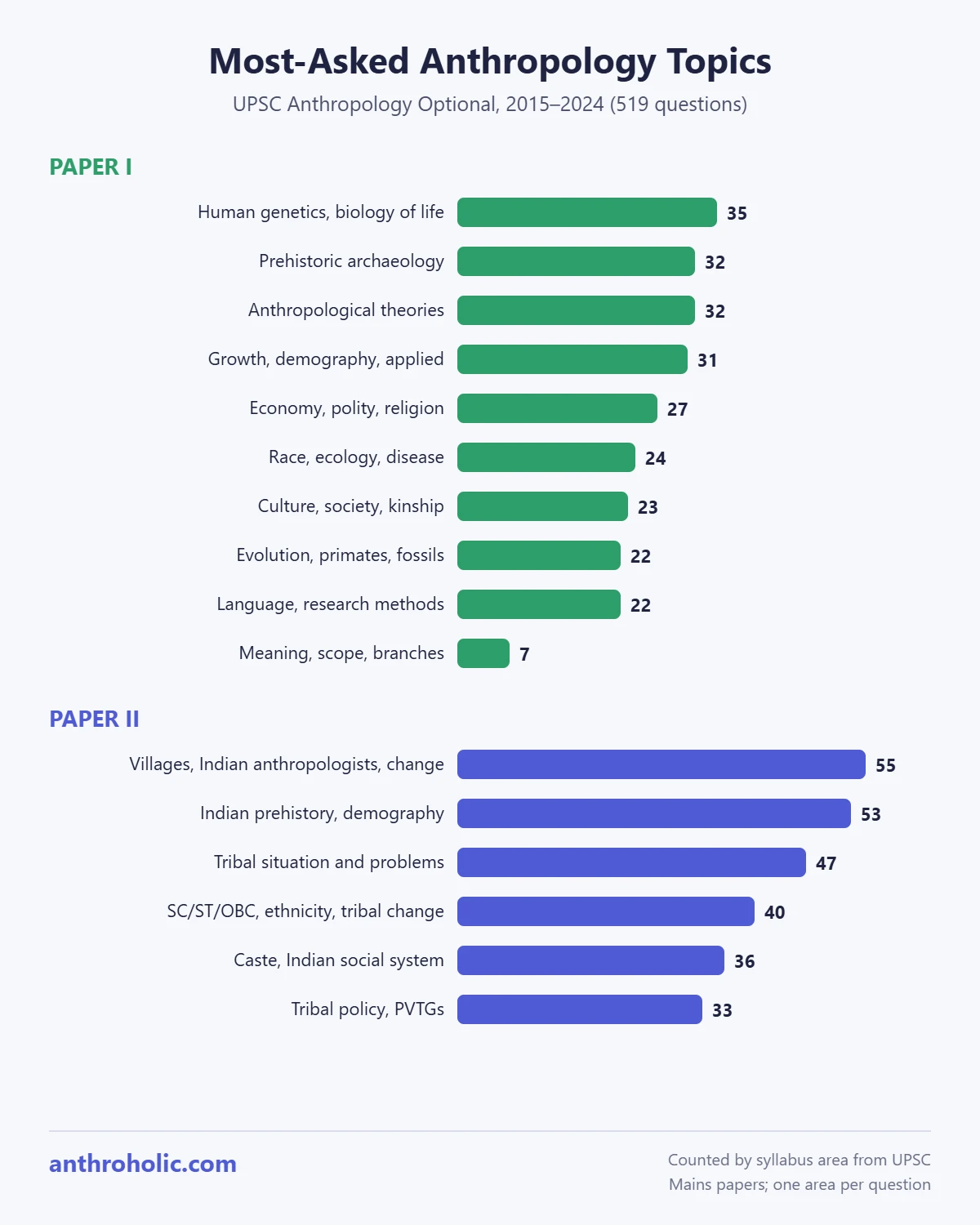
Themes that keep coming back
These themes were asked in at least two papers between 2015 and 2024 (P1 = Paper I, P2 = Paper II):
| Theme | Papers asked | Year (paper) |
|---|---|---|
| Ramapithecus | 4 | 2017 (P2), 2019 (P2), 2021 (P2), 2023 (P2) |
| Tribe–caste continuum | 4 | 2015 (P2), 2016 (P2), 2018 (P2), 2021 (P2) |
| PVTGs | 4 | 2017 (P2), 2019 (P2), 2023 (P2), 2024 (P2) |
| Sanskritisation | 4 | 2015 (P2), 2016 (P2), 2020 (P2), 2023 (P2) |
| Panchayati Raj | 5 | 2015 (P2), 2017 (P2), 2018 (P2), 2019 (P2), 2021 (P2) |
| PESA Act | 3 | 2018 (P2), 2022 (P2), 2024 (P2) |
| Forest rights and forest policy | 3 | 2018 (P2), 2021 (P2), 2024 (P2) |
| Jajmani system | 3 | 2017 (P2), 2019 (P2), 2023 (P2) |
| Development-induced displacement | 4 | 2017 (P2), 2020 (P2), 2021 (P2), 2023 (P2) |
| Homo erectus | 5 | 2015 (P1), 2018 (P1), 2021 (P1), 2022 (P2), 2024 (P1) |
| Mesolithic cultures | 8 | 2016 (P2), 2017 (P1), 2018 (P2), 2019 (P1), 2021 (P1), 2022 (P1), 2023 (P1), 2023 (P2) |
| Clifford Geertz | 5 | 2015 (P1), 2016 (P1), 2019 (P1), 2021 (P1), 2023 (P1) |
| Lévi-Strauss | 4 | 2016 (P1), 2019 (P1), 2021 (P1), 2024 (P1) |
| Cultural relativism | 3 | 2016 (P1), 2019 (P1), 2020 (P1) |
| Genetic polymorphism | 3 | 2015 (P1), 2019 (P1), 2022 (P1) |
| Acclimatisation and high altitude | 4 | 2015 (P1), 2017 (P1), 2018 (P1), 2021 (P1) |
| Forensic anthropology and personal identification | 5 | 2015 (P1), 2016 (P1), 2017 (P1), 2023 (P1), 2024 (P1) |
| Menarche and menopause | 4 | 2015 (P1), 2017 (P1), 2022 (P1), 2023 (P1) |
What the pattern shows: UPSC rarely repeats a question word for word, but it returns to the same themes with a new angle: Ramapithecus as a fossil, then as a debate; PVTGs as a note, then as a policy question. Paper II often links tribal issues to recent laws and schemes (PESA, the Forest Rights Act, PVTG programmes), so read current tribal policy alongside the books.
How to use previous years’ questions
- Start early: after finishing a unit, read its previous years’ questions (use the table above) before making notes, so you know what UPSC asks.
- Sort by unit: copy each question under its syllabus sub-unit in your notes; the repeat themes become obvious.
- Write under time: a 10-mark note in about 7 minutes and a 15- or 20-mark answer in 10–12 minutes, with a diagram or map where it helps.
- Link the papers: for each Paper I concept, add one Indian example that Paper II might ask about.
- Do full papers late: in the last two months, write at least three full papers in three hours each.
See also the Anthropology Optional syllabus, the booklist and answer writing for Anthropology Optional.
Why Practicing Anthropology Optional Previous Year Question Papers is Important?
Practicing Anthropology Optional Previous Year Question Papers (PYQs) is crucial for UPSC aspirants as it helps in understanding the exam pattern, frequently asked topics, and important themes. Solving UPSC Anthropology Optional PYQs enhances answer-writing skills, time management, and conceptual clarity. Many toppers emphasize revising Anthropology PYQ PDFs to identify trends and prepare strategically. Candidates looking for Anthropology Optional PYQ PDF downloads can find them on reliable platforms like Anthroholic, which offers a well-structured collection of previous years’ question papers along with expert guidance.
Frequently Asked Questions (FAQs) on Anthropology Optional PYQs
Why should I solve Anthropology Optional Previous Year Question Papers?
Solving Anthropology PYQs helps in understanding question trends, improving answer-writing skills, and refining preparation strategy.
Where can I find UPSC Anthropology Optional PYQs?
You can find Anthropology Optional Previous Year Question Papers on UPSC’s official website or on Anthroholic.com. Anthroholic provide all the Original Anthropology Optional PYQs in PDF form from 2009.
How do Anthropology PYQs help in UPSC Mains preparation?
They help in identifying recurring topics, structuring answers effectively, and improving time management in the actual exam.
Can I get Anthropology Optional PYQ PDFs for free?
Yes, Anthropology PYQ PDF downloads are available for free on UPSC’s official website including Anthroholic.
How many years of Anthropology PYQs should I solve?
It is advisable to solve at least the last 10 years of Anthropology Optional Previous Year Question Papers for a thorough understanding.
Are Anthropology PYQs sufficient for UPSC Mains preparation?
No, while Anthropology PYQs are essential, supplementing them with standard books, notes, and test series is necessary.
How can I analyze Anthropology Optional Previous Year Question Papers effectively?
Categorize questions topic-wise, note frequently repeated themes, and attempt writing structured answers under exam conditions.
Do UPSC questions repeat in Anthropology Optional?
Yes, UPSC often repeats themes and concepts, making UPSC Anthropology Optional PYQs a valuable resource for preparation.
Where can I find solved Anthropology Optional PYQs?
Anthroholic provides solved Anthropology Optional PYQ PDFs along with expert guidance to help aspirants.
Is it necessary to write full-length answers while solving PYQs?
Yes, writing full-length answers improves articulation, structure, and presentation, which is crucial for UPSC Mains scoring.
More questions about Anthropology PYQs
What is the pattern of the Anthropology Optional question paper?
Each paper has eight questions in two sections and carries 250 marks in three hours. Questions 1 and 5 (five short notes of about 150 words, 10 marks each) are compulsory; you answer three more, at least one from each section. Other parts carry 15 or 20 marks.
Where can I find the 2026 Anthropology question papers?
On the UPSC website; the official links for 2024, 2025 and 2026 are in the table above.
Which topics are asked most in Anthropology Optional?
In 2015–2024, the biggest groups in Paper I were human genetics, prehistoric archaeology, theories, and growth and applied anthropology (31–35 questions each); in Paper II they were villages and social change, and Indian prehistory and demography (53–55 each), followed by tribal problems.
Are topic-wise Anthropology PYQs available?
Yes. The topic-wise analysis above groups the 2015–2024 questions by syllabus unit, with example questions and recurring themes.
Sources
[1] Union Public Service Commission. Civil Services (Main) Examination: Anthropology Paper I and Paper II, question papers for 2024, 2025 and 2026 (links in the table above).
Disclaimer
The Question Paper we share—both original creations and scanned copies—do not belong to anthroholic.com. We’re merely offering connections to resources that are already online. Moreover, the materials we share are solely for educational purposes, and we do not own any trademarks or copyrights belonging to any institute. All rights to these Question Paper materials belong to the individual institutes or companies. If you feel that our content infringes on your privacy rights or your copyrights in any way, please contact us at info@anthroholic.com and we will endeavour to resolve the situation as best we can. We don’t want to take advantage of your hard work or cause you harm. Thanks a lot.
The content on this page has been taken from the official website of Union Public Service Commission (UPSC). You can visit the website for more details: https://upsc.gov.in/
Download Complete UPSC CSE IAS Exam Syllabus here: https://www.upsc.gov.in/uploads/2026/05/Civil-Services-Preliminary-Examination-2026-Notice-E.pdf
Suggested Articles for UPSC Aspirants
Anthroholic
Anthroholic helps the world learn Anthropology for Free. We strive to provide comprehensive and high quality content for deep understanding of the discipline.
Newsletter Updates
Enter your email address below and subscribe to our newsletter