AI Answer Evaluation Platform Live Now. Try Free Answer Evaluation Now

Ethological Research on Ape Communication
The quest to understand the origins of human language has long led researchers to our closest living relatives: the great apes. For decades, the field of Ethological Research on Ape Communication has served as a mirror, reflecting the evolutionary foundations of our own cognitive and social structures.
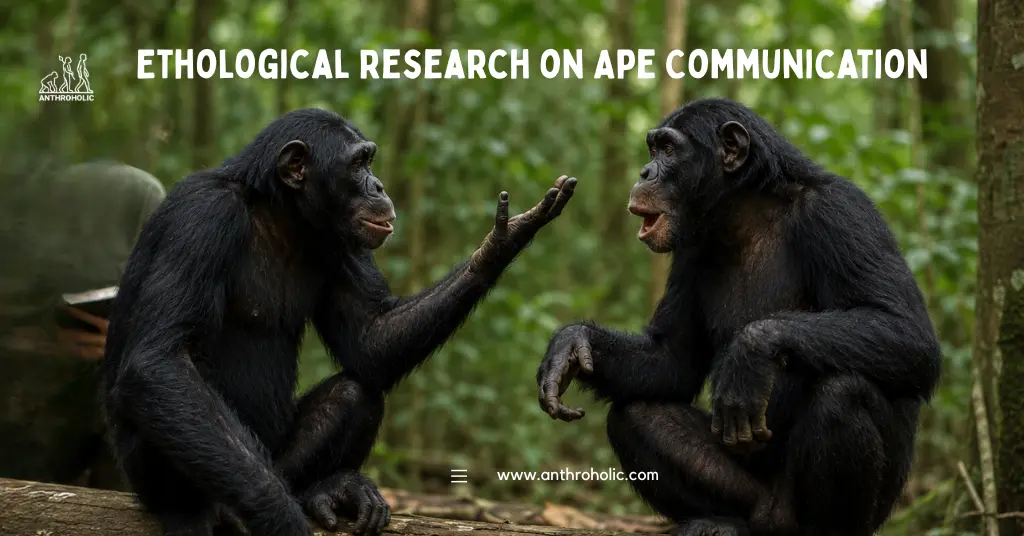
By observing chimpanzees, bonobos, gorillas, and orangutans in both naturalistic and controlled environments, anthropologists are uncovering a complex tapestry of gestures, vocalizations, and facial expressions that challenge the traditional “human uniqueness” narrative.
The Foundations of Primate Ethology
Ethology, the scientific study of animal behavior under natural conditions, treats communication not merely as a set of signals, but as a dynamic tool for social navigation. In apes, communication is intentional, referential, and context-dependent. Unlike the innate, reflexive calls of lower primates, great ape communication involves a high degree of cognitive processing.
The Multi-modal Approach
Apes do not rely on a single channel of communication. Instead, they utilize a “multi-modal” system:
- Gestural Communication: Often considered the precursor to human language, gestures are flexible and used to achieve specific goals (e.g., begging for food or initiating play).
- Vocalizations: Long-distance calls, such as the “pant-hoot” in chimpanzees, convey identity, emotional state, and resource location.
- Facial Expressions: Subtle movements of the lips, eyes, and brow communicate social hierarchy and intent.
- Olfactory and Tactile Signals: Grooming acts as a vital “social glue,” communicating trust and alliance.
Key Theories and Evolutionary Paradigms
To understand the trajectory of research, we must compare the two dominant theories regarding the origins of language: the Gestural Primacy Hypothesis and the Vocal Continuity Theory.
| Feature | Gestural Primacy Hypothesis | Vocal Continuity Theory |
| Core Argument | Language evolved from manual gestures. | Language evolved from primitive vocalizations. |
| Evidence | Apes use gestures more flexibly than vocalizations; brain areas (Broca’s) control both. | Apes possess complex laryngeal control and distinct “functional” calls. |
| Proponents | Michael Corballis, Michael Tomasello | Seyfarth & Cheney |
| Anthropological View | Highly favored due to the cognitive overlap between tool use and syntax. | Gaining ground with new data on vocal learning in orangutans. |
Landmark Case Studies in Ape Communication
1. The Great Ape Language Projects (1960s–1980s)
Early research focused on teaching apes human-like symbolic systems.
- Washoe (Chimpanzee): The first non-human to learn American Sign Language (ASL), demonstrating the ability to combine signs into novel strings.
- Kanzi (Bonobo): Through the use of a lexigram board (symbols representing words), Kanzi demonstrated receptive competence, understanding complex spoken English commands and syntax.
“Kanzi’s ability to comprehend the semantic and syntactic structure of sentences suggested that the cognitive architecture for language predates the human lineage.” Dr. Sue Savage-Rumbaugh
2. Great Ape Dictionary Project (2010s–Present)
Moving away from teaching apes “human” language, researchers like Dr. Catherine Hobaiter have focused on decoding the natural repertoire of wild apes. By studying chimpanzees in the Budongo Forest, researchers identified over 80 distinct gestures, many of which are shared across species, suggesting a “Great Ape Gestural Dictionary” rooted in a common ancestor.
Recent Breakthroughs: 2024-2025 Data
Recent studies have shifted the focus toward the rhythm and timing of communication. A 2024 study published in Current Biology analyzed over 8,000 communicative interactions in wild bonobos and chimpanzees.
Key Findings from Recent Research:
- Fast-Paced Turn-Taking: Apes engage in rapid back-and-forth exchanges with an average response time of 200 milliseconds, nearly identical to the timing of human conversation.
- Cultural Variation: Different groups of the same species use different “dialects” of gestures, indicating that communication is learned and socially transmitted rather than purely instinctive.
- Vocal Flexibility: 2025 research on Sumatran orangutans has shown they can produce “consonant-like” and “vowel-like” calls simultaneously, a feat previously thought impossible for non-humans.
Cognitive Prerequisites for Communication
Ethologists argue that for communication to be “language-like,” it must possess specific cognitive traits:
- Theory of Mind (ToM): The ability to understand that another individual has their own thoughts and intentions. Research shows apes adjust their signaling based on whether their audience is looking at them.
- Displacement: The ability to communicate about things not present in time or space. While rare, some apes have shown the ability to signal about past events or future intentions (e.g., planning a travel route).
- Recursion: The ability to nest ideas within ideas. This remains a point of intense debate, with some scholars arguing this is the “true” dividing line between apes and humans.
The Significance in Anthropology
For students of anthropology (including [UPSC Anthropology Paper 1]), ethological research is critical for several reasons:
- Phylogenetic Reconstruction: It allows us to infer the communicative abilities of the Last Common Ancestor (LCA) of humans and chimpanzees.
- Bio-Cultural Evolution: It highlights how social complexity drives the need for sophisticated communication systems.
- Deconstructing Anthropocentrism: It challenges the notion that humans are the only beings with “culture” or “thought.”
Pull Quote: “Communication is not just about the transfer of information; it is the negotiation of social relationships. In this regard, the ape and the human are more alike than they are different.”
Conclusion
Ethological research on ape communication has evolved from a quest to make apes “speak” like humans to a profound appreciation of their own unique, complex systems. From the rapid turn-taking of bonobos to the symbolic lexigrams of Kanzi, the evidence suggests that the building blocks of human language intentionality, social coordination, and symbolic thought are deeply rooted in our primate heritage.
As we continue to decode the “silent dialogue” of the forest, we move closer to answering the ultimate question: what does it truly mean to be human?
Frequently Asked Questions (FAQs)
1. Can apes learn to speak like humans?
Physically, no. Apes lack the specialized vocal tract (including a descended larynx) required to produce the range of sounds found in human speech. However, they can communicate effectively through gestures, lexigrams, and sign language.
2. What is the difference between “animal communication” and “human language”?
Traditional linguistics defines human language by features like recursion, syntax, and productivity (creating infinite meanings from finite sounds). While ape communication shares many traits, it generally lacks the complex recursive syntax found in all human languages.
3. Why is gestural communication emphasized over vocalization in ape research?
Gestures are considered more “intentional” because apes can control them voluntarily, target them at specific individuals, and wait for a response. Vocalizations were long thought to be purely emotional/reflexive, though recent research is challenging this view.
4. How does this research help in understanding human evolution?
By identifying shared traits between humans and apes (like turn-taking and intentional gesturing), anthropologists can map which communicative behaviors were likely present in our common ancestors 6–7 million years ago.
References
- Graham, K. E., & Hobaiter, C. (2023). A Rosetta Stone for Primate Communication? Exploring the Compositional Nature of Chimpanzee Gestures. Journal of Human Evolution, 174, 103-121. https://doi.org/10.1016/j.jhevol.2022.103284
- Savage-Rumbaugh, S., & Lewin, R. (1994). Kanzi: The Ape at the Brink of the Human Mind. Wiley.
- Tomasello, M. (2008). Origins of Human Communication. MIT Press. https://mitpress.mit.edu/9780262515207/origins-of-human-communication/
- Verspeek, J., et al. (2024). Turn-taking dynamics in wild bonobos and chimpanzees: A comparative study. Current Biology, 34(12), 2678-2690. https://doi.org/10.1016/j.cub.2024.04.052
- Lameira, A. R. (2025). The Vocal Origins of Language: New insights from Orangutan Phonology. Trends in Cognitive Sciences. https://doi.org/10.1016/j.tics.2024.11.003

Related Posts