
AI Answer Evaluation Platform Live Now. Try Free Answer Evaluation Now
Henry James Sumner Maine
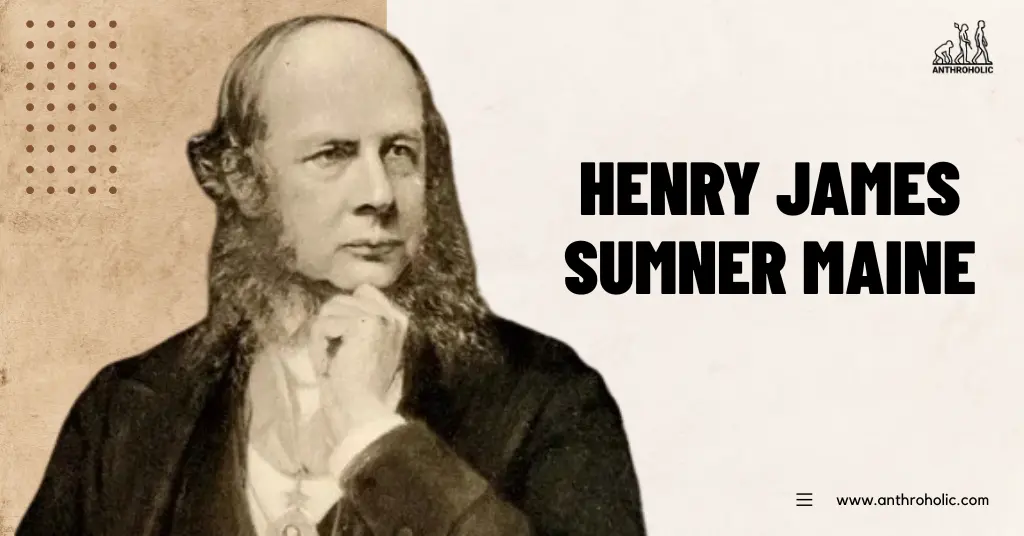
Sir Henry James Sumner Maine occupies a distinguished place in the intellectual history of law and anthropology as one of the earliest thinkers to apply historical and comparative methods to the study of social institutions. A Victorian polymath, Maine’s scholarship laid the foundations of legal anthropology, comparative jurisprudence, and historical sociology. His magnum opus, Ancient Law (1861), introduced the evolutionary thesis that societies transition from being governed by inherited status relations (based on kinship and birth) to contractual relations (based on individual will and consent).
By systematically comparing legal systems Roman, Hindu, and primitive Maine demonstrated that law is a social institution deeply embedded in culture and history rather than a mere command of the sovereign. His work was revolutionary for its time, bridging classical jurisprudence, colonial governance, and the emerging anthropological understanding of social evolution.
Early Life and Education
Henry Maine was born on August 15, 1822, in Kelso, Roxburghshire, Scotland, into a family of Anglican clergy and scholars. His father, James Maine, was a schoolmaster, and his upbringing emphasized intellectual discipline and classical education. Maine’s early academic brilliance was evident during his schooling at Christ’s Hospital, London, and later at Pembroke College, Cambridge, from which he transferred to Trinity Hall a college noted for law studies.
At Cambridge, Maine excelled in classics and law, winning the Craven Scholarship and becoming a Fellow of Trinity Hall at a remarkably young age. His grounding in Roman Law and classical antiquity deeply shaped his later comparative perspective. The intellectual climate of early Victorian Cambridge dominated by the study of classical texts, moral philosophy, and emerging historical inquiry provided Maine with the tools to analyze legal systems as evolving social phenomena.
After being called to the Bar at Lincoln’s Inn in 1850, Maine balanced legal practice with academic interests. He served as Regius Professor of Civil Law at Cambridge (1847–1854), marking the beginning of a career that would straddle law, governance, and scholarship. His early exposure to Roman Law and canonical traditions prepared him for his later engagement with Indian and “primitive” legal forms.
Academic Career and Early Scientific Work
Maine’s intellectual maturity coincided with a period of significant shifts in the British Empire and Victorian scholarship. The mid-19th century saw the rise of comparative method in history, linguistics, and anthropology. Thinkers like Max Müller, Tylor, and Darwin were rethinking evolution in cultural and biological contexts. Maine’s contribution was to apply this evolutionary logic to legal institutions.
As Regius Professor at Cambridge, he began articulating how law evolves organically, mirroring social development rather than arising from abstract reasoning. His Cambridge lectures formed the basis for Ancient Law (1861), which became one of the most influential books in 19th-century jurisprudence.
Work in India (1861–1869)
In 1861, Maine joined the Indian Law Commission and later served as Law Member of the Governor-General’s Council under Lord Lawrence and Sir John Lawrence. His Indian years profoundly influenced his comparative outlook.
Observing the intricate interplay of customary law, kinship, and village communities, Maine saw living examples of what he considered early stages of social evolution. He noted that Indian village life was organized around kin-based authority and collective property, resembling the ancient systems he had studied in texts. His empirical experience in India gave credibility to his thesis that social evolution could be traced through law and property institutions.
During this time, Maine contributed to the codification of Indian laws and was instrumental in reforming civil procedure, marriage laws, and local self-government. He later reflected on these experiences in Village Communities in the East and West (1871), arguing that Indian and European village systems shared common evolutionary roots.
Later Academic Roles
Upon returning to England, Maine was appointed Corpus Professor of Jurisprudence at Oxford (1869–1885). His Oxford lectures later published as Early History of Institutions (1875) and Dissertations on Early Law and Custom (1883)extended his analysis to the origins of political institutions and kinship systems.
He also served as Master of Trinity Hall, Cambridge, and as a member of the Council of the Secretary of State for India. His intellectual stature was recognized with his appointment to the Privy Council and his knighthood in 1871.
Major Contributions
Maine’s intellectual contributions are multifaceted and foundational to both law and anthropology.
A. Evolutionary Theory of Law
Maine proposed that all societies pass through stages of legal development. Early societies were governed by kinship and patriarchal authority (status-based), while modern societies were governed by individual rights and contractual obligations. This is encapsulated in his renowned axiom:
“The movement of progressive societies has hitherto been a movement from Status to Contract.”
This principle became a cornerstone for both legal and anthropological models of social evolution.
B. Comparative Jurisprudence
Maine introduced the comparative method into the study of legal systems. By comparing Roman, Hindu, and primitive laws, he demonstrated that legal systems evolve in patterns reflecting broader social changes. His work challenged legal positivism by emphasizing law as a historical and social institution.
C. Patriarchal and Familial Theory
In Maine’s model, the patriarchal family was the primitive social unit, where the father’s authority mirrored that of a sovereign. This concept connected family, property, and political authority in a single evolutionary schema. Though later criticized for its androcentric bias, it provided early anthropologists a model for tracing kinship and governance.
D. Study of Property and Village Communities
In Village Communities in the East and West (1871), Maine compared Indian, Slavic, and Teutonic land systems, showing that communal property ownership preceded individual ownership. This thesis influenced Marx, Engels, and later anthropologists interested in pre-capitalist social formations.
E. Empirical Legacy in India
Maine’s administrative writings reveal an effort to understand Indian law through indigenous customs rather than imposing Western models. His observations on Indian society became a key source for the study of customary law and rural institutions, influencing both colonial administration and early ethnography.
F. Key Works
- Ancient Law (1861)
- Village Communities in the East and West (1871)
- Early History of Institutions (1875)
- Dissertations on Early Law and Custom (1883)
- Popular Government (1885)
Role in Anthropology and Legacy
In Anthropology
Maine is often regarded as one of the forerunners of legal anthropology. His comparative and evolutionary framework paralleled that of Lewis Henry Morgan, Edward Tylor, and Herbert Spencer. While Morgan examined kinship and social organization, Maine analyzed the same themes through legal and institutional transformations.
His theory of social evolution through legal change influenced the British structural-functionalists (e.g., Radcliffe-Brown, Fortes) and the legal anthropologists of the mid-20th century (e.g., Max Gluckman, Simon Roberts). His work paved the way for socio-legal studies, where law is understood as a reflection of social structure.
In Law and Governance
Maine is considered the founder of historical jurisprudence, inspiring later scholars like Friedrich Karl von Savigny and Roscoe Pound. His influence extended to the study of comparative law, constitutional theory, and colonial administration.
In India, Maine’s analysis of village communities shaped British colonial understanding of indigenous institutions, influencing land reforms and administrative policies well into the 20th century.
Critiques
Later anthropologists and historians have critiqued Maine for:
- His Eurocentric evolutionism, which assumed Western societies represented the highest stage of progress.
- His patriarchal bias, overlooking matrilineal and bilateral systems.
- Overgeneralizing from textual and limited ethnographic data.
Yet, even his critics acknowledge that Maine’s method tracing the evolution of law and custom comparatively remains an indispensable tool in historical anthropology.
Conclusion
Sir Henry Maine’s intellectual legacy lies in transforming the study of law from a static and normative discipline into a dynamic, historically grounded science. His work established that law evolves with society, mirroring its moral, economic, and familial transformations.
Maine bridged the gap between jurisprudence and anthropology, setting the stage for later scholars to treat law as a cultural system rather than a mere legal code. His empirical observations in India enriched his theoretical formulations and provided cross-cultural depth to his comparative analyses.
He died on February 3, 1888, in Cannes, France. Yet, his influence endures in the fields of legal anthropology, sociology of law, and historical jurisprudence. For anthropologists and legal theorists alike, Maine remains a towering figure who demonstrated that the history of law is, in essence, the history of human civilization itself.
References
- “Sir Henry Maine.” Encyclopaedia Britannica.
https://www.britannica.com/biography/Henry-Maine Encyclopedia Britannica - “Maine, Sir Henry James Sumner (1822-1888), jurist.” Oxford Dictionary of National Biography.
https://www.oxforddnb.com/view/10.1093/ref%3Aodnb/9780198614128.001.0001/odnb-9780198614128-e-17808 oxforddnb.com - “Henry Maine – Students.” Britannica Kids.
https://kids.britannica.com/students/article/Henry-Maine/275623 kids.britannica.com - “Letters of Sir Henry James Sumner Maine.” Archives Hub (Jisc).
https://archiveshub.jisc.ac.uk/data/gb237-coll-638 archiveshub.jisc.ac.uk - “The Legacy of Sir Henry Maine in the 21st Century.” Noesis / OpenEdition Journals.
https://journals.openedition.org/noesis/5179 OpenEdition Journals - “Maine, Henry Sumner.” Encyclopedia.com – Applied & Social Sciences.
https://www.encyclopedia.com/social-sciences/applied-and-social-sciences-magazines/maine-henry-sumner Encyclopedia.com - “Ancient Law: Its Connection with the Early History of Society and Its Relation to Modern Ideas.” Britannica Topic Page.
https://www.britannica.com/topic/Ancient-Law-Its-Connection-with-the-Early-History-of-Society-and-Its-Relation-to-Modern-Ideas Encyclopedia Britannica - “Ancient Law.” Taylor & Francis eBook page.
https://www.taylorfrancis.com/books/mono/10.4324/9781315082318/ancient-law-sir-henry-sumner-maine-dante-scala Taylor & Francis - “Henry James Sumner Maine [textual record].” Library & Archives Canada (BAC-LAC).
https://central.bac-lac.gc.ca/.redirect?app=FonAndCol&id=103277&lang=eng

Related Posts