
AI Answer Evaluation Platform Live Now. Try Free Answer Evaluation Now

How to Take Notes in Anthropology Lectures?
Anthropology lectures are rich with complex theories, detailed case studies, and diverse cultural contexts. To succeed, you need to do more than just listen; you need to capture this information in a way that makes sense long after the lecture has ended. Developing effective lecture note taking strategies is fundamental for understanding course material, preparing for exams, and deepening your engagement with the subject.

This guide provides practical, step-by-step advice on how to take notes in lectures, specifically tailored for the unique demands of anthropology. From pre-lecture preparation to post-lecture review, these tips will help you create clear, comprehensive, and useful anthropology lecture notes. These notes will also come in handy when you decide to use an essay writing service like EssayShark to hire a professional editor or proofreader. By the end of this post, you’ll have a toolkit of methods to transform your note-taking from a passive task into an active learning process.
Prepare for Success Before the Lecture
Effective note-taking begins before you even walk into the classroom. Proper preparation sets the stage for a productive session, allowing you to engage with the material on a deeper level instead of just scrambling to write everything down.
Gather Your Tools
First, decide on your preferred note-taking medium. There’s no single “best” tool, it’s about what works for you.
- Traditional Notebook and Pens: For some, the physical act of writing helps with memory retention. Using different colored pens can help organize concepts, definitions, and examples.
- Laptop or Tablet: Digital tools offer speed, easy editing, and the ability to incorporate images or links directly into your notes. Apps like OneNote, Evernote, or Notability are popular choices.
Whichever you choose, make sure your tools are ready to go before the lecture starts. A dead laptop battery or a missing pen can be a major distraction.
Review and Prime Your Brain
A few minutes of preparation can make a huge difference. Before class, take 10-15 minutes to:
- Review notes from the previous lecture: This refreshes your memory and helps you connect new information to what you’ve already learned.
- Skim assigned readings: Your professor will likely assume you’ve done the reading. Having a basic understanding of the key concepts, terms, and ethnographic examples will allow you to follow the lecture more easily and identify the most important points.
This simple routine primes your brain, making it easier to recognize and absorb key information during the lecture.
Master Your Technique During the Lecture
Once the lecture begins, your focus should shift to active listening and strategic recording. The goal is not to transcribe every word but to capture the essence of the argument and its supporting evidence.
Listen Actively for Main Ideas
Instead of passively writing, actively listen to identify the core themes and arguments. Pay attention to signposting language from your professor, such as “The three main reasons for this are…” or “What’s most important to understand is…”. These cues highlight the lecture’s structure and key concepts. Focus on capturing these main ideas first and foremost.
Use Abbreviations and Symbols
Anthropology is full of long, complex terms. To save time and keep up with the speaker, develop a personal shorthand system.
- Abbreviations: Use common abbreviations (e.g., w/ for with, bc for because) and create your own for recurring terms (e.g., “CG” for “cultural relativism,” “FN” for “field notes”).
- Symbols: Use symbols to denote relationships or ideas. An arrow (→) can show cause and effect, an exclamation mark (!) can highlight a crucial point, and a question mark (?) can flag something you need to clarify later.
Record Examples and Evidence
Anthropology isn’t just about abstract theories; it’s grounded in real-world examples and ethnographic data. When your professor mentions a specific case study, an ethnographer’s name, or a particular cultural practice, make sure to note it down alongside the concept it illustrates. This supporting evidence is vital for understanding the theories and will be invaluable when writing essays or studying for exams.
Find the Right Note-Taking Method for You
Students learn in different ways, so it’s important to find a note-taking method that suits your style. Here are four popular note taking methods for university lectures that you can adapt for your anthropology courses.
1. Linear Note-Taking
This is the most traditional method, involving writing notes in a sequential, outlined format.
- How it works: You start with a main topic as a heading and use bullet points or numbered lists for sub-points and supporting details.
- Pros: It’s straightforward and reflects the linear structure of most lectures.
- Cons: It can be difficult to add information or see connections between different topics if the lecture isn’t perfectly structured.
2. The Cornell Method
Developed at Cornell University, this method organizes your page into distinct sections for more effective review.
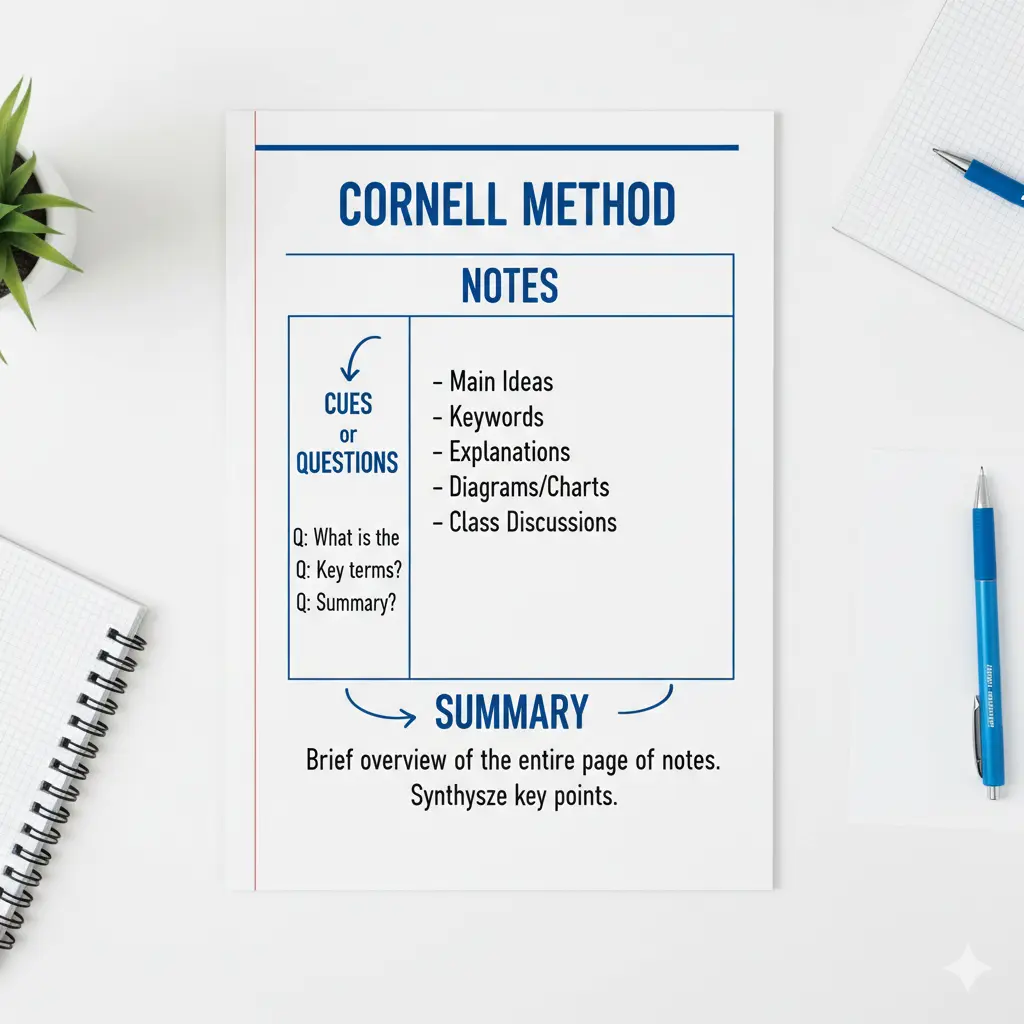
- How it works:
- Divide your page into three sections: a large main notes column on the right, a smaller cues column on the left, and a summary section at the bottom.
- During the lecture, take notes in the main column.
- After the lecture, pull out key terms, questions, and main ideas in the cues column.
- Write a brief summary of the page’s content in the bottom section.
- Pros: It encourages active review and self-testing, making it one of the most effective lecture note-taking strategies for retention.
- Cons: It requires more effort during the review phase.
3. Mind Mapping
Mind mapping is a visual note-taking method that is great for making connections between concepts.
- How it works: Start with the central topic in the middle of the page. Branch out with main ideas, and then create smaller sub-branches for details, examples, and related concepts. Use colors and images to make it more memorable.
- Pros: It helps visualize the relationships between different anthropological theories and case studies, which is especially useful for a holistic discipline like anthropology.
- Cons: It can get messy if the lecture is dense with information, and it might be difficult to capture detailed descriptions.
Unlock Your Potential with Better Notes
Taking effective notes is a skill, and like any skill, it improves with practice. By preparing before class, engaging actively during the lecture, and reviewing your notes afterward, you can create a powerful learning resource. The right lecture note taking tips for students can make all the difference in a demanding field like anthropology.
Don’t be afraid to experiment with different note-taking methods for university lectures until you find what works for you. The effort you put into refining your note-taking process will pay off in clearer understanding, better grades, and a more profound appreciation for the fascinating world of anthropology.

Related Posts