AI Answer Evaluation Platform Live Now. Try Free Answer Evaluation Now
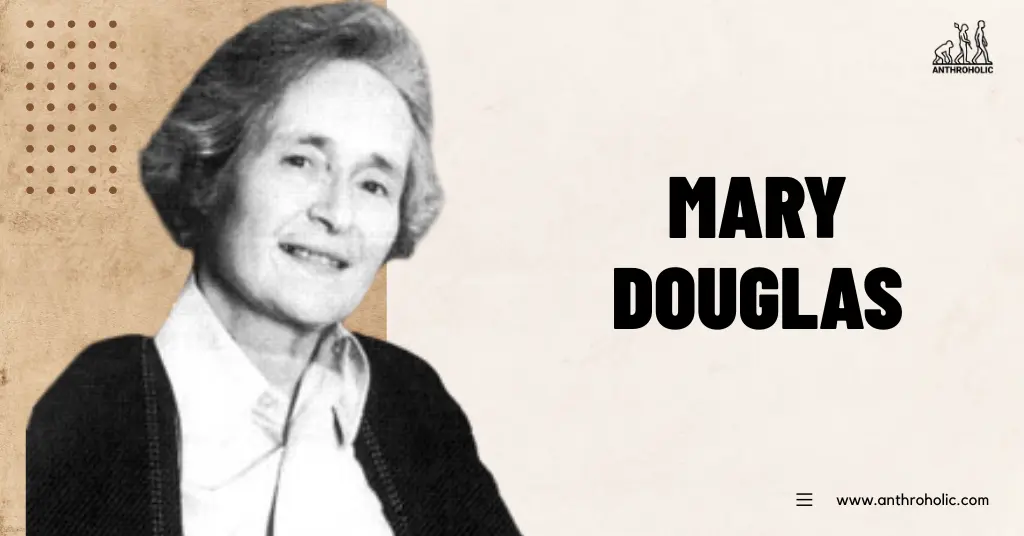
Mary Douglas
Dame Mary Douglas (1921–2007) was a distinguished British social anthropologist best known for her groundbreaking contributions to symbolic anthropology, structuralism, and the anthropology of ritual, purity, and risk. Her work bridged the classical Durkheimian tradition with modern cultural theory, offering profound insights into how societies construct systems of meaning, order, and pollution.
Douglas’s most famous book, Purity and Danger (1966), remains a cornerstone of cultural anthropology, exploring how concepts of pollution and taboo reflect deeper structures of social order. She later expanded her analytical framework through works such as Natural Symbols (1970) and Risk and Culture (1982, with Aaron Wildavsky), developing what became known as the Grid-Group Cultural Theory a model explaining variations in social organization and perceptions of risk.
Her intellectual influence transcended anthropology, shaping fields such as sociology, theology, environmental studies, and organizational theory. Through her structuralist interpretation of symbols and classification systems, Douglas redefined the study of culture as a system of thought not merely as a collection of customs.
Early Life and Education
Mary Douglas was born on March 25, 1921, in San Remo, Italy, into an Anglo-Irish Catholic family. Her father, Gilbert Tew, was a colonial officer, and her upbringing between Britain and Africa exposed her early to the complexities of culture and difference. Educated initially at Sacred Heart Convent School in London, she developed a keen interest in philosophy, religion, and moral order themes that would later inform her anthropological theories.
She went on to study at St. Anne’s College, Oxford, where she read Philosophy, Politics, and Economics (PPE) before turning to social anthropology under the mentorship of E. E. Evans-Pritchard, one of the leading figures in British structural-functionalism. Under his guidance, she trained in the classical ethnographic method and the comparative study of social systems.
After completing her degree, Douglas joined the Colonial Office during World War II, but her passion for fieldwork led her back to academia. She returned to Oxford to pursue a doctorate in anthropology, focusing on the Lele people of the Kasai region (Belgian Congo). Her fieldwork between 1949 and 1950 formed the basis of her doctoral dissertation and later her first major ethnographic monograph, The Lele of the Kasai (1963).
Her early ethnographic experience gave her a lifelong concern with ritual, purity, boundaries, and social order, themes that would become central to her later theoretical works.
Major Works and Contributions
Mary Douglas’s career was marked by a series of highly influential theoretical works that reshaped the landscape of modern anthropology. Her writings drew upon Durkheim, Mauss, Lévi-Strauss, and Evans-Pritchard, while also engaging with contemporary debates in sociology and cultural studies.
A. Purity and Danger (1966)
Douglas’s most celebrated work, Purity and Danger: An Analysis of Concepts of Pollution and Taboo, explores how societies distinguish between the pure and the impure, the sacred and the profane. She argued that notions of pollution are not about hygiene but about symbolic boundaries they express a society’s underlying structure of classification and order. Her famous line, “Dirt is matter out of place,” encapsulates her idea that pollution symbolizes a violation of cultural order.
The book was groundbreaking for its synthesis of symbolic interpretation, social structure, and cognitive anthropology, making it one of the most cited works in the social sciences.
B. Natural Symbols (1970)
In this book, Douglas developed the Grid-Group Theory, later refined in Cultural Bias (1978) and Risk and Culture (1982). This model classified societies along two axes grid (degree of social regulation) and group (strength of social cohesion) to explain how cultural systems shape attitudes toward authority, ritual, and risk.
C. Risk and Culture (1982, with Aaron Wildavsky)
Here, Douglas applied her Grid-Group model to modern environmental and political issues. She argued that risk perception is culturally constructed, not purely scientific, and that social groups interpret dangers (like pollution or technology) in ways that reflect their moral order. This work became foundational for cultural theory of risk and continues to influence environmental policy and sociology.
D. Other Significant Works
Her other notable books include:
- The Lele of the Kasai (1963) — Ethnographic monograph.
- Cultural Bias (1978) — Refinement of her theoretical model.
- How Institutions Think (1986) — Application of cultural theory to organizational systems.
- Leviticus as Literature (1999) — Theological interpretation of biblical texts through anthropological theory.
Douglas’s enduring contribution was to demonstrate that classification systems, taboos, and institutions all function as symbolic structures that maintain social coherence.
Role in Indian and World Anthropology
Mary Douglas’s work had an enormous impact on world anthropology, particularly in the development of symbolic and interpretive approaches during the 1960s and 1970s. She was one of the few British anthropologists whose theoretical contributions reshaped global anthropological thought beyond regional boundaries.
Her emphasis on symbolism, ritual, and cognitive order paralleled similar trends in the works of Victor Turner and Clifford Geertz, though her orientation remained deeply structural. She redefined the anthropological study of religion, not as the study of belief systems alone but as the study of the moral and symbolic order underlying them.
In India, her theoretical influence emerged primarily through the study of ritual purity, caste hierarchy, and pollution, key themes in Indian ethnography. Indian anthropologists and sociologists such as M. N. Srinivas, Louis Dumont, and later T. N. Madan drew upon Douglas’s symbolic framework to analyze caste, ritual status, and social stratification. Her concept of “matter out of place” proved particularly relevant to understanding Hindu ideas of pollution and ritual avoidance.
Globally, Douglas’s theories informed cross-disciplinary debates in theology, sociology, political science, and organizational behavior. Her work continues to shape studies of risk perception, environmental politics, and the sociology of institutions.
Critical Evaluation
Mary Douglas’s intellectual stature lies in her ability to bridge structuralism, functionalism, and interpretivism, crafting a unified vision of culture as a system of symbolic classification. Her work is remarkable for its theoretical coherence and empirical grounding.
Critically, Purity and Danger remains one of the most influential books in anthropology for its elegant argument that symbolic pollution expresses social anxiety about boundaries and ambiguity. Her approach transformed the anthropological understanding of ritual from a set of isolated customs into a reflection of societal order and meaning-making.
However, Douglas’s work has also faced criticism. Some scholars argue that her structuralist framework overemphasizes cognitive order, leaving limited space for historical change and individual agency. Others contend that her analysis of purity and taboo, while brilliant, is primarily comparative rather than ethnographically detailed. Her later works, especially on institutions, were sometimes viewed as abstract or too theoretical for empirical anthropology.
Nevertheless, Douglas’s intellectual rigor, interdisciplinary influence, and theoretical originality far outweigh these criticisms. Her synthesis of Durkheimian sociology and Lévi-Straussian structuralism created a durable framework that continues to inform cultural analysis across the humanities and social sciences.
Conclusion and Legacy
Mary Douglas stands among the most important anthropological theorists of the twentieth century. Through her structural and symbolic analysis, she revealed how culture orders experience, classifies reality, and gives meaning to purity, danger, and moral order. Her Grid-Group theory expanded anthropology’s explanatory reach into domains such as politics, religion, environment, and organizations.
Her influence persists in the anthropology of religion, cultural theory of risk, and organizational anthropology, and her ideas continue to be applied to topics ranging from environmental debates to public policy. Douglas’s intellectual legacy endures as a reminder that culture is not merely a way of life but a system of thought one that encodes human attempts to impose order upon the world.
She was made Dame Commander of the Order of the British Empire (DBE) in 2006 for her services to anthropology and passed away on May 16, 2007, in London. Her work remains central to both academic anthropology and broader cultural theory, symbolizing the bridge between classical structuralism and modern interpretive anthropology.
References
- “Dame Mary Douglas 1921-2007” (Proceedings of the British Academy) — https://www.thebritishacademy.ac.uk/documents/1696/166p135.pdf The British Academy
- Obituary: “Dame Mary Douglas” — The Guardian, 18 May 2007 — https://www.theguardian.com/news/2007/may/18/guardianobituaries.obituaries The Guardian
- Interview: “Mary Douglas” (HAU Journal / Alan Macfarlane) — https://www.haujournal.org/haunet/douglas.php haujournal.org
- Academic chapter: “Mary Douglas (1921-2007)” — Oxford Academic / OUP — https://academic.oup.com/book/5811/chapter/149026564 OUP Academic
- Article: “Mary Douglas, A Taste for Hierarchy” — Books & Ideas (France) — https://booksandideas.net/Mary-Douglas-A-Taste-for-Hierarchy booksandideas.net
- Biographical note: “Dame Mary Tew Douglas, 1921-2007” — Douglashistory.co.uk — https://www.douglashistory.co.uk/history/marydouglas2.html douglashistory.co.uk
- Review essay: “A Very Personal Method: Anthropological Writings Drawn from Life” — Society & Space — https://www.societyandspace.org/articles/a-very-personal-method-by-mary-douglas-edited-by-richard-fardon

Related Posts