
AI Answer Evaluation Platform Live Now. Try Free Answer Evaluation Now

National Crime Record Bureau (NCRB)
In a country as vast and culturally complex as India, understanding the dynamics of crime is not merely an exercise in legal statistics; it is a profound anthropological inquiry into the fractures of a society. What social tensions translate into violence? How do gender, caste, and region shape vulnerability? To answer these questions, scholars, policymakers, and law enforcement invariably turn to one definitive source: the National Crime Records Bureau (NCRB).

The NCRB, established in 1986 under the Ministry of Home Affairs, Government of India, serves as the national repository of information on crime and criminals. Its primary mandate is to collect, collate, and analyze crime data from all States and Union Territories (UTs), equipping the police with IT and criminal intelligence. Far from being a dry statistical agency, the NCRB acts as the sociological mirror of the nation, reflecting annual shifts in law and order, and offering critical data points that illuminate India’s evolving socio-criminological landscape.
For an aspirant or enthusiast studying Anthropology, the NCRB’s data particularly its annual flagship publication, Crime in India is an indispensable tool for grounding abstract theories of deviance, social control, and legal anthropology in concrete, real-world patterns.
The Genesis and Core Mandate of NCRB
The establishment of the NCRB in 1986 was a direct response to the need for a modern, centralized, and systematic mechanism for crime data management. It was formed based on the recommendations of key bodies like the Tandon Committee, the National Police Commission (1977-81), and a Task Force set up by the Ministry of Home Affairs (MHA) in 1985. The goal was to unify and modernize disparate state-level records, thereby enabling a national perspective on crime.
Core Objectives: A Triple Mandate
The Bureau’s functions extend beyond mere reporting; they are fundamentally about enabling effective criminal justice administration:
- Repository of Information: To function as the central information hub for crime and criminals, including maintaining the national database of convicted individuals’ fingerprints (Central Finger Print Bureau).
- IT and Systems Implementation: To guide and manage the development of IT applications for police forces across India, with the flagship project being the Crime and Criminal Tracking Network & Systems (CCTNS).
- Data Analysis and Reporting: To collect, analyze, and publish statistics on crime, accidental deaths, suicides, and prisons, which inform policy and public discourse.
Why the NCRB Matters in Anthropology
Anthropology is concerned with how societies organise themselves and respond to change. Crime is one such locus of social change, resistance, deviance and control. The NCRB’s data and systems illuminate:
- how evolving norms (gender roles, caste relations, technology) impact criminal behaviour,
- how states and institutions collect, record and interpret social deviance,
- how data-driven governance affects marginalized communities.
Thus, studying the NCRB is not simply about crime statistics it is about the anthropology of state, society and risk in India.
National Crime Records Bureau (NCRB) Crime in India 2023 Report
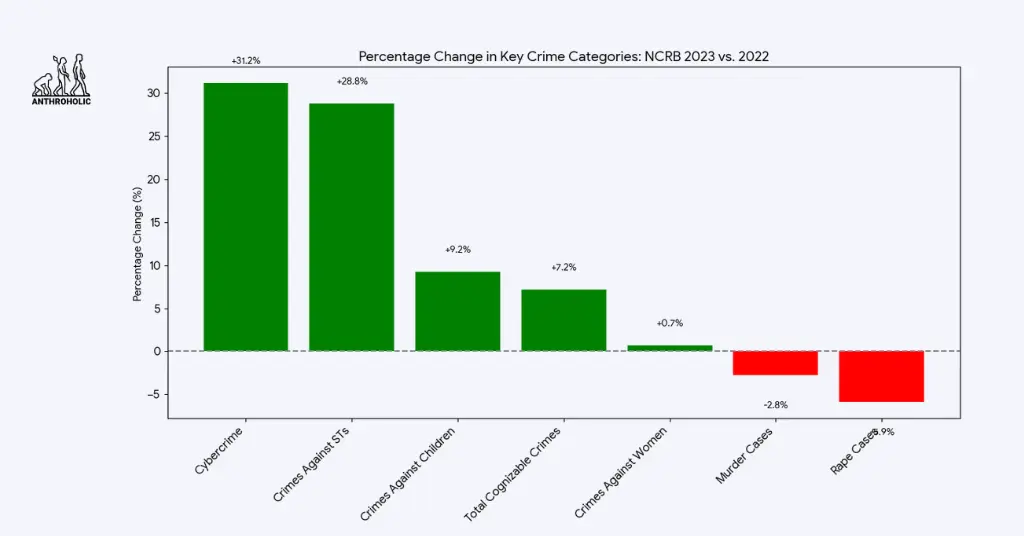
The National Crime Records Bureau (NCRB) Crime in India 2023 Report highlights a shift in India’s crime profile:
- Overall Crime Rise: Total cognizable crimes increased by 7.2%, with the crime rate rising to 448.3 cases per lakh population.
- Traditional Crime Decline: Violent crimes like Murder ($\downarrow$ 2.8%) and Rape ($\downarrow$ 5.9%) saw marginal decreases.
- Surge in Modern/Administrative Crimes:
- Cybercrime spiked by 31.2%, driven heavily by fraud.
- Violations of Special and Local Laws (SLL), such as Motor Vehicle Act violations, significantly boosted the overall numbers.
- Crimes Against Vulnerable Groups:
- Crimes against Scheduled Tribes (STs) surged by 28.8% (largely due to ethnic violence in Manipur).
- Crimes against Children rose by 9.2%.
- Crimes against Women saw a marginal increase of 0.7%, with ‘Cruelty by Husband or Relatives’ remaining the largest category.
The National Crime Records Bureau (NCRB): Mapping India’s Socio-Criminological Landscape
In a country as vast and culturally complex as India, understanding the dynamics of crime is not merely an exercise in legal statistics; it is a profound anthropological inquiry into the fractures of a society. What social tensions translate into violence? How do gender, caste, and region shape vulnerability? To answer these questions, scholars, policymakers, and law enforcement invariably turn to one definitive source: the National Crime Records Bureau (NCRB).
The NCRB, established in 1986 under the Ministry of Home Affairs, Government of India, serves as the national repository of information on crime and criminals. Its primary mandate is to collect, collate, and analyze crime data from all States and Union Territories (UTs), equipping the police with IT and criminal intelligence. Far from being a dry statistical agency, the NCRB acts as the sociological mirror of the nation, reflecting annual shifts in law and order, and offering critical data points that illuminate India’s evolving socio-criminological landscape.
For an aspirant or enthusiast studying Anthropology, the NCRB’s data particularly its annual flagship publication, Crime in India is an indispensable tool for grounding abstract theories of deviance, social control, and legal anthropology in concrete, real-world patterns. This article provides an authoritative deconstruction of the NCRB, its functions, its crucial reports, and its profound, albeit debated, significance in understanding the human condition in India.
The Genesis and Core Mandate of NCRB
The establishment of the NCRB in 1986 was a direct response to the need for a modern, centralized, and systematic mechanism for crime data management. It was formed based on the recommendations of key bodies like the Tandon Committee, the National Police Commission (1977-81), and a Task Force set up by the Ministry of Home Affairs (MHA) in 1985. The goal was to unify and modernize disparate state-level records, thereby enabling a national perspective on crime.
Core Objectives: A Triple Mandate
The Bureau’s functions extend beyond mere reporting; they are fundamentally about enabling effective criminal justice administration:
- Repository of Information: To function as the central information hub for crime and criminals, including maintaining the national database of convicted individuals’ fingerprints (Central Finger Print Bureau).
- IT and Systems Implementation: To guide and manage the development of IT applications for police forces across India, with the flagship project being the Crime and Criminal Tracking Network & Systems (CCTNS).
- Data Analysis and Reporting: To collect, analyze, and publish statistics on crime, accidental deaths, suicides, and prisons, which inform policy and public discourse.
The Anthropological Lens on NCRB Reports
For anthropologists, the value of NCRB data lies in its ability to reveal patterns of inequality, social conflict, and the efficacy of social control mechanisms. The annual reports are a treasure trove for examining how social structure influences deviance.
Flagship Publications: More Than Crime Statistics
The NCRB publishes several key annual reports that provide a holistic picture of deviance and correctional administration:
- Crime in India (CII): The most prominent report, detailing cognizable crimes registered under the Indian Penal Code (IPC) and Special and Local Laws (SLL), along with crime rates (crimes per one lakh population).
- Accidental Deaths & Suicides in India (ADSI): Provides crucial data on non-crime-related deaths, which are often indicators of underlying social stress, economic hardship, and mental health crises.
- Prison Statistics India: Details the demographics of prison inmates, overcrowding, educational profiles, and the progress of the judicial system.
| NCRB Report | Key Anthropological Utility | Indicative Statistic (e.g., 2022 Data) |
| Crime in India | Mapping spatial (State/City) and social (caste, gender) distribution of violence, revealing institutionalized inequalities and regional crime cultures. | In 2022, cases of ‘Cruelty by Husband or his Relatives’ (Section 498A IPC) accounted for the largest share of crimes against women. |
| ADSI | Analyzing social anomie; correlating economic/family issues with suicide rates, particularly among vulnerable groups like daily wage earners and farmers. | ‘Family Problems’ and ‘Illness’ are consistently among the major causes for suicides reported across India. |
| Prison Statistics | Studying the social identity of the convicted, highlighting potential biases in the criminal justice system (e.g., disproportionate incarceration of marginalized groups). | Provides data on the educational and economic background of inmates, offering a demographic profile of those most frequently caught in the legal net. |
Case Study: Crime Against Vulnerable Groups
The NCRB’s granular data allows for the anthropological study of specific vulnerabilities:
- Crimes Against Women: The crime rate against women (Crimes per lakh population) is often scrutinized. The classification of crime motives and the relationship between the victim and the accused allows researchers to explore the prevalence of domestic violence and the failure of familial social control, linking it back to patriarchal social structures.
- Crimes Against Scheduled Castes (SCs) and Scheduled Tribes (STs): The surge in registered cases under the SC/ST (Prevention of Atrocities) Act points to the persistent problem of structural violence and social exclusion. The data helps chart the geography of caste-based conflict, providing empirical evidence for the socio-economic vulnerabilities of these groups.
Pull Quote: “The NCRB reports offer a ‘field-view’ of societal pathology, showing us where social norms break down, where power is abused, and which populations bear the heaviest burden of systemic failure. The numbers are merely proxies for human suffering and structural inequality.”
Challenges, Critiques, and the Data Gap
While invaluable, the NCRB is not without its critics. The data presents a complex picture, often criticized for what it misses rather than what it contains.
1. The Reporting Bias and the ‘Dark Figure’ of Crime
A fundamental issue is that NCRB data is based on crimes registered with the police (First Information Reports or FIRs). This introduces a significant reporting bias.
- Under-reporting: Crimes involving sexual violence, domestic abuse, or offences in areas with low police trust are notoriously under-reported.
- Registration Disparities: Fluctuations in crime rates can often reflect changes in police policy (e.g., a new directive to register all cybercrime complaints) rather than an actual change in the crime rate itself. States with a high crime rate, such as Delhi’s high crime rate per lakh population reported in the 2023 data, may simply have a more diligent registration process than others. The anthropologist must, therefore, be cautious in comparing raw state-wise numbers.
2. Methodological Limitations
The NCRB employs the “Principal Offence Rule,” which dictates that if a single criminal act involves multiple offenses (e.g., robbery resulting in murder), only the most heinous crime (murder) is counted for statistical purposes. While this prevents over-counting, it obscures the full spectrum of criminal activity involved in a single incident, limiting the nuance in sociological analysis.
3. Emerging Crime and Data Classification
The rapid rise of cybercrime presents a significant challenge. The NCRB data has shown alarming increases—a 31.2% surge in registered cybercrime offences from 2022 to 2023 (NCRB, 2023)—but even these figures are considered to underrepresent the reality. Many non-financial cyber offences, such as gendered cyber-harassment, may be poorly recorded or ‘reclassified for efficiency’ by local police, leading to a silence in the official statistics on a pervasive new form of digital social violence (SabrangIndia, 2024).
Technology and the Interoperable Justice System
To address data limitations and enhance criminal intelligence, the NCRB is the nodal agency for the Crime and Criminal Tracking Network & Systems (CCTNS). This national project aims to link over 15,000 police stations and 6,000 high offices, creating a massive, interoperable database.
- CCTNS and ICJS: CCTNS forms the base layer of the Inter-operable Criminal Justice System (ICJS), which seeks to integrate the core components of the justice system: Police (NCRB/CCTNS), Courts, Prisons, Prosecution, and Forensics.
- Anthropological Impact: The successful implementation of CCTNS and ICJS could offer unprecedented opportunities for anthropological research, moving beyond mere state-level aggregates to track individual criminal careers, and analyze the social and spatial mobility of criminals and victims across state lines, offering a dynamic rather than static picture of crime.
Conclusion
The National Crime Records Bureau (NCRB) is far more than a government bureaucracy; it is the statistical backbone of India’s criminal justice system and an essential resource for social science. Its reports are the vital sign monitors of the nation’s health, translating individual tragedies into quantifiable trends. For students and researchers, engaging with the NCRB data is not just about citing a statistic; it is about undertaking an ethical and intellectual responsibility to critically analyze the quantitative expression of profound social realities.
As India’s development continues to create new social and digital frontiers, the data generated by the NCRB even with its inherent limitations will remain the critical starting point for all research into deviance, law, and social change. The true measure of its value is the degree to which its facts incite policy action and deepen our collective understanding of human behavior in a rapidly evolving, complex society.
Frequently Asked Questions (FAQs)
Q1. What is the difference between Crime Incidence and Crime Rate in NCRB reports?
A. Crime Incidence refers to the absolute number of cases registered for a particular crime head (e.g., 28,522 murder cases in 2022). Crime Rate is a proportional measure calculated as the number of crimes per 1,00,000 (one lakh) population. The crime rate is generally considered a better measure for comparative analysis between different states or cities because it adjusts for population size.
Q2. What is the ‘Principal Offence Rule’ used by the NCRB?
A. The Principal Offence Rule is a methodological convention where, if a single criminal incident involves multiple offenses (e.g., a case involving both kidnapping and rape), only the most severe offense (in this case, rape) is counted for the purpose of crime statistics. The primary purpose is to avoid statistical inflation (double-counting) of a single incident.
Q3. How can I use NCRB data to study caste dynamics in anthropology?
A. The NCRB’s Crime in India report provides a separate section dedicated to crimes registered under the SC/ST (Prevention of Atrocities) Act. Anthropologists use this data, along with statistics on victims and accused classified by caste/community, to map the geographical distribution and changing nature of caste-based violence, measure the efficacy of protective legislation, and correlate social marginalization with crime victimization.
Q4. What is CCTNS and what role does NCRB play in it?
A. CCTNS stands for Crime and Criminal Tracking Network & Systems. It is a national mission-mode project under the Ministry of Home Affairs aimed at creating a comprehensive and integrated IT-enabled system for enhancing police efficiency. NCRB is the nodal agency responsible for its implementation, technical management, and data synchronization across all police stations in the country, thereby enabling seamless sharing of crime and criminal data.
References
- Chahal Academy. (2023). All About National Crime Records Bureau UPSC CSE. Retrieved from https://chahalacademy.com/ncrb
- Hindustan Times. (2025, October 26). What NCRB data says about the nature of crime in India. Hindustan Times. Retrieved from https://www.hindustantimes.com/opinion/what-ncrb-data-says-about-the-nature-of-crime-in-india-101761492382353.html
- National Crime Records Bureau. (2023). Crime in India 2022. Ministry of Home Affairs, Government of India. Retrieved from https://ncrb.gov.in/sites/default/files/CII-2022/Crime%20in%20India%20-%202022.pdf
- NEXT IAS. (2025, September 30). National Crime Records Bureau (NCRB) Released Crime in India 2023. Retrieved from https://www.nextias.com/ca/current-affairs/30-09-2025/ncrb-crime-in-india-2023
- ORF. (2024, May 16). Crime in India: A Critical Review of Data Collection and Analysis. Retrieved from https://www.orfonline.org/research/crime-in-india-a-critical-review-of-data-collection-and-analysis
- SabrangIndia. (2024, February 19). Screens of Silence: What NCRB Data Misses about Cybercrime in India. Retrieved from https://sabrangindia.in/screens-of-silence-what-ncrb-data-misses-about-cybercrime-in-india/

Related Posts