AI Answer Evaluation Platform Live Now. Try Free Answer Evaluation Now
Rites of Passage
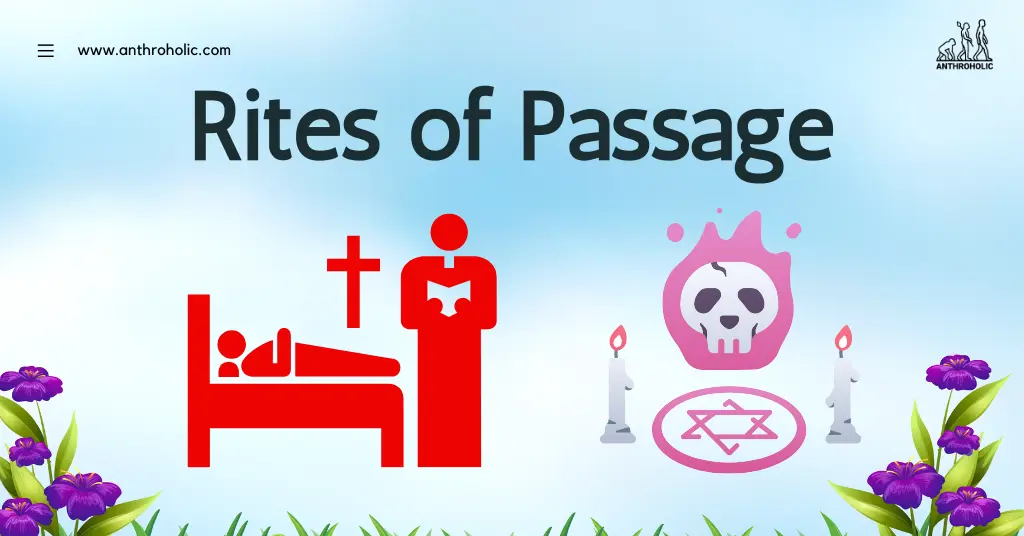
Short answer: Rites of passage are rituals that mark a person’s move from one social status to another, such as birth, initiation, marriage and death. Arnold van Gennep (1909) showed they have three phases: separation, transition (liminality) and incorporation. Victor Turner later developed the idea of the liminal phase, when people are “betwixt and between” statuses.
Rites of passage are ceremonies or rituals signifying an individual’s progress from one stage of life to another [1]. This concept was first coined by ethnographer Arnold Van Gennep in his work “The Rites of Passage” (1909), where he identified these rituals as a universal phenomenon existing in all cultures [2].
Significance of Rites of Passage
Rites of passage serve several key functions in society:
- Cultural Cohesion: They strengthen the bonds within a community and reinforce shared cultural values and norms.
- Life Stage Transition: They provide individuals with a structure to understand and navigate major life transitions.
- Personal Growth: They offer a platform for personal development and identity formation.
Types of Rites of Passage
Rites of passage differ vastly in their nature, reflecting the cultural diversity around the world. However, Van Gennep identified three key phases present in all rites of passage: separation, liminality, and incorporation [3]. In van Gennep’s scheme every rite passes through all three phases; the “Phase” column below shows the phase each example most clearly stresses. The following table presents a few examples of rites of passage across the globe:
| Rite of Passage | Culture | Phase | Description |
|---|---|---|---|
| Birth Rituals | Various | Separation | Various practices such as naming ceremonies, baptisms, and blessings that introduce a new life into the community. |
| Vision Quest | Native American | Liminality | Adolescent boys undergo a period of fasting and solitude to seek spiritual guidance and their life’s purpose. |
| Bar/Bat Mitzvah | Jewish | Incorporation | Marks the transition of boys/girls (at age 13 and 12 respectively) to adulthood, signifying their responsibilities under religious law. |
Detailed Examination of Specific Rites of Passage
Birth Rituals
Many cultures have special ceremonies or practices to welcome a new child. For example, in Christian traditions, a child’s birth is often marked by a baptism, a ritual symbolizing the removal of sin and the child’s entry into the church [4]. Similarly, in Hindu culture, a naming ceremony called ‘Namkaran’ is performed, where the baby’s name is decided based on astrological calculations [5].
Vision Quest
In some Native American cultures, adolescent boys undertake a vision quest as a coming-of-age ritual. During this rite, the individual seeks spiritual guidance and their life’s purpose through a period of solitude, fasting, and connection with nature [6].
Bar/Bat Mitzvah
In Jewish culture, the Bar Mitzvah (for boys) and Bat Mitzvah (for girls) mark the transition to adulthood at the ages of 13 and 12, respectively. This rite of passage signifies that they are now responsible for their actions under Jewish law. The ceremony typically involves the individual reading from the Torah for the first time, symbolizing their religious maturity [7].
The Universality and Variations of Rites of Passage
Rites of passage are found in every corner of the world, revealing a universal human desire to symbolically mark the transitions of life. The anthropologist Bronisław Malinowski emphasized that rites of passage are crucial to maintaining societal order, providing individuals with clearly defined roles and responsibilities within their community [8].
Despite this universality, there are numerous variations in the types and execution of rites of passage globally. These variations reflect the diversity of human culture and spirituality. This section will explore a few examples in more detail.
Circumcision
In many cultures, male circumcision is a significant rite of passage. For instance, among the Maasai people of East Africa, circumcision signifies the transition from boyhood to the responsibilities and privileges of manhood. This is a community-wide event marked by celebration and ceremony [9].
| Rite of Passage | Culture | Phase | Description |
|---|---|---|---|
| Circumcision | Maasai, East Africa | Incorporation | The transition from boyhood to manhood, signifying the boy’s readiness to take on the responsibilities of an adult. |
Quinceañera
In Latin American cultures, the Quinceañera is a significant rite of passage for girls. This elaborate celebration marks a girl’s 15th birthday, symbolizing her transition from childhood to womanhood. It includes a religious ceremony followed by a party with friends and family [10].
| Rite of Passage | Culture | Phase | Description |
|---|---|---|---|
| Quinceañera | Latin America | Incorporation | Celebrates a girl’s 15th birthday and her transition from childhood to womanhood. |
Seijin-no-Hi
In Japan, Seijin-no-Hi or “Coming of Age Day” is an important rite of passage. Held annually, this national holiday celebrates all individuals who have reached or will reach the age of 20 in the current year. The day is marked by official ceremonies and parties, with the new adults wearing traditional dress [11].
| Rite of Passage | Culture | Phase | Description |
|---|---|---|---|
| Seijin-no-Hi | Japan | Incorporation | Celebrates those reaching the age of 20, the traditional age of adulthood in Japan (the legal age was lowered to 18 in April 2022, but most ceremonies are still held at 20) [12]. |
Conclusion
Rites of passage play a pivotal role in every culture, guiding individuals through the critical transitions of life and reinforcing the shared values, norms, and identities of their communities. Despite their diverse expressions, these rites universally provide a structured approach to life’s inevitable changes, ultimately contributing to societal cohesion and individual growth.
References
[1] Encyclopedia Britannica. (2021). Rite of Passage | Definition, Types, & Facts. Retrieved from https://www.britannica.com/topic/rite-of-passage
[2] Van Gennep, A. (1909). The Rites of Passage.
[3] Turner, V. (1967). The Forest of Symbols: Aspects of Ndembu Ritual.
[4] BBC. (2014). Baptism.
[5] Tiwari, A. (2018). Namkaran: The Hindu Naming Ceremony. Retrieved from https://www.learnreligions.com/namkaran-hindu-naming-ceremony-1770159
[6] Gish, A. (2004). Vision Quest: Men, Women and Sacred Sites of the Sioux Nation.
[7] Rich, T.R. (2011). Bar Mitzvah, Bat Mitzvah and Confirmation. Retrieved from https://www.jewfaq.org/barmitz.htm
[8] Malinowski, B. (1945). The Dynamics of Culture Change: An Inquiry into Race Relations in Africa.
[9] Spencer, P. (1988). The Maasai of Matapato: A Study of Rituals of Rebellion.
[10] Cantú, N. (2002). The Sexuality of the Quinceañera Ceremony: Performative and Symbolic Rituals in Latino Culture.
[11] Hendry, J. (1993). Wrapping Culture: Politeness, Presentation, and Power in Japan and Other Societies.
[12] Nippon.com. (2022). Official age of adulthood in Japan lowered to 18. https://www.nippon.com/en/japan-data/h01285/

Related Posts