AI Answer Evaluation Platform Live Now. Try Free Answer Evaluation Now
Visualism
For centuries, the Western intellectual tradition has operated under a hidden hegemony: the belief that “seeing is believing.” In the realm of anthropology, this reliance on the optical has a name Visualism. It is not merely the act of looking, but an ideological commitment to the eye as the primary, and most objective, organ of knowledge. From the sketches of early Victorian explorers to the high-definition ethnographic films of the 21st century, the “gaze” has shaped how we understand, categorize, and most controversially distance the “Other.”
As anthropology evolves in an era of digital immersion and sensory revival, understanding visualism is no longer just an academic exercise; it is a prerequisite for ethical fieldwork.We explores the origins of visualism, its critique by seminal thinkers like Johannes Fabian, its impact on ethnographic methodology, and the modern shift toward a more balanced, multisensory approach to human culture.
Defining Visualism
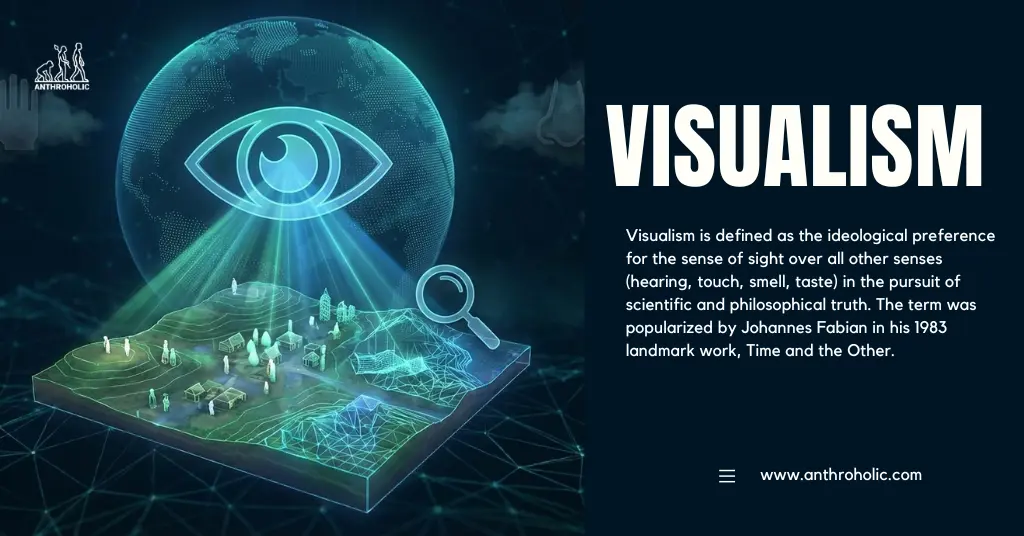
Visualism is defined as the ideological preference for the sense of sight over all other senses (hearing, touch, smell, taste) in the pursuit of scientific and philosophical truth. Within anthropology, it refers to the tendency to treat cultural data as something to be “seen,” mapped, and observed from a distance, rather than experienced through participation or dialogue.
The term was popularized by Johannes Fabian in his 1983 landmark work, Time and the Other. Fabian argued that visualism is deeply linked to the Western concept of “objectivity.” By transforming people and cultures into visual “objects,” the researcher creates a spatial distance that often translates into a temporal one.
The Ocularcentric Tradition
The roots of visualism lie in Western Ocularcentrism. Since the Enlightenment, metaphors for knowledge have been overwhelmingly visual: we speak of “enlightenment,” “insight,” “perspective,” and “observation.” In early anthropology, this manifested in the “armchair” tradition, where scholars analyzed photographs and artifacts as static visual evidence of “primitive” stages of human evolution.
Distance and Allochronism
The primary critique of visualism centers on its tendency to “freeze” subjects. When we prioritize the visual, we often prioritize the spatial over the temporal.
1. The Distancing Effect
Unlike sound or touch, which require proximity or immersion, sight allows for distance. The anthropologist can watch a ritual from the periphery, capturing it on film without ever engaging in the social fabric that gives the ritual meaning. This “spectator” status can lead to a dehumanized representation of the subjects.
2. Allochronism
Johannes Fabian coined the term Allochronism to describe the “denial of coevalness.” Visualism contributes to this by presenting non-Western cultures as if they exist in a different time—a “past” that we are observing from the “present.”
“Visualism is a practice of distancing that transforms the ‘Other’ into an object of a colonial or scientific gaze, effectively stripping them of their agency and shared time with the observer.” — Johannes Fabian
3. The Power of the Gaze
The “Anthropological Gaze” is rarely neutral. It is often a Colonial Gaze, where the act of looking is also an act of categorizing and controlling. For example, colonial-era photography in India often focused on “types” and “castes,” using visual markers to justify administrative hierarchies.
Visualism vs. The Sensory Turn
To understand the dominance of visualism, it is helpful to contrast it with the emerging field of Sensory Anthropology, which advocates for a holistic engagement with the human experience.
| Feature | Visualism (Ocularcentrism) | Sensory Anthropology (Multisensory) |
| Primary Medium | Observation, Mapping, Photography | Participation, Soundscapes, Embodiment |
| Relationship | Subject-Object (Distance) | Intersubjective (Immersion) |
| Temporal State | Static/Frozen (Allochronism) | Fluid/Shared (Coevalness) |
| Data Type | Quantitative/Visual Evidence | Qualitative/Affective Experience |
| Goal | Classification and Description | Understanding through “Being-with” |
The Paradox of Visual Anthropology
It is a common misconception to equate visualism with Visual Anthropology. While visualism is a critique of a bias, visual anthropology is a subfield that uses visual media (film, photography, digital media) as a tool for research and representation.
In fact, modern visual anthropologists are some of the fiercest critics of visualism. Pioneers like Jean Rouch advocated for “shared anthropology,” where the camera is not a wall between the researcher and the subject, but a bridge. According to a 2025 study on Multimodal Ethnography, over 68% of new ethnographic projects now incorporate “reflexive visuality,” where the subjects are given the camera to document their own lives, thereby dismantling the traditional external gaze.
Case Study: The “Aural Turn” in the Amazon
Recent research among the Kalapalo people of Brazil has highlighted the limits of visualism. While early visualist accounts focused on their colorful feather-work and dance patterns, contemporary ethnographers have focused on their soundscapes. They found that for the Kalapalo, the world is primarily “heard” and “spoken” into existence through complex musical metaphors. A purely visualist approach would have missed the core ontological structure of their society.
Visualism in the Age of AI
As we move into 2026, the debate over visualism has entered the digital realm. With the rise of Virtual Reality (VR) and Augmented Reality (AR) in ethnographic representation, there is a risk of “Visualism 2.0.”
- The Risk: VR can create a “digital zoo” where the viewer feels they are “there” without the ethical responsibility of actual social interaction.
- The Opportunity: If used reflexively, digital tools can simulate a “haptic” (touch-based) or “ambience-based” experience that moves beyond the flat image.
“The challenge for the 21st-century anthropologist is to use the tools of the visual to transcend the limitations of visualism.”
Toward a “Sense-ible” Anthropology
To move beyond visualism, the discipline has embraced Multimodal Anthropology. This approach recognizes that human culture is not just seen, but felt, heard, smelled, and tasted. It requires the anthropologist to move from being an “observer” to being a “participant-sensor.”
Key Strategies to Mitigate Visualism:
- Aural Ethnography: Recording and analyzing the “soundscapes” of a community.
- Collaborative Filmmaking: Allowing subjects to edit and direct their own visual narratives.
- Embodied Knowledge: Learning through doing such as an anthropologist learning to weave or hunt to understand the tactile knowledge involved.
- Internal Link Suggestion: For more on how these methods apply to fieldwork, see our guide on [Ethnographic Research Methods].
Conclusion
Visualism has been both a powerful engine for anthropological documentation and a restrictive cage for ethnographic understanding. By prioritizing the eye, Western scholarship gained clarity and order but lost the messy, resonant, and immersive reality of lived experience.
As we decolonize the discipline, the critique of visualism serves as a vital reminder: culture is not a spectacle to be watched from afar. It is a shared conversation. The future of anthropology lies not in closing our eyes to the visual, but in opening our ears, hands, and hearts to the full spectrum of human existence. In the end, we must learn to see not just at the world, but with it.
Frequently Asked Questions (FAQs)
1. What is the main difference between visualism and visual anthropology?
Visualism is a theoretical bias or “prejudice” that privileges sight as the only reliable source of knowledge. Visual anthropology is a specialized subfield that uses visual tools (like film and photography) to conduct and communicate ethnographic research, often working to actively counter visualist biases.
2. Who coined the term “Visualism” in anthropology?
The term was popularized by the anthropologist Johannes Fabian in his 1983 book Time and the Other: How Anthropology Makes Its Object. He used it to critique how Western researchers use visual observation to distance themselves from their subjects.
3. How does visualism relate to colonialism?
Visualism facilitated the “Colonial Gaze,” where colonized peoples were treated as specimens to be observed, measured, and photographed. This helped justify colonial hierarchies by presenting non-Western cultures as static, “primitive” objects of study rather than dynamic, contemporary societies.+1
4. Is visualism still a problem in modern anthropology?
While the discipline has moved toward “sensory” and “multimodal” anthropology, visualism persists in the form of “digital tourism” and the over-reliance on data visualization/mapping which can sometimes strip away the human element of ethnographic data.
References
- Clifford, J., & Marcus, G. E. (Eds.). (1986). Writing Culture: The Poetics and Politics of Ethnography. University of California Press. https://www.ucpress.edu/book/9780520266810/writing-culture
- Fabian, J. (1983). Time and the Other: How Anthropology Makes Its Object. Columbia University Press. https://cup.columbia.edu/book/time-and-the-other/9780231169271
- Howes, D. (2019). The Sensory Studies Manifesto: Tracking the Sensorial Revolution in the Academe. University of Toronto Press. https://utorontopress.com/9781487523589/the-sensory-studies-manifesto/
- Ong, W. J. (1982). Orality and Literacy: The Technologizing of the Word. Methuen. https://www.routledge.com/Orality-and-Literacy/Ong/p/book/9780415538381
- Pink, S. (2025). Doing Sensory Ethnography (3rd ed.). SAGE Publications. https://uk.sagepub.com/en-gb/eur/doing-sensory-ethnography/book273415

Related Posts