AI Answer Evaluation Platform Live Now. Try Free Answer Evaluation Now
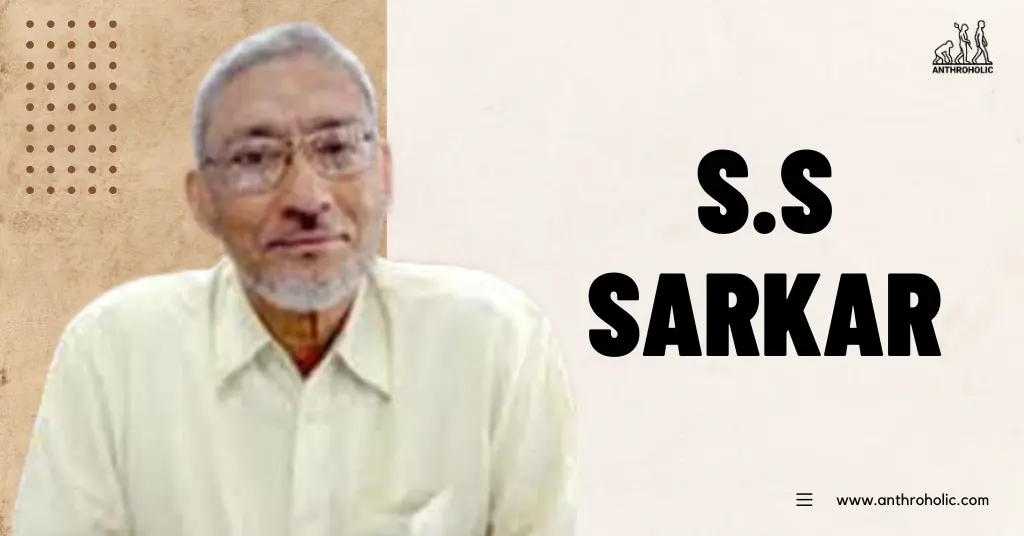
S.S Sarkar
S.S. Sarkar (1908-1969) was a prominent Indian anthropologist and physical anthropologist who made significant contributions to the study of India’s population history, skeletal anthropology, racial classification and prehistoric archaeology. His work bridged physical anthropology, ethnography and archaeological skeletal studies, particularly focusing on ancient Indian populations, megalithic bone remains and cephalic (head-shape) classifications.
He remains one of the key figures in Indian anthropology whose theories (especially his six-element classification of Indian populations) continue to be discussed and critiqued in modern anthropological literature.
Early Life & Education
S.S. Sarkar (full name Sasanka Sekhar Sarkar) was born in 1908 (some sources indicate 1907-09) in Bengal. He undertook his early schooling in Bengal and later moved into anthropological studies. He was among the generation of Indian anthropologists who emerged before full institutionalisation of anthropology in India, and he thus combined field-ethnographic work, skeletal biology, and physical anthropological surveys. After his education in India, he engaged with archaeological and skeletal remains research in Indian contexts particularly with the skeletal remains from sites such as Brahmagiri, Lothal, and the Deccan megaliths. His background therefore straddled both the “physical/biological anthropology” tradition and the indigenous ethnographic tradition of India.
Academic/Professional Career
S.S. Sarkar’s career encompassed work at the Anthropological Survey of India (ASI) and in academic publishing and field-survey work. He produced substantial studies of human skeletal remains in Indian archaeological contexts (for example his paper “Human Skeletal Remains from Brahmagiri” in 1960) which brought physical anthropology into the service of prehistoric archaeology in India.
He also developed his well-known classification of Indian populations on the basis of cephalic index and other physical anthropometric measures.
Although specific institutional appointments (such as university headships) are less frequently documented, his scholarly output and field-survey work earned him recognition as a “doyen of Indian anthropology” in retrospective reviews.
Major Contributions
S.S. Sarkar made several major contributions that can be grouped as follows:
- Classification of Indian populations: Sarkar proposed a classification of the Indian population into six ethnic/racial elements based on cephalic index and anthropometric traits (Australoid, Indo-Aryan, Irano-Scythian, Mundari-speaking, Far-Eastern (Malayan), and Mongolian) in his work on Indian population history.
- Skeletal studies of prehistoric Indian populations: The book Ancient Races of the Deccan (1972, posthumous) is attributed to S.S. Sarkar and offers skeletal-anthropological comparisons of populations from megalithic sites and ancient Harappan remains, arguing for an Australo-Dravidian substratum in India.
- Bridging anthropology and archaeology: By documenting human skeletal remains from sites such as Brahmagiri (in Karnataka), Lothal (Gujarat) and Deccan megaliths, Sarkar drew attention to the biological dimensions of India’s prehistoric cultural complexes. This work helped bring skeletal anthropology into mainstream Indian prehistoric research.
- Physical anthropology surveys and fieldwork: Through his measurement-based studies (head shape, stature, etc.) he contributed to the tradition of Indian physical anthropology and the study of Indian racial and ethnic variation.
- Ethnographic intervention: Although more known for physical anthropology, Sarkar also conducted ethnographic studies of tribal groups (for example Maler and Santal) as his early work indicates.
Theoretical Perspectives & Methodology
S.S. Sarkar’s theoretical-methodological approach can be summarised as follows:
- Cephalic index and racial typology: Sarkar placed emphasis on the cephalic index (head-shape) along with stature, complexion, cranial measurements and other physical features. He used these to propose ethnic/racial strata in Indian populations. For instance, his six-element model uses head shape and physical traits to categorise populations.
- Biological anthropology in archaeological context: He believed that skeletal remains from prehistoric and protohistoric India (such as megalithic burials and Harappan skeletal material) could reveal the “racial” and “ethnic” origins of Indian populations, as well as cultural continuity or discontinuity. For example, in Ancient Races of the Deccan, he argued for an indigenous Australo-Dravidian substratum in India.
- Holistic anthropology: Despite his emphasis on physical measurements, Sarkar claimed to adopt a holistic approach he combined ethnography, skeletal biology and archaeology. A biography of Sarkar noted: “he was a holistic anthropologist.”
- Change and mixture: He recognised hybridisation and cultural contact e.g., he argued that Dravidian-speaking people evolved from the autochthonous element of India (the Veddoids/Australoids) with later contributions from other racial elements.
- Critique and evolution of his work: While his typological approach was influential, later anthropologists have critiqued his heavy reliance on cephalic indexes and “racial” categories. In modern anthropology, the notion of fixed racial typologies has been largely replaced by genetic, cultural, and social frameworks. Sarkar’s work thus remains historically significant but also a subject of theoretical re-appraisal.
Legacy & Influence
The legacy of S.S. Sarkar is substantial though somewhat mixed in contemporary assessment.
- Foundational work in Indian physical anthropology: Sarkar helped institutionalise skeletal and biological anthropology in India, encouraging fieldwork in skeletal collections, megalithic studies and population classification.
- Influence on subsequent anthropologists: His classification of Indian populations and his skeletal-anthropological studies were widely taught in Indian anthropology courses for decades (for example in IGNOU modules referencing his work).
- Historical value and archival importance: His documentation of skeletal remains from megalithic and Harappan sites remains a valuable archival source for researchers in Indian prehistory and physical anthropology.
- Theoretical and methodological shift: His typological methods are now largely outdated scientifically, but they highlight the evolution of anthropology in India from racial typologies to more nuanced genetic, sociocultural and historical frameworks. Contemporary anthropology often studies Sarkar’s work as part of historical anthropology, ethnology and history of anthropology.
- Renewed interest and biography: A recent chapter titled “Dr. Sasanka Sekhar Sarkar: The Doyen of Indian Anthropology” (2022) reflects the renewed interest in his work as a key figure in the early Indian anthropological tradition.
In sum, while modern anthropology may critique his racial typologies, S.S. Sarkar remains a significant figure in Indian anthropology’s history: a researcher who attempted to chart India’s population history through physical anthropological methods, who combined archaeology, ethnography and skeletal studies, and who helped build the institutional scaffolding of physical anthropology in India.
Conclusion
S.S. Sarkar’s life and work illustrate the trajectory of Indian anthropology from the early 20th century focus on race, skull-types and physical classification, to the current era of genetic, cultural and historical anthropology. Through his skeletal surveys, population classifications and interdisciplinary fieldwork, he contributed to the shaping of Indian anthropological research. While his typologies are now reconsidered, his efforts paved the way for subsequent generations of Indian anthropologists and remain a critical reference point in the discipline’s history.
References
- ResearchGate – Sovanjan Sarkar (2022)
Dr. Sasanka Sekhar Sarkar: The Doyen of Indian Anthropology (in Architects of Anthropology in India, Vol. II).
Comprehensive biographical and analytical study on S.S. Sarkar’s career, theories, and influence.
https://www.researchgate.net/publication/360485764_Dr_Sasanka_Sekhar_Sarkar_The_Doyen_of_Indian_Anthropology - INFLIBNET e-Book – Indian Anthropologists (Unit: Classification of Indian Population)
Detailed summary of S.S. Sarkar’s six-fold classification of Indian racial elements.
https://ebooks.inflibnet.ac.in/antp08/chapter/classification-of-indian-population/ - Anthropological Survey of India – Journal of the ASI (1960)
Sarkar, S.S. (1960). Human Skeletal Remains from Brahmagiri, Journal of the Anthropological Survey of India.
https://journals.sagepub.com/doi/10.1177/2277436X19600101 - Book – Ancient Races of the Deccan (1972)
Sasanka Sekhar Sarkar. Ancient Races of the Deccan, Munshiram Manoharlal Publishers. Posthumous monograph based on skeletal studies.
https://books.google.com/books/about/Ancient_Races_of_the_Deccan.html?id=d7ckAAAAMAAJ - Academia.edu – Sovanjan Sarkar (2022)
Sasanka Sekhar Sarkar – Biographical Essay. A personal and professional narrative of his life and research approach.
https://www.academia.edu/89471347/Sasanka_Sekhar_Sarkar_by_Sovanjan_Sarkar - eGyanKosh – IGNOU Anthropology Module (Unit 8)
Mentions S.S. Sarkar’s racial classification, skeletal studies, and influence on Indian physical anthropology.
https://egyankosh.ac.in/bitstream/123456789/84440/1/Unit-8.pdf - IGNTU eContent – Introduction to Indian Anthropologists
Section highlighting S.S. Sarkar’s contributions to racial classification and his significance in physical anthropology.
https://www.igntu.ac.in/eContent/IGNTU-eContent-640794057779-BA-TribalStudies-4-Dr.kumkumKasturi-IntroductiontoEthnography-I.pdf

Related Posts


