AI Answer Evaluation Platform Live Now. Try Free Answer Evaluation Now
N.K Bose
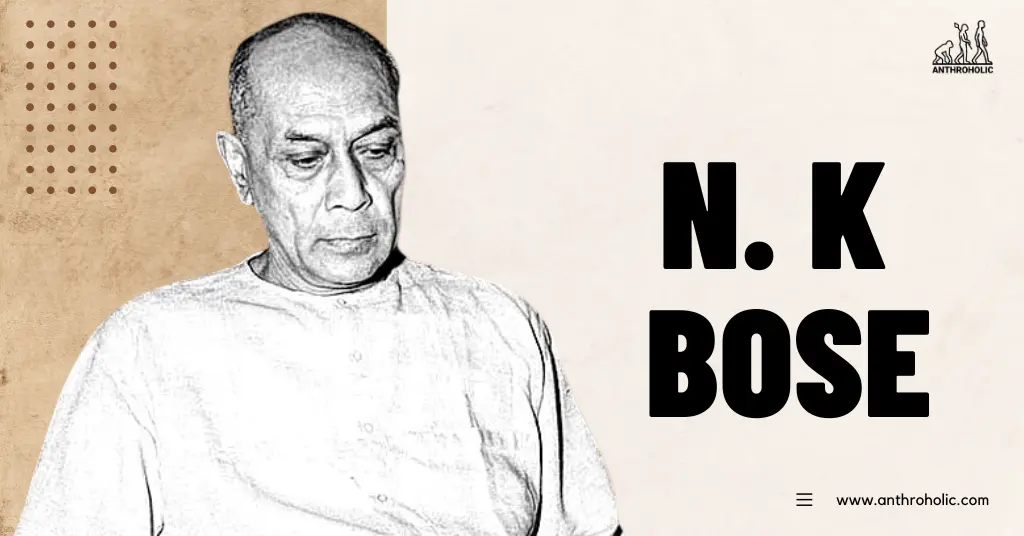
N. K Bose (1901–1972) stands among the most influential figures in Indiananthropology and sociology. He was not only a meticulous ethnographer and insightful cultural theorist but also a public intellectual who bridged scholarship with the ideals of the Indian freedom movement. A close associate of Mahatma Gandhi, Bose infused anthropology with moral and humanistic concerns.
Often regarded as the pioneer of cultural anthropology in India, he sought to interpret Indian civilization through its own categories rather than through Western theoretical models. His major works Hindu Civilization: Tradition and Ideals, Peasant Life in India, and Culture and Society in India represent a lifelong effort to understand the continuity, complexity, and unity of Indian society.
Early Life and Education
N.K Bose was born on 22 January 1901 in Calcutta (now Kolkata) into a Bengali middle-class family known for its intellectual leanings. His father, Prasanna Kumar Bose, was an educator, and the young Nirmal grew up in an environment that valued both Indian tradition and modern learning.
He studied at Presidency College, where he was drawn to the national movement that was sweeping through Bengal in the early 1920s. In 1921, inspired by Mahatma Gandhi, he left college to participate in the Non-Cooperation Movement an early indication of his lifelong commitment to ethical action.
After the suspension of the movement, he resumed his studies and later earned a master’s degree in anthropology from the University of Calcutta, becoming one of the first Indians formally trained in the subject. His academic mentors introduced him to both Western anthropological theories and Indian cultural thought, shaping his distinctive blend of empirical rigor and philosophical insight.
Academic Career
Bose began his professional journey as a lecturer in anthropology at Calcutta University. There, he worked with other pioneers of Indian anthropology and helped expand the discipline beyond the study of tribal communities to include rural and urban societies.
During this period, his relationship with Gandhi deepened. He served as Gandhi’s personal secretary from 1946 to 1948, accompanying him during the Noakhali peace mission. These experiences of communal tension and reconciliation left a profound impression on his understanding of India’s cultural fabric and the challenges of unity amid diversity.
After Independence, Bose was appointed Director of the Anthropological Survey of India. Under his leadership, the institution undertook comprehensive ethnographic surveys across the country, emphasizing fieldwork, regional documentation, and applied research. He later served as Secretary to the Government of India in the Ministry of Scientific Research and Cultural Affairs, symbolizing the growing recognition of anthropology in national development.
Throughout his career, Bose was also an active editor and writer, nurturing platforms that encouraged interdisciplinary dialogue among Indian scholars.
Major Contributions
a. Cultural Interpretation of Indian Civilization
Bose viewed Indian civilization as a vast, enduring cultural system that evolved through accommodation rather than assimilation. For him, diversity was not a mark of fragmentation but a form of unity held together by shared values, rituals, and ethical ideals. His study of Hindu civilization illustrated how regional variations coexisted within a common civilizational framework.
b. Village and Peasant Studies
Bose was one of the earliest anthropologists to shift attention from isolated tribal communities to Indian villages. His studies of peasant life revealed how caste, kinship, land relations, and ritual practices intertwined to create complex local orders. This focus on rural social structure influenced later village studies and rural development programs in independent India.
c. Gandhian Anthropology
Having worked closely with Gandhi, Bose integrated Gandhian ethics into anthropology. He saw concepts like Sarvodaya, non-violence, and self-sufficiency not merely as political ideals but as social values that shaped everyday life. His writings reflected a deep concern with moral order and cultural harmony.
d. Applied and Administrative Anthropology
As Director of the Anthropological Survey of India, Bose promoted the idea that anthropology must serve society. He emphasized using ethnographic knowledge in tribal welfare, education, and public administration, laying the foundation for applied anthropology in India.
Theoretical Perspectives and Methodology
Bose’s theoretical and methodological orientation combined empirical fieldwork, cultural holism, and humanistic interpretation.
He believed that anthropology should begin with direct observation and dialogue with the people being studied. His approach was grounded in respect for indigenous categories of thought and experience. By combining descriptive ethnography with interpretive analysis, he portrayed Indian society as a dynamic synthesis of continuity and change.
Bose also proposed that anthropology in India must grow from within India’s intellectual traditions. He rejected the idea of mechanically importing Western models, insisting that Indian realities required Indian concepts.
Influenced by Gandhi’s moral vision, he viewed anthropology as an ethical pursuit. Understanding culture, for him, was inseparable from promoting empathy, justice, and social balance. His integration of field inquiry with philosophical reflection gave Indian anthropology its distinctively humanistic tone.
Legacy and Influence
He transformed the discipline from a colonial study of tribes into a broad, self-reflective exploration of India’s civilization. His concept of cultural unity amid diversity anticipated later theoretical developments in symbolic and interpretive anthropology.
As head of the Anthropological Survey of India, he institutionalized field research and documentation practices that continue to shape the discipline. As a writer and teacher, he inspired a generation of anthropologists including S. C. Dube, M. N. Srinivas, and T. N. Madan to study Indian society through a balanced blend of empirical rigor and cultural empathy.
Bose’s Gandhian humanism also left a deep mark on Indian social thought. His life demonstrated that anthropology could be a moral as well as scientific enterprise concerned not only with how people live but with why they choose to live in certain ways.
Although later critics have debated his emphasis on harmony over conflict, his enduring message remains clear: India’s strength lies in its ability to reconcile diversity through shared ethical and cultural foundations.
Conclusion
Nirmal Kumar Bose remains one of the great architects of modern Indian anthropology. He combined the scholar’s curiosity with the reformer’s conscience, the ethnographer’s precision with the philosopher’s depth. Through his studies of villages, civilizations, and moral values, he redefined anthropology as a discipline rooted in empathy, responsibility, and self-understanding.
His vision continues to remind us that the study of culture is also the study of humanity and that to understand India, one must listen to its people, its traditions, and its living moral imagination.
References
- eGyanKosh – Indira Gandhi National Open University (IGNOU) Anthropology Module
Unit on Indian anthropologists including N.K. Bose, with discussion on his cultural approach and Gandhian influence.
https://egyankosh.ac.in/bitstream/123456789/90335/1/Unit-15.pdf - ResearchGate – “Nirmal Kumar Bose and the Ethnography of Indian Civilization”
Scholarly paper analyzing his cultural and civilizational framework.
https://www.researchgate.net/publication/321105193_Nirmal_Kumar_Bose_and_the_Ethnography_of_Indian_Civilization - Cambridge University Press – Modern Asian Studies
Articles discussing N.K. Bose’s interpretation of Indian civilization and his influence on post-colonial anthropology.
https://www.cambridge.org/core/journals/modern-asian-studies - IGNTU e-Content – Introduction to Ethnography
Course materials highlighting Bose’s fieldwork tradition and theoretical framework.
https://www.igntu.ac.in/eContent/IGNTU-eContent-640794057779-BA-TribalStudies-4-Dr.kumkumKasturi-IntroductiontoEthnography-I.pdf - Anthropological Survey of India – Official Portal
Institutional history and reference to N.K. Bose’s tenure as Director.
https://asi.nic.in/ - Frontier Weekly – “N.K. Bose and the Making of National Anthropology”
Analysis of his efforts to indigenize anthropology and link it to social reconstruction.
https://frontierweekly.com/ - JSTOR – “The Study of Indian Civilization: Nirmal Kumar Bose’s Perspective”
Academic paper situating Bose within comparative civilizational studies.
https://www.jstor.org/stable/4414585 - Gandhi Heritage Portal – Correspondence and Writings
Collection of letters and writings showing Bose’s close association with Mahatma Gandhi.
https://www.gandhiheritageportal.org/

Related Posts