AI Answer Evaluation Platform Live Now. Try Free Answer Evaluation Now
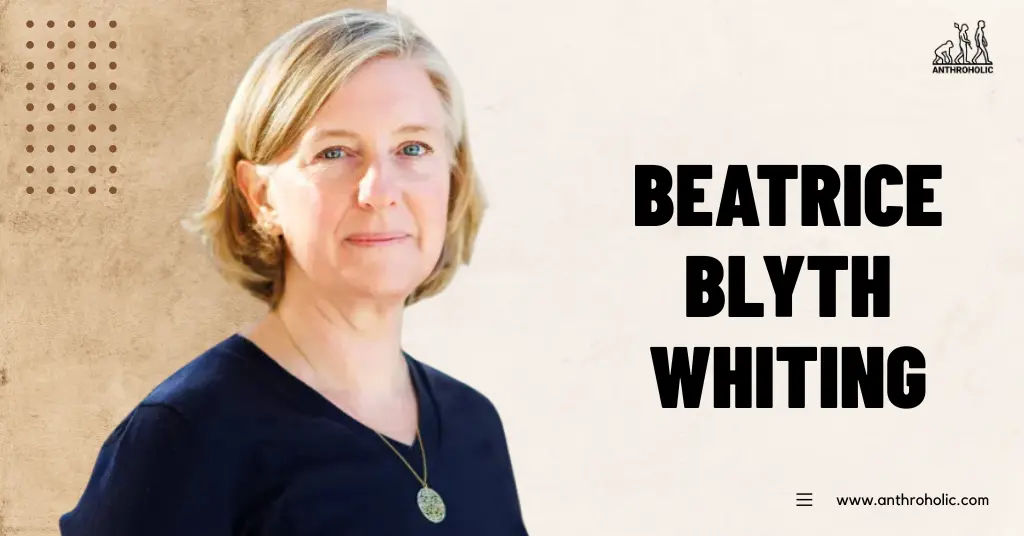
Beatrice Blyth Whiting
Beatrice Blyth Whiting (1914–2003) was an eminent American cultural anthropologist and developmental psychologist, renowned for her pioneering cross-cultural research on child socialization, gender roles, and human development. As a central figure in the Culture and Personality tradition’s later empirical phase, she, along with her husband John Wesley Mayhew Whiting, helped establish the foundations of psychological anthropology and cross-cultural child development studies.
Her work is best exemplified by her leadership in the Six Cultures Study of Socialization, one of the most ambitious comparative research projects in anthropology, which examined child-rearing practices and behavior across diverse societies. Whiting’s approach combined the ethnographic richness of traditional anthropology with the methodological precision of psychology, producing data-driven insights into how cultural and ecological contexts shape childhood experiences.
Over a career spanning six decades at Harvard University, Beatrice Whiting trained and inspired generations of scholars, emphasizing the interdependence of culture, gender, and social learning. Her contribution helped bridge anthropology, education, and psychology, influencing not only academic research but also practical policies on child development and family studies.
Early Life and Education
Beatrice Blyth Whiting was born on April 13, 1914, in New York City, into an educated and progressive family environment that valued learning and intellectual exploration. She attended Smith College, where she completed her Bachelor of Arts degree in 1935. Her undergraduate studies sparked a deep interest in the social sciences, particularly in understanding how cultural context influences individual behavior.
After completing her undergraduate education, Whiting pursued graduate studies in anthropology at Yale University, one of the leading centers for cultural research at the time. Yale’s anthropology department, under the influence of scholars like George Peter Murdock and Edward Sapir, provided her with a strong foundation in cross-cultural analysis and cultural theory.
She earned her Ph.D. in Anthropology from Yale University in 1943, making her one of the earliest women to achieve a doctorate in anthropology from that institution. Her doctoral work focused on socialization and cultural learning, foreshadowing her lifelong interest in childhood development. During her time at Yale, she met John W. M. Whiting, who shared her interest in combining anthropology and psychology. The two married in 1938 and began a lifelong intellectual partnership that would redefine cross-cultural studies.
Major Works and Contributions
Beatrice Whiting’s scholarly output is characterized by methodological innovation, interdisciplinary synthesis, and an enduring focus on the interplay between culture and human development.
Her most significant contribution came through the Six Cultures Study of Socialization, conducted from the 1950s through the 1970s. This project, undertaken with her husband and a team of anthropologists, examined child-rearing and behavioral patterns across six culturally diverse societies: Kenya, India, Okinawa (Japan), Mexico, the Philippines, and the United States (New England). The study sought to understand how ecological, social, and cultural factors shape children’s daily experiences, emotional expression, aggression, and dependency behaviors.
Whiting directed and coordinated the study’s fieldwork and analysis, emphasizing participant observation, film documentation, and standardized behavioral coding. The results were synthesized in Children of Six Cultures: A Psycho-Cultural Analysis (1975), a landmark publication that remains one of the most cited works in cross-cultural psychology and anthropology.
Beyond this monumental project, Whiting contributed substantially to gender studies and family systems research. Her later works examined the gendered division of labor, parental expectations, and the development of prosocial and aggressive behavior among children in varying cultural contexts. Her focus on women’s roles in child socialization was among the earliest attempts to systematically connect gender and developmental outcomes in cross-cultural settings.
Beatrice Whiting’s scholarship also helped standardize the use of film and visual documentation in anthropological research, providing a model for empirical behavioral observation. Her teaching at Harvard University and supervision of numerous doctoral dissertations further disseminated her integrated model of anthropological and psychological inquiry.
Role in Indian and World Anthropology
Beatrice Whiting’s influence extends globally, both through her methodological framework and her empirical findings on cultural variability in socialization. In the broader field of world anthropology, she represents a crucial transition from theoretical culture-and-personality approaches to empirical psychological anthropology.
Her work demonstrated that culture-specific patterns of child development could only be understood through direct observation of children in their natural social environments. This emphasis on situated learning and contextual behavior had profound implications for developmental theory, leading to more nuanced cross-cultural models of personality formation. The Six Cultures Study became a blueprint for future cross-national research in education, family structure, and childhood behavior, influencing scholars across North America, Europe, and Asia.
In the context of Indian anthropology, Whiting’s comparative framework resonated with post-independence researchers studying enculturation, gender socialization, and family dynamics in rural and tribal settings. Indian anthropologists and psychologists, such as D. N. Majumdar, T. N. Madan, and Nirmal Kumar Bose, drew upon diffusionist and cross-cultural insights similar to those advanced by Whiting to analyze how social norms and parenting practices shape personality and values. Her research also indirectly influenced Indian educational psychology by highlighting the importance of contextualized child development, particularly in relation to caste, class, and gender roles.
Globally, Beatrice Whiting helped integrate anthropological perspectives into policy-oriented disciplines, including education, health, and family welfare, contributing to the global understanding of how cultural systems influence human development trajectories.
Critical Evaluation
Beatrice Whiting’s contributions are both pioneering and complex, marking a turning point in how anthropology approached the study of children, families, and learning processes.
One of her greatest strengths lay in combining rigorous empirical methodology with ethnographic depth. Her ability to operationalize cultural variables such as child behavior, household structure, and gendered roles—into measurable, comparable data was revolutionary for her time. This methodological precision allowed anthropology to engage meaningfully with psychology, a collaboration that had long been hindered by disciplinary divides.
Moreover, her research placed women and children at the center of anthropological analysis, challenging earlier male-dominated paradigms that focused on adult males as the primary subjects of study. In doing so, Whiting advanced both feminist anthropology and developmental anthropology, decades before these became formal subfields.
However, her approach was not without limitations. Critics have noted that her reliance on behavioral observation and quantitative coding sometimes led to the reduction of complex cultural meanings into standardized categories. Her framework also occasionally underemphasized historical and political dimensions, focusing more on ecological and social variables. Nonetheless, these limitations are minor when weighed against her immense contributions to methodological innovation and the integration of psychological anthropology with developmental science.
Her influence persists in the fields of biocultural anthropology, cross-cultural psychology, and educational anthropology, where her emphasis on empirical validation and cultural relativity continues to shape contemporary research designs.
Conclusion and Legacy
Beatrice Blyth Whiting stands as one of the most influential women in twentieth-century anthropology, whose work transformed the study of childhood, family, and culture. Her scholarship represents the highest synthesis of cultural anthropology, psychology, and human development, combining observational rigor with theoretical sophistication.
Through the Six Cultures Study and her later analyses, Whiting demonstrated that the process of growing up is universally human yet profoundly shaped by cultural context. She redefined the anthropological understanding of socialization as an adaptive and dynamic process linking individual psychology to collective cultural systems.
Her interdisciplinary legacy endures through the numerous students she mentored at Harvard and the enduring use of her frameworks in cross-cultural developmental research worldwide. Beyond academia, her insights contributed to broader discourses on education, gender equity, and childhood welfare, making her a figure whose intellectual reach transcended disciplinary boundaries.
Beatrice Whiting passed away in 2003, leaving behind a monumental intellectual heritage and a body of work that continues to inform both theoretical debates and applied research in anthropology, psychology, and education. Her life’s work epitomizes the anthropological vision of understanding humanity through the intimate, formative processes of everyday life childhood, family, and culture.
References
- “Beatrice Blyth Whiting.” Harvard Gazette, Harvard University, October 10, 2003. https://news.harvard.edu/gazette/story/2003/10/beatrice-blyth-whiting-anthropologist-dies-at-89/
- “Whiting, Beatrice Blyth (1914–2003).” Encyclopedia.com, Gale Group. https://www.encyclopedia.com/arts/educational-magazines/whiting-beatrice-blyth-1914-2003
- “Whiting, Beatrice B.” The Encyclopedia of Cross-Cultural Psychology, Wiley Online Library. https://onlinelibrary.wiley.com/doi/abs/10.1002/9781118339893.wbeccp567
- “Bea Whiting, 89, Was an Eminent Anthropologist.” The Vineyard Gazette, October 10, 2003. https://vineyardgazette.com/obituaries/2003/10/10/bea-whiting-89-was-eminent-anthropologist
- “Whiting, Beatrice B | Request PDF.” ResearchGate Profile & Publications Overview. https://www.researchgate.net/publication/316090803_Whiting_Beatrice_B
- “Beatrice Blyth Whiting (Author Page).” Amazon Books & Biography Database. https://www.amazon.com/Beatrice-Blyth-Whiting/e/B001HOQNM2
- “Beatrice Blyth Whiting.” Minnesota State University eMuseum Biography. https://www.mnsu.edu/emuseum/information/biography/uvwxyz/whiting_beatrice.html

Related Posts