AI Answer Evaluation Platform Live Now. Try Free Answer Evaluation Now
Hindu Marriage
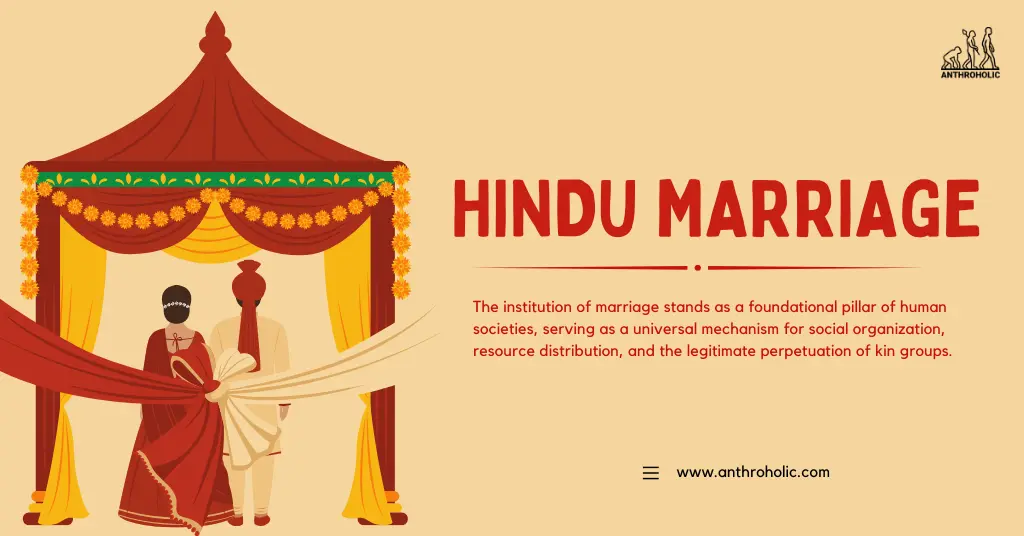
The institution of marriage stands as a foundational pillar of human societies, serving as a universal mechanism for social organization, resource distribution, and the legitimate perpetuation of kin groups. Yet, the specific rituals, laws, and meanings woven into this bond are profoundly culture-specific. Among the most complex and enduring of these forms is Hindu Marriage, or Vivaha, a sacrament (samskara) that transcends a mere social contract to become a cosmic and religious obligation.
For anthropologists and students of South Asian culture, studying Hindu marriage offers a window into the core values of the Vedic tradition, exploring concepts of Dharma (duty), Artha (prosperity), Kama (desire), and Moksha (salvation) collectively known as the Purusharthas. Unlike the Western concept of marriage primarily based on individual romance and companionship, the Hindu perspective traditionally prioritizes the union of two families, the fulfillment of religious duties (Dharma), and the procreation of sons to continue the lineage and perform ancestral rites.
Historical and Conceptual Framework
The conceptualization of Vivaha is deeply rooted in the ancient scriptures of Hinduism, primarily the Vedas, Upanishads, and Dharmashastras (especially the Manusmriti).
The Four Goals of Human Life (Purusharthas)
Marriage is not an end in itself but a necessary stage (Grihastha Ashrama) through which an individual can pursue the four prescribed goals of life. It is the only Ashrama (stage of life) that supports all others (student, renunciate, elder).
- Dharma (Righteous Conduct): The primary goal, focused on fulfilling one’s duty to family, ancestors, and society. Marriage enables the performance of Yajnas (sacrifices) and sacred rituals.
- Artha (Economic Well-being): Marriage creates an economic unit, ensuring the security and prosperity of the family.
- Kama (Pleasure/Desire): The legitimate pursuit of pleasure, including sexual relations, is fulfilled within the marital structure.
- Moksha (Salvation): The ultimate goal, which is approached through the correct performance of duties in the preceding three Purusharthas.
“Marriage, in the Hindu context, is fundamentally a religious sacrament, not a contract. It is an indissoluble spiritual partnership designed to enable the couple to fulfill their Dharma and continue the family line.”
Traditional Forms of Marriage: The Ashta Vivaha
The Manusmriti classifies Hindu marriages into eight distinct forms (Ashta Vivaha), categorized as either approved (Prashasta) or unapproved (Aprashasta) based on the intent, the role of the families, and the presence or absence of a dowry/bride-price.
| Category | Form of Marriage | Description | Status |
| Approved | Brahma | The father gives his daughter to a man learned in the Vedas, of good character, and invited by him. (The ideal form). | Highest |
| Daiva | The daughter is given to a priest as part of his fee for performing a sacrifice (Yajna). | High | |
| Arsha | The groom gives a pair of cows and bulls to the father of the bride, not as a price, but for the performance of sacred duties. | High | |
| Prajapatya | The father gives the daughter with the condition that the couple will fulfill their Dharma together. | Approved | |
| Unapproved | Asura | Marriage by purchase, where the groom gives wealth to the bride’s father and/or the bride. (Considered inappropriate). | Low |
| Gandharva | Marriage by mutual consent of the man and woman, without parental knowledge or ritual. (The basis for love marriage, often frowned upon traditionally). | Unapproved | |
| Rakshasa | Marriage by capture or abduction of the maiden, common among warrior classes. | Unapproved | |
| Paishacha | The worst form; when a man secretly approaches a sleeping, intoxicated, or mentally incapable woman. (A form of non-consensual union). | Lowest |
Key Anthropological Features and Rituals
The Hindu marriage ceremony itself is a rich tapestry of rituals that span days and serve to sociologically and religiously solidify the union. These rituals are highly regional, but certain core components remain consistent across India.
Pre-Wedding and Alliance-Building
A critical aspect of Hindu marriage, particularly in the context of arranged marriage (which remains the dominant form), is the emphasis on exogamy (marrying outside one’s lineage/clan, or Gotra) and endogamy (marrying within one’s caste or Jati). The primary goal of the pre-wedding phase is the establishment of the Jodi (match) based on social, economic, and astrological compatibility.
- Gotra and Sapinda Rules: The Gotra (clan or lineage descended from a common ancestor-sage) is strictly exogamous; a person cannot marry within their father’s or mother’s Gotra. The Sapinda rule restricts marriage within certain degrees of kinship (usually seven generations on the father’s side and five on the mother’s). This ensures a wide genetic pool and reinforces the alliance between distant families.
- Kundali Milan (Astrological Matching): A traditional prerequisite where the horoscopes (Kundalis) of the prospective bride and groom are matched for compatibility, highlighting the blend of fatalism and social engineering inherent in the process.
The Sacred Seven Steps: Saptapadi
The most crucial ritual that legally and religiously solemnizes the marriage is the Saptapadi (seven steps). This ritual occurs around the Agnikunda (sacred fire), with the fire deity, Agni, serving as the divine witness.
During the Saptapadi, the couple takes seven vows together:
- To nourish and provide for the family.
- To develop physical and mental strength.
- To acquire wealth and prosperity.
- To achieve happiness and harmony.
- To care for the children and uphold family values.
- To live a long life with mutual understanding.
- To remain lifelong companions and true friends.
Once these seven steps are completed, the marriage is considered irrevocable in a religious sense, symbolizing the transition from a collection of individuals to a cohesive, interdependent unit. Other key rituals include Kanyadaan (giving away of the bride), Mangalsutra Dharana (tying of the sacred necklace), and Sindoor Daan (application of vermillion).
The Evolving Dynamics of Hindu Marriage
Contemporary Hindu marriage is a dynamic institution caught between the weight of tradition and the forces of modernity, globalization, and legislative reform.
The Role of Legislation: The Hindu Marriage Act, 1955
Post-Independence, the Indian government codified and reformed Hindu marriage law through the Hindu Marriage Act, 1955. This landmark legislation introduced several pivotal changes that significantly altered the anthropological landscape of marriage:
- Monogamy: It legally enforced monogamy, declaring bigamy and polygamy illegal.
- Divorce: For the first time, it introduced the provision for judicial separation and divorce, recognizing that marriage could be dissolved on specific grounds (cruelty, desertion, adultery, etc.). This shifted the concept from an indissoluble sacrament to a legal bond that could be broken, reflecting a move toward recognizing individual rights.
- Inter-Caste Marriage: It legalized inter-caste marriages and, crucially, eliminated the mandatory Gotra and Sapinda restrictions for legal validity, although social acceptance lags behind the law.
Love vs. Arrangement
While arranged marriages remain culturally dominant, there is a distinct shift toward semi-arranged marriages and love marriages, particularly in urban centers and among the educated middle class.
| Feature | Traditional Arranged Marriage | Contemporary Love/Semi-Arranged Marriage |
| Decision Maker | Parents, elders, and kin networks. | Individual preference, with parental consent/veto. |
| Criteria | Caste (Jati), Gotra, wealth, reputation, Kundali. | Education, career, mutual attraction, personality. |
| Goal Focus | Fulfillment of Dharma, continuation of lineage. | Companionate marriage, emotional satisfaction, individual happiness. |
| Alliances | Primarily between two families/lineages. | Primarily between two individuals. |
The rise of matrimonial websites and apps acts as an anthropological intermediary, preserving the arranged structure but empowering individuals with more choice and autonomy, illustrating a subtle but profound democratization of mate selection.
Challenges: Dowry, Gender, and Social Stratification
Despite legal reforms, Hindu marriage remains intertwined with complex social issues:
- Dowry: The practice of dowry (transfer of wealth from the bride’s family to the groom’s family) is legally prohibited by the Dowry Prohibition Act, 1961, but persists widely in various disguised forms. Anthropologically, dowry often reinforces hypergamy (marrying a daughter into a family of higher social status) and creates a financial burden that devalues the female child.
- Patrilocality: The overwhelming norm of patrilocality (the bride moves to live with the groom’s family) reinforces the patriarchal structure, often leading to the bride’s social and emotional vulnerability and loss of ties with her natal kin.
“The transformation of Vivaha is a perfect case study of how a resilient religious institution negotiates with the modern state and global values. The samskara of yesterday is becoming the companionate contract of tomorrow, even as its fundamental patriarchal architecture resists change.”
Conclusion
Hindu marriage, or Vivaha, is far more than a simple legal transaction; it is a sacrament (samskara) that shapes identity, kinship, and the moral fabric of Indian society. Anthropologically, it serves as a powerful instrument for the maintenance of social stratification (through Jati endogamy), the regulation of descent (through Gotra exogamy), and the transmission of culture across generations.
While the Saptapadi and the sacred fire continue to anchor the ceremony in timeless tradition, the legal and social reality of Hindu marriage has irrevocably changed. The introduction of divorce, the rise of individual choice, and the pressure of a modern, egalitarian ethos are continually reshaping its contours. Understanding this institution requires appreciating its deep scriptural roots while simultaneously analyzing its continuous negotiation with contemporary laws and values. The marriage bond remains sacred, but the agency of the individuals within it is finally beginning to assert itself.
Frequently Asked Questions (FAQs)
What is the primary difference between Hindu marriage and a Western/Contractual marriage?
Hindu marriage is traditionally considered a sacrament (samskara) and is religiously indissoluble, focused on the fulfillment of Dharma and familial duties over multiple lifetimes. A Western/Contractual marriage is primarily a legal contract between two individuals, focused on companionship and is legally dissolvable.
What is Kanyadaan and what is its significance?
Kanyadaan literally means “giving away the maiden.” It is the ritual where the bride’s father entrusts his daughter to the groom. Anthropologically, it signifies the transfer of the bride from her natal Gotra (paternal lineage) to the groom’s Gotra, marking her official entry into her husband’s family and relinquishing of her ritual status in her birth family.
Are inter-caste and inter-religious marriages legal under the Hindu Marriage Act?
The Hindu Marriage Act, 1955 fully legalizes inter-caste marriages (marriages between two Hindus of different castes). However, it does not cover inter-religious marriages. For a Hindu to marry a non-Hindu, the couple must register their union under the Special Marriage Act, 1954, which provides a civil contract option for all Indian citizens, regardless of their religion.
What is the role of Gotra and why is it exogamous?
Gotra is a patrilineal clan or lineage tracing descent from a common ancient sage. The rule of Gotra exogamy (marrying outside one’s Gotra) is vital to Hindu marriage as it prevents inbreeding and, more importantly, ensures that the alliance brings together two entirely distinct family lines, broadening the kin network and social support system.
References
- Bhadana, P. (2023). Marriage in the Forms of Ancient History. The International Journal of Engineering and Research (TIJER), 10(9). Retrieved from https://tijer.org/tijer/papers/TIJER2309158.pdf Tijer
- BigStartups. (n.d.). Understanding Hindu Marriage: Exploring the 8 Types of Marriage in Hinduism. Retrieved from https://bigstartups.co/articles/article/understanding-hindu-marriage-exploring-the-8-types-of-marriage-in-hinduism Big Startups
- Bhatṛi Saṃskṛti. (n.d.). Sacred Bonds: Exploring the 8 Types of Marriage in Hinduism. Retrieved from https://bhartisanskriti.com/culture/exploring-the-8-types-of-marriage-in-hinduism/ bhartisanskriti.com
- India Ministry of External Affairs. (n.d.). Volume 4. In [Document on traditional Hindu marriage forms]. Retrieved from https://www.mea.gov.in/Images/CPV/Volume4.pdf MEA India
- ResearchGate. (2021). Hindu Marriage: A Saga of Journey from Ancient to Modern India. International Journal of Research in Social Sciences and Humanities, 11(2). Retrieved from https://www.researchgate.net/publication/352748253_HINDU_MARRIAGE_A_SAGA_OF_JOURNEY_FROM_ANCIENT_TO_MODERN_INDIA ResearchGate
- Apastamba, & Oldror.lbp.world. (n.d.). [Discussion on forms of Hindu marriage]. Retrieved from https://oldror.lbp.world/UploadedData/9401.pdf Review of Research Journal
- Times of India. (n.d.). What are the Saath Vachans of a Hindu marriage and their meanings explained. Retrieved from article page. The Times of India
- Praveen, S., Siddhanta, S., & Chaudhuri, A. (2025). Determinants of the Spousal Age Gap in India: Analysis of Indian Microdata. arXiv. Retrieved from https://arxiv.org/abs/2502.17059
- Dutta, S., Srivastava, P., Solunke, V., Nath, S., & KhudaBukhsh, A. R. (2023). Disentangling Societal Inequality from Model Biases: Gender Inequality in Divorce Court Proceedings. arXiv. Retrieved from https://arxiv.org/abs/2307.10200

Related Posts