AI Answer Evaluation Platform Live Now. Try Free Answer Evaluation Now

Choice of Spouse
The choice of spouse the deliberate selection of a lifelong partner is one of the most fundamental and universally significant social processes across human cultures. Far from being a mere matter of individual romantic preference, mate selection is deeply embedded in the economic, political, and kinship structures of society. Anthropologically, this process is a critical lens through which we can analyze social organization, gender roles, power dynamics, and the perpetuation of cultural norms.
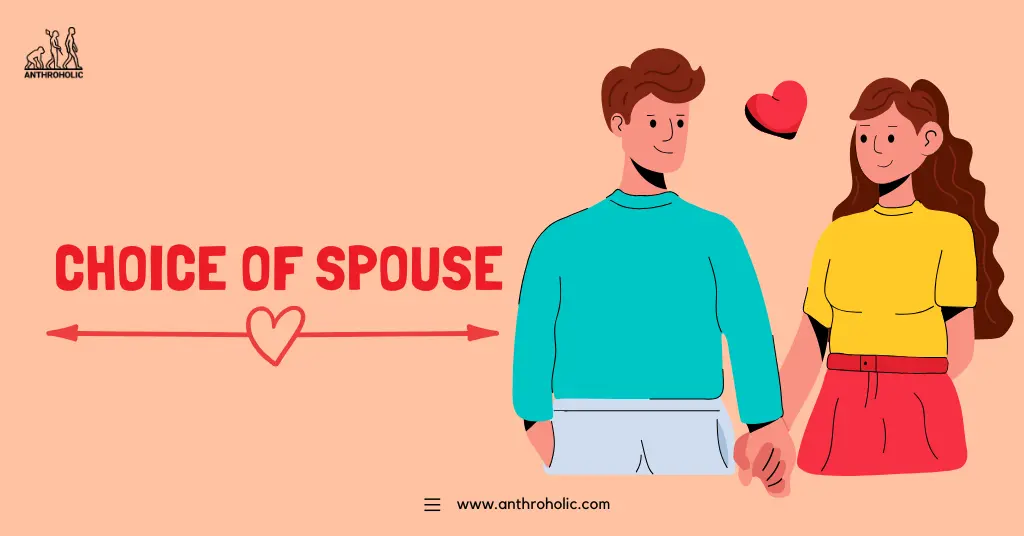
We will explore the universal rules that govern this choice, the varying cultural mechanisms employed, and the dramatic shifts occurring in contemporary mate selection practices around the globe. Understanding the choice of spouse is key to grasping how human societies structure themselves and ensure their continuity.
Universal Rules and Anthropological Imperatives
Despite the staggering diversity of marriage customs, the selection of a spouse is universally governed by two core, often contrasting, rules: Endogamy and Exogamy. These rules define the boundaries of the eligible marriage pool and are crucial for maintaining social order and biological viability.
Defining the Boundaries of Eligibility
- Exogamy: This rule mandates marriage outside of a specific social group, such as the family, clan, or village. Its primary function is to prevent incest, forge alliances, and broaden the social network. The classic example is found in the moiety and clan systems common across Indigenous American and Australian societies, where marriage is strictly prohibited within one’s own descent group, forcing an exchange of partners between groups.
- Endogamy: This rule mandates marriage within a specific social group. This can be based on caste, class, religion, ethnicity, or lineage. Endogamy serves to maintain group identity, preserve wealth and resources within the group, and uphold social status. The Indian caste system, where hypergamy (marrying a spouse of higher status) and hypogamy (marrying a spouse of lower status) are often regulated within endogamous boundaries, provides a powerful illustration.
“The regulation of marriage is not just a mechanism for finding a mate; it is a fundamental act of social construction, dictating who belongs and how resources will be distributed across generations.”
Prohibitions: The Incest Taboo
The most stringent and universally observed prohibition in mate selection is the incest taboo the rule against sexual relations or marriage between close kin. While the definition of “close kin” varies (ranging from nuclear family members to distant cousins), its universal existence is a major point of anthropological inquiry. Explanations range from:
- Biological Theory (Westermarck Effect): Those raised in close proximity from infancy develop a sexual aversion to one another.
- Sociological Theory (Malinowski): The taboo forces individuals to look outward for partners, preventing familial conflict and facilitating group alliances necessary for cooperation and survival.
Mechanisms of Spouse Selection: From Regulation to Agency
The process of finding and securing a spouse varies dramatically, reflecting the varying emphasis cultures place on the individual agency versus social regulation.
1. Arranged Marriages: The Collective Decision
In many traditional and non-Western societies, the choice of spouse is primarily a collective decision made by the families or kinship groups of the individuals involved. This system is not about individual happiness alone, but about cementing political and economic alliances.
- Pact of Alliance: The marriage is seen as a contract between two families, often involving the exchange of goods (bridewealth or dowry). Bridewealth, common in many African societies, represents compensation to the bride’s family for the loss of her labor and reproductive potential, while dowry, historically common in parts of Europe and South Asia, is wealth transferred with the bride to her new family.
- Role of Intermediaries: Professionals or respected community members (matchmakers) often facilitate the selection process, basing their recommendations on social status, economic compatibility, and astrological signs.
| Selection Mechanism | Primary Decision-Maker | Primary Goal | Historical/Geographic Examples |
| Arranged Marriage | Families/Kinship Groups | Alliance, Economic Security, Status Maintenance | Traditional India, East Asia, Middle East |
| Cousin Marriage (e.g., Cross-Cousin) | Kinship Structure/Lineage | Resource Consolidation, Strengthening Kin Ties | Many traditional societies (e.g., Middle East, Amazonia) |
| Love Marriage (Self-Selection) | Individuals | Personal Affection, Emotional Compatibility | Modern Western societies, increasingly global urban centers |
2. Preferential Marriage Rules: Consolidating Power
Certain rules explicitly recommend marriage between specific types of relatives, often to keep property and influence within the lineage. The most famous example is the cross-cousin marriage, where a person marries the child of their parent’s opposite-sex sibling (i.e., mother’s brother’s child or father’s sister’s child).
- Case Study: The Kachin of Burma (Leach, 1954): Anthropologist E.R. Leach detailed how the patrilineal Kachin utilized asymmetrical cross-cousin marriage to create hierarchical relationships between the wife-giving and wife-taking lineages, perpetuating a political structure based on ritual rank and debt.
3. Mate Selection in Modernity: The Rise of Individualism
The rise of industrialization, urbanization, and globalization has dramatically shifted the balance from kinship-based selection to individualized choice or love marriage. This transition is characterized by:
- Delayed Marriage: Increased educational and economic opportunities, especially for women, have led to a postponement of marriage.
- The Market of Choice: The move from face-to-face community vetting to anonymous, digital platforms. According to a 2023 study published in Proceedings of the National Academy of Sciences (PNAS), a significant and rising proportion of new relationships in Western nations begin online.
- Homogamy vs. Heterogamy: While individual choice reigns, selection is often still driven by homogamy (marrying someone similar in education, socioeconomic status, and religious background). However, urbanization and migration also increase the frequency of heterogamy (marrying someone different), which can challenge established social norms.
Gender Dynamics and Power in Selection
The choice of spouse is inherently intertwined with gender roles and power dynamics. In patriarchal societies, men typically hold greater authority in selecting a wife (or having one selected for him), while women’s agency is often limited, sometimes reduced to a pawn in familial alliances.
Agency vs. Constraint
- The Male Perspective: For men, the choice of spouse often focuses on securing a partner who can provide labor, bear and raise children, and enhance the family’s social standing. The ability to acquire bridewealth or meet dowry demands is often a prerequisite for marriage.
- The Female Perspective: For women, the “choice” is frequently a calculation of security and opportunity. Anthropologist Gail Rubin’s seminal work, The Traffic in Women, argued that marriage systems across cultures fundamentally involve the “exchange of women” between male kin groups, limiting female autonomy. Even in love marriages, studies show that women often face disproportionate pressure to compromise careers or social ties upon marriage.
The Future of Mate Selection: Blending Tradition and Technology
Contemporary mate selection is a complex blend of global and local forces. While individualized choice is spreading through media and globalization, older traditions persist, often adapting to the new environment.
- In India, for example, the concept of a “semi-arranged” marriage has emerged, where parents filter and select potential partners, but the final decision rests with the couple.
- Data and algorithms are becoming the new matchmakers, yet the underlying social criteria (class, education, caste/religion) remain powerful filters even on platforms like matrimonial websites.
The anthropological study of spouse choice continues to illuminate how deeply personal decisions are shaped by massive, impersonal social structures.
Conclusion
The anthropological analysis of the choice of spouse reveals a process far more intricate than simple romance. It is a critical nexus of social regulation and individual desire, dictated by universal rules of endogamy and exogamy, and shaped by diverse cultural mechanisms like arranged alliances and modern self-selection. From the political economy of bridewealth to the algorithms of dating apps, the selection of a partner is a powerful, ongoing act of social reproduction that determines the shape and future of human societies.
The shifting dynamics from collective decision to individual agency reflect profound changes in economic structure, gender equality, and globalized communication, ensuring that the study of mate selection remains central to understanding the human condition.
Frequently Asked Questions (FAQs)
What is the anthropological difference between Endogamy and Exogamy?
Endogamy is the rule that mandates marrying within a specific social group (e.g., caste, religion, class) to preserve group identity and wealth. Exogamy is the rule that mandates marrying outside a specific social group (e.g., family, clan) to prevent incest and forge beneficial alliances between groups. Both rules define the permissible field of mates.
How does Bridewealth differ from Dowry, and what is the function of each?
Bridewealth is a payment or transfer of goods from the groom’s family to the bride’s family. Its function is often seen as compensation for the loss of the bride’s labor and reproductive capacity, and it legitimizes the children as members of the groom’s lineage. Dowry is a transfer of goods or money with the bride to the groom’s family. Its function has been interpreted as a pre-mortem inheritance for the bride or as a way to enhance her status and security in her new home, though it often becomes an economic burden on the bride’s family.
What is the ‘Westermarck Effect’ and how does it relate to the Incest Taboo?
The Westermarck Effect is a psychological hypothesis proposing that individuals who live in close domestic proximity during the first few years of life, typically siblings, develop a profound sexual aversion to one another. Anthropologically, this is one of the key biological-psychological theories used to explain the near-universal existence of the Incest Taboo, suggesting the taboo is rooted in innate human behavior rather than purely social legislation.
References
- Buss, D. M., & Schmitt, D. P. (2019). Mate preferences and their behavioural manifestations. Annual Review of Psychology, 70, 77-110. https://doi.org/10.1146/annurev-psych-010418-103408 Annual Reviews+2labs.la.utexas.edu+2
- Apostolou, M. (2024). Strategies for meeting prospective mates: An exploratory investigation. Swiss Journal of Psychology. https://onlinelibrary.wiley.com/doi/10.1111/sjop.12975 Wiley Online Library
- Agey, E. (2024). Arranged and non-arranged marriages have similar reproductive outcomes. PMC Human Behaviour. https://www.ncbi.nlm.nih.gov/articles/PMC11094175/ PubMed Central
- Agey, E. (2024). Offspring and parent preferences for a spouse or in-law: The parental influence over mate choice and marriage. SCiAdvances. https://www.sciencedirect.com/science/article/pii/S1090513824000886 ScienceDirect
- Agey, E. (2023). What makes it difficult to start an intimate relationship? European Journal of Psychology Open. https://ejop.psychopen.eu/index.php/ejop/article/download/1852/1852.html ejop.psychopen.eu
- “Annual Review of Psychology – Volume 70, 2019” (2019). Annual Review of Psychology. https://www.annualreviews.org/content/journals/psych/70/1 Annual Reviews
- Publications page – David P. Schmitt (n.d.). Publications – David P. Schmitt. https://davidschmitt.com/publications David P. Schmitt
- “Universal dimensions of human mate preferences” (2014). ResearchGate. https://www.researchgate.net/publication/222557486_Universal_Dimensions_of_Human_Mate_Preferences

Related Posts