AI Answer Evaluation Platform Live Now. Try Free Answer Evaluation Now
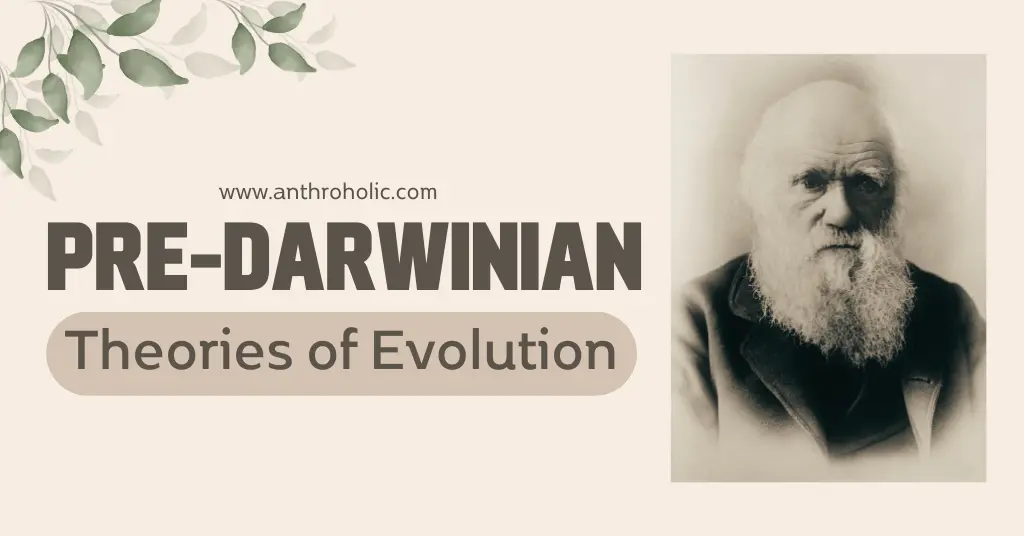
Pre-Darwinian Theories of Evolution
Short answer: Pre-Darwinian theories of evolution are the ideas about the origin and change of species proposed before Charles Darwin’s On the Origin of Species (1859). They range from special creation and the fixity of species, through Buffon’s and Erasmus Darwin’s early hints of change and Cuvier’s catastrophism, to Lamarck’s first full theory of evolution (1809) and Lyell’s uniformitarian geology, which gave Darwin the vast time he needed.
Key takeaways
- Lamarck (Philosophie Zoologique, 1809) proposed use and disuse and the inheritance of acquired characters [1].
- Cuvier proved that species go extinct but believed species were fixed and explained change by catastrophes.
- Lyell (Principles of Geology, 1830–1833) showed that slow processes shape the Earth over immense time, but at first rejected the transmutation of species [2].
- Darwin and Wallace replaced these ideas with evolution by natural selection (1858, 1859) [3] [4].
- Darwinian means relating to Darwin’s theory of evolution by natural selection; see Darwinism.
The theory of evolution, proposed by Charles Darwin (with Alfred Russel Wallace) in the mid-19th century, revolutionized our understanding of the natural world. However, before Darwin’s seminal work, there were several pre-Darwinian theories of evolution that laid the foundation for his ideas. These early theories, though incomplete and sometimes flawed, contributed to the gradual development of evolutionary thought. In this article, we will explore some of the prominent pre-Darwinian theories of evolution and their key principles.
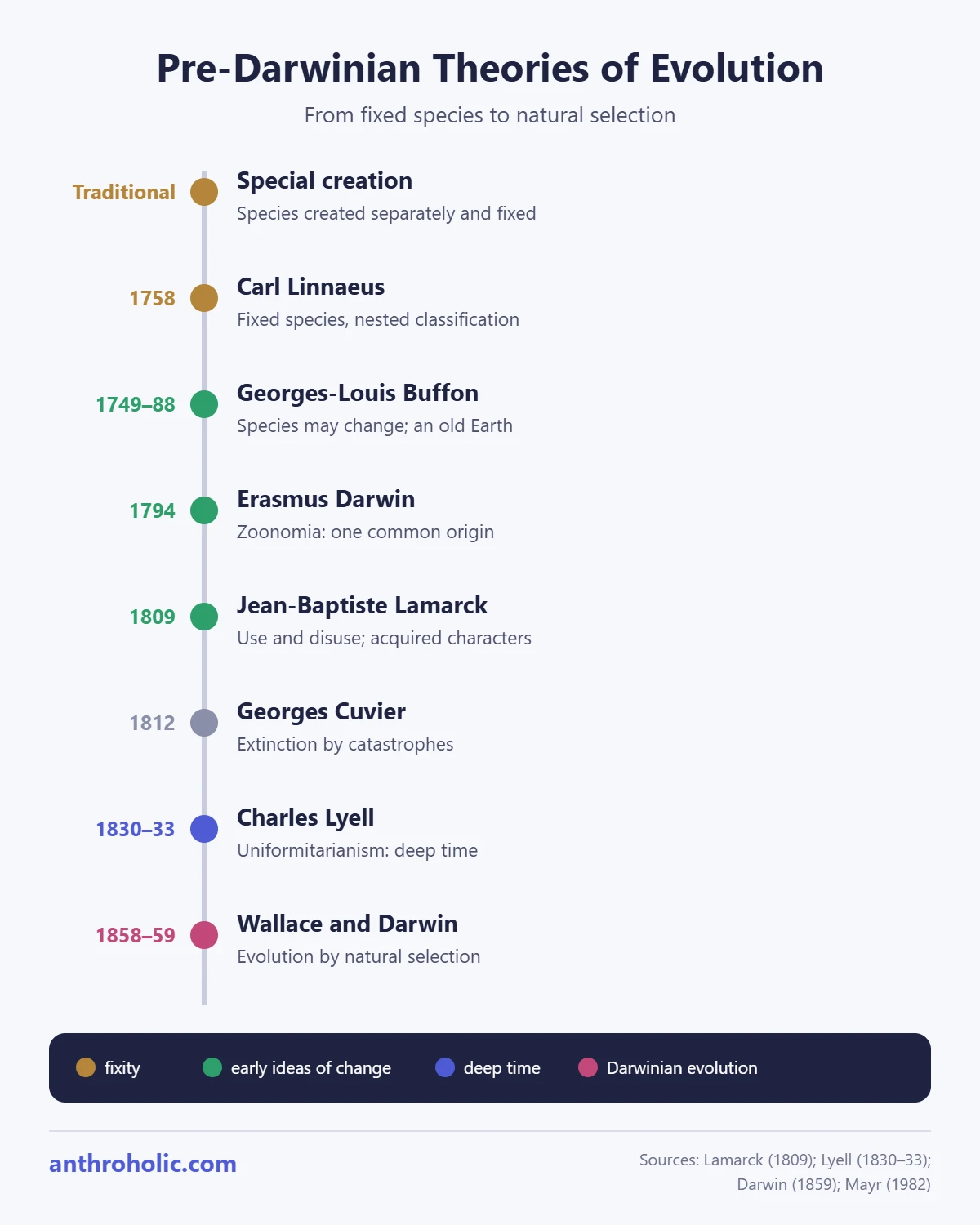
Timeline of pre-Darwinian ideas
Ideas about evolution grew step by step over two centuries [7]:
| Year | Thinker | Idea |
|---|---|---|
| Ancient | Anaximander, Empedocles, Aristotle | Early speculation; Aristotle’s “ladder of nature” (scala naturae), without change |
| Traditional | Special creation | Each species created separately and fixed; see theory of special creation |
| 1758 | Carl Linnaeus | Classification of fixed species in a nested hierarchy |
| 1749–1788 | Georges-Louis Buffon | Species may change under the influence of the environment; the Earth is far older than the Bible suggests |
| 1794–1796 | Erasmus Darwin | Zoonomia: all life may descend from one ancestral form |
| 1809 | Jean-Baptiste Lamarck | First full theory of evolution: use and disuse, inheritance of acquired characters |
| 1812 | Georges Cuvier | Extinction is real; catastrophes, not gradual change |
| 1830–1833 | Charles Lyell | Uniformitarianism: slow processes over deep time |
| 1858–1859 | Alfred Russel Wallace and Charles Darwin | Evolution by natural selection |
- Lamarckism: The Inheritance of Acquired Characteristics Jean-Baptiste Lamarck, a French naturalist, proposed Lamarckism, also known as the theory of inheritance of acquired characteristics. Lamarck suggested that organisms can pass on traits acquired during their lifetime to their offspring. According to Lamarck, if an organism develops a particular feature through its environment or behavior, it can transmit that trait to the next generation. For example, a giraffe’s elongated neck was believed to have evolved as a result of generations of giraffes stretching their necks to reach higher leaves. However, Lamarckism was later discredited due to lack of evidence for the inheritance of acquired characteristics [1].
- Catastrophism: Extinction and Replacement Catastrophism, popularized by French naturalist Georges Cuvier, proposed that Earth’s history is marked by periodic catastrophic events that caused the extinction of certain species. Cuvier suggested that after each catastrophe, the region was repopulated by species from elsewhere (some of his followers spoke of new creations). This theory highlighted the idea that Earth’s history is not static, though Cuvier himself held that species were fixed and did not change. However, catastrophism fell out of favor as scientific evidence for gradual changes and the concept of deep time accumulated.
- Transformism: Species Transformation over Time Transformism, advocated by the French naturalist Jean-Baptiste Lamarck, and earlier hinted at by Buffon and Erasmus Darwin (Charles Lyell, by contrast, argued against transmutation in his Principles of Geology [2]), posited that species gradually transform into new forms over time. Transformists believed that existing species could change and give rise to new species through a process called transmutation. They emphasized the idea of species as fluid entities, constantly adapting to their environment and evolving into new forms. Transformism laid the groundwork for the concept of species mutability and contributed to the acceptance of evolution as a dynamic process.
- Natural Theology: Design in Nature Natural theology, often associated with the theologian William Paley, attempted to reconcile the existence of a divine creator with the observable natural world. It argued that the intricate complexity and design found in nature are evidence of a divine plan. Natural theologians pointed to various adaptations in organisms as proof of intelligent design. While not explicitly proposing an evolutionary mechanism, natural theology set the stage for future debates on the relationship between science and religion in the context of evolution.
- Uniformitarianism: Gradual Geological Processes Uniformitarianism, championed by Charles Lyell, suggested that the Earth’s geological features and processes are the result of gradual, ongoing forces that have operated over long periods of time. Lyell’s ideas challenged the prevailing view of catastrophism and emphasized the role of gradual change in shaping the Earth’s surface. Uniformitarianism provided a framework for understanding the slow, continuous processes that could potentially account for the long-term changes required for evolutionary processes.
Lamarck’s four propositions
- An inner drive towards complexity: living things tend to grow larger and more complex.
- New needs produce new organs: a changed environment creates needs, and effort to meet them produces new structures.
- Use and disuse: organs used a great deal become stronger; unused organs weaken and disappear.
- Inheritance of acquired characters: changes gained in a lifetime pass to offspring (the giraffe’s neck; wading birds’ long legs; snakes losing their legs) [1].
Why it was rejected: August Weismann showed that changes to the body do not alter the germ cells (eggs and sperm), and cut off the tails of mice for generations without producing tailless offspring. Mendel’s laws of heredity, rediscovered in 1900, and the modern synthesis of the 1930s–1940s explained inheritance without acquired characters. See Lamarckism.
Does epigenetics bring back Lamarck?
Epigenetics studies chemical marks, such as DNA methylation, that switch genes on or off without changing the DNA sequence. Some environmental effects leave such marks: people exposed to the Dutch “Hunger Winter” famine before birth still showed methylation differences six decades later [5]. In plants and some animals, marks can pass across several generations.
But this is not a return to Lamarck. Most marks are reset in each generation, inheritance across many generations is rare in mammals, and the effects are not the purposeful, adaptive changes Lamarck imagined [6]. Evolution by natural selection remains the main explanation.
In summary, the pre-Darwinian theories of evolution played a crucial role in paving the way for Charles Darwin’s groundbreaking ideas. While these early theories had their limitations, they introduced key concepts such as species transformation, inheritance of acquired characteristics, and the recognition of geological processes. Darwin built upon these foundations, eventually presenting the theory of evolution by natural selection, which revolutionized our understanding of life on Earth. Darwin’s theory incorporated the principles of variation, heredity, and natural selection, providing a comprehensive explanation for the diversity and adaptation of species.
Although the pre-Darwinian theories discussed in this article were ultimately incomplete or flawed, they played an important role in shaping the intellectual landscape of their time. They challenged prevailing notions of fixity and provided alternative perspectives on the origin and transformation of species. The gradual accumulation of knowledge and scientific evidence eventually led to the formulation of Darwin’s theory, which provided a powerful framework for understanding the complexity and diversity of life.
Darwin’s theory of evolution by natural selection represented a paradigm shift in our understanding of the natural world. It explained how species change over time in response to environmental pressures, highlighting the crucial role of variation and differential reproductive success. Darwin’s work laid the foundation for modern evolutionary biology and continues to be supported by an extensive body of evidence from various scientific disciplines.
It is important to recognize the contributions of pre-Darwinian thinkers, as their ideas and debates set the stage for the revolutionary breakthrough that Darwin achieved. Their theories, though imperfect, provided stepping stones toward the development of a comprehensive and evidence-based theory of evolution. By building upon these earlier concepts, Darwin was able to present a cohesive framework that forever changed our understanding of life’s history and diversity on Earth.
Conclusion
In conclusion, the pre-Darwinian theories of evolution, including Lamarckism, catastrophism, transformism, natural theology, and uniformitarianism, laid the groundwork for Darwin’s groundbreaking ideas. While each theory had its limitations, they contributed to the gradual development of evolutionary thought and played a vital role in shaping the scientific revolution that followed. Darwin’s theory of evolution by natural selection built upon these early ideas, providing a comprehensive explanation for the origin, adaptation, and diversity of species that continues to be the cornerstone of modern biology.
For UPSC aspirants
Where it fits: Anthropology Optional Paper I, 1.4 (theories of organic evolution: pre-Darwinian, Darwinian and post-Darwinian) [8].
Questions asked: “What is Organic Evolution? Describe the theories of organic evolution” (1991); “Lamarckism & Darwinism” (1986); “Elucidate the theory of Evolution as put forward by Lamarck” (1988); “Critically examine the Darwin’s theory of evolution” (2015, 15 marks).
- Give a timeline from special creation to Darwin in five or six lines.
- Explain Lamarck’s four propositions with examples and Weismann’s criticism.
- Finish with Lyell’s deep time and Darwin and Wallace, and one line on epigenetics.
Frequently asked questions
What are pre-Darwinian theories of evolution?
Ideas about the origin and change of species before Darwin’s 1859 book: special creation, Buffon’s and Erasmus Darwin’s early ideas, Lamarckism, Cuvier’s catastrophism, transformism and Lyell’s uniformitarianism.
What does Darwinian mean?
Darwinian means relating to Charles Darwin or to his theory of evolution by natural selection, in which individuals with useful variations survive and reproduce more.
Who gave the first theory of evolution?
Jean-Baptiste Lamarck, in Philosophie Zoologique (1809), gave the first complete theory of evolution.
What is the difference between Lamarckism and Darwinism?
Lamarck said organisms change by use and disuse and pass on acquired traits. Darwin said variations arise and nature selects those that help survival and reproduction; acquired traits are not inherited.
What is catastrophism?
Georges Cuvier’s view that the Earth’s history was marked by sudden catastrophes that wiped out species, explaining the fossil record without gradual change.
Did Lyell support evolution?
Not at first. Lyell’s Principles of Geology argued against Lamarck’s transmutation, though his idea of slow change over deep time influenced Darwin. Lyell accepted evolution only in the 1860s.
References
[1] Lamarck, J.-B. (1809). Philosophie Zoologique. Paris: Dentu.
[2] Lyell, C. (1830–1833). Principles of Geology (3 vols.). London: John Murray.
[3] Darwin, C., & Wallace, A. R. (1858). On the tendency of species to form varieties. Journal of the Proceedings of the Linnean Society of London, Zoology, 3, 45–62. doi.org/10.1111/j.1096-3642.1858.tb02500.x
[4] Darwin, C. (1859). On the Origin of Species by Means of Natural Selection. London: John Murray.
[5] Heijmans, B. T., et al. (2008). Persistent epigenetic differences associated with prenatal exposure to famine in humans. PNAS, 105, 17046–17049. doi.org/10.1073/pnas.0806560105
[6] Heard, E., & Martienssen, R. A. (2014). Transgenerational epigenetic inheritance: myths and mechanisms. Cell, 157, 95–109. doi.org/10.1016/j.cell.2014.02.045
[7] Mayr, E. (1982). The Growth of Biological Thought. Cambridge, MA: Harvard University Press.
[8] Union Public Service Commission. Civil Services (Main) Examination syllabus: Anthropology, Paper I.
Related Posts