AI Answer Evaluation Platform Live Now. Try Free Answer Evaluation Now
From Sacred Symbols to Screen Icons: Why Ancient Mythology Remains Popular in Online Slots
Ancient gods, protective amulets and legendary creatures appear throughout modern entertainment. They can be found in films, novels, video games, advertising and online slots, often centuries after the societies that first gave them meaning disappeared. Their continued popularity reflects more than an interest in the distant past.
Mythology provides recognisable characters, dramatic conflicts and a rich visual vocabulary. A thunderbolt can suggest divine power, a scarab can evoke ancient Egypt, and a golden wreath can establish a Greek setting before a story has even begun. These symbols allow digital games to create an identifiable world within a small screen.
Their meanings are not fixed, however. When a sacred image enters popular entertainment, it is selected, simplified and placed within a new context. Looking at that process through anthropology reveals how cultures continually reinterpret inherited stories rather than simply preserving them unchanged.
Mythology Communicates a Theme Almost Instantly
An original fantasy world usually needs time to introduce its history and characters. Mythological settings arrive with much of that work already completed. Zeus is associated with thunder and authority, Athena with wisdom and warfare, while Thor and Odin immediately suggest the Norse world.
These associations make mythology useful in visually driven games. Developers can place columns, temples, shields or hieroglyph-inspired designs around the central interface and create a clear setting without presenting several paragraphs of background information. Music and animation then reinforce the same idea.
Myths also contain conflicts that adapt naturally to interactive entertainment. Heroes face monsters, gods compete for influence, and travellers search for guarded treasure. A game does not need to retell an entire epic to benefit from this structure. One figure, object or location can supply enough material for a distinct visual identity.
The strongest designs choose a focused group of references. Combining unrelated symbols merely because they appear “ancient” may produce an attractive screen, but it can also remove the cultural distinctions that originally gave those symbols meaning.
Ancient Figures Now Share the Same Digital Catalogue
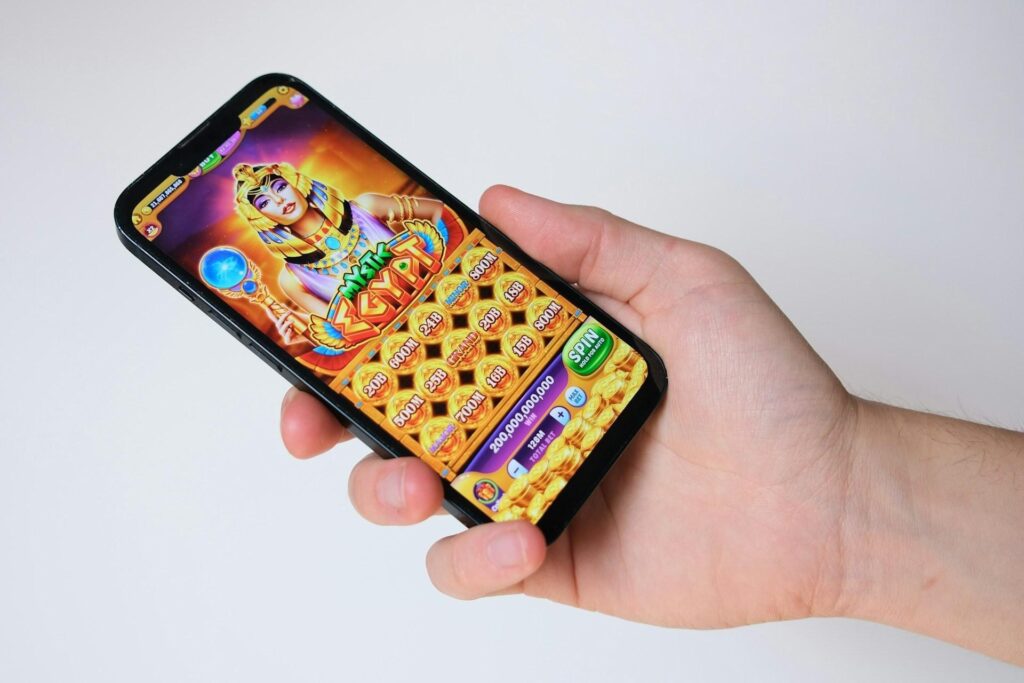
The continuing appeal of mythology is easy to observe across slots online with Mr Q, where titles draw on Egyptian, Greek and Norse traditions. Eye of Horus Megaways uses ankhs, scarabs, jackals and the protective eye associated with Horus. Wisdom of Athena places the Greek goddess at the centre of its theme, while games featuring Zeus, Apollo, Hermes, Odin and Thor interpret other well-known figures through different artwork and features.
Mr Q is a UK-facing platform whose browser-based catalogue also includes film-inspired, adventure and classic slot titles. Within that broader selection, mythology helps individual games communicate their identities quickly. Egyptian games tend to emphasise tombs, temples and symbolic objects, while Greek and Norse releases often focus more directly on gods, weapons and displays of supernatural power.
These titles do not function as historical reconstructions. They are contemporary entertainment products that select recognisable elements from older traditions. Their value as anthropological examples lies precisely in that transformation. They show which parts of mythology remain legible to modern audiences and how ancient narratives are repackaged for new technology.
The Eye of Horus Carried Protective Meaning
The Eye of Horus is now one of the most familiar visual shortcuts for ancient Egypt, but its historical significance extended beyond decoration. It was associated with restoration, protection and healing, and appeared on amulets and funerary objects.
A recent report from Smithsonian Magazine described discoveries at Marina el-Alamein that included a gold object shaped as the Eye of Horus. The source explains that the symbol was connected with healing and protection, while the gold funerary objects were intended to assist the dead in the afterlife.
In digital entertainment, the eye is more likely to represent mystery, ancient power or a special game function. The new use is not identical to the original one, yet traces of the protective and supernatural associations remain. Its history gives the image a depth that a completely invented symbol would not automatically possess.
This process is common in popular culture. A complex religious object becomes a compact visual sign, but its older meanings continue to influence how modern audiences interpret it.
Scarabs Show How Meanings Can Travel
The scarab offers another example of a symbol surviving through reinterpretation. Ancient Egyptians connected the dung beetle with creation, renewal and the movement of the sun. Scarab-shaped objects were used as seals, amulets and funerary items.
To a modern viewer, the scarab may simply signal “ancient Egypt.” Games commonly place it beside pharaohs, ankhs, pyramids and golden treasure, combining several periods and meanings into one instantly recognisable setting.
Anthropologically, this is a form of cultural compression. Symbols that once served different religious, administrative and personal purposes are grouped into a shared visual package. The package is understandable, but it is less precise than the historical reality.
That does not make every modern use inherently inappropriate. Creative adaptation is one way cultural material remains visible. The important distinction is between using a symbol as inspiration and presenting entertainment imagery as an accurate account of the past.
Greek Gods Offer Characters With Distinct Personalities
Greek mythology is particularly adaptable because its gods are not abstract forces without individual traits. They have recognisable domains, relationships, strengths and weaknesses. Zeus commands thunder, Hermes moves between worlds, Apollo is connected with music and prophecy, and Athena combines strategic intelligence with warfare.
This variety allows separate games to use the same mythological tradition without appearing identical. A Zeus theme can emphasise storms and divine authority, while an Apollo design may favour sunlight, art or archery. Athena supports another visual language built around armour, owls and wisdom.
Popular entertainment frequently reduces these figures to one dominant characteristic. Zeus becomes the thunder god, Hermes the swift messenger and Thor the wielder of a hammer. Such simplification helps audiences identify them quickly, although it leaves out much of the ambiguity found in the original myths.
The characters nevertheless remain compelling because they operate on both human and supernatural levels. They possess extraordinary powers but also display jealousy, pride, courage and deception. Those contradictions have allowed their stories to be retold in radically different media.
Thor’s Hammer Moved From Amulet to Entertainment Icon
Few mythological objects have travelled as widely through modern culture as Thor’s hammer. Today it appears in comics, films, games, jewellery and clothing, but archaeological evidence shows that hammer-shaped charms were worn in the Viking world.
Smithsonian has reported on a Viking-era charm carrying an inscription that identified it as a hammer. Similar objects found across Europe have been interpreted as representations of Thor’s hammer and as protective amulets. Some appeared alongside Christian crosses, suggesting that symbols from different belief systems could coexist during periods of cultural change.
Modern games usually present the hammer as a weapon and shorthand for thunderous power. Its protective function is less visible, but not entirely absent. The idea of a powerful object defending its holder still shapes contemporary portrayals.
The shift demonstrates that symbols do not simply lose their meaning when they enter entertainment. More often, one aspect becomes dominant while others recede into the background.
Symbols of Fortune Differ Between Cultures
Not every image of luck has the same history. Four-leaf clovers, horseshoes, golden coins, lucky numbers and Daruma figures emerge from different cultural traditions. Digital catalogues frequently place them within the same general category of “fortune,” even though their original meanings and uses are not interchangeable.
The Daruma figure, for example, is connected with perseverance and the Japanese Buddhist tradition. It is commonly used when setting and completing a goal, with its eyes marked at different stages of the process. Presenting it only as a generic lucky object overlooks that emphasis on determination.
A four-leaf clover belongs to a different body of European folklore, while the Egyptian scarab carries associations with creation and rebirth. All may be used to suggest favourable outcomes, but they reach that idea through separate cultural histories.
Thoughtful design can retain some of these distinctions through artwork, descriptions and narrative context. It can also encourage curiosity, prompting audiences to learn where a familiar image came from.
Digital Technology Continues an Old Pattern of Retelling
Stories have always changed as they moved between communities. Oral traditions produced multiple versions of the same myth, while merchants, migrants and conquerors carried religious figures across cultural boundaries. Greek, Roman, Egyptian and Persian imagery influenced one another long before digital media existed.
Online games continue this process at a different speed and scale. A symbol created thousands of years ago can now appear on phones across many countries, surrounded by music, animation and interface elements that its original users could never have imagined.
Technology changes the form, but the underlying cultural practice remains familiar. People inherit stories, select the elements that speak to their own time and use them to create something new.
For an anthropologist, mythology-based slots are therefore more than collections of colourful symbols. They are small examples of cultural transmission. They reveal how sacred objects become entertainment icons, how complicated figures are converted into recognisable characters and how ancient ideas about fortune, protection and power continue to circulate through modern life. Their enduring presence suggests that new technology does not necessarily replace old stories. It often gives those stories another screen on which to appear.

Related Posts