
AI Answer Evaluation Platform Live Now. Try Free Answer Evaluation Now

Why Games Become Social Rituals: The Anthropology of Play and Shared Attention
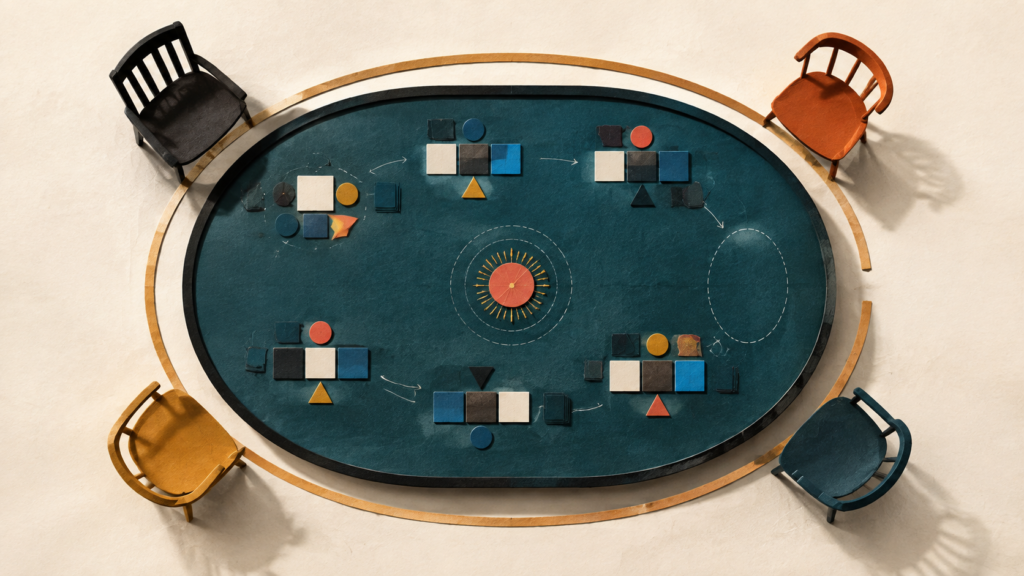
Image source: Illustration by the author
A game played once is an event. A game played regularly can become a routine. It becomes a social ritual when participants mark off a distinct period of play, focus on the same symbols, follow recognized roles, and close the session in a mutually understood way. The rules organize moves, but the surrounding habits organize people. Taking familiar seats, waiting for a customary signal, or ending after an agreed final round can carry meanings that are absent from the written rules.
Digital participation can produce similar patterns without everyone occupying one room. A 2025 study of digital game culture examined 462 videos and 77,781 real-time comments posted while game videos were watched. The researchers analyzed visual material alongside audience responses, finding recurring forms of cultural communication, emotional expression, and group identification. A screen changes how people encounter one another, yet simultaneous attention to the same scene can still create shared references that continue beyond a single viewing or session.
The Ritual Order of Table Play
Shared references become more durable when play itself has a recognizable order. Participants do not need identical motives, but they must be able to tell when the activity has begun, whose action is pending, and what settles the round. Repeated timing turns individual choices into an exchange that others can anticipate and answer. Table play concentrates these signals in one bounded setting, where objects, turn order, and visible outcomes keep attention aligned.
At a gaming table, the playing surface, cards, chips, wheel, or dice acquire a temporary shared importance. Participants recognize who acts first, when a decision is complete, and which result closes the sequence. The formal order found in classic online casino table games also gives unfamiliar participants a readable route into play: observe the current stage, wait for the appropriate turn, and respond within the same rule set as everyone else. Online tables replace some physical gestures with buttons, timers, and onscreen markers, while the sequence continues to coordinate attention.
Anticipation rises around a deal, spin, or throw, and releases when the outcome becomes visible. Each new round resets the temporary order and returns participants to recognized roles. When the same people return, they may add their own conventions around pace, conversation, and departure. These repeated openings, pauses, and resolutions can turn separate decisions into a shared occasion without altering the formal rules of the game.
Physical presence adds further signals. The handling of cards, the movement of chips, and a pause before revealing an outcome make timing publicly observable. Ritual timing also includes the point at which participation stops. A recent Instagram video shows a woman resting and deliberately going offline. That withdrawal marks a boundary comparable to a customary final round: participation ends, attention shifts, and the screen stops being the focus.
https://www.instagram.com/p/DW_0bMGCU9L
Online play translates many in-session cues into visual or audible signals, but neither setting automatically produces solidarity. A silent session among strangers may remain a collection of individual actions, while a regular online group can develop greetings, jokes, expected roles, and an accepted time to leave. A glance, hesitation, or planned break can alter the tempo without changing any formal rule.
Five Signs That Play Has Become Ritualized
| Sign | Observable feature | Social effect |
| Boundary | A particular table, screen, time, or group separates play from daily activity. | Participants recognize entry into a distinct setting. |
| Opening | Objects are arranged, people take positions, or a familiar first action begins the session. | Individual attention converges on one activity. |
| Mutual focus | Everyone follows the same move, symbol, or outcome. | Reactions become intelligible across the group. |
| Repeated roles | Dealer, player, observer, or scorekeeper carries expected actions. | The session develops a temporary social order. |
| Closure | A final result, sign-off, or clearing of the table ends play. | Participants return to ordinary activity. |
All five signs vary in strength. A casual session may have clear rules and an ending but little shared mood. A long-standing weekly gathering may have remembered incidents, preferred seats, and private expressions that newcomers cannot immediately interpret. The game supplies the formal sequence; the group accumulates an additional layer of memory and convention. Changes to that layer, such as a missing regular participant or an unfamiliar opening, can alter the atmosphere before any move is made.
What Changes on a Screen
Online play weakens some boundaries while strengthening others. Logging in creates a clear point of entry, but notifications and other open windows can interrupt the separation from ordinary life. Timers synchronize decisions, result screens provide closure, and persistent usernames allow recognition across sessions. When participants can enter or leave instantly, however, the group may never become stable enough to form its own conventions.
Mutual focus also differs from simple simultaneity. Several people can view the same screen while attending to different information or switching between tasks. Ritual intensity rises when reactions respond to one another in sequence: one action draws attention, others anticipate the result, and the outcome produces a recognizable collective response. Delays, interruptions, or automated pacing can break that rhythm, even when the formal game continues correctly.
Where the Ritual Description Stops
A 2025 account of interaction ritual theory identifies group assembly, a boundary separating participants from outsiders, mutual focus, and shared mood as central ingredients. It also describes a range from weak encounters to highly engaging solidarity. Repetition without coordinated attention may therefore remain routine, while one unusually intense session can acquire symbolic importance despite never being repeated in precisely the same form.
Ritual does not imply harmony. Familiar roles can organize status, private conventions can exclude newcomers, and a shared mood can be tense rather than cheerful. The same sequence may also mean different things to different participants. One person may value the company, another the disciplined turn-taking, and another the temporary break from ordinary responsibilities. Common action does not require identical motives.
The clearest evidence appears at the edges of play. Note what must happen before the first move, which objects or signals hold everyone’s attention, and how participants recognize that the session has ended. When those boundaries, roles, and responses acquire a history shared by the group, the game has become part of its social life.

Related Posts