AI Answer Evaluation Platform Live Now. Try Free Answer Evaluation Now
Historical Aspect of Forensic Science
The dead do not speak, but their remains are far from silent. For centuries, the human skeleton has served as a biological archive, recording the circumstances of a person’s life, their ancestry, and, most crucially, the nature of their death. The historical journey of Forensic Science, particularly through the lens of Anthropology, is a transition from rudimentary observation and “blood-feuds” to a high-precision, AI-integrated discipline that can solve cold cases dating back decades or even centuries.
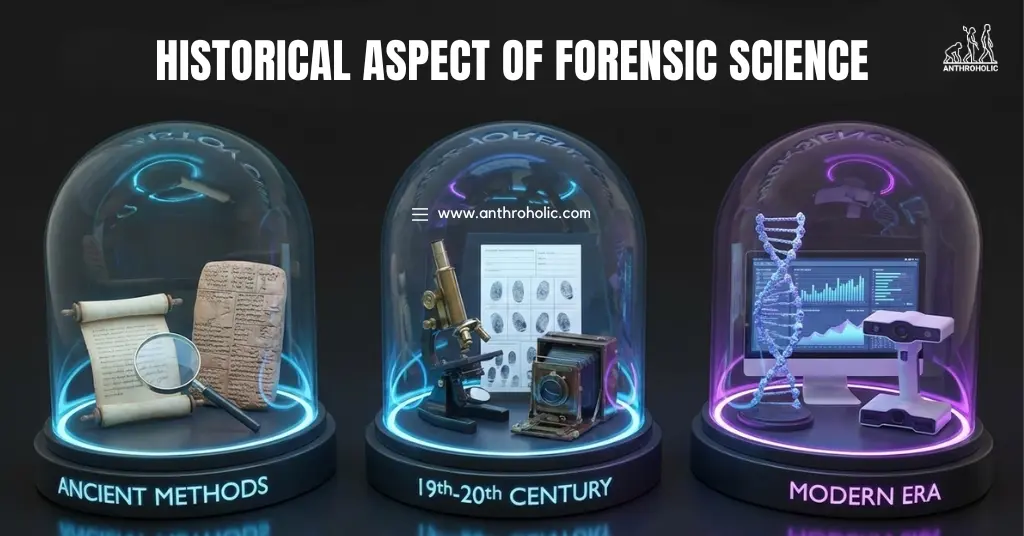
In anthropology, forensic science is the bridge between the biological past and the legal present. It is the application of physical anthropology and human osteology to legal investigations.
The Four Pillars of Forensic History
The history of forensic anthropology is traditionally divided into distinct periods, each marked by a shift in methodology and social demand for justice.
1. The Pre-Scientific Era: Antiquity to the Middle Ages
Long before the term “forensic” was coined, ancient societies utilized early logic to solve crimes.
- Archimedes (3rd Century BCE): Used the principle of displacement to determine if a crown was pure gold, an early application of physical science to fraud.
- The Washing of Wrongs (1248 AD): Written by Chinese judge Sung Tz’u, this text is the world’s first forensic manual. It documented how to distinguish between drowning and strangulation, and famously described how flies were used to identify a murder weapon (a sickle).
2. The Formative Period (1849–1938): The Birth of Skeletal Biology
The 19th century saw the formal marriage of anatomy and the law.
- The Parkman-Webster Case (1849): This is often cited as the birth of forensic anthropology in the US. Anthropologists identified the remains of George Parkman from a furnace by analyzing his dentures and skeletal stature, leading to the conviction of a Harvard professor.
- Thomas Dwight (1843–1911): Known as the “Father of Forensic Anthropology,” Dwight published The Identification of the Human Skeleton: A Medicolegal Study in 1878, establishing the first scientific protocols for sex, age, and stature estimation.
3. The Consolidation Period (1939–1971): Standardizing the Science
The necessity of identifying war casualties during World War II and the Korean War accelerated the field.
- Wilton Marion Krogman: His 1962 book, The Human Skeleton in Forensic Medicine, became the definitive guide for investigators, standardizing how we “read” bones.
- The Central Identification Laboratory (CILHI): Established to identify missing soldiers, it provided a massive database of healthy young adult skeletons, which significantly refined stature and age estimation formulas.
4. The Modern Era and Beyond (1972–Present): Technology and Human Rights
The founding of the American Board of Forensic Anthropology (ABFA) in 1972 marked the professionalization of the field.
- DNA and Databases: The 1980s introduction of DNA profiling by Sir Alec Jeffreys and the creation of the FORDISC software in the 1990s shifted forensics from subjective “expert opinion” to objective statistical probability.
- Human Rights Investigations: Forensic anthropologists became global actors, investigating mass graves in the Rwandan Genocide and the Srebrenica Massacre
AI and Machine Learning in Image Interpretation
Recent reports from the 2025 NIJ Forensic Science Symposium highlight the integration of Artificial Intelligence in analyzing skeletal trauma. AI can now differentiate between perimortem (at time of death) and postmortem (after death) fractures with 94% accuracy, outperforming many human experts in detecting subtle “micro-cracks.”
Forensic Expansion in India
According to a December 2025 report from the Ministry of Home Affairs (PIB Delhi), India has significantly expanded its forensic capabilities.
- The establishment of the National Cyber Forensic Laboratory in Assam (August 2025) and New Delhi ensures that digital evidence is processed alongside biological remains.
- The Indian forensic market is projected to grow from 3% to 10% of the global share by 2030, driven by new central labs in Pune, Bhopal, and Kamrup.
“Bones are like a time capsule. They don’t just tell us how someone died; they tell us how they lived, what they ate, and where they travelled.” — Dr. Douglas Owsley, Smithsonian Institution.
Case Study: The “Starving Time” at Jamestown (1609-1610)
A landmark example of historical forensic anthropology is the analysis of a 14-year-old girl’s remains found in Virginia. In 2013, Dr. Douglas Owsley used forensic techniques to prove she had been cannibalized during a severe famine. By analyzing the “chopping” marks on the skull consistent with hesitant, unskilled cuts forensic science confirmed 400-year-old historical accounts that were previously dismissed as myth. This case demonstrates how forensic science can “fact-check” history itself.
Conclusion
The history of forensic science in anthropology is a story of narrowing the margin of error. From the 13th-century flies in a Chinese field to the 2025 AI models in a New Delhi laboratory, the objective has remained constant: to restore identity to the nameless and provide closure to the living.
For the modern student, forensic science is no longer just about the past it is a dynamic, interdisciplinary field that demands proficiency in biology, law, and data science. As we move further into the 21st century, the “silent witnesses” will only become more vocal, ensuring that truth remains the ultimate outcome of every investigation.
Frequently Asked Questions (FAQs)
1. Who is considered the father of forensic anthropology? Thomas Dwight is widely recognized as the “Father of Forensic Anthropology” due to his pioneering research on human skeletal identification in the late 19th century.
2. How did World War II influence forensic science? The massive number of unidentified casualties led to the creation of standardized databases for age and stature. This transition from identifying individuals to creating population-wide skeletal standards was crucial for the field’s growth.
3. What is the significance of “Locard’s Exchange Principle”? While more related to general forensics, Edmond Locard’s principle “every contact leaves a trace” is the foundation of all forensic recovery, including the recovery of micro-traces on bones at a crime scene.
4. What is the latest trend in forensic anthropology in 2025? The most significant trend is the use of Machine Learning for automated skeletal analysis and Stable Isotope Analysis to determine a victim’s geographic movements during the final years of their life.
References
- American Academy of Forensic Sciences. (2025). Proceedings of the 77th Annual Scientific Conference. https://www.aafs.org/
- Deloitte India. (2025). Indian Digital Forensic Market Report: Strategic Trends and Forecasts. https://www.deloitte.com/in/en/
- Ministry of Home Affairs, Government of India. (2025). Press Release: Strengthening of DNA Analysis and Cyber Forensic Capacities. https://www.pib.gov.in/
- Owsley, D. W., & Jantz, R. L. (2024). The Bioarchaeology of the Chesapeake: Forensic Perspectives on Colonial Remains. Smithsonian Institution Press.
- United Nations Office on Drugs and Crime (UNODC). (2024). Global Forensic Science Services: 2024 Status Report. https://www.unodc.org/

Related Posts