AI Answer Evaluation Platform Live Now. Try Free Answer Evaluation Now
Primitivism
In a world increasingly dominated by digital saturation, urban congestion, and ecological crisis, the concept of Primitivism has experienced a powerful resurgence. From “paleo” diets to anarcho-primitivist political movements, the idea that human beings were happier, healthier, and more “authentic” before the advent of civilization remains a potent cultural force. Yet, for anthropologists, Primitivism is far more than a lifestyle trend; it is a complex, often problematic, intellectual construct that has shaped the history of the discipline and our understanding of the “other.”
Primitivism is defined as the belief that earlier, “simpler” stages of human social development are superior to modern civilization. While it often manifests as a romanticized yearning for the past, in anthropology, it serves as a critical lens through which we examine the concepts of progress, technology, and social evolution.
The “Noble Savage” and the Critique of Progress
The intellectual bedrock of Primitivism lies in the Enlightenment-era reaction against industrialization. The most famous proponent of this view was Jean-Jacques Rousseau, who, in his Discourse on the Origin and Basis of Inequality Among Men (1754), introduced the trope of the Noble Savage.
Rousseau argued that in the “state of nature,” humans were physically robust, morally innocent, and free from the corrupting influences of private property and social hierarchy. He famously stated that “man is born free, and everywhere he is in chains,” suggesting that civilization is a process of degeneration rather than improvement.
The Evolutionary Ladder
Early anthropology in the 19th century was heavily influenced by Unilineal Evolutionism. Thinkers like Edward Burnett Tylor and Lewis Henry Morgan classified societies into stages: Savagery, Barbarism, and Civilization.
- The “Primitive” as a Living Ancestor: In this framework, contemporary indigenous groups were viewed as “living fossils” remnants of humanity’s past.
- The Shift: While the evolutionists used the term “primitive” to justify colonialism, the Primitivists used the same data to argue that these “primitive” stages were morally superior to the “decadent” West.
From Canvas to Commune
Primitivism has not remained confined to academic texts; it has permeated art, psychology, and radical politics.
A. Artistic Primitivism
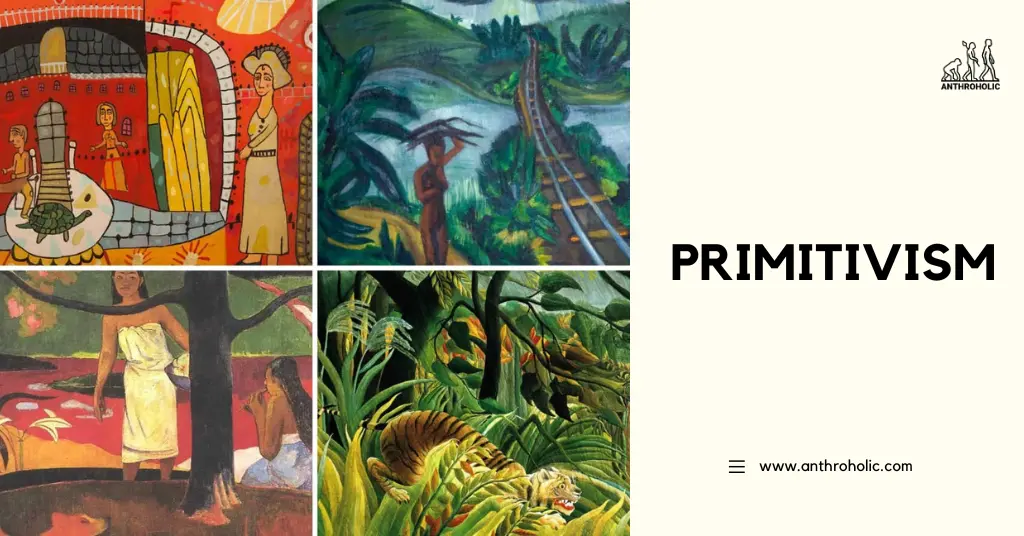
In the early 20th century, Western artists like Paul Gauguin and Pablo Picasso turned toward non-Western art forms specifically African masks and Oceanic sculptures to revitalize European art.
- Gauguin in Tahiti: Gauguin famously fled France for Tahiti, seeking an “unspoiled” paradise. His work focused on the vibrant colors and perceived “erotic innocence” of the islanders.
- The Critique: Modern art historians now view Artistic Primitivism as an extension of Orientalism. These artists often stripped indigenous artifacts of their original sacred meanings, using them as mere “primitive” aesthetic tools to shock the Western bourgeoisie.
B. Anarcho-Primitivism
In the late 20th and early 21st centuries, Primitivism evolved into a radical political philosophy. Anarcho-primitivism, championed by thinkers like John Zerzan, argues that the shift from hunter-gatherer societies to agriculture was the “original sin” of humanity.
- The Argument: Agriculture led to the concept of time, language (as a form of mediation), and the division of labor, which ultimately gave rise to the state and systemic violence.
- Modern Relevance: According to a 2024 study on “Rewilding” movements, there is a significant uptick in individuals attempting to live “off-grid,” citing the anarcho-primitivist critique of domesticity and technology.
The Original Affluent Society
The most significant anthropological contribution to the Primitivism debate came from Marshall Sahlins in his landmark 1972 essay, The Original Affluent Society. Sahlins used ethnographic data from the Ju/’hoansi (Bushmen) and Australian Aboriginal groups to dismantle the “wretched” image of the primitive hunter-gatherer.
Primitive vs. Industrial
| Feature | Primitive Hunter-Gatherer Society | Modern Industrial Society |
| Working Hours | Average 15–20 hours per week. | Average 40+ hours per week. |
| Material Needs | Low; easily satisfied by the environment. | High; infinite desires created by markets. |
| Social Inequality | Highly egalitarian; food-sharing norms. | Highly stratified; extreme wealth gaps. |
| Leisure Time | Abundant; focused on ritual and rest. | Scarce; often used for “recovering” from work. |
Sahlins argued that “affluence” isn’t about having a lot of things; it’s about having everything you want. Because hunter-gatherers had few desires, they were, in effect, the only truly affluent people on earth.
“The world’s most primitive people have few possessions, but they are not poor. Poverty is a social status. As such it is the invention of civilization.” Marshall Sahlins.
Deconstructing the “Primitive”
While Sahlins and others provided a necessary counter-narrative, modern anthropology has become deeply critical of the very word “primitive.”
- The “Primitive” Does Not Exist: Anthropologists like Adam Kuper have argued that the “primitive” is a Western invention. No society is “frozen in time.” Indigenous groups have histories that are as long and as complex as those of Europe; they have simply chosen or been forced into different social paths.
- The Danger of Romanticization: Romantic Primitivism can be just as damaging as blatant racism. By viewing indigenous people as “children of nature” or “guardians of the forest,” we deny them their political agency. If a “primitive” person uses a smartphone or engages in the global market, they are often seen as “less authentic,” which ignores their right to evolve and change.
- Orientalism and the “Other”: Edward Said’s critique of Orientalism applies here: the West uses the “primitive other” as a mirror to discuss its own problems, rather than engaging with indigenous people on their own terms.
Primitivism in 2025
As we navigate the Anthropocene, the Primitivist urge has taken on an ecological dimension. Indigenous knowledge systems are no longer seen as “backward” but as vital blueprints for sustainable living.
Recent research (Lenton et al., 2025) suggests that areas managed by indigenous communities the very groups once labeled as “primitive” possess significantly higher biodiversity than protected government lands. This “New Primitivism” seeks a synthesis: it doesn’t necessarily call for a return to the Stone Age but advocates for the integration of ancient ecological wisdom into modern survival strategies.
Conclusion
Primitivism remains one of the most resilient and controversial concepts in the human sciences. It began as a tool of colonial classification, transformed into a romantic critique of industrialization, and today serves as a rallying cry for environmental sustainability. While anthropologists have rightly debunked the idea of the “static primitive,” the core question of Primitivism remains: What have we lost in our rush toward “progress”? By deconstructing the myth of the primitive while respecting the reality of indigenous ingenuity, anthropology helps us imagine a future that values both technological innovation and our deep, ancestral connection to the earth.
Frequently Asked Questions (FAQs)
1. Is “Primitivism” a racist term? In its historical application within Evolutionism, yes, it was used to suggest that non-Western people were less evolved. However, as an intellectual movement (like Artistic or Anarcho-primitivism), it is often an attempt albeit sometimes a flawed one to praise and learn from non-Western cultures.
2. What is the difference between Primitivism and Indigenous studies? Primitivism is a Western intellectual movement about the idea of the primitive. Indigenous studies is a discipline focused on the actual lives, histories, and rights of indigenous peoples.
3. Did “primitive” people really work less? Yes, ethnographic data from the 1960s through to the 2020s consistently shows that hunter-gatherer and small-scale horticultural societies spend significantly less time on “subsistence labor” than industrial workers spend on “employment.”
4. Why did Gauguin go to Tahiti if he was a Primitivist? Gauguin believed that European society had become “sick” and artificial. He went to Tahiti seeking what he called “the savage state,” hoping to find a more raw and authentic human experience to translate into his paintings.
References
- Childe, V. G. (1936). Man Makes Himself. Watts & Co. https://archive.org/details/manmakeshimself0000chil
- Kuper, A. (2005). The Reinvention of Primitive Society: Transformations of a Myth. Routledge. https://www.routledge.com/The-Reinvention-of-Primitive-Society-Transformations-of-a-Myth/Kuper/p/book/9780415358034
- Rousseau, J.-J. (1754). Discourse on the Origin and Basis of Inequality Among Men. https://www.gutenberg.org/files/1188/1188-h/1188-h.htm
- Sahlins, M. (1972). Stone Age Economics. Aldine-Atherton. https://www.taylorfrancis.com/books/mono/10.4324/9781315184951/stone-age-economics-marshall-sahlins
- Zerzan, J. (2024). Elements of Refusal. Feral House. https://feralhouse.com/elements-of-refusal/

Related Posts