AI Answer Evaluation Platform Live Now. Try Free Answer Evaluation Now

Ape Sign Language
For decades, the field of Linguistic Anthropology has been captivated by a singular, provocative question: Is the capacity for language a uniquely human trait, or is it a biological continuum shared with our closest primate relatives? The study of Ape Sign Language (specifically involving Chimpanzees, Gorillas, and Orangutans) provides a profound window into the cognitive architecture of the primate mind and the evolutionary origins of human speech.
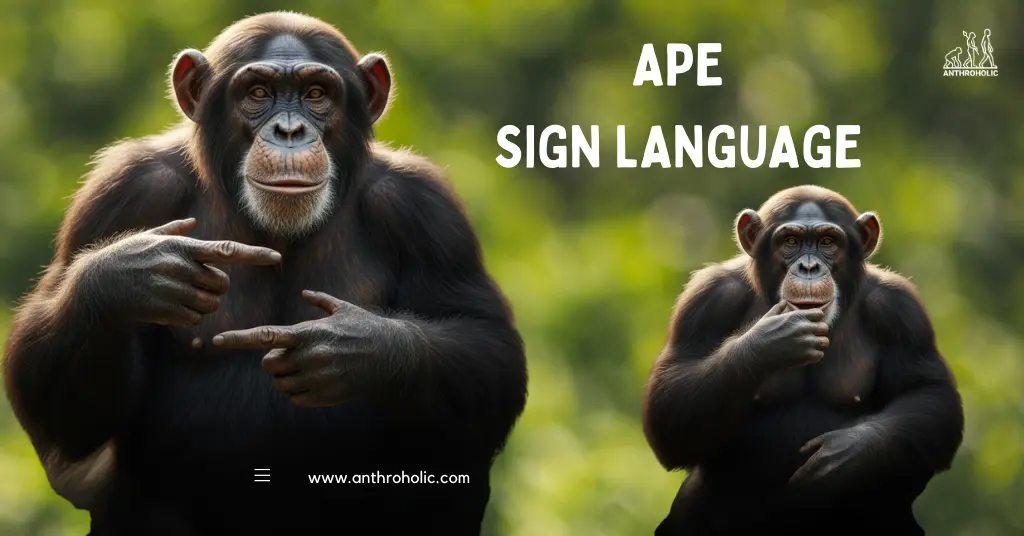
Since non-human primates lack the vocal apparatus (a descended larynx) required for complex human speech, researchers pivoted to American Sign Language (ASL) as a medium for cross-species dialogue.
Historical Milestones in Primate Linguistics
The journey to teach apes sign language began as an attempt to prove that “culture” and “language” were not exclusive to Homo sapiens.
Project Washoe (1966)
Washoe, a chimpanzee, was the first non-human to acquire a human language. Raised by Allen and Beatrix Gardner, she learned approximately 350 signs of ASL. Crucially, Washoe demonstrated displacement (talking about things not present) and even taught signs to her adopted son, Loulis, without human intervention.
Koko the Gorilla (1971)
Perhaps the most famous subject, Koko, studied by Dr. Francine “Penny” Patterson, reportedly mastered over 1,000 signs (dubbed “GSL” or Gorilla Sign Language). Koko’s case was significant for her apparent display of emotional depth and the use of metaphor, famously referring to a ring as a “finger necklace.”
Chantek the Orangutan (1978)
Anthropologist Lyn Miles taught Chantek not only signs but also the concept of economic exchange. Chantek learned to “buy” treats with poker chips, demonstrating an understanding of symbolic value and future planning.
Do Apes Truly “Speak”?
To determine if apes are truly using language, anthropologists measure their communication against Charles Hockett’s Design Features of Language.
| Feature | Definition | Observed in Apes? |
| Semanticity | Specific signals can be matched with specific meanings. | Yes , Apes consistently associate signs with objects/actions. |
| Productivity | The ability to create new expressions by combining signs. | Partial., “Water-bird” for a swan (Washoe) or “Cry-fruit” for an onion (Koko). |
| Displacement | Talking about things that are not present in time or space. | Yes , Apes have signed about past events or absent owners. |
| Syntax | The use of grammatical rules to structure sentences. | Highly Debated , Most critics argue ape “sentences” are random strings. |
The “Nim Chimpsky” Controversy and the Great Critique
In the late 1970s, psychologist Herbert Terrace launched Project Nim, aiming to debunk the idea that apes could master grammar. After analyzing Nim’s signing, Terrace concluded that the chimpanzee was merely mimicking his trainers to receive rewards a phenomenon known as the Clever Hans Effect.
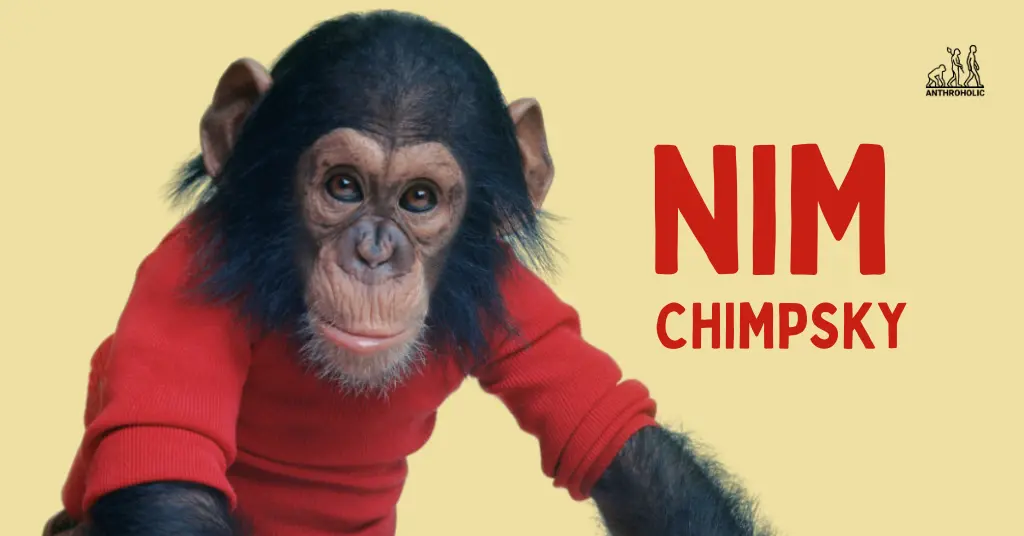
Terrace argued that while apes could learn vocabulary, they lacked the cognitive “recursive” ability to form complex sentences. This critique shifted the anthropological focus from “Can they speak?” to “How do they think?”
Pull Quote: “The question is not whether apes can communicate, but whether they can grasp the infinite productivity of human syntax.” Herbert Terrace
Cognition and Symbolism
From an anthropological perspective, Ape Sign Language challenges the “Human Exception” theory. If a Bonobo like Kanzi (who uses lexigrams) can understand spoken English and respond with symbolic gestures, it suggests that the cognitive foundations for language symbolic thought, empathy, and intentionality predate the evolution of the human vocal tract.
Key Takeaways for UPSC Aspirants:
- Continuity Theory: Suggests language evolved gradually from primate gestures.
- Discontinuity Theory: Claims language appeared suddenly in humans due to a specific mutation (the “FOXP2” gene).
- Cultural Primatology: The fact that apes can pass signs to their offspring suggests a form of “non-human culture.”
Ethical Considerations in 2025
Modern anthropology has moved away from “teaching” apes human languages, viewing it as anthropocentric. Today, researchers focus on naturalistic observation of wild primate gestures. The consensus in 2025 is that while apes have the capacity for high-level symbolic communication, forcing them into human linguistic frameworks may overlook the complexity of their own native communication systems.
Conclusion
The study of Ape Sign Language remains a cornerstone of Bio-cultural Anthropology. While the debate over “syntax” may never be fully resolved, the legacy of Washoe, Koko, and Kanzi has forever altered our understanding of the primate continuum. They have shown us that the “bridge” between human and animal is not a wall, but a span of shared cognitive history.
Frequently Asked Questions (FAQs)
Q1: Did Koko the Gorilla really understand the concept of death?
Answer: Dr. Patterson reported that Koko expressed grief and used signs to discuss the passing of her pet kitten. While some skeptics view this as human over-interpretation, it remains a central case study in primate thanatology (the study of death).
Q2: What is the FOXP2 gene?
Answer: Often called the “language gene,” FOXP2 is required for the fine motor control of the larynx and mouth. Humans have a specific mutation of this gene that apes lack, which may explain why we speak while they can only sign.
Q3: How does Kanzi’s communication differ from Washoe’s?
Answer: Washoe used gestural signs (ASL), whereas Kanzi, a Bonobo, uses a lexigram board (geometric symbols representing words). Kanzi is also famous for his ability to understand complex spoken English sentences.
Q4: Is Ape Sign Language still a major field of research?
Answer: In 2025-2026, the focus has shifted toward Acoustic Primatology and the study of wild gestural repertoires, as researchers seek to understand how apes communicate in their own environments rather than in laboratories.
Q5: Can apes create new words?
Answer: They have shown productivity. For example, when Washoe saw a swan for the first time, she combined the signs for “Water” and “Bird” because she didn’t have a specific sign for “Swan.”
Q6: Why is this important for Anthropology Paper-I?
Answer: It is a core component of the “Human Evolution” and “Communication” sections, specifically regarding the Biological Basis of Language and the comparison between human and non-human communication.
References
- Gardner, R. A., & Gardner, B. T. (1969). Teaching Sign Language to a Chimpanzee. Science. https://www.science.org/doi/10.1126/science.165.3894.664
- Miles, H. L. (1990). The cognitive foundations for reference in a signing orangutan. “Language” and Intelligence in Monkeys and Apes. https://doi.org/10.1017/CBO9780511665486.017
- Patterson, F. G., & Linden, E. (1981). The Education of Koko. Holt, Rinehart and Winston. https://www.worldcat.org/title/education-of-koko/oclc/7173141
- Savage-Rumbaugh, S., & Lewin, R. (1994). Kanzi: The Ape at the Brink of the Human Mind. Wiley. https://www.worldcat.org/title/kanzi-the-ape-at-the-brink-of-the-human-mind/oclc/29952520
- Terrace, H. S. (1979). Nim. Knopf. https://www.worldcat.org/title/nim/oclc/5239556

Related Posts