AI Answer Evaluation Platform Live Now. Try Free Answer Evaluation Now
Why Study Anthropology
What makes us human?
That deceptively simple question lies at the heart of anthropology-a field that explores everything from ancient skulls to Snapchat habits, from tribal rituals to city life. In a world grappling with identity, inequality, climate change, and technological disruption, anthropology gives us the tools to understand not just others, but ourselves.
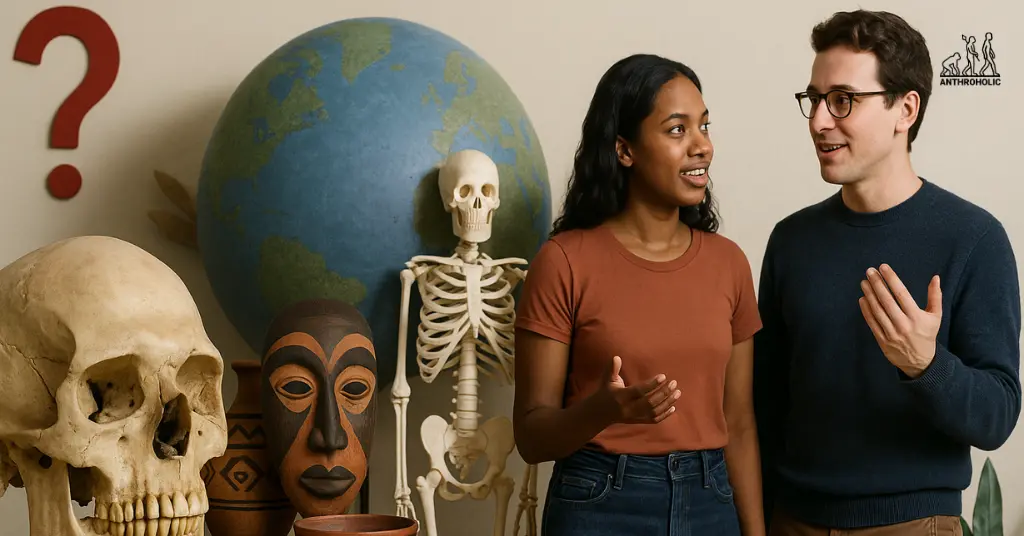
Whether you’re curious about lost civilizations, fascinated by different cultures, or driven to tackle today’s global challenges, anthropology offers more than academic insight-it offers a way of seeing. A way of connecting the past to the present and thinking critically about the future.
Ready to rethink what it means to be human? Let’s dive in.
What Is Anthropology?
Anthropology is the study of humans-past and present. It’s a broad, interdisciplinary field that brings together insights from biology, culture, language, and history to understand the full sweep and complexity of the human experience.
Anthropology is typically divided into four main subfields:
- Cultural Anthropology explores the social lives, customs, beliefs, and values of different societies. It examines how people live, interact, and make meaning in their worlds.
- Biological (or Physical) Anthropology studies the biological and evolutionary aspects of humans and their ancestors. This includes everything from fossil records to genetics and primatology.
- Linguistic Anthropology focuses on how language influences social life-how we communicate, shape identity, and construct meaning.
- Archaeology investigates past human societies through material remains such as tools, structures, and art.
What makes anthropology unique is its holistic approach. Anthropologists don’t isolate one piece of the human puzzle-they examine how biology, culture, environment, and history intersect to shape our lives.
Understanding Human Diversity
One of anthropology’s core goals is to understand human diversity-not just in terms of outward appearances, but in how people think, live, and relate to each other across different cultures and historical periods.
Anthropologists often immerse themselves in the communities they study, practicing participant observation, learning local languages, and engaging in long-term ethnographic research. This kind of work has led to powerful insights into kinship systems in Papua New Guinea, healing rituals in the Amazon, and even street life in American cities.
Studying anthropology helps combat ethnocentrism-the belief that one’s own culture is superior. Instead, it encourages cultural relativism, the idea that cultures must be understood on their own terms. This perspective is essential in today’s interconnected world, where miscommunication and cultural assumptions can lead to conflict or marginalization.
In short, anthropology teaches us to see difference not as something threatening, but as something to understand and respect.
Anthropology’s Relevance Today
Far from being an ivory tower discipline, anthropology is deeply relevant to modern global issues. From pandemics to refugee crises, anthropologists contribute essential perspectives on how human behavior shapes, and is shaped by, major events.
Take COVID-19, for example. Anthropologists helped public health agencies understand how cultural beliefs and community structures affected the way people responded to the virus, vaccine campaigns, and lockdowns.
In the realm of climate change, anthropologists study how Indigenous communities adapt to environmental shifts-and how traditional ecological knowledge can inform sustainable policies.
Anthropology also plays a key role in:
- Migration and refugee policy
- Human rights advocacy
- Urban planning and housing
- International development
- AI ethics and digital behavior
By looking beyond statistics and headlines, anthropologists help uncover the human stories behind global systems—offering more nuanced, effective solutions to today’s complex problems.
Career Opportunities in Anthropology
Contrary to popular belief, anthropology degrees are not limited to academic careers. While many anthropologists do work in universities or research institutions, a growing number apply their skills across diverse industries.
Academic and research roles remain core to the discipline. These include university teaching, museum curation, and archaeological fieldwork. However, applied anthropology is on the rise, with professionals working in areas like:
- Non-Governmental Organizations (NGOs): conducting community-based research or program evaluations
- Government and policy-making: advising on cultural sensitivity in immigration, education, and public health
- Healthcare: working as medical anthropologists to improve patient care and understand health disparities
- Museums and heritage management: curating exhibits, preserving artifacts, and developing educational programs
- Technology and user experience (UX): helping tech companies understand user behavior and design more inclusive products
- Corporate anthropology: studying workplace culture, consumer habits, or market trends to guide business decisions
Anthropologists are valued for their ability to interpret complex human behavior, communicate across cultures, and adapt to changing environments-skills that are increasingly important in a globalized economy.
Skills You Gain by Studying Anthropology
One of anthropology’s greatest strengths is its capacity to develop versatile, transferable skills. These include:
- Critical thinking: analyzing problems from multiple perspectives and questioning assumptions
- Cultural sensitivity: understanding diverse worldviews and avoiding cultural bias
- Qualitative research: conducting interviews, ethnographic fieldwork, and participatory observation
- Analytical writing: organizing complex information into clear, compelling arguments
- Collaboration and communication: working effectively with people from different backgrounds
These abilities prepare students not only for jobs in anthropology but for careers in education, international relations, journalism, business, and more. In today’s workforce, where adaptability and human-centered thinking are prized, anthropology graduates bring a unique and valuable perspective.
Why Anthropology Matters More Than Ever
As we face accelerating change in the 21st century-from artificial intelligence and environmental collapse to rising inequality and mass migration-anthropology offers a way to navigate these shifts with insight and humanity.
It teaches us to ask better questions. Instead of just asking how to make technology faster, anthropologists ask how it affects relationships, identity, and ethics. Instead of simply measuring economic growth, they explore how people experience poverty, success, or community.
Anthropology helps us understand others, reflect on ourselves, and engage the world with empathy. It is a discipline grounded in curiosity and a commitment to making the invisible visible-the forgotten stories, the marginalized voices, the cultural patterns that shape our daily lives.
In a time when societies are becoming more polarized and disconnected, anthropology can help build bridges. It equips us not just with knowledge, but with the capacity to imagine a more informed, inclusive, and humane future.
Rethinking Humanity in a Changing World
Anthropology is more than the study of bones, tools, or exotic customs. It’s a powerful lens for making sense of our shared humanity-across time, space, and culture. Whether you’re trying to understand a local community or a global crisis, anthropology helps reveal the deeper patterns behind human behavior.
In an era marked by rapid technological change, ecological uncertainty, and deep social divisions, the skills and insights anthropology provides are not just relevant-they’re essential. From developing inclusive technologies to shaping fairer policies, anthropologists are contributing meaningfully across disciplines and industries.
But perhaps the most lasting impact of studying anthropology is personal. It challenges your assumptions, broadens your worldview, and nurtures empathy. It teaches you to listen before judging, to question without dismissing, and to see value in difference.
In short, anthropology doesn’t just change what you know-it changes how you see the world.
References
- “Anthropological foundations of public health; the case of COVID-19,” ScienceDirect. https://www.sciencedirect.com/science/article/pii/S221133552100022X
- “COVID-19 & the value of anthropology in public health,” Institute for Public Health at Washington University in St. Louis. https://publichealth.wustl.edu/covid-19-the-value-of-anthropology-in-public-health/
- “Partnering with Indigenous Communities to Confront Climate Change,” Northeast Climate Adaptation Science Center. https://necasc.umass.edu/news/partnering-indigenous-communities-confront-climate-change
- “How Indigenous Communities Are Adapting To Climate Change,” Health Affairs. https://www.healthaffairs.org/doi/10.1377/hlthaff.2020.00997
- “Indigenous scientists are fighting to protect their data — and their culture,” The Verge. https://www.theverge.com/features/664282/indigenous-data-sovereignty-native-trump-musk-dei
- “In India, Indigenous women and their ‘dream maps’ seek to protect lands from climate change,” Associated Press News. https://apnews.com/article/fe099e6b33589330f7aa1bb27da75005
- “Indigenous communities adapt as climate change upends ecological calendars,” Cornell CALS. https://cals.cornell.edu/news/2023/06/indigenous-communities-adapt-climate-change-upends-ecological-calendars
- “Cultural context of health is critical in responding to pandemics, new research shows,” Vanderbilt University News. https://news.vanderbilt.edu/2021/04/09/cultural-context-of-health-is-critical-in-responding-to-pandemics-new-research-shows
- “Leaning into Indigenous knowledge on climate change,” Knowable Magazine. https://knowablemagazine.org/content/article/food-environment/2023/leaning-into-indigenous-knowledge-on-climate-change
- “Indigenous Peoples and local communities report ongoing climate change impacts,” Nature. https://www.nature.com/articles/s43247-023-01164-y

Related Posts