AI Answer Evaluation Platform Live Now. Try Free Answer Evaluation Now
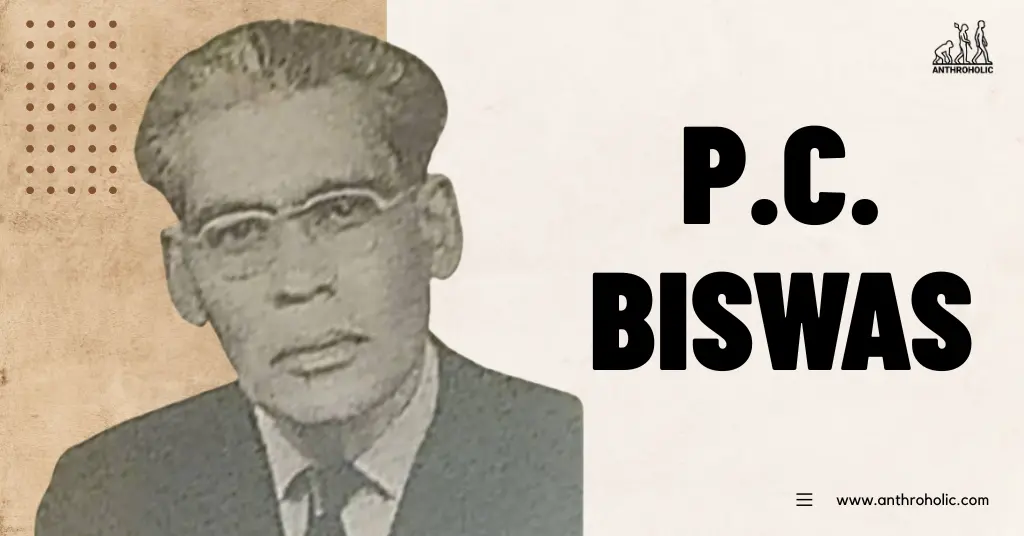
P.C. Biswas (Pranab Chandra Biswas)
Professor P.C. Biswas (Pranab Chandra Biswas) was one of the foremost pioneers of biological anthropology in India and a foundational figure in the institutional history of the discipline. He was the founder and first Head of the Department of Anthropology, University of Delhi, and the Founder-Chairman of the Indian Anthropological Association (IAA).
Emerging during the post-Independence phase of Indian academia, Biswas played a crucial role in transforming anthropology from a colonial ethnographic pursuit into a modern, interdisciplinary science grounded in genetics, human biology, and cultural context. His contributions laid the groundwork for physical anthropology, human genetics, dermatoglyphics, and race biology in India.
A visionary academic and administrator, Biswas combined rigorous scientific methodology with a deep commitment to national development. He believed anthropology should not remain confined to the study of isolated tribes or skeletal remains but should engage with public health, human variation, and social welfare. His teaching, research, and leadership helped consolidate anthropology as a recognized academic and research discipline in post-colonial India.
Throughout his career, P.C. Biswas served as a bridge between European anthropological science and Indian biological diversity studies, integrating race biology, population genetics, and human ecology within an Indian framework. His intellectual vision continues to influence departments of anthropology across India particularly in Delhi, Calcutta, and Lucknow and his students went on to define new research traditions in biosocial and human evolutionary studies.
Early Life & Education
Pranab Chandra Biswas, better known as P.C. Biswas, was born in Bengal in the early decades of the 20th century, during a period when anthropology in India was emerging as an academic discipline. Growing up in an intellectually vibrant environment shaped by the Bengal Renaissance, Biswas developed an early interest in human variation, biological science, and the study of man in relation to his environment.
He pursued his higher education at the University of Calcutta, which at the time was the epicentre of anthropological learning in India, under the influence of pioneering figures such as L.K. Ananthakrishna Iyer, S.C. Roy, and T.C. Das. The Department of Anthropology at Calcutta University had already begun to merge biological, archaeological, and cultural perspectives an interdisciplinary approach that deeply influenced Biswas’s own academic orientation.
He obtained both his Master’s and Doctoral degrees (Ph.D.) in Anthropology from the University of Calcutta, where his early research focused on human physical variation and racial classification among Indian populations. His doctoral studies reflected a strong grounding in physical anthropology, serology, and population biology, which were then being developed internationally by scholars such as Earnest Hooton, Egon von Eickstedt, and Carleton Coon.
In pursuit of advanced training, Biswas spent time studying and collaborating with European scholars of human biology and genetics, familiarizing himself with contemporary developments in dermatoglyphics (the study of fingerprints and palm patterns) and human morphological variation. This exposure helped him modernize Indian physical anthropology by aligning it with quantitative and genetic research methods.
Upon his return to India, he joined the academic faculty and soon became a leading figure in anthropological education and research. His solid scientific training, combined with his sensitivity to India’s social realities, made him a natural leader in shaping the next phase of Indian anthropology after Independence.
By the late 1940s, with India newly free, Biswas was chosen to establish the Department of Anthropology at the University of Delhi (1947) a historic step that made him not just an educator but an institutional architect of modern Indian anthropology.
Major Works & Contributions
Professor P.C. Biswas occupies a central position in the development of biological anthropology in India. His contributions were multidimensional covering rigorous scientific research, institution building, teaching, and professional organization. In 1947, soon after India’s Independence, he founded the Department of Anthropology at the University of Delhi and became its first Head. This marked a historic milestone in Indian anthropology, as Biswas envisioned the discipline as a comprehensive study of humankind, combining physical, cultural, and archaeological perspectives. Under his leadership, the Delhi department became a model for modern anthropological education, emphasizing laboratory training, field research, and the integration of biological data with social context.
His research made pioneering contributions to physical and biological anthropology, particularly in the areas of dermatoglyphics, human biology, and racial classification. Biswas was among the first Indian anthropologists to apply scientific and quantitative methods to study population diversity through fingerprint and palm pattern analysis. These studies laid the foundation of dermatoglyphic research in India, later extended into medical and forensic anthropology. He also conducted comparative analyses of morphological and serological traits to understand the racial composition and adaptive variation of Indian populations. Importantly, he moved beyond the colonial race typologies of the early 20th century and adopted a population-genetic perspective, aligning Indian anthropology with emerging global trends in human biology.
In addition to his research, Biswas played a decisive role in building academic and professional institutions. He was the Founder-Chairman of the Indian Anthropological Association (IAA), established in 1969, which became the premier professional body for anthropologists in India. Through the IAA and its journal, Indian Anthropologist, Biswas provided a national forum for scholarly dialogue and professional development. As a teacher and mentor, he trained a generation of scholars including R.K. Bhattacharya, K.S. Mathur, and V.K. Srivastava who went on to define the direction of Indian anthropology in later decades.
P.C. Biswas’s writings, though scattered across departmental bulletins and journals, reflect his clarity of method and scientific orientation. His key works include Studies in Dermatoglyphics of Indian Populations (1954), “Anthropometry and Racial Composition in North Indian Populations” (1962), and “Development of Physical Anthropology in India” (1965). These works collectively demonstrated his commitment to transforming anthropology into a modern, data-driven science relevant to India’s health, development, and diversity. By integrating genetics, physiology, and social context, Biswas not only elevated the status of physical anthropology but also gave it a national and applied dimension that remains influential to this day.
Role in Indian and World Anthropology
Professor P.C. Biswas played a transformative role in shaping both Indian and global anthropology during the mid-20th century. His contribution lies not only in research but also in institution building, policy orientation, and the internationalization of Indian anthropological scholarship. He represented the generation of post-Independence anthropologists who sought to decolonize the discipline by replacing racial determinism with a human biological and cultural approach grounded in scientific objectivity and social relevance.
In the Indian context, Biswas was instrumental in establishing the University of Delhi as a major center of anthropological research and training. Under his leadership, the department became a nucleus for interdisciplinary studies combining physical anthropology, genetics, and ecology with archaeology and social anthropology. This holistic orientation aligned with his belief that anthropology must study humans “in their total biological, environmental, and cultural framework.” His vision shaped Delhi University into an intellectual hub comparable to the earlier anthropological tradition of Calcutta University, bridging the eastern and northern schools of thought in India.
As the Founder-Chairman of the Indian Anthropological Association (IAA), Biswas institutionalized the professional identity of Indian anthropologists. Through the IAA’s journal, Indian Anthropologist, launched under his guidance, he fostered a platform for Indian scholars to publish and engage with international academic communities. The association also promoted field collaboration, conferences, and cross-university exchanges, elevating Indian anthropology’s global visibility.
Internationally, P.C. Biswas maintained close contact with global anthropological networks in Britain, Germany, and the United States, corresponding with physical anthropologists and geneticists on issues of race and population studies. His approach mirrored global transitions in anthropology during the post-war era from typological race classification to population genetics and human variation studies. Scholars like Egon von Eickstedt and Carleton S. Coon recognized his contributions to the study of biological diversity in South Asia. Biswas’s insistence on using quantitative, laboratory-based methods placed Indian anthropology in dialogue with Western scientific paradigms while asserting its unique regional relevance.
Biswas also advocated for the application of anthropology in national development, arguing that anthropologists should contribute to public health, education, and social welfare. He emphasized that the study of human biology and variation must serve India’s nation-building efforts by informing policy on nutrition, disease, and rural development. In this way, he extended anthropology beyond academia, shaping it into a discipline with practical and ethical responsibility toward society.
In global perspective, P.C. Biswas belongs to the rare group of mid-20th-century scholars who successfully linked the laboratory and the field, the nation and the world, and science with humanity. His pioneering synthesis of biological data and cultural understanding ensured that Indian anthropology emerged as a serious contributor to world anthropological thought rather than a peripheral imitation of the West.
Conclusion & Legacy
Professor P.C. Biswas remains one of the foundational pillars of Indian anthropology an architect who transformed it from a descriptive, colonial discipline into a scientific, institutionalized, and nationally relevant field of study. His career embodies the post-Independence transformation of Indian academia, where anthropology evolved as a biosocial science integrating the biological and cultural dimensions of human life.
Biswas’s legacy rests on three enduring pillars: scientific modernization, institutional creation, and academic mentorship. Through his establishment of the Department of Anthropology at the University of Delhi (1947), he laid the cornerstone for one of India’s leading centers of anthropological research and teaching. His scientific leadership nurtured a generation of scholars who continued to shape anthropology across universities and national institutes, ensuring that his methodological standards and academic values became embedded in the discipline’s DNA.
As the Founder-Chairman of the Indian Anthropological Association (IAA), Biswas also gave Indian anthropology its professional identity and voice. The association’s flagship journal, Indian Anthropologist, initiated under his guidance, became the country’s most prominent platform for anthropological scholarship, bridging Indian research with global academic currents. His institutional foresight provided anthropology with the professional legitimacy it needed in newly independent India.
His contributions to biological and physical anthropology, especially in dermatoglyphics, racial composition, and human adaptation, represent a lasting scientific achievement. By shifting emphasis from typological race studies to population genetics and biological diversity, he aligned Indian anthropology with global scientific paradigms of his time. More importantly, he demonstrated that anthropology was not merely an academic subject but a discipline capable of addressing issues of public health, nutrition, and social welfare.
In retrospect, P.C. Biswas’s intellectual legacy extends beyond the laboratory and classroom. He championed an anthropology that combined empirical precision with human purpose, transforming the study of man into a science of national importance. His influence endures in the continuing strength of Delhi University’s anthropology program, in the institutional vitality of the IAA, and in the orientation of Indian anthropology toward both scientific rigor and social relevance.
Today, Biswas is rightly remembered as one of the “architects of modern Indian anthropology.” His life’s work symbolizes the discipline’s journey from colonial ethnography to postcolonial science anchored in the conviction that understanding human diversity is both a scholarly and a moral responsibility.
References
- University of Delhi – Department of Anthropology, “Memory Lane Archive.”
Mentions Prof. P.C. Biswas as the Founder and First Head of the Department (established 1947).
🔗 https://anthro.du.ac.in/memorylane_archive.html - Indian Anthropological Association – “About Us.”
Lists Late Prof. P.C. Biswas as Founder Chairman and outlines the Association’s origin under his leadership.
🔗 https://indiananthro.in/about.html - Biswas, P.C. (1954). Studies in Dermatoglyphics of Indian Populations. Delhi University Press.
Catalogued on Open Library.
🔗 https://openlibrary.org/authors/OL5069916A/P._C._Biswas - E-GyanKosh (IGNOU). Unit 8 – Contributions of Biosocial Anthropologists in India (mentions P.C. Biswas’s dermatoglyphic research).
🔗 https://www.egyankosh.ac.in/bitstream/123456789/84440/1/Unit-8.pdf - Gyan Books (2021). Architects of Anthropology in India, Vol. 1 – Professor P.C. Biswas: An Architect of Indian Anthropology.
🔗 https://gyanbooks.com/

Related Posts