AI Answer Evaluation Platform Live Now. Try Free Answer Evaluation Now
John Ferguson McLennan
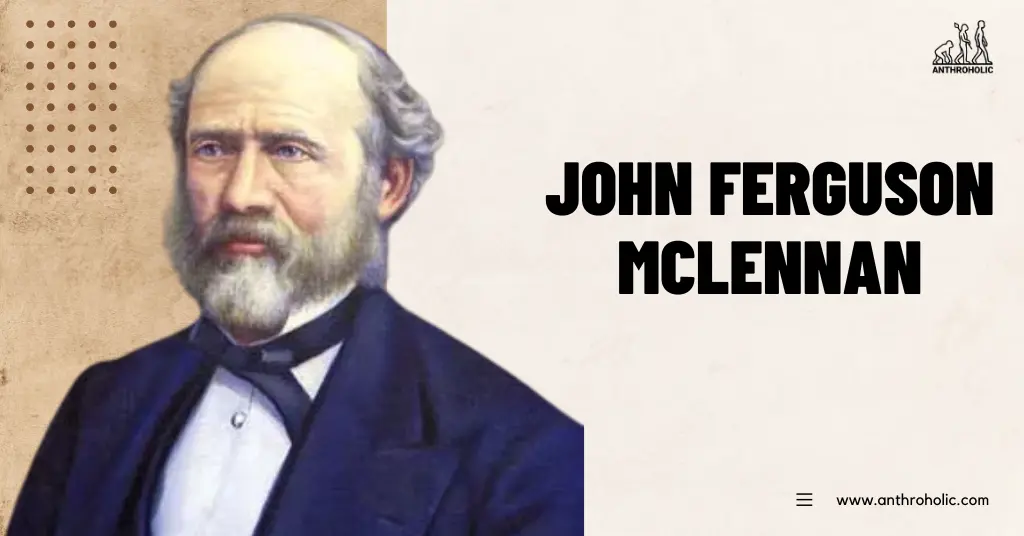
John Ferguson McLennan (1827–1881) was a pioneering Scottish social theorist and anthropologist whose work laid the foundation for the comparative study of kinship, marriage, and primitive social institutions. A contemporary of Lewis Henry Morgan and Edward B. Tylor, McLennan was among the first to propose that social customs and institutions evolved according to universal stages of development, linking anthropology with the emerging field of evolutionary theory.
His most influential work, Primitive Marriage (1865), introduced the ideas of exogamy, endogamy, and the development of the family from promiscuity to monogamy concepts that deeply influenced late 19th-century anthropology and sociology. McLennan’s analytical approach combined historical evidence, mythology, andethnography to construct general laws of social evolution, establishing him as one of the earliest comparative anthropologists.
Though later overshadowed by Morgan and Tylor, McLennan’s theories marked a decisive shift from descriptive ethnology to analytical anthropology, framing kinship and marriage as key institutions in human social development.
Early Life and Education
John Ferguson McLennan was born in Inverness, Scotland, on October 14, 1827, into a middle-class Presbyterian family that valued scholarship and civic duty. He received his early education locally and later attended King’s College, University of Aberdeen, where he graduated with distinction in 1849.
Initially interested in classical studies and law, McLennan proceeded to study jurisprudence at Trinity College, Cambridge, and was later called to the Scottish Bar in 1857. His early legal career brought him into contact with issues of customary law, inheritance, and marriage regulations, which kindled his lifelong fascination with the origins and evolution of social institutions.
McLennan was part of the intellectual milieu of Victorian Britain, a period marked by growing interest in historical and comparative studies of society. Influenced by thinkers such as Herbert Spencer and Charles Darwin, he became convinced that law, kinship, and religion evolved like biological systems through gradual adaptation and survival of the fittest institutions.
His legal background and historical sensibility distinguished him from many of his contemporaries: while others focused on field observation, McLennan employed comparative textual analysis of myths, rituals, and customs to reconstruct the early stages of human society.
Academic Career and Early Scientific Work
McLennan’s intellectual career began outside formal academia. Practicing as an advocate in Edinburgh, he conducted his anthropological research independently, publishing in major British journals. His early papers, particularly “The Worship of Animals and Plants” (1869) and “Totemism” (published posthumously in 1885 by his brother Donald McLennan), demonstrate his commitment to building a scientific framework for social evolution.
The publication of Primitive Marriage (1865) established McLennan’s reputation as a major theorist. The work originated from an article titled “Law of Marriage and Descent” (1863) in the Fortnightly Review and expanded into a full-length monograph. In this text, he proposed that marriage systems evolved through identifiable evolutionary stages beginning with polyandry, moving through group marriage, and culminating in monogamy.
He introduced two enduring anthropological concepts:
- Exogamy – the rule requiring individuals to marry outside their social group, which he associated with the scarcity of women and early practices of female infanticide;
- Endogamy – the rule of marriage within a defined group, which he considered a later social development.
McLennan argued that primitive societies practiced wife capture (symbolically represented in marriage rituals), which gradually gave way to more regulated forms of exchange and alliance. His use of comparative ethnographic material from ancient texts, travelers’ accounts, and mythology was innovative for his time, prefiguring later structural and comparative approaches.
Although McLennan held no academic chair, his writings earned him recognition from major intellectual circles in Britain. He became a member of the Ethnological Society of London and corresponded with influential figures like E.B. Tylor, John Lubbock, and Lewis Henry Morgan, often debating them on theoretical issues concerning social evolution and kinship systems.
Contributions
McLennan’s contributions can be grouped into four major areas of anthropological theory:
- Evolution of Marriage and Family
- In Primitive Marriage, McLennan proposed that human family structures evolved progressively from promiscuous mating to monogamous unions.
- He linked this evolution to social constraints (infanticide, warfare, scarcity of women) and to mechanisms of alliance and reciprocity.
- His model influenced Morgan’s “Systems of Consanguinity” (1871) and later Durkheim’s sociological analyses.
- Theory of Exogamy and Totemism
- McLennan coined and systematically analyzed the concept of exogamy, interpreting it as a survival mechanism emerging from demographic imbalance and tribal hostility.
- His later studies on totemism (posthumously published) suggested that clan identity and totem worship preceded organized religion, foreshadowing later works by Robertson Smith and Émile Durkheim.
- Historical Method in Anthropology
- He pioneered the comparative-historical method, arguing that customs and myths were fossilized evidence of earlier social stages.
- This method made anthropology a scientific discipline concerned with the evolution of institutions, not just the collection of ethnographic curiosities.
- Influence on Social Evolutionism
- McLennan’s work contributed significantly to 19th-century evolutionary anthropology, alongside Spencer and Morgan.
- His emphasis on universality and progress provided a conceptual bridge between legal history (Maine) and cultural evolution (Tylor).
Legacy
John Ferguson McLennan’s legacy in anthropology is both intellectual and methodological. His ideas on exogamy, totemism, and the evolution of the family shaped the early foundations of kinship studies. Although many of his assumptions were later revised or rejected, his influence is visible in the works of Morgan, Frazer, Durkheim, and Lévi-Strauss.
He laid the groundwork for the comparative study of social institutions, inspiring later anthropologists to examine marriage and kinship not merely as cultural variations but as universal structures governed by social laws. His emphasis on symbolism in marriage rituals (e.g., bride capture) influenced ritual theory and symbolic anthropology.
Critically, McLennan also represents a turning point in methodology from speculative ethnology toward systematic, cross-cultural comparison. His insistence that social customs evolve through identifiable stages became a cornerstone of evolutionary anthropology, even as his specific hypotheses (like wife capture or universal polyandry) lost favor.
By integrating law, history, and anthropology, McLennan bridged disciplines and demonstrated that social institutions have natural histories, making him one of the intellectual architects of modern social theory.
Conclusion
John Ferguson McLennan remains a foundational figure in the history of anthropology a thinker whose work transformed isolated observations of custom into a theoretical science of social evolution. His model of marriage evolution, theories of exogamy and totemism, and his comparative methodology marked the beginning of a systematic attempt to understand human societies in evolutionary terms.
Though later critics challenged his speculative reconstructions, McLennan’s influence persisted through scholars like E.B. Tylor, J.G. Frazer, and Émile Durkheim, who built upon his concepts of primitive institutions and social cohesion. His ideas anticipated the structural analyses of the 20th century, where kinship, alliance, and exchange became central to anthropology.
Ultimately, McLennan’s legacy lies not in the accuracy of his hypotheses but in his vision of anthropology as a comparative and law-seeking science one that sought to uncover the universal principles behind human social organization. He transformed anthropology from a colonial curiosity into a theoretical inquiry, paving the way for its modern, interdisciplinary form.
References
- Primitive Marriage: An Inquiry into the Origin of the Form of Capture in Marriage Ceremonies (1865) — Internet Archive: https://archive.org/details/cu31924101874190 archive.org
- Catalog entry: HathiTrust “Primitive Marriage” — https://catalog.hathitrust.org/Record/006512703 catalog.hathitrust.org
- Entry in Encyclopaedia Britannica for McLennan — https://www.britannica.com/biography/John-Ferguson-McLennan Encyclopedia Britannica
- “Studies in Ancient History: Comprising a Reprint of Primitive Marriage” (review) — https://www.nature.com/articles/035003a0 Nature
- Biodiversity Heritage Library bibliographic listing — https://www.biodiversitylibrary.org/bibliography/50206 biodiversitylibrary.org
- PDF (Spanish translation) of El Matrimonio Primitivo — https://www.ciesas.edu.mx/publicaciones/clasicos/wp-content/uploads/2022/07/MacLennan_Matrimonio_Primitivo.pdf CIESAS
- ResearchGate author entry for McLennan — https://www.researchgate.net/publication/327433264_McLennan_John_Ferguson_1827-81 ResearchGate
- Google Books preview of Primitive Marriage — https://books.google.com/books/about/Primitive_Marriage.html?id=1IJJAAAAIAAJ Google Books

Related Posts