AI Answer Evaluation Platform Live Now. Try Free Answer Evaluation Now

Black Magic
A chill in the air. A whispered incantation. A hidden curse believed to break fortunes, sow misfortune, or manipulate destinies. For many across the world, the idea of black magic evokes fear, suspicion, and moral conflict. But far from being a relic of superstition, black magic remains a living social phenomenon deeply embedded in cultural, religious, and economic contexts. From witch-hunts in rural Assam to accusations in African townships, black magic provides a rich lens for anthropologists to analyze how beliefs in supernatural harm shape societies, power relations, and collective anxieties.
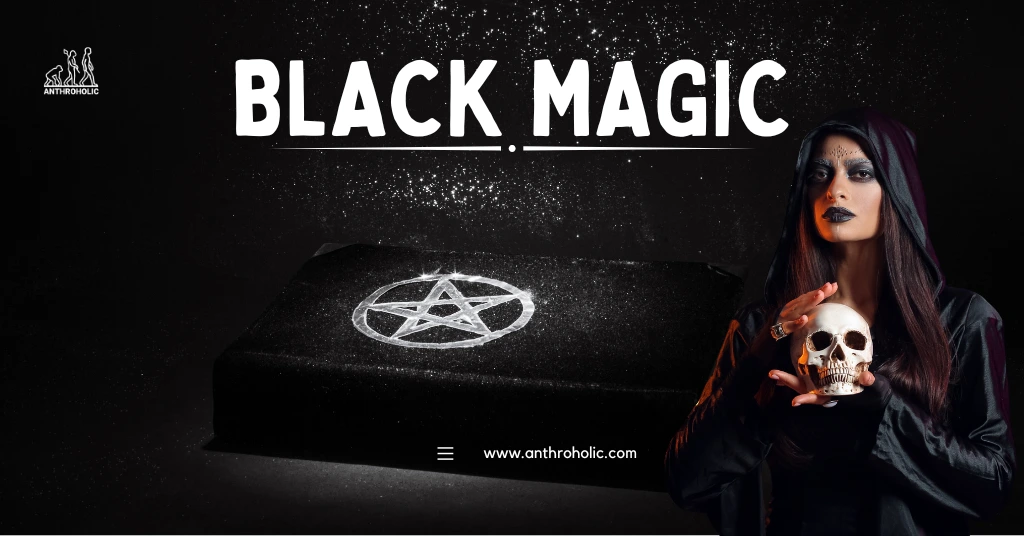
For millennia, across every continent and culture, humans have sought ways to influence the world through non-material means. While religious prayer and ritual appeal to benevolent forces, a far more compelling, feared, and often misunderstood domain of practice exists: Black Magic. Is it merely a superstitious remnant of a less enlightened age, or does it hold a deeper mirror to human psychology, social structure, and power dynamics?
Black Magic, Sorcery, and Witchcraft
In popular culture, black magic is an umbrella term for any supernatural practice intended to cause harm, misfortune, or death. Anthropologically, however, the concept requires more nuanced classification, largely revolving around the source and intent of the malevolent power.
Sorcery vs. Witchcraft
The critical distinction introduced by anthropologist E. E. Evans-Pritchard in his seminal 1937 work, Witchcraft, Oracles, and Magic Among the Azande, remains foundational. This framework helps separate practices based on their method and agency.
Sorcery is viewed as manipulative magic. It involves the active, learned, and conscious manipulation of external objects, rituals, incantations, spells, and substances (e.g., bone fragments, potions) to cause harm. The sorcerer has full control and agency; the act is a deliberate crime, and the perpetrator is condemned.
In contrast, Witchcraft stems from an innate power. It is believed to originate from an internal, inherent psychic or bodily substance (mangu among the Azande), which is often unconscious or inherited. The power operates autonomously, frequently as an unconscious projection of malice or psychic energy; the ‘witch’ may not even know they are causing harm. Witchcraft is considered a state of being rather than a deliberate action, and the person, not just the act, is condemned as a threat to the community.
This dichotomy helps explain differing social responses globally. In many societies, a sorcerer is seen as a malicious individual using learned techniques, whereas a witch is an inherently evil being whose very existence threatens the moral and physical order of the community.
“The belief in black magic, specifically witchcraft and sorcery, is not an irrational deviation from reason, but a coherent and logical system for interpreting misfortune, explaining causality, and maintaining moral accountability within a community.”
The Functions of Malevolent Magic
The widespread presence of black magic beliefs is not random; it fulfills critical psychological and sociological functions:
- Explaining Misfortune: It provides a culturally satisfying explanation for unexplainable calamities (e.g., sudden death, crop failure, infertility). When “bad luck” strikes, magic offers a discernible enemy, preventing the chaos of pure randomness.
- Social Control: Fear of being accused of practicing black magic can enforce conformity and adherence to social norms. Conversely, the accusation itself can be a tool to target rivals or challenge the authority of unpopular or non-conforming individuals (See: Internal Link: Social Control Theory).
- Psychological Outlet: It provides a safe, non-violent channel for expressing hostility, envy, and aggression between neighbors, family members, or competitors. Instead of resorting to physical violence, people often attribute their misfortune to a magical attack.
- Leveling Mechanism: In many contexts, accusations of witchcraft often target wealthy or powerful individuals. This can function as a “leveling mechanism,” preventing excessive accumulation of power or wealth that might disrupt egalitarian social structures.
Case Studies
The manifestation and interpretation of black magic are deeply embedded in specific cultural matrices.
The Azande and the Logic of Mangu
The Azande of Sudan attribute misfortune to mangu, or witchcraft substance, which is believed to reside within the body. Evans-Pritchard showed that mangu provides a “second spear” a mystical explanation for the why even when a natural cause (the “first spear”) is obvious. For example, if a granary collapses and kills a man, the natural cause is termites (the first spear). But why did it collapse at the exact moment the man was sitting beneath it? Mangu explains this coincidence and ill-timing. Witch doctors and oracles are consulted to diagnose the source of the mangu and identify the witch.
The Scapegoating Phenomenon
While often perceived as a relic of the past, contemporary cases demonstrate the enduring power of these beliefs.
- Data & Statistics: According to a 2025 report from the Center for Modern Anthropology (CMA), over 10,000 cases of violence or murder linked to witchcraft accusations were reported globally in the past decade, with significant clusters in parts of Sub-Saharan Africa, India, and Papua New Guinea.
- Case Study: Tanzania: The accusation of Pumziko (a form of black magic) is often directed at elderly women, particularly widows, who are marginalized and lack kin support. These accusations frequently escalate into violence, driven by disputes over land, jealousy, or attempts to scapegoat a community’s rising anxiety and poverty.
Black Magic in Globalized Contexts
Globalization and urbanization have not eradicated these beliefs; they have merely transformed them.
- In mega-cities, sorcery is often commercialized. Practitioners, sometimes called juju or muti men, offer services for both malevolent (curses, revenge) and benevolent (love spells, prosperity) purposes. The anonymity of the city means the practitioner is often a distant, transactional figure rather than a neighbor, fundamentally altering the social dynamic of the magic.
- The internet has become a new medium, with “cyber-witchcraft” and online instruction for spell-casting, suggesting that the underlying human desire for non-material agency remains powerful, simply adopting new technologies.
Black Magic as Power and Resistance
Anthropologist Michael Taussig, in his book The Devil and Commodity Fetishism in South America, argued that beliefs in black magic often reflect and critique economic power structures.
In post-colonial settings and capitalist economies, stories of men making pacts with the Devil or using malevolent magic to rapidly accumulate wealth become common. This narrative acts as a moral critique: excessive, rapid wealth is seen as unclean or unearned, suggesting a Faustian bargain rather than honest labor.
Key Takeaways on Power:
- Weapon of the Weak: Black magic is a way for individuals with little economic or political power to symbolically strike back against the powerful, creating fear and disruption where physical resistance is impossible.
- Tool of Oppression: Conversely, the powerful can use accusations of sorcery or witchcraft to eliminate political opponents or consolidate their control over resources and people.
“The discourse of black magic is intrinsically a discourse of power. It allows the powerless to imagine agency and the powerful to legitimize their dominance by mystifying the source of their success or the failures of their enemies.”
Conclusion
Black magic in all its varied forms as sorcery, witchcraft, mangu, or juju is far more than a footnote of human history. It is a vital and active social institution. It provides systems of causality, enforces ethical norms, explains the inexplicable, and offers a powerful lexicon for negotiating social relationships, envy, and misfortune.
By rigorously studying these beliefs, anthropologists gain profound insights into the human condition: the desperate search for control in a chaotic world, the inherent moral ambiguity of power, and the complex, enduring ways in which communities define and defend their moral boundaries. The shadow archive of black magic is, in essence, a profound testament to the complexity of human culture.
Frequently Asked Questions (FAQs)
1. What is the main difference between “magic” and “religion” in anthropology?
Magic, as defined by anthropologists like Sir James Frazer, is typically manipulative a direct means of forcing a specific outcome by controlling supernatural forces through a formula or ritual. Religion, conversely, is generally supplicative—a means of appealing to higher powers (like gods or spirits) through prayer, sacrifice, or worship. Black magic falls squarely into the manipulative category.
2. Is there a distinction between “white magic” and “black magic”?
Anthropologically, yes. The distinction rests primarily on intent. Black magic (sorcery, witchcraft) is intended to cause harm, sickness, or death. White magic (sometimes called benevolent magic) is intended for healing, protection, love, or ensuring fertility and good fortune. In many cultures, the same techniques and practitioners can be used for both.
3. How does the belief in black magic relate to modern mental health issues?
In cultures where black magic beliefs are strong, misfortunes like severe illness, sudden psychosis, or clinical depression are often interpreted as the result of a magical attack or possession. While Western medicine diagnoses the condition, a culturally appropriate treatment often involves consulting a ritual specialist or traditional healer to counteract the curse or identify the witch, integrating spiritual and psychological healing.
4. Why are women often the primary targets of witchcraft accusations?
Historical and contemporary data show a disproportionate number of accusations are leveled against women, particularly those who are marginalized, economically independent, or lack male protection (e.g., widows, older women). This is often explained by the fact that women are positioned at the critical nexus of domestic life and community gossip, making them prime targets for channeling communal anxieties related to fertility, health, and domestic disputes.
References
- Abdelli, S. E. (2023). The Anthropology of Magic and Sorcery in Tunisian Society: An Ethnographic Study. Journal of Umm Al-Qura University for Social Sciences, 15(1), 15–24. ResearchGate
- Hutton, R. (2004). Anthropological and Historical Approaches to Witchcraft: Potential for a New Collaboration? The Historical Journal. Cambridge University Press. Cambridge University Press & Assessment
- Jacob, K. S. (2019). Understanding black magic and other systems of belief. The National Medical Journal of India, 32(3), 167–170. The National Medical Journal of India
- James, E. C. (2012). Witchcraft, Bureaucraft, and the Social Life of (U.S.) Aid in Haiti. Cultural Anthropology, 27(1), 50–75. anthropology.mit.edu
- Lowrey, K. (2007). Witchcraft as Metaculture in the Bolivian Chaco. Journal de la Société des Américanistes, 93(2), 121–152. OpenEdition Journals
- Nag, S. (Ed.). (2023). Black Magic, Witchcraft and Occultism: Secret Cultural Practices in India. Routledge. Routledge
- Saud, S. (2018). Perception of people and role of State in the prevalence of Witchcraft: A case study on Mayong village (Assam). International Journal of Applied Social Science, 5(3–4), 275–282. scientificresearchjournal.com
- (n.d.). Witchcraft and Sorcery: Taxonomy versus Dynamics. Africa, 34(4), 314–325. International African Institute. University Press & Assessment

Related Posts