
AI Answer Evaluation Platform Live Now. Try Free Answer Evaluation Now

Buddhist Marriage
In the vast landscape of global religions, Buddhism presents a unique perspective on the institution of marriage. Unlike traditions that prescribe it as a mandatory religious sacrament (samskara) or a divine commandment, Buddhism views marriage fundamentally as a social contract rooted in mutual respect, ethical conduct, and the voluntary commitment of two individuals to support each other’s journey toward spiritual fulfillment.
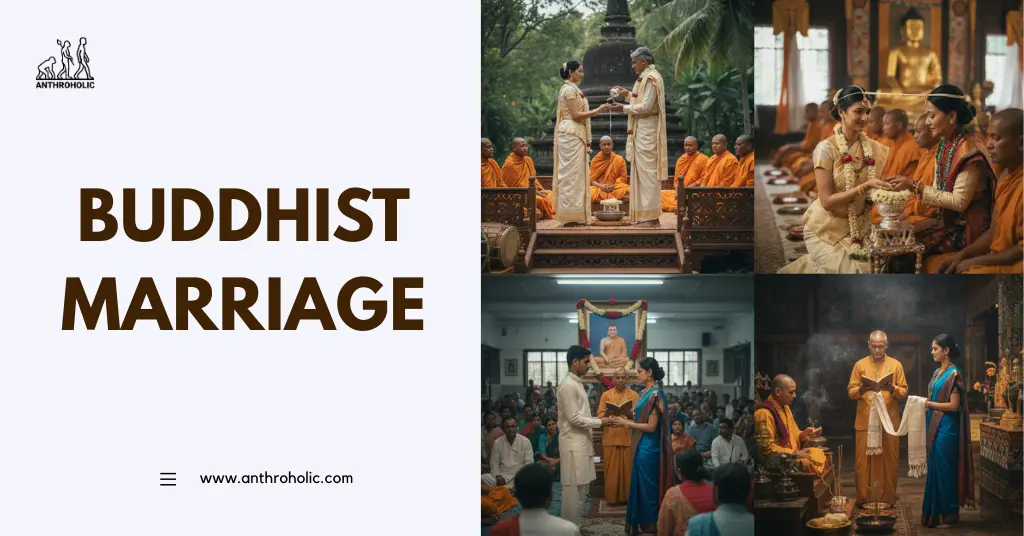
For anthropologists, Buddhist marriage offers valuable insights into how religious philosophies shape kinship, ritual practices, and the construction of moral communities. It analyzes its core principles, examines the influential ethical framework provided by the Sigalovada Sutta, and documents the fascinating regional variations and modern adaptations across the Buddhist world, from Theravada Southeast Asia to globalized diaspora communities.
Unlike Hinduism or Christianity, Buddhism does not prescribe marriage as a religious ceremony. The Buddha regarded marriage as a secular and social institution, governed by mutual respect, compassion, and personal choice. Yet, across Sri Lanka, Thailand, Myanmar, Tibet, Japan, and Himalayan communities, marriage is deeply embedded in cultural and ritual practices influenced by Buddhist ethics.
The Sigalovada Sutta often called the “householder’s code” outlines mutual obligations between spouses, emphasizing fidelity, kindness, and shared moral duties.
“In the Noble Path, marriage is companionship rooted in compassion, not compulsion.” Traditional Buddhist teaching
The Foundational Buddhist View on Marriage
The search for liberation (Nirvana) is central to the Buddhist worldview, a goal most directly pursued by the monastic order (Sangha) through renunciation and celibacy. However, the lay life (grahastha) is equally recognized as a path for accumulating merit (punya) and practicing virtue, and it is within this context that marriage is defined.
Not a Sacrament, but an Ethical Bond
A critical distinction in Buddhist anthropology is that the canonical scriptures, such as the Pāli Canon, do not prescribe a specific religious ceremony for marriage. The Buddha, Gautama, did not legislate on marriage, nor is a monk or nun strictly required to officiate the legal union. This absence of a religious mandate classifies marriage as a secular agreement under the law of the land or local custom.
- Absence of Divine Command: Marriage is not necessary for salvation, nor is it a religious duty to procreate.
- Focus on Ethics: The emphasis is shifted from ritual obligation to moral responsibility and the cultivation of a supportive partnership.
- Monastic Role: Monks and nuns (Bhikkhus and Bhikkhunis) do not solemnize marriages; they offer a Dharma Talk (Anusasana) and spiritual blessings for the couple’s future happiness, reinforcing the ethical dimension of the union.
The Code of Reciprocity: The Sigalovada Sutta
The most authoritative source guiding Buddhist lay life, and thus marriage, is the Sigalovada Sutta (Dīgha Nikāya 31), often referred to as the “Vinaya of the Householder.” This discourse, given by the Buddha to the young layman Sigala, reinterprets the traditional Vedic worship of the six directions as a metaphor for reciprocal social duties.
In this text, the West direction is identified with the spouse and children, and the Buddha outlines the reciprocal responsibilities for a harmonious partnership:
| Husband’s Duties (Towards Wife) | Wife’s Duties (Towards Husband) |
| Respect: Treat her with honor and courtesy. | Diligence: Manage the household skillfully. |
| Fidelity: Be faithful and avoid adultery. | Hospitality: Be kind to his relatives and friends. |
| Authority: Hand over authority to her (in domestic affairs). | Fidelity: Be faithful to him. |
| Gifts: Provide her with adornments/clothing. | Protection: Guard the wealth he earns. |
| Love: Speak to her kindly. | Skill: Perform her duties efficiently. |
“The Sigalovada Sutta transforms a ritualistic act into a practical, ethical code, defining marriage not by supernatural sanction but by the concrete, reciprocal acts of kindness, respect, and mutual support that sustain the social order.”
Rituals, Regionalism, and Cultural Synthesis
While the Buddhist texts offer an ethical framework, the form of the wedding ceremony is highly dependent on the local culture, illustrating a key anthropological concept: cultural synthesis. Buddhism, as it spread across Asia, assimilated local rites, transforming them through a core Buddhist lens of simplicity and non-violence.
The Theravada Tradition: Simplicity and Blending
In Theravada countries like Sri Lanka and Thailand, the ceremony is a clear blend of pre-Buddhist local traditions and later Buddhist blessings.
- Sri Lanka: The Poruwa Ceremony: This is the most distinct ceremony in Sinhalese Buddhism. The couple ascends the Poruwa (a decorated wooden platform) with their right foot first. An elder or officiant then ties the couple’s little fingers together with a white thread (Jaya Mangala Gatha is chanted), while consecrated water is poured over them from an ornamental silver vessel. This symbolizes the bond. It is followed by the breaking of a coconut to symbolize purity and prosperity, a common folk ritual.
- Thailand: The Rod Nam Sang and Monks’ Blessings: Thai weddings begin with a Buddhist component, where the couple pays respect to the Buddha image and offers food (pindapata) to invited monks. The monks chant Parittas (protective verses in Pāli) and tie a white string (sai mongkhon) connecting the heads of the couple, symbolizing their common destiny. The Rod Nam Sang (shell ceremony) follows, where elders pour lustral water over the couple’s hands, blessing the union a non-Buddhist ritual adapted into the ceremony.
Mahayana and Vajrayana Variations
In Mahayana and Vajrayana traditions (e.g., Tibetan, Japanese, Chinese), the influence of local spiritual practices is even more pronounced. Tibetan weddings often feature elaborate rituals involving the exchange of white silk scarves (khatas), symbolizing purity and commitment, and may involve a Lama (spiritual teacher) performing an auspicious ceremony, including a reading of the Metta Sutta (Discourse on Loving-Kindness).
In all cases, the central Buddhist act is the offering to the Sangha and the recitation of key suttas to generate merit for the new family, cementing the union through shared dharma practice rather than mandatory religious rites.
Modernity, Divorce, and Kinship in the Buddhist Diaspora
Contemporary anthropological data highlights how globalization and socio-legal changes are influencing Buddhist marital practices, particularly among urban and diaspora communities.
The Question of Divorce
Given that marriage is a secular contract, divorce is not prohibited in Buddhism. The Buddha’s teachings prioritize the cessation of suffering. If a marriage becomes a source of irreconcilable suffering for both partners, separation is not only permitted but sometimes seen as the most compassionate course of action, aligning with the principle of non-attachment.
“Buddhism does not force a commitment upon the householder; it simply advises how to live within it skillfully. Therefore, if a marriage cannot be conducted harmoniously, the ultimate goal of reducing suffering justifies its dissolution.”
Navayana (Ambedkarite) Weddings
A distinct and influential case study in India is the Navayana or Ambedkarite Buddhist movement. Dr. B. R. Ambedkar, who led a mass conversion to Buddhism, actively designed a new set of rituals based on rationalism and equality, explicitly rejecting caste-based and Brahmin-led rites.
- These weddings feature vows of social equality and are often officiated by a Bhikkhu who provides a Dharma Diksha (initiation into Buddhism) and an ethical talk.
- The focus is heavily on mutual respect and social progress, serving as a powerful anti-caste statement and a model of modern, simplified Buddhist practice.
Kinship and Marriage Timing
A 2024 analysis suggests that while many Buddhist communities historically practiced forms of endogamy (marrying within a local group), this is rapidly changing. In Western countries, Buddhist couples often prioritize a Mindfulness-based ceremony, focusing on personal vows aligned with the Five Precepts (non-harming, honesty, non-stealing, fidelity, non-intoxication). Marriage is often undertaken later in life following career and educational milestones, reflecting a global trend toward individual agency over prescribed kinship obligations.
Conclusion
The institution of Buddhist marriage stands as a compelling example of a religious tradition accommodating social life without sacrificing its core spiritual mission. Anthropologically, it showcases the power of syncretism the integration of local cultural practices with a universal ethical code. It is defined not by the exchange of ritual words but by the quality of the lifelong relationship, governed by the principles of compassion (Karuna) and loving-kindness (Metta). The Buddhist marriage is a partnership in dharma, a journey where two individuals commit to assisting each other in the reduction of suffering, ultimately making their domestic life a foundation for spiritual growth.
Frequently Asked Questions (FAQs)
Q1: Do you have to be Buddhist to have a Buddhist wedding?
A: No. Since marriage is viewed primarily as a social or legal contract rather than a religious sacrament, a Buddhist individual can marry a non-Buddhist without any canonical prohibition. While the blessing ceremony will be Buddhist, the couple is not required to convert, emphasizing Buddhism’s open and non-exclusive approach to lay life.
Q2: What is the most important part of a Buddhist wedding ceremony?
A: The most important element is not a specific ritual but the Spiritual Blessing or Dharma Talk given by the Bhikkhu or religious elder. This talk, often incorporating teachings from the Sigalovada Sutta and the Metta Sutta, emphasizes the reciprocal duties of the spouses, the commitment to mutual compassion, and the creation of merit to ensure a peaceful life together.
Q3: What is the Buddhist view on divorce and remarriage?
A: Buddhism does not prohibit divorce or remarriage. As marriage is a secular agreement, if the relationship becomes a source of suffering (Dukkha) for the partners, it is considered ethical to dissolve the union. The focus remains on acting with compassion and minimizing harm during and after the separation.
Q4: Are there any universal vows used in Buddhist weddings?
A: While no universal vows are strictly mandated, many couples adapt their vows to align with the Five Precepts (the ethical guidelines for laypeople) or the principles of the Sigalovada Sutta. Common themes include vowing to practice non-attachment, cultivate compassion, share resources, and support each other’s spiritual path.
References
- Gombrich, R. (1988). Theravada Buddhism: A Social History from Ancient Benares to Modern Colombo. Routledge. https://www.routledge.com/
- Goldstein, M. (1971). Stratification, polyandry, and family structure in Central Tibet. Southwestern Journal of Anthropology, 27(1), 64–74. https://www.jstor.org/
- Harvey, P. (2013). An Introduction to Buddhism: Teachings, History and Practices (2nd ed.). Cambridge University Press. https://www.cambridge.org/
- Holt, J. C. (2011). Marriage customs in Theravada Buddhist societies. Journal of Asian Studies, 70(2), 367–392. https://www.cambridge.org/
- Kapstein, M. (2006). The Tibetans. Blackwell Publishing. https://www.wiley.com/
- Keown, D. (2005). Buddhist Ethics: A Very Short Introduction. Oxford University Press. https://global.oup.com/
- Obeyesekere, G. (1963). The Great Tradition and the Little in the perspective of Sinhalese Buddhism. The Journal of Asian Studies, 22(2), 139–153. https://www.jstor.org/
- Samuel, G. (2013). Introducing Tibetan Buddhism. Routledge. https://www.routledge.com/
- Tambiah, S. J. (1976). World Conqueror and World Renouncer: A Study of Buddhism and Polity in Thailand. Cambridge University Press. https://www.cambridge.org/

Related Posts