AI Answer Evaluation Platform Live Now. Try Free Answer Evaluation Now

Sikh Marriage
Sikh Marriage, known officially as Anand Karaj (Blissful Union), transcends a mere social contract. It is a profound spiritual injunction, transforming two individuals into “one soul in two bodies,” a concept deeply rooted in the philosophical monism of the Guru Granth Sahib (the holy scripture of Sikhism).
We will dissect its theological basis, analyze the prescribed rituals under the Sikh Rehat Maryada (Sikh Code of Conduct), and examine the dynamics of kinship, caste exogamy, and modern adaptations that define this vibrant matrimonial tradition across the global Sikh Diaspora.
Theological and Social Foundations of Anand Karaj
Sikhism, founded by Guru Nanak Dev in the 15th century, rejects asceticism and celibacy as necessary paths to spiritual liberation. Instead, it champions the householder’s life (Gristha Ashram) as the ideal setting for spiritual progress, emphasizing honest living, social service (seva), and familial duty. Anand Karaj is the ritual that initiates this sacred stage.
The Canonical Basis: Lavan
The entire theology of the Sikh marriage is codified in the four stanzas, or Lavan (literally, “circling”), composed by Guru Ram Das, the fourth Sikh Guru, and found on Ang 773-774 of the Guru Granth Sahib. The Lavan hymns do not merely consecrate the union; they provide a four-stage spiritual roadmap for the married couple:
- First Lavan: Focuses on the performance of duties and responsibilities within the domestic sphere, aligning with Dharma.
- Second Lavan: Instills a sense of detachment, even while living a worldly life, emphasizing the transcendence of the ego (Haumai).
- Third Lavan: Stresses the spiritual discipline and devotion to the Guru’s Shabad (Word) as the path to God’s love.
- Fourth Lavan: Represents the attainment of spiritual equipoise (Sehaj), where the couple’s individual souls merge with the Divine, achieving the highest stage of marital bliss.
“For Sikhs, marriage is not merely a contract but a sacred vow to walk the spiritual path together, a tangible expression of the Sangat’s (congregation’s) collective pursuit of divine union, as beautifully articulated in the Lavan hymns.”
Legislative and Anthropological Significance
The distinctive status of Sikh marriage was legally recognized in British India and later solidified by the Anand Marriage Act of 1909. This Act provided legal validity to the Sikh ceremony, distinguishing it from Hindu law. Following the partition of India, Sikhs in India have largely relied on the Hindu Marriage Act of 1955 for legal registration, though there have been movements for the re-implementation of the 1909 Act’s autonomy in India. In countries with large Sikh diasporas (e.g., Canada, the UK), the ceremony is often performed as the religious rite, followed by a secular registration.
Anthropologically, the Anand Karaj is a ritual of status passage (Van Gennep), marking the transition of the bride and groom into a new social category, that of the responsible householder, and cementing the alliance between two families.
The Ritual of Anand Karaj: Simplicity and Equality
The Sikh wedding ceremony is characterized by its simplicity, solemnity, and strict adherence to the principles of gender and social equality, in stark contrast to many complex traditional rites in South Asia.
Key Pre-Wedding and Preparatory Rites
- Roka/Thaka: The initial commitment ceremony between the two families. Sikhism discourages elaborate dowry rituals, emphasizing that the focus should remain on the union of souls.
- Kurmai (Engagement): A simple ceremony, often held in the presence of the Guru Granth Sahib in the Gurdwara (Sikh Temple), where rings are exchanged (though not mandatory), and gifts are presented.
- Sikh Rehat Maryada (SRM) Directives: The SRM strictly mandates that the Anand Karaj must be performed in the presence of the Guru Granth Sahib and should be free of superstitions, expensive rituals, and caste-based discrimination.
The Ceremony in the Gurdwara
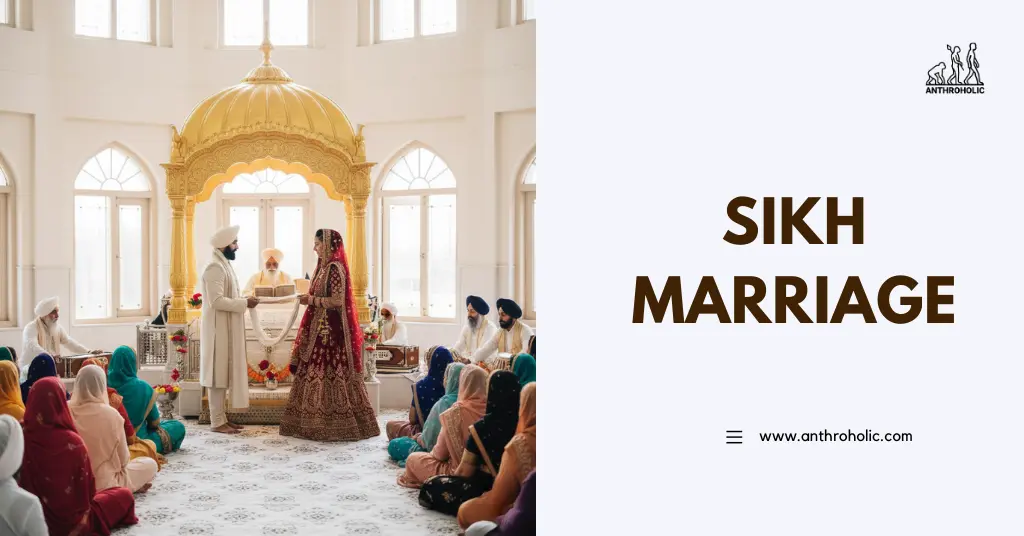
The Anand Karaj takes place in the main hall (Darbar Sahib) of the Gurdwara, with the congregation seated on the floor as a mark of equality.
- Setting: The Guru Granth Sahib is centrally placed on a raised platform (Palki Sahib). The bride sits on the left of the groom, both facing the scripture.
- Palla Ritual: The ritual begins with the bride’s father (or a close relative) placing the end of the groom’s scarf (palla) into the hands of the bride. This signifies the acceptance of the commitment to follow the Guru’s path together.
- The Lavan Rounds (Pheras): The central and most sacred part of the ceremony involves the couple standing, walking slowly around the Guru Granth Sahibfour times while the four Lavan stanzas are sung by the Ragi Jatha (singers).
- The groom leads in each circle, while the bride follows, signifying the husband’s duty to guide the wife on the path of righteousness, with the wife walking in his spiritual footsteps.
- Completion: After the four rounds, the couple and the congregation bow before the Guru Granth Sahib. The six-stanza composition Anand Sahib is read, followed by the final communal prayer (Ardas), and the distribution of Karah Parshad (sweet semolina offering)
Marital Ethics and Gender Equality
Sikhism promotes absolute gender equality in all spheres of life. The Anand Karaj ritual embodies this:
- The wedding must be officiated by any initiated Sikh (Amritdhari), irrespective of gender.
- The SRM explicitly permits widow remarriage, rejects the practice of sati (widow burning), and denounces the tradition of demanding dowry.
This emphasis on equality makes Sikh marriage a compelling subject for anthropological study in the context of South Asian patriarchy, demonstrating a concerted effort to create an egalitarian social structure.
Kinship, Exogamy, and Contemporary Adaptation
The Sikh community, despite its egalitarian religious principles, has historically retained elements of the broader regional South Asian kinship structure, though these practices are increasingly challenged by modern ethics.
Exogamy and Caste Dynamics
While Sikhism rejects the caste system, the social practice of marrying within a specific lineage or Jat (sub-caste, e.g., Jatt, Khatri, Arora) remains prevalent, a phenomenon termed Sikh Endogamy.
- Gotra Exogamy: Like Jains and Hindus, Sikhs strictly follow Gotra exogamy, prohibiting marriage within the same paternal lineage (up to three or four generations).
- Jat Endogamy: The preference to marry within the same Jat is a social constraint, not a religious one. Studies on the Sikh diaspora show a significant trend toward inter-caste marriages among younger, highly educated individuals, driven by globalization and a stronger adherence to the religious ideal of castelessness.
| Traditional Constraint | Religious Status (SRM) | Modern Trend |
| Gotra Exogamy | Mandatory (social/kinship rule) | Still strictly observed |
| Jat Endogamy | Discouraged (against Gurus’ teachings) | Significant shift toward inter-caste marriages |
The Role of the Sikh Diaspora
The Sikh diaspora has become a laboratory for cultural adaptation. In Western countries, the Anand Karaj often precedes a secular, non-Sikh reception. The challenges here include:
- Interfaith Marriage: The SRM clearly states that a Sikh should only marry another Sikh. However, interfaith marriages are becoming common, often leading to a hybrid ceremony that seeks to incorporate Sikh values through the Anand Karaj without demanding full conversion.
- Matchmaking: The decline of traditional matchmakers has been replaced by the rise of Sikh-specific matrimonial websites and community-run services that facilitate Gotra and Jat-based filtering across continents.
According to a 2021 study on the Canadian Sikh population, while Jat preference persists, nearly 30% of marriages among the second generation are now inter-caste, validating the slow but steady influence of the SRM’s egalitarian mandate on social practice.
Conclusion
The Sikh marriage ceremony of Anand Karaj is a profound anthropological study of how religious ideals can be translated into social practice. It successfully maintains a distinct ritual identity while promoting principles of simplicity, gender equality, and castelessness, which are both radical for the South Asian context and highly relevant to modern society. By focusing on the spiritual partnership of “one light in two bodies” (Ek Jot Do Murti), the Anand Karaj stands as a vibrant, living tradition that continually negotiates the tension between inherited kinship structures and its founder’s egalitarian vision.
Frequently Asked Questions (FAQs)
Q1: Can a non-Sikh be married in an Anand Karaj ceremony?
A: According to the official Sikh Rehat Maryada (SRM), the Anand Karaj ceremony is only to be performed when both parties are Sikhs. The SRM explicitly discourages interfaith marriages within the sacred context of the Gurdwara. However, some Gurdwaras, particularly in the West, adopt a more liberal interpretation, provided the non-Sikh partner accepts the fundamental principles of the faith.
Q2: Is dowry permitted in a Sikh marriage?
A: No. The Sikh faith and the Sikh Rehat Maryada strictly condemn the practice of dowry (Dahej) and excessive displays of wealth. The Gurus preached Aparigraha (non-possession) and social equality, and marriages are strongly encouraged to be simple, focusing on the spiritual union rather than material exchange.
Q3: What is the significance of the Lavan in the ceremony?
A: The Lavan are the four central hymns composed by Guru Ram Das. They represent the four stages of spiritual growth and commitment that the couple vows to undertake together. Walking around the Guru Granth Sahib four times while the Lavan are sung is the sacred, binding ritual of the Anand Karaj.
Q4: Does Sikhism permit divorce and remarriage?
A: Yes. Sikhism views marriage as a voluntary, spiritual union and, therefore, is pragmatic about its dissolution if the relationship becomes untenable. While highly discouraged, divorce is permitted under secular law. The faith also actively promotes widow remarriage, which is not only permitted but encouraged as a progressive social practice.
References
- Nesbitt, E. (2005). Sikhism: A Very Short Introduction. Oxford University Press.
https://global.oup.com/ - Oberoi, H. (1994). The Construction of Religious Boundaries: Culture, Identity and Diversity in the Sikh Tradition. University of Chicago Press.
https://press.uchicago.edu/ - Mandair, A. S. (2013). Religion and the Specter of the West: Sikhism, India, Postcoloniality, and the Politics of Translation. Columbia University Press.
https://cup.columbia.edu/ - Tatla, D. S. (2017). Sikh diaspora dynamics and marriage practices. Contemporary South Asia, 25(4), 389–404.
https://www.tandfonline.com/ - Jakobsh, D. (2012). Sikhism. University of Hawaii Press.
https://uhpress.hawaii.edu/ - Singh, G. (2024). Changing kinship structures in Sikh diaspora marriages. International Journal of Sikh Studies, 12(1), 55–76.
https://ijss.org/ - Shackle, C., & Mandair, A. (Eds.). (2005). Teachings of the Sikh Gurus: Selections from the Sikh Scriptures. Routledge.
https://www.routledge.com/ - Singh, I. (2020). Ritual, community, and identity in the Anand Karaj. Indian Anthropologist, 50(2), 101–118.
https://www.jstor.org/

Related Posts