AI Answer Evaluation Platform Live Now. Try Free Answer Evaluation Now

Jain Marriage
Marriage stands at the heart of every cultural system, but within Jainism one of India’s most ancient and philosophically rich traditions it assumes a distinctive expression shaped by non-violence, ascetic values, and community cohesion. For anthropologists, Jain marriage offer a compelling case of how religious worldviews deeply structure kinship, ritual forms, and social organization.
Far from being mere personal unions, they are profound spiritual and social contracts, reflecting the core tenets of Jain philosophy: Ahimsa (non-violence), Aparigraha (non-possession), and Anekantavada (multiplicity of views). Understanding the Jain marriage is key to appreciating how a religious tradition focused on asceticism and renunciation manages the central social obligation of procreation and societal maintenance.
Origins and Philosophical Foundations
Jainism emphasizes ahimsa (non-violence), aparigraha (non-possession), and satya (truthfulness). These principles extend into marriage, shaping ideals of companionship, mutual restraint, and ethical living. Unlike Vedic Hinduism, Jain marriage is not a sacrament (sanskara) but a social contract, though still imbued with ritual significance.
Anthropologist Vilas Sangave notes that Jain marriage functions primarily as a “socio-religious duty that preserves community continuity while reflecting Jain ethical principles.”
Ethical and Social Significance
For Jains, the primary goal of life is Moksha (liberation), which is achieved through the Three Jewels: Samyak Darshana (Right Faith), Samyak Jnana (Right Knowledge), and Samyak Charitra (Right Conduct). While the path of a Muni (monk) or Aryika (nun) involves complete renunciation, marriage is the sanctioned path for the Shravaka (householder) to fulfill social duties (grahastha dharma) while striving for spiritual progress.
“The householder’s life, including marriage and procreation, is a necessary and ethical stage in the gradual spiritual ascent, provided it is conducted with Ahimsa and ethical moderation.”
Kinship and Exogamy: The Gotra System
The fundamental rule governing Jain marriage is exogamy, the requirement to marry outside a specific group. This rule is maintained through the Jain Gotra system, which, while borrowed in structure from the Hindu tradition, operates primarily as a mechanism for lineage identification.
- Gotra: A Gotra denotes descent from a common ancestral sage. Jains strictly prohibit marriage between individuals belonging to the same Gotra. This practice is observed across both major sects: the Digambara (Sky-clad) and the Shvetambara (White-clad).
- Intra-caste Preference: While theoretically open to inter-caste marriages, the majority of Jain marriages still occur within the same Jati or sub-caste (e.g., Khandelwal Jains, Agrawal Jains, Oswal Jains). This preference helps maintain cultural homogeneity and social stability within the community.
Anthropological studies indicate that the strict adherence to Gotra exogamy reinforces patrilineal descent and prevents the dilution of family lineages, a key social mechanism for property and identity maintenance.
Rituals and Ceremonies in a Jain Wedding
Jain weddings, while varying regionally, follow a comprehensive sequence of rituals that are distinct in their focus on simplicity, non-violence, and commitment to the family unit. The entire process can be broadly divided into three stages: Pre-Wedding, Wedding Day, and Post-Wedding.
An Anthropological Study of Ritual, Kinship, and Modern Adaptation
The institution of marriage, a universal social fact, is meticulously woven into the fabric of every culture, serving as a primary mechanism for regulating sexual behavior, establishing kinship networks, and ensuring social continuity. Within the diverse tapestry of South Asian traditions, Jain Marriages stand out as a unique subject of anthropological inquiry. Far from being mere personal unions, they are profound spiritual and social contracts, reflecting the core tenets of Jain philosophy: Ahimsa (non-violence), Aparigraha (non-possession), and Anekantavada (multiplicity of views).
This article, tailored for students of anthropology and UPSC aspirants, delves into the intricate structure of Jain matrimonial rituals, the underlying principles of kinship and exogamy that govern them, and the contemporary adaptations they are undergoing in a rapidly globalizing world. Understanding the Jain marriage is key to appreciating how a religious tradition focused on asceticism and renunciation manages the central social obligation of procreation and societal maintenance.
The Foundational Pillars of Jain Matrimony
Jainism, one of the world’s oldest living religions, is categorized as a Dharmic tradition. Unlike Hindu samskaras (life-cycle rites), Jains do not traditionally classify marriage as a primary religious sacrament (sanskar). Instead, it is viewed primarily as a social contract between two families, sanctified by custom and tradition, with an ethical dimension rooted in the faith’s moral code.
Ethical and Social Significance
For Jains, the primary goal of life is Moksha (liberation), which is achieved through the Three Jewels: Samyak Darshana (Right Faith), Samyak Jnana (Right Knowledge), and Samyak Charitra (Right Conduct). While the path of a Muni (monk) or Aryika (nun) involves complete renunciation, marriage is the sanctioned path for the Shravaka (householder) to fulfill social duties (grahastha dharma) while striving for spiritual progress.
“The householder’s life, including marriage and procreation, is a necessary and ethical stage in the gradual spiritual ascent, provided it is conducted with Ahimsa and ethical moderation.”
Kinship and Exogamy: The Gotra System
The fundamental rule governing Jain marriage is exogamy, the requirement to marry outside a specific group. This rule is maintained through the Jain Gotra system, which, while borrowed in structure from the Hindu tradition, operates primarily as a mechanism for lineage identification.
- Gotra: A Gotra denotes descent from a common ancestral sage. Jains strictly prohibit marriage between individuals belonging to the same Gotra. This practice is observed across both major sects: the Digambara (Sky-clad) and the Shvetambara (White-clad).
- Intra-caste Preference: While theoretically open to inter-caste marriages, the majority of Jain marriages still occur within the same Jati or sub-caste (e.g., Khandelwal Jains, Agrawal Jains, Oswal Jains). This preference helps maintain cultural homogeneity and social stability within the community.
Anthropological studies indicate that the strict adherence to Gotra exogamy reinforces patrilineal descent and prevents the dilution of family lineages, a key social mechanism for property and identity maintenance.
Rituals and Ceremonies in a Jain Wedding
Jain weddings, while varying regionally, follow a comprehensive sequence of rituals that are distinct in their focus on simplicity, non-violence, and commitment to the family unit. The entire process can be broadly divided into three stages: Pre-Wedding, Wedding Day, and Post-Wedding.
Pre-Wedding Ceremonies
These rites establish the alliance between the two families and prepare the couple for their new roles.
- Lagna Lekhan (Date Fixing): The formal proposal is accepted, and an auspicious date (muhurat) for the wedding is determined by the family priests, often based on the couple’s birth charts.
- Sagai/Tilak (Engagement): A formal ceremony where the groom’s family visits the bride’s house (or vice-versa in some communities) to exchange gifts, and the marriage is formally announced.
- Mendhi and Sangeet: These festive events, often borrowing from regional Hindu customs, involve application of henna and celebratory music and dance, signifying joy and transition.
The Wedding Day (Vivah)
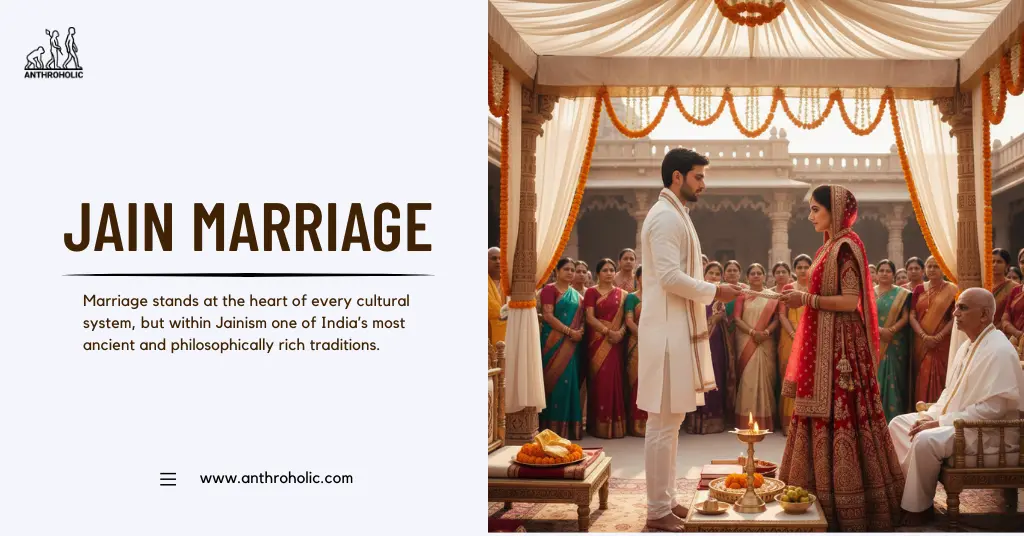
The central rituals of the Jain marriage are characterized by a lack of sacrificial fire (yajna) and a strong presence of Jain munis or scholars, who may recite the sacred Namokar Mantra.
| Ritual | Description | Significance |
| Ghudchadi | The groom’s procession on horseback to the wedding venue. | Symbolic journey of the groom to take up his responsibilities. |
| Kanyadaan | The formal giving away of the bride by her parents. | The transition of the bride from her parental home to her conjugal family. |
| Granthi Bandhan | Tying the ends of the bride’s dupatta and the groom’s scarf together. | The physical and spiritual union of the two individuals and families. |
| Phera/Havan | Walking around a sacred object (often a small table or mandap). The use of the fire Havan is minimal or completely replaced by a Jain Diya or a sacred text. | The couple takes vows to support and respect each other, guided by principles of Jain Dharma. |
| Saptapadi (Seven Steps) | The couple walks seven steps together, articulating seven vows. | These vows focus on mutual respect, spiritual development, financial stability, and care for the family. |
Post-Wedding Ceremonies
- Ashirvada: The couple seeks blessings from family elders and a Jain Muni or Aryika if available, reinforcing the spiritual dimension of the union.
- Jina Griha Darshan: The couple visits a Jain temple (Deravasar or Mandir) to offer prayers to the Tirthankaras, marking their first act as a married couple and dedicating their new life to Dharma.
Modernity, Adaptation, and Change in Jain Matrimony
Anthropological evidence, particularly from studies conducted after 2000, suggests that while the core tenets of exogamy and ethical conduct remain firm, Jain matrimonial practices are adapting significantly, driven by urbanization, globalization, and the increasing agency of youth.
Societal Shifts and Emerging Trends
- Rise of Nuclear Families: The traditional joint family structure, which heavily influenced marriage negotiations, is giving way to nuclear families, leading to a shift in decision-making power.
- Increased Female Education and Agency: According to a 2023 demographic analysis of the Jain community in India, educational attainment among Jain women has significantly increased, leading to a greater demand for equal partnership in marriage and influencing career and life choices post-wedding.
- Inter-sect and Inter-faith Marriages: While historically discouraged, a growing number of Jains are entering into inter-sect marriages (Digambara-Shvetambara), and in metropolitan centers, even inter-faith marriages. These alliances often involve negotiated rituals that incorporate elements from both religious traditions, posing an interesting challenge to traditional Jain identity.
“The preservation of Jain identity in a modern marriage is not just about avoiding prohibited food or customs; it is about finding a contemporary way to practice Ahimsa and ethical non-attachment within a conjugal relationship.”
Technological Integration
The process of mate-selection has been profoundly transformed by technology. The use of Jain-specific matrimonial websites and apps has replaced traditional matchmakers (vichauliyas) to a large extent. This digital selection process expands the geographical pool of potential partners, often across national boundaries (Diaspora Jains), while still filtering for Gotra compatibility and caste preference.
| Feature | Traditional Selection | Modern (Digital) Selection |
| Mechanism | Community elders, matchmakers (vichauliyas), local network. | Matrimonial websites, social media groups, apps. |
| Reach | Limited to local or regional communities. | Global, connecting Jain Diaspora across continents. |
| Focus | Primarily family reputation and wealth. | Equal emphasis on individual’s education, career, and lifestyle fit. |
| Key Constraint | Physical meetings were time-consuming and difficult. | Data verification and the potential for misrepresentation. |
Conclusion
Jain marriages are a fascinating anthropological study in cultural continuity and ethical adaptation. They embody the community’s successful effort to reconcile the imperative of social continuation with the ascetic ideal of liberation. The rituals, while appearing similar to those of neighboring traditions, are fundamentally distinct in their philosophical underpinnings stressing simplicity, non-violence, and a spiritual partnership that supports the couple’s journey toward righteousness (dharma).
As the Jain community globalizes and embraces modernity, the institution of marriage will continue to serve as a crucible for negotiating tradition with change. The rules of Gotra exogamy and the preference for endogamy remain powerful forces that anchor the community’s identity, ensuring that the legacy of Tirthankaras is carried forward through the sacred, albeit social, contract of marriage.
Frequently Asked Questions (FAQs)
Q1: Is the use of fire mandatory in a Jain wedding?
A: No, the use of a sacred fire (Havan) is generally not mandatory and is often minimized or entirely replaced by a Jain Diya (lamp) or the presence of a sacred Jain text. This is done primarily to adhere to the core principle of Ahimsa (non-violence), avoiding harm to any organisms, including the micro-organisms that might be affected by the fire.
Q2: What is the rule of Gotra in Jain marriage?
A: The Gotra rule in Jain marriage is one of strict exogamy. A Jain individual is strictly prohibited from marrying anyone belonging to the same Gotra (paternal lineage). This rule is a foundational mechanism for regulating kinship and preventing incestuous unions, ensuring the healthy continuation of the lineage.
Q3: Do Jain marriages involve dowry?
A: While the official tenets of Jainism discourage elaborate displays of wealth and the practice of dowry is illegal in India, the tradition, like many South Asian traditions, has unfortunately been influenced by regional customs. Many Jain organizations and community leaders actively campaign against the practice of dowry (Dahej), promoting simple, ethical weddings that align with the philosophy of Aparigraha (non-possession).
Q4: Are inter-caste marriages common among Jains?
A: Inter-caste marriages (marrying outside one’s Jati or sub-caste) are increasing but are still not the norm. The majority of Jain marriages remain endogamous (within the same sub-caste) due to strong social and cultural preferences. However, the rise of education and urbanization is leading to greater acceptance, particularly of alliances between different Jain sub-castes (e.g., Digambara and Shvetambara).
Reference List
- Babb, L. A. (1996). Asceticism and Society in Jainism. Oxford University Press.
https://global.oup.com/ - Banks, M. (2019). Ritual, identity, and community among Jains in India. Journal of South Asian Studies, 42(1), 45–62.
https://www.tandfonline.com/ - Cort, J. E. (2001). Jains in the World: Religious Values and Ideology in India. Oxford University Press.
https://global.oup.com/ - Dundas, P. (2002). The Jains (2nd ed.). Routledge.
https://www.routledge.com/ - Laidlaw, J. (1995). Riches and Renunciation: Religion, Economy, and Society among the Jains. Clarendon Press.
https://global.oup.com/ - Sangave, V. A. (1980). Jaina Community: A Social Survey. Popular Prakashan.
https://archive.org/ - Shah, N. J. (1998). Marriage rituals and family patterns among Gujarati Jains. Contributions to Indian Sociology, 32(2), 215–233.
https://journals.sagepub.com/ - Carrithers, M. (1989). Jainism and Jain communities. In R. Burghart & S. Tambiah (Eds.), Ethical Traditions in Indian Civilisation (pp. 72–98). Cambridge University Press.
https://www.cambridge.org/ - Flügel, P. (2006). The social organization of Jain religious communities. International Journal of Jain Studies, 2(1), 1–28.
https://www.soas.ac.uk/ - Jain, J. (2015). Contemporary transformations in Jain marriage practices in India. Indian Anthropologist, 45(1), 59–78.
https://www.jstor.org/

Related Posts