AI Answer Evaluation Platform Live Now. Try Free Answer Evaluation Now

Development of Personality: Nature, Nurture, and Culture
Why do some people seem naturally outgoing while others prefer to stay in the background? Is it something we’re born with-or something we learn?
Personality is more than just a set of traits; it’s a reflection of how we think, feel, and interact with the world. From the earliest moments of childhood, a complex dance of biology, upbringing, and culture begins shaping who we become. Whether a child is raised to obey authority or encouraged to voice opinions can have lasting impacts on adult behavior. These influences may seem subtle at first but go on to form the building blocks of what psychologists and anthropologists call personality.
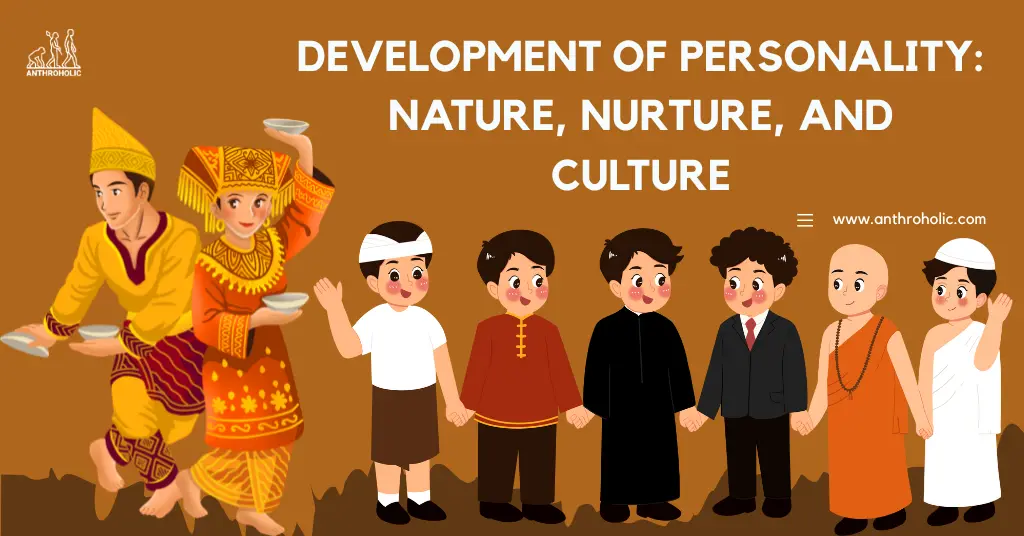
If you’ve ever wondered why cultures produce different “types” of people-or why your upbringing matters-read on. This is personality, decoded.
Understanding Personality Development
Personality refers to the relatively stable patterns of thoughts, emotions, and behaviors that make each person unique. Psychologists like Carl Jung and Sigmund Freud were among the early pioneers trying to understand how personalities form, but today, modern research blends biology, psychology, and culture.
Nature vs. Nurture: A Longstanding Debate
The question of whether we’re born with certain traits (nature) or shaped by our environment (nurture) has long intrigued scientists. Genetic studies show that certain personality traits-like introversion or risk-taking-can be partly inherited. However, how these traits manifest depends heavily on socialization: the lifelong process of learning norms, values, and behaviors.
Socialization: The Early Shaper
From the moment we’re born, social forces begin molding our personality. Parents, caregivers, schools, religion, and peers all play key roles. Culture especially acts as a blueprint, providing models for what’s desirable or unacceptable. Whether a child is praised for obedience or encouraged to speak up, those early cues shape their sense of self.
Dependence and Independence Training
Two of the most studied methods of early socialization are dependence training and independence training-terms introduced by anthropologist Ruth Benedict and later expanded by scholars like John and Beatrice Whiting.
What is Dependence Training?
Dependence training occurs in cultures where group harmony, respect for elders, and social responsibility are emphasized. In these settings, children are encouraged to:
- Stay close to parents or caregivers
- Share toys and food
- Defer to authority
- Value obedience over initiative
These traits are often seen in collectivist societies like Japan, China, or many Indigenous cultures. For example, in rural villages of Kenya or India, children are often raised in extended families and taught to prioritize the group’s needs over their own.
Psychological outcomes of dependence training may include:
- Strong empathy and cooperation
- A high value on tradition and duty
- Discomfort with standing out or self-promotion
What is Independence Training?
In contrast, independence training is common in individualistic societies like the United States, Canada, or Western Europe. Here, children are socialized to:
- Make their own choices
- Develop personal opinions
- Compete and stand out
- Take responsibility for individual success
From a young age, kids might be encouraged to sleep alone, choose their own outfits, or express disagreement with adults-behaviors that may seem disrespectful in more collectivist cultures.
Psychological outcomes of independence training often include:
- Self-confidence and assertiveness
- Higher tolerance for ambiguity
- Emphasis on personal achievement and identity
Not Better or Worse-Just Different
Neither approach is inherently superior. Each prepares individuals to succeed within their cultural framework. Problems often arise when a person raised with one set of expectations enters a culture with different norms-a common challenge for immigrants or third-culture kids.
The Blend: Combined Dependence and Independence
Many societies today are no longer strictly collectivist or individualist. Globalization, urbanization, and technology have led to hybrid cultural norms that promote both social responsibility and self-expression. This creates combined dependence, where children are trained to respect community values while still being encouraged to pursue personal goals.
For example:
- In modern South Korea, students are expected to honor family and elders (dependence), yet also perform competitively in school and career (independence).
- Scandinavian countries like Sweden emphasize social equality and cooperation but also encourage children to explore their identities and opinions.
Psychological traits shaped by this blend:
- Flexibility in social roles
- Balanced self-esteem
- Ability to adapt to diverse environments
This combination may be ideal in multicultural or rapidly changing societies, where both collaboration and initiative are valued.
Group Personality: Modal Personality & National Character
Modal Personality: The Common Cultural Pattern
Coined by anthropologist Cora DuBois, modal personality refers to the most frequently occurring personality traits within a specific culture or community. It doesn’t mean everyone is the same-but that there’s a statistically dominant profile shaped by shared values, institutions, and child-rearing practices.
For example:
- In Pueblo societies of the American Southwest, researchers found high conformity, emotional restraint, and communal responsibility to be common traits.
- Among the Dobu of Papua New Guinea (studied by Ruth Benedict), suspicion and competitiveness were more prominent.
These patterns help anthropologists understand how cultures develop certain norms-and how they sustain them across generations.
National Character: Stereotype or Reality?
National character takes this idea further by associating personality traits with entire nations. While sometimes rooted in oversimplified stereotypes (“Germans are orderly,” “Brazilians are lively”), cross-cultural psychologists like Geert Hofstede have attempted to study these differences more systematically.
His research shows, for instance:
- Americans tend to score high in individualism and low in uncertainty avoidance.
- Japanese culture emphasizes group harmony and high uncertainty avoidance.
However, critics caution that national character studies risk ignoring internal diversity, subcultures, and individual variation.
So, while useful in marketing or international relations, national character should be viewed as a general trend, not a fixed truth.
Normal vs. Abnormal Personality
What Counts as “Normal”?
Defining “normal” personality is surprisingly tricky. In psychology, normal often refers to traits that fall within a cultural average-not too extreme, and socially functional. Traits like kindness, self-control, and emotional stability are usually seen as healthy.
But what’s normal in one culture may be odd in another. For example:
- In the U.S., eye contact is encouraged and interpreted as confidence.
- In some Asian cultures, too much eye contact may seem aggressive or disrespectful.
This cultural relativity is crucial when assessing personality health across global populations.
Abnormal Personality and Disorders
Some personality patterns can be harmful-both to the individual and to others. The DSM-5 (Diagnostic and Statistical Manual of Mental Disorders) defines Personality Disorders as enduring, inflexible patterns of behavior that deviate from cultural expectations and cause distress or dysfunction.
Examples include:
- Borderline Personality Disorder (BPD) – instability in relationships, self-image, and emotions
- Antisocial Personality Disorder (ASPD) – disregard for others’ rights, manipulative behavior
- Obsessive-Compulsive Personality Disorder (OCPD) – extreme perfectionism, control
Such disorders usually become evident in adolescence or early adulthood and require clinical diagnosis and treatment.
It’s important to note that mental health and personality are closely linked, and cultural sensitivity is key in understanding both.
Final Thoughts: Personality Is Culture in Action
Personality isn’t carved in stone at birth-it’s a living, evolving reflection of our upbringing, experiences, and cultural environment. Whether you were raised to obey elders, speak your mind, or strike a balance between both, your social environment has likely shaped your worldview more than you realize.
From dependence and independence training to the influence of modal personality and national norms, we’ve seen how deeply culture penetrates the individual psyche. What’s considered a “normal” personality in one culture might be misunderstood-or even pathologized-in another. That’s why psychologists and anthropologists emphasize cultural context when studying personality traits and behaviors.
In today’s interconnected world, understanding how personality develops across different societies isn’t just academic-it’s practical. It helps educators better support diverse students, allows mental health professionals to treat patients more effectively, and encourages greater empathy in global workplaces and relationships.
In short, the development of personality is a mirror of humanity’s incredible diversity. By learning how we become who we are, we also learn how to better live together.
References
- Dependence and Independence Training
- Anthropologists have identified two general patterns of enculturation based on child-rearing: dependence training and independence training. Different types of child-rearing develop different sets of values and cultural norms. https://www.lensofanthropology.com/chapter-08.html
- Modal Personality
- The term “modal personality” was introduced by anthropologist Cora DuBois in her 1944 monograph The People of Alor: A Social-Psychological Study. It refers to the statistically most common personality traits in a society. https://sk.sagepub.com/ency/edvol/anthropology/chpt/modal-personality
- Overview of Personality Disorders
- Personality disorders involve rigid, maladaptive personality traits that are marked enough to cause significant distress or to impair work and/or interpersonal functioning. https://www.merckmanuals.com/professional/psychiatric-disorders/personality-disorders/overview-of-personality-disorders
- Types of Personality Disorders
- According to the DSM-5, there are ten specific types of personality disorders, categorized into three clusters: Cluster A (odd or eccentric behavior), Cluster B (dramatic or erratic behavior), and Cluster C (anxiety-related behavior). https://www.verywellmind.com/personality-disorders-a2-425427

Related Posts