AI Answer Evaluation Platform Live Now. Try Free Answer Evaluation Now
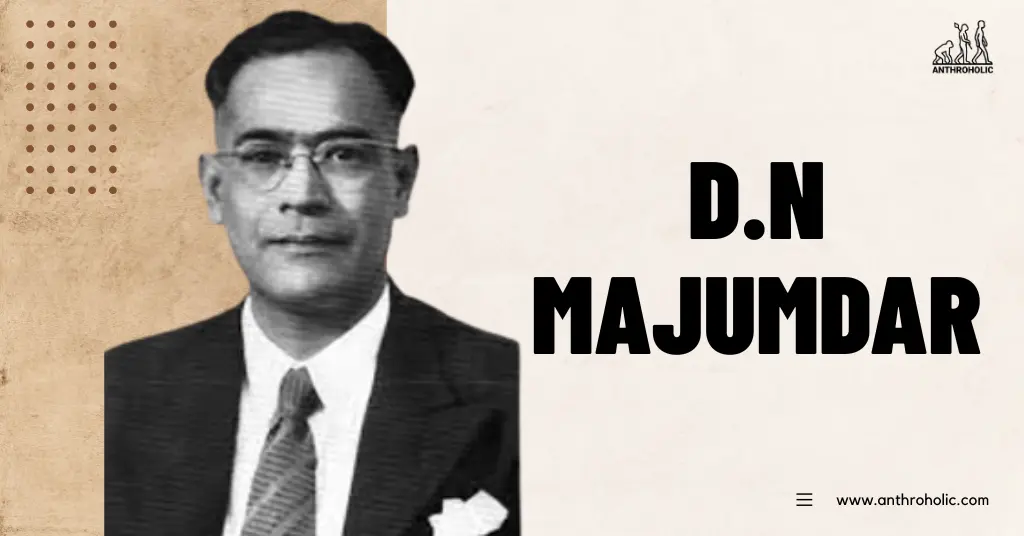
Dhirendra Nath Majumdar (D.N Majumdar)
Dhirendra Nath Majumdar (1903-1960) was one of the founding architects of Indian anthropology who shaped its modern, empirical, and institutional form. Trained in both India and Britain, Majumdar combined tribal ethnography, village studies, and physical anthropology with a keen sense of social policy and development.
As one of the first Indians to integrate field-based functionalism with applied anthropology, he extended the scope of the discipline beyond descriptive tribal monographs to dynamic studies of social change. His works such as A Tribe in Transition (1937), Races and Cultures of India (1944), Caste and Communication in an Indian Village (1958), and Indian Anthropological Studies (1960) mark a bridge between the colonial and post-independence phases of Indian social research.
Majumdar is also remembered as the founder of the Ethnographic and Folk Culture Society and the journal The Eastern Anthropologist, both of which remain vital to Indian anthropological scholarship today.
Early Life and Education
Dhirendra Nath Majumdar was born on 3 June 1903 in Patna (then part of Bengal Presidency, British India) into a middle-class Bengali family. His early education was marked by intellectual curiosity and exposure to both science and humanities.
He graduated from Dacca Government College and pursued his higher studies at the University of Calcutta, where anthropology was just emerging as a new discipline under scholars like L.K. Ananthakrishna Iyer and S.C. Roy. Majumdar earned his Master’s degree in Anthropology in 1924, distinguishing himself as one of the first generation of formally trained Indian anthropologists.
In 1933, Majumdar travelled to Cambridge University for advanced studies, where he came under the influence of Bronislaw Malinowski’s functionalism and the growing body of British social anthropology. He completed his Ph.D. at Cambridge in 1935, after which he returned to India to build a distinctly Indian tradition of anthropological teaching and research.
His academic formation, rooted in both Indian field sensibility and British theoretical rigor, gave him a rare balance between empirical realism and conceptual structure.
Academic Career
Majumdar’s career was primarily associated with the University of Lucknow, where he joined in 1928 as a lecturer in the Department of Economics and Sociology. His vision and dedication led to the creation of a separate Department of Anthropology in 1951, which he headed until his death in 1960.
His early fieldwork among the Ho tribe of Kolhan (Chota Nagpur) in the 1930s formed the basis for his seminal work A Tribe in Transition. This study marked one of the first systematic attempts to understand culture change among Indian tribes, rather than merely describing their customs.
In the 1940s and 1950s, Majumdar expanded his research focus from tribal areas to rural and village India. His later works reflected a growing concern with the dynamics of social mobility, caste communication, and modernization. Caste and Communication in an Indian Village (1958) was among the first Indian studies to examine how communication networks maintained social cohesion within a caste-based system.
Majumdar also played a pivotal institutional role:
- Founded the Ethnographic and Folk Culture Society (EFCS) in 1945, to promote ethnographic and folkloristic studies in India.
- Established the quarterly journal The Eastern Anthropologist, which remains one of India’s most respected anthropology journals.
- Served as President of the Anthropology and Archaeology section of the Indian Science Congress.
- Supervised and mentored numerous students who later became significant figures in Indian anthropology and sociology.
By the time of his untimely death in 1960, Majumdar had firmly established Lucknow University as a national hub for anthropological training and research.
Major Contributions
Majumdar’s contribution to anthropology in India was both theoretical and institutional. His work can be classified into five key domains:
a. Tribal Studies and Culture Change
Majumdar’s early fieldwork among the Ho tribe remains a landmark in Indian ethnography. In A Tribe in Transition (1937), he analyzed the processes of acculturation and culture contact, introducing the concept of the “Cultural Base” defined by four elements: Man, Area, Resources, and Cooperation (MARC).
He emphasized that when the cultural base changes—due to external pressure, resource scarcity, or migration, social institutions also undergo transformation.
b. Physical Anthropology
As a trained biological anthropologist, Majumdar conducted large-scale anthropometric and serological surveys across northern India. He contributed to studies on racial classification, blood group distribution, and genetic diversity, helping link biological variation with cultural adaptation.
c. Village and Rural Studies
Majumdar expanded anthropology’s scope beyond tribal societies to the study of villages and rural India. His village studies emphasized how caste, kinship, and communication networks structure rural life. These studies paved the way for later scholars like M.N. Srinivas and S.C. Dube.
d. Applied and Developmental Anthropology
Majumdar was among the first Indian scholars to argue that anthropology should not remain confined to academic study. He advocated for its application in planning, administration, tribal welfare, and national integration. His approach influenced post-independence anthropological policy, particularly in community development and rural reconstruction programs.
e. Institutional and Editorial Leadership
By founding the EFCS and The Eastern Anthropologist, Majumdar created two lasting platforms that continue to sustain anthropological research and dialogue in India. His vision of a self-reliant academic community free from colonial dependency remains relevant even today.
Theoretical Perspectives and Methodology
Majumdar’s theoretical approach can be described as a functionalist-humanistic synthesis, anchored in empirical fieldwork, social structure, and the processes of change.
- Functionalism and Cultural Integration: Influenced by Malinowski, he saw every society as an integrated whole where institutions fulfill social needs. Yet, he modified this view by emphasizing the role of ecological and cooperative variables (MARC) in maintaining equilibrium.
- Processual Approach to Change: Majumdar treated culture as dynamic, not static. His studies illustrated how contact with markets, schools, and administration led to adaptation rather than simple disruption among tribal and rural communities.
- Interdisciplinary Method: He combined ethnography, physical anthropology, and social statistics,a rare synthesis at that time. His methodological pluralism inspired Indian universities to treat anthropology as a holistic science.
- Applied Orientation: For Majumdar, anthropology was a discipline of “understanding in order to improve.” He envisioned it as a guide for administrators and social planners in a developing India.
- Empirical Rigor: His insistence on field data collection, standardized measurement, and comparison made him one of the most methodologically sound anthropologists of his generation.
Majumdar’s methodological pluralism and applied orientation remain embedded in Indian anthropology’s teaching and research ethos.
Legacy and Influence
D.N. Majumdar’s influence on Indian anthropology is enduring, both intellectually and institutionally.
a. Builder of Institutions
The Anthropology Department at Lucknow University, the EFCS, and The Eastern Anthropologist continue as living symbols of his vision. His leadership helped establish anthropology as a respected discipline in India’s academic landscape.
b. Mentor and Nation-Builder
Majumdar trained several generations of anthropologists and guided research on both tribal and peasant communities. He also advised the government on tribal and development policies, making anthropology relevant to governance and planning.
c. Scholarly Legacy
His concept of the Cultural Base (MARC) continues to be cited in discussions of cultural ecology and development anthropology. His field studies are still referenced for their meticulous detail and balanced analysis of culture change.
d. Reassessment and Continuing Relevance
Recent scholarship has revisited Majumdar’s contributions. The 2017 volume Tribal Studies and Beyond: Contributions of D.N. Majumdar to Indian Anthropology re-evaluates his work in light of postcolonial theory, recognizing him as a bridge between early ethnography and modern social science.
His humanistic vision, institutional foresight, and scientific rigor make him one of the three pillars of modern Indian anthropology, alongside G.S. Ghurye and N.K. Bose.
Conclusion
Dhirendra Nath Majumdar transformed anthropology in India from a colonial, descriptive field into a scientific, socially engaged discipline. His life’s work combined intellectual depth with practical purpose-linking the study of man to the progress of society.
He embodied the anthropologist as both scholar and nation-builder, deeply empirical, theoretically informed, and socially responsible. More than six decades after his passing, Majumdar’s legacy continues to inspire anthropologists, policymakers, and students who seek to understand India through its people, its villages, and its living cultures.
References
- eGyanKosh – IGNOU Anthropology Notes, Unit on Indian Anthropologists.
https://egyankosh.ac.in/bitstream/123456789/90335/1/Unit-15.pdf - Encyclopedia.com – Profile of D.N. Majumdar and his theoretical framework.
https://www.encyclopedia.com/social-sciences/applied-and-social-sciences-magazines/majumdar-d-n - Rawat Publications – Tribal Studies and Beyond: Contributions of D.N. Majumdar to Indian Anthropology (2017).
https://www.rawatbooks.com/anthropology/Tribal-studies-and-beyond - Anthropology India Forum – Biographical note on Prof. D.N. Majumdar.
https://www.anthropologyindiaforum.org/indian-luminaries/professor-dhirendra-n-majumdar - e-Books (INFLIBNET) – Indian Anthropologists Chapter: D.N. Majumdar, Verrier Elwin, and Irawati Karve.
https://ebooks.inflibnet.ac.in/antp10/chapter/d-n-majumder-v-elwin-g-s-ghurye-irawati-karve/

Related Posts