AI Answer Evaluation Platform Live Now. Try Free Answer Evaluation Now

Intercultural Communication
In an increasingly globalized world, the ability to decode the silent languages of culture is no longer just an academic pursuit; it is a survival skill. From the diplomatic boardrooms of the United Nations to the remote villages of the Amazon, the exchange of meaning between individuals of different cultural backgrounds Intercultural Communication serves as the bridge between cooperation and conflict.
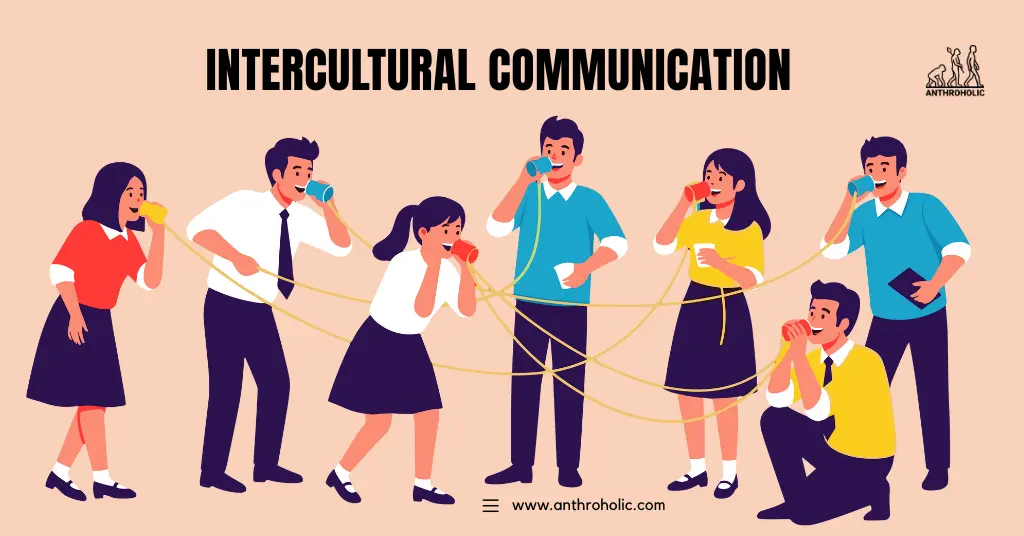
For anthropologists, this field is not merely about language, but about the deeply embedded cognitive maps that dictate how we perceive time, space, and social hierarchy.
Defining Intercultural Communication in Anthropology
Intercultural communication is the study of how people from different cultural backgrounds communicate, in similar and different ways among themselves, and how they endeavor to communicate across cultures. In anthropology, this involves analyzing symbolic systems, non-verbal cues, and the socio-linguistic frameworks that shape human interaction.
While linguistics focuses on the “code” (language), anthropology focuses on the “context.” As Edward T. Hall, a pioneer in the field, famously stated in The Silent Language (1959), “Culture is communication and communication is culture.”
The Significance for UPSC and Academic Scholars
For students of anthropology, understanding these dynamics is crucial for paper-II (Tribal India) and Paper-I (Linguistic Anthropology). It provides the tools to understand how administrative policies may fail when they do not account for the cultural nuances of the communities they serve.
High-Context vs. Low-Context
One of the most enduring contributions to this field is the distinction between High-Context and Low-Context cultures. This framework explains why a simple “yes” can mean “I agree” in one culture and “I hear you (but I disagree)” in another.
In High-Context Cultures (such as Japan, India, and many Arab nations), communication is deeply embedded in the physical context or internalized in the person. The Communication Style is typically implicit, indirect, and layered, requiring the listener to “read between the lines.” There is a heavy Emphasis on non-verbal cues, body language, and the social standing of the participants. Because these societies often value long-term, trust-based Relationships, their Conflict Resolution tends to be indirect to “save face” and maintain communal harmony.
Conversely, Low-Context Cultures (such as the USA, Germany, and Scandinavia) rely on the explicit code of the message. The Communication Style is direct, literal, and precise, with a primary Emphasis on the actual words spoken and factual information. In these environments, Relationships are often more task-oriented and compartmentalized, allowing for Conflict Resolution that is direct, transparent, and focused on immediate solutions rather than social preservation.
Pull Quote: “In high-context cultures, the information is already in the person; very little is in the coded, explicit, transmitted part of the message.” Edward T. Hall
Proxemics and Chronemics
Intercultural communication extends beyond speech into the realms of Proxemics (the use of space) and Chronemics (the use of time).
Proxemics
Anthropologist Edward Hall identified four “distance zones” in Western culture (Intimate, Personal, Social, and Public). However, these boundaries are culturally fluid. In Latin American or Middle Eastern cultures, the “personal” distance is significantly smaller than in North American culture. Misinterpreting these zones often leads to the “dance of the retreating conversationalist,” where one party moves closer to show warmth while the other retreats to maintain comfort.
Chronemics
- Monochronic Cultures: View time as linear and “tangible” (e.g., “spending” or “wasting” time). Punctuality is paramount.
- Polychronic Cultures: View time as fluid and cyclical. Several things can happen at once, and social relationships often take precedence over strict schedules.
Barriers to Effective Intercultural Communication
Even with the best intentions, several anthropological barriers can impede the flow of meaning:
- Ethnocentrism: The tendency to view one’s own culture as the “correct” standard, leading to the devaluation of others’ communication styles.
- Kinesic Variation: Differences in body language. For example, the “thumbs up” gesture is positive in the West but offensive in parts of West Africa and Greece.
- Anxiety and Uncertainty: According to William Gudykunst’s Anxiety/Uncertainty Management (AUM) Theory, high levels of anxiety when meeting “strangers” can cause communicators to rely on stereotypes rather than actual observation.
The “Paperless” Literacy Programs in Rural India (2024-2025)
A recent 2025 ethnographic study on digital literacy in rural Rajasthan highlighted the friction in intercultural communication between urban NGO workers and tribal communities. The workers used Low-Context instructional methods (PDF manuals, direct commands), while the tribal elders expected a High-Context approach (storytelling, communal consensus). The project only succeeded after the communication strategy was shifted to include traditional folk media, proving that the medium must align with the cultural cognitive style.
The Role of Cultural Intelligence (CQ)
In contemporary anthropology, the focus has shifted toward Cultural Intelligence (CQ) the capability to relate and work effectively across cultures. Unlike IQ, CQ can be developed through:
- Cognitive CQ: Knowledge of norms and practices.
- Physical CQ: Adapting one’s speech and body language.
- Emotional CQ: The confidence and desire to adapt.
Conclusion
Intercultural communication is the bedrock of modern anthropological inquiry. As we navigate a world where digital connectivity brings us closer, the “cultural distance” remains a significant factor in human relations. By understanding the nuances of context, time, and space, we move beyond mere tolerance toward a state of Cultural Synergy, where differences are leveraged to create richer, more inclusive societies.
Final Thought: To communicate across cultures is not to lose one’s identity, but to gain a second window through which to view the world.
Frequently Asked Questions (FAQs)
Q1: What is the difference between cross-cultural and intercultural communication? Answer: Cross-cultural communication compares communication patterns between two different cultures (e.g., comparing Japanese vs. American negotiation styles). Intercultural communication focuses on what happens when people from these two cultures actually interact.
Q2: How does “Saving Face” affect communication? Answer: Popular in many Asian cultures, “Face” refers to one’s social reputation or dignity. Intercultural communication in these contexts often involves “Face-work” using indirect language to avoid embarrassing the other person or oneself.
Q3: Can Intercultural Communication be learned, or is it innate? Answer: It is a learned skill. Anthropologists emphasize that while we are socialized into our “home” culture, we can develop “intercultural competence” through exposure, reflexivity, and study of different symbolic systems.
Q4: Is English the “Universal Language” of intercultural communication? Answer: While English is a lingua franca for business, it does not eliminate cultural barriers. People often speak “Global English” while still using the non-verbal cues and logic of their native culture, leading to “pragmatic failure.”
References
- Gudykunst, W. B. (2003). Bridging Differences: Effective Intergroup Communication. SAGE Publications. https://books.google.com/books?id=P7N1AwAAQBAJ
- Hall, E. T. (1959). The Silent Language. Anchor Books. https://www.worldcat.org/title/silent-language/oclc/208881
- Hofstede, G. (2011). Dimensionalizing Cultures: The Hofstede Model in Context. Online Readings in Psychology and Culture. https://doi.org/10.9707/2307-0919.1014
- Spencer-Oatey, H., & Franklin, P. (2024). Intercultural Interaction: A Multidisciplinary Approach to Intercultural Communication. Palgrave Macmillan. https://link.springer.com/book/10.1057/9780230244511
- Thomas, D. C., & Inkson, K. (2025). Cultural Intelligence: Living and Working Globally. Berrett-Koehler Publishers. https://www.bkconnection.com/books/title/cultural-intelligence

Related Posts