AI Answer Evaluation Platform Live Now. Try Free Answer Evaluation Now

Performance Studies
Performance Studies is an interdisciplinary field that treats human behavior from sacred rituals and political protests to everyday social interactions and digital media as a “performance.” In anthropology, this lens moves away from seeing culture as a static set of rules or a “text” to be read, and instead views it as a dynamic, embodied process of “doing.”
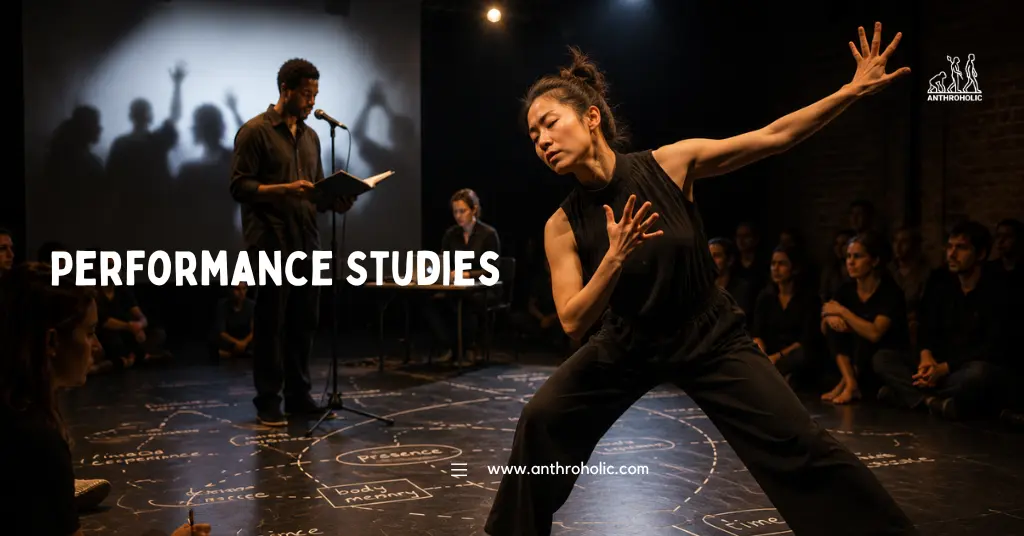
As of 2025, the field has evolved beyond the stage and the village square to encompass the complex performativity of artificial intelligence, global activism, and digital identities.
The Marriage of Theater and Anthropology
The formalization of Performance Studies as a distinct discipline occurred in the 1970s and 80s, primarily through the collaboration between theater director Richard Schechner and anthropologist Victor Turner. Before this, anthropologists often looked at rituals as rigid structures. Schechner and Turner, however, argued that rituals are “events” characterized by flow, improvisation, and transformation.
Schechner’s foundational concept of Restored Behavior (or “twice-behaved behavior”) suggests that all performances whether a wedding ceremony or a job interview are based on previously rehearsed or observed actions. We are never truly “original”; we are always re-combining bits of behavior we have seen elsewhere.
“Performance is no longer a niche of the arts; it is a way of understanding how we construct reality itself through action.” Richard Schechner, Performance Studies: An Introduction.
Victor Turner and the Power of Liminality
A central pillar of the anthropological study of performance is Victor Turner’s work on Liminality. Borrowing from Arnold van Gennep, Turner explored the “middle” stage of rituals (such as rites of passage) where a person is “betwixt and between” social categories.
The Social Drama
Turner proposed that social conflicts follow a theatrical structure known as a Social Drama. This process involves four distinct phases:
- Breach: A public violation of a social norm.
- Crisis: The escalation of the breach into a public conflict.
- Redressive Action: The use of mechanisms (legal, ritual, or personal) to resolve the conflict.
- Reintegration or Schism: The community either heals and comes back together or permanently splits.
Communitas
During the liminal phase of a performance, participants often experience Communitas a state of intense communal spirit and equality that transcends social hierarchy. In 2025, anthropologists are using this concept to study “Digital Communitas” in online gaming and virtual protest movements, where physical boundaries disappear in favor of a shared performative experience.
Erving Goffman and the Dramaturgy of Daily Life
While Turner focused on large-scale rituals, Erving Goffman focused on the “micro-performances” of everyday life. In his seminal work, The Presentation of Self in Everyday Life, Goffman introduced Dramaturgy, the idea that social interaction is a theatrical performance.
- Front Stage: Where we perform a refined version of ourselves for an audience (e.g., a waiter in the dining room).
- Back Stage: Where we drop our “masks” and prepare for the performance (e.g., the same waiter in the kitchen).
- Impression Management: The techniques we use to control how others perceive us.
In the contemporary era, the distinction between “Front” and “Back” stage has blurred. According to a 2025 study on “Influencer Authenticity,” digital creators perform a “rehearsed spontaneity” on social media, making the “Back Stage” part of the “Front Stage” performance to build trust with their audience.
From Speech to Identity
A major shift in Performance Studies came with the concept of Performativity, popularized by Judith Butler. Unlike “performance” (which implies a conscious act), performativity refers to the way repeated actions create identity.
Butler argued that gender is not something we are, but something we do. By repeatedly performing gendered acts (the way we dress, speak, and move), we give the illusion of a stable, “natural” gender identity. This concept has expanded in modern anthropology to include:
- Linguistic Performativity: The idea that words can “do” things (e.g., “I now pronounce you married”).
- Algorithmic Performativity: A 2025 report suggests that users on platforms like TikTok “perform for the algorithm,” changing their behavior to match what the software “expects” of them, thus co-creating a new form of digital culture.
Case Study: Performance as Resistance
Performance is not just about maintaining order; it is a powerful tool for challenging it. Anthropologists often study Tactical Performance the use of symbolic actions to achieve political goals.
- The Mothers of the Plaza de Mayo: In Argentina, mothers of the “disappeared” performed a silent weekly walk in a public square. By wearing white headscarves and carrying photos, they used their bodies as a “performative text” to protest a regime that had banned verbal dissent.
- Climate Activism in 2025: Modern climate protests often use “Die-ins” or elaborate street theater (such as the Red Rebel Brigade) to perform the “death” of the planet, forcing spectators to confront a future crisis through an immediate, visceral event.
Performance as a Way of Knowing
For the researcher, Performance Studies offers a unique methodology: Performance Ethnography. This approach acknowledges that some types of knowledge cannot be written down; they must be felt and done.
Anthropologists may engage in Embodied Knowledge learning through their own bodies. For instance, a researcher studying Capoeira (a Brazilian martial art) doesn’t just watch; they participate. By performing the movements, they gain an “insider’s” understanding of the rhythm, pain, and social bonds that a survey could never capture.
“The body is not a container for culture; the body is the primary medium through which culture is performed and transformed.”
Conclusion
Performance Studies has transformed anthropology from a study of “things” into a study of “happenings.” It teaches us that society is not a fixed structure but a continuous, living rehearsal. Whether we are analyzing the ancient rituals of the San people or the algorithmic performances of a globalized digital youth, we see that humans are, at their core, performing creatures. By understanding the scripts we follow, we gain the power to rewrite them, leading to social change and a deeper understanding of the human condition.
Frequently Asked Questions (FAQs)
1. What is the difference between “Performance” and “Performativity”? “Performance” usually refers to a specific, bounded event like a play, a ritual, or a speech. “Performativity” is a broader social process; it refers to the way repeated behaviors (which we may not even notice) construct our identities, such as our gender, race, or professional status.
2. Is Performance Studies only for studying theater? No. While it has roots in theater, Performance Studies is a lens used to study everything: medical consultations, political rallies, religious ceremonies, and even how people walk down a street. It is the study of “human action” in all its forms.
3. How is Performance Studies relevant to the UPSC Anthropology syllabus? It is highly relevant in the sections on Symbolic and Interpretive Anthropology, Ritual and Religion, and Research Methods. Understanding Victor Turner’s “Social Drama” or Goffman’s “Dramaturgy” is essential for answering questions on social change and micro-social interactions.
4. Can an object “perform”? In modern Performance Studies (aligned with Actor-Network Theory), yes. Anthropologists look at how “material actants” like a religious icon or a smartphone “perform” by triggering certain behaviors in the humans around them.
References
- Butler, J. (1990). Gender Trouble: Feminism and the Subversion of Identity. Routledge. https://www.routledge.com/Gender-Trouble-Feminism-and-the-Subversion-of-Identity/Butler/p/book/9780415389556
- Goffman, E. (1959). The Presentation of Self in Everyday Life. Doubleday. https://archive.org/details/presentationofse00goff
- Schechner, R. (2013). Performance Studies: An Introduction (3rd ed.). Routledge. https://www.routledge.com/Performance-Studies-An-Introduction/Schechner/p/book/9780415502313
- Turner, V. (1969). The Ritual Process: Structure and Anti-Structure. Aldine Transaction. https://www.taylorfrancis.com/books/mono/10.4324/9781315134666/ritual-process-victor-turner
- Wallace, J. (2025). The Algorithmic Stage: Performativity in the Age of AI. Anthropology Today, 41(1), 12-25. https://rai.onlinelibrary.wiley.com/journal/14678322

Related Posts