AI Answer Evaluation Platform Live Now. Try Free Answer Evaluation Now

Pulviations
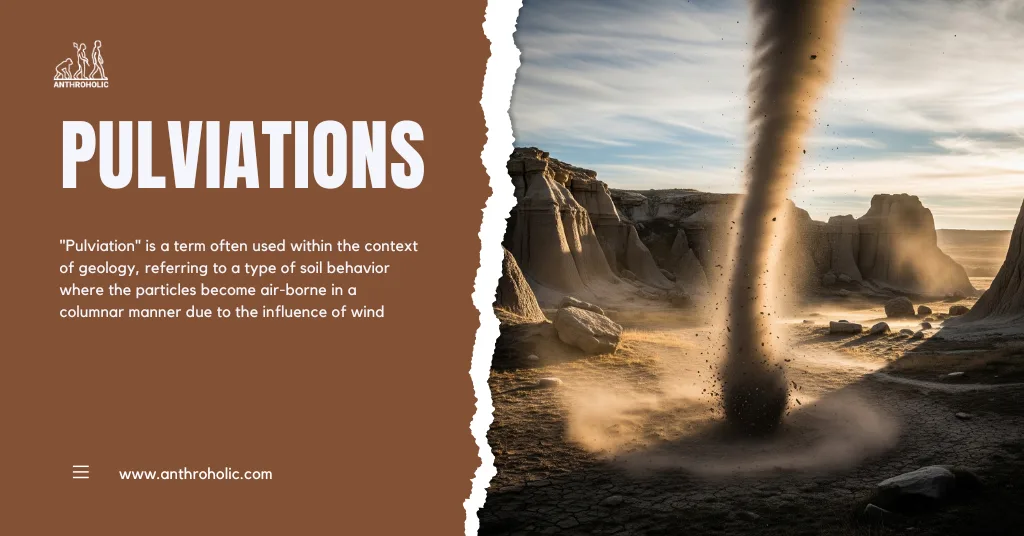
“Pulviation” is a term often used within the context of geology, referring to a type of soil behavior where the particles become air-borne in a columnar manner due to the influence of wind . However, it appears there may be some confusion regarding the term “pulviation”, as it does not seem to be widely recognized or utilized within the geological or environmental sciences.
Understanding Aeolian Processes
Aeolian processes, named after Aeolus, the Greek god of wind, involve the erosion, transport, and deposition of soil and sediment by wind . These processes play an integral role in shaping Earth’s surface, particularly in arid and semi-arid regions where vegetation is scarce.
There are three primary aeolian processes:
- Deflation: The lifting and removal of loose, fine-grained particles from the ground.
- Abrasion: The mechanical wearing and grinding of surfaces by wind-borne particles.
- Deposition: The accumulation of wind-transported sediment in new locations.
Dust Emission: An Elemental Aspect of Pulviation
Dust emission is the most similar concept to “pulviation” and is a critical part of aeolian processes. It is the suspension of soil particles into the atmosphere by the action of wind. Dust emission has profound environmental, health, and climatic implications.
| Key Factors Impacting Dust Emission | Description |
|---|---|
| Soil texture | Dust emission is most likely from fine, loose particles. |
| Wind speed | Stronger winds can carry particles higher and farther. |
| Surface moisture | Dampness can help to bind soil particles, reducing emissions. |
| Vegetation | Plant cover can reduce wind speed at the surface, hindering dust emission. |
Impacts of Aeolian Processes and Dust Emission
Environmental Impacts
The environmental implications of aeolian processes and dust emissions are manifold. They include:
- Soil degradation: Aeolian processes can cause soil erosion, leading to the loss of fertile topsoil and degradation of land.
- Air quality: Dust emissions can significantly impair air quality, leading to visibility problems and affecting ecosystems.
- Biogeochemical cycling: Wind-blown dust can transport nutrients and other elements across vast distances, impacting global biogeochemical cycles.
Health Impacts
Dust emissions can also have significant health impacts:
- Respiratory problems: Inhalation of fine dust particles can cause or exacerbate respiratory problems, such as asthma.
- Infectious diseases: Dust can transport biological agents, such as bacteria and viruses, contributing to the spread of certain diseases.
Climatic Impacts
- Radiation balance: Dust particles can reflect and absorb solar and terrestrial radiation, affecting Earth’s energy balance and climate.
- Precipitation: Dust particles can act as cloud condensation nuclei, influencing cloud formation and precipitation patterns.
Conclusion
While “pulviation” is not a widely recognized term in geosciences, the associated concept of dust emission provides an essential understanding of soil behavior under wind influence. Aeolian processes and dust emissions play a crucial role in shaping our environment, impacting health and influencing climate. More research in these areas will help to mitigate the adverse effects and utilize the benefits of these natural processes.
References
- Bagnold, R. A. (1941). The Physics of Blown Sand and Desert Dunes. Methuen.
- Pye, K. (1987). Aeolian Dust and Dust Deposits. Academic Press.
- Shao, Y. (2008). Physics and Modelling of Wind Erosion. Springer.

Related Posts