AI Answer Evaluation Platform Live Now. Try Free Answer Evaluation Now
Material and Non-material Culture
Short answer: Material culture is the physical side of culture: the objects people make and use, such as tools, houses, clothes, food and smartphones. Non-material culture is the intangible side: values, norms, beliefs, language and symbols. The two shape each other, and when technology changes faster than norms and laws, the gap is called “cultural lag” [2].
Key takeaways
- Material culture can be seen and touched: a Harappan seal, a saree, a temple, a plough, a smartphone.
- Non-material culture exists in people’s minds and shared practice: respect for elders, gotra rules, a language, the meaning of a festival.
- The terms were made popular by the American sociologist William F. Ogburn in Social Change with Respect to Culture and Original Nature (1922) [2].
- Every object carries meaning: a wedding mangalsutra is material, but what it stands for is non-material.
- Cultural lag happens when non-material culture (norms, laws) is slow to adjust to new material culture (technology) [2].
Culture plays a crucial role in molding the social structure, beliefs, behaviors, and identities of societies across the globe. Anthropologists and sociologists commonly divide culture into two categories, material culture and non-material culture, a distinction made popular by the sociologist William F. Ogburn in 1922 [2].
Material Culture
Material culture refers to the physical objects, artifacts, and spaces that people create and use to define their culture. These items are tangible and observable, embodying the values, beliefs, norms, and technologies of a society.
Examples of Material Culture
Material culture can manifest in numerous forms:
- Architecture: The buildings, monuments, and spaces people create, like the pyramids of Egypt, the Eiffel Tower in France, or the Great Wall of China. These architectural works reflect the technological abilities, aesthetics, and beliefs of their creators [1].
- Art: Paintings, sculptures, pottery, and other artistic creations. For instance, Renaissance art is a testament to the period’s religious and philosophical beliefs.
- Technology: Tools and machinery. Stone tools from prehistoric cultures to the modern smartphones demonstrate the progression of human innovation.
- Clothing: Traditional dresses like Japanese kimonos or Scottish kilts symbolize cultural identity.
- Food: Specific cuisines associated with cultures, like Italian pasta or Indian curry, are part of material culture.
Table 1. Some Examples of Material Culture
| Category | Example | Description |
|---|---|---|
| Architecture | Pyramids of Egypt | Reflects ancient Egyptian engineering, religious beliefs |
| Art | Renaissance paintings | Symbolizes religious and philosophical beliefs of the era |
| Technology | Smartphones | Signifies contemporary technological capabilities |
| Clothing | Scottish kilts | Represents cultural identity |
| Food | Indian curry | Exemplifies cultural tradition and taste preferences |
Non-Material Culture
Non-material culture refers to the intangible aspects of a society’s culture, including values, norms, language, beliefs, and symbolic meanings. It represents the unseen spiritual and intellectual substance of a society’s culture [2].
Examples of Non-Material Culture
Non-material culture encompasses a broad range of elements, such as:
- Values: The deeply ingrained principles that guide behavior, like respect for elders in Asian cultures.
- Norms: The expectations or rules within a society, like the driving laws or social etiquette.
- Language: The spoken and written words, gestures, and other communication forms that carry cultural meanings.
- Beliefs: Religious, spiritual, or philosophical convictions.
- Symbols: Items or signs that carry particular meanings, like a nation’s flag representing patriotism and national identity.
| Category | Example | Description |
|---|---|---|
| Values | Respect for elders in Asian cultures | Defines societal principles and guides behavior |
| Norms | Social etiquette | Establishes rules for social interaction |
| Language | English | Communication medium carrying cultural meanings |
| Beliefs | Christianity | Expresses religious convictions |
| Symbols | American Flag | Symbolizes patriotism and national identity |
Material vs non-material culture: key differences
| Basis | Material culture | Non-material culture |
|---|---|---|
| Meaning | Physical objects people make, use and value | Ideas, values, norms, beliefs, language and symbols |
| Nature | Tangible: can be seen, touched and measured | Intangible: exists in minds and shared behaviour |
| Examples | Tools, houses, temples, clothes, food, vehicles, smartphones | Respect for elders, marriage rules, religion, language, a flag’s meaning |
| How it is studied | Artefacts, museums, archaeology, ethnoarchaeology | Fieldwork, interviews, participant observation, texts |
| Speed of change | Usually faster (new inventions spread quickly) | Usually slower; this creates cultural lag [2] |
| After a society disappears | Often survives as archaeological remains | Mostly lost unless written down or remembered |
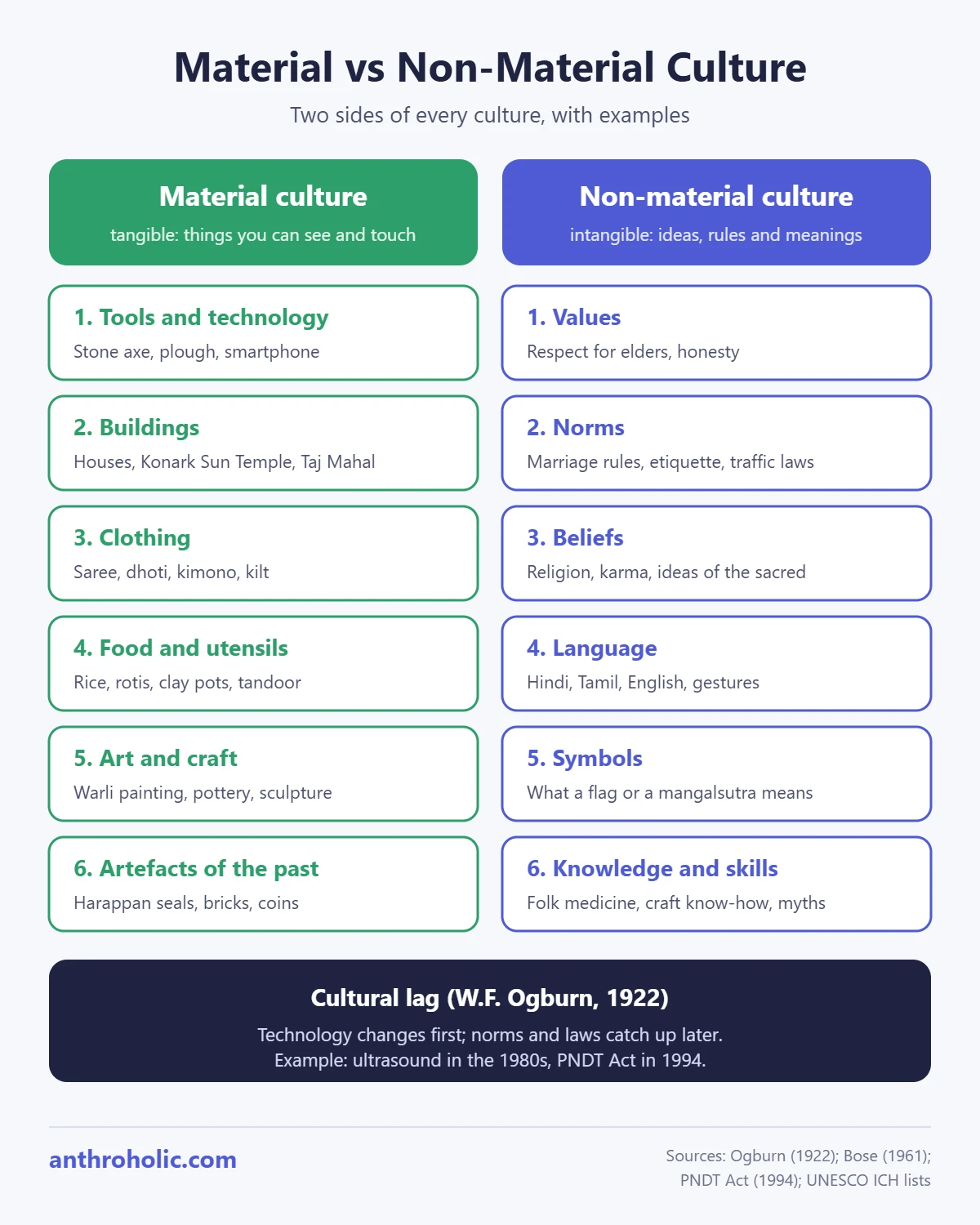
Examples of material and non-material culture from India
| Material culture (things) | Non-material culture (ideas and rules) |
|---|---|
| Harappan seals, bricks and drains | The Harappan script, still undeciphered |
| Konark Sun Temple, village shrines | Beliefs about the sacred, pilgrimage, rituals |
| Saree, dhoti, turban, tribal ornaments | Ideas of modesty, status and identity those clothes express |
| Plough, oil press, house types (studied by N.K. Bose [7]) | Caste and jajmani relations around village work |
| Warli and Madhubani paintings | The myths and stories the paintings tell |
| Smartphones and UPI payments | New norms about privacy, money and online behaviour |
| Books, signboards, printed scripts | The 22 languages in the Eighth Schedule of the Constitution [9] |
| Kumbh Mela ghats, Durga Puja pandals, Garba costumes | The festivals themselves, listed by UNESCO as intangible cultural heritage: Kumbh Mela (2017), Durga Puja in Kolkata (2021), Garba of Gujarat (2023) [10] |
The anthropologist Nirmal Kumar Bose surveyed material traits such as house types, ploughs and oil presses across India in Peasant Life in India (1961) and found an underlying unity of material culture beneath regional diversity [7].

The Relationship Between Material and Non-Material Culture
Material and non-material cultures are not isolated but interact and influence each other constantly. For instance, a society’s values (non-material culture) often influence its architecture and art (material culture). Conversely, technological innovations (material culture) can impact societal norms and behaviors (non-material culture) [3].
Cultural lag: when material culture changes faster
Ogburn argued that the parts of a culture change at different speeds. Material culture, especially technology, usually changes first. The “adaptive culture” of customs, beliefs and laws that tells people how to use the new things adjusts later, and the gap between the two is cultural lag [2].
- Ogburn’s own example: factory machinery raised the number of industrial accidents, but laws on compensating injured workers in the United States took decades to catch up [2].
- An Indian example: ultrasound scanners spread in the 1980s and were misused to find the sex of the foetus. The law caught up with the Pre-Natal Diagnostic Techniques Act, 1994, renamed the PCPNDT Act in 2003 [8].
- Digital life: smartphones and social media spread faster than shared norms about privacy, misinformation and screen time [11].
Critics point out that the line between material and non-material culture is not sharp, and that ideas and values can also drive technology rather than only follow it. Read more in our article on cultural lag and cultural change.
Exploring Material Culture
Material culture studies involve a multi-disciplinary approach. Archaeologists, anthropologists, and historians all study material culture, focusing on how human-made artifacts reveal clues about societies, their values, lifestyles, and technologies. This exploration often involves examining the production methods, usage, and societal significance of various artifacts [4].
Importance of Material Culture
Material culture serves as the tangible evidence of a society’s history and cultural practices:
- Historical Documentation: Artifacts serve as physical records of history, providing evidence of past societies, events, and lifestyles.
- Cultural Expression: Material culture offers insights into the aesthetic tastes, religious practices, and technological prowess of a society.
- Identity Representation: Objects like national flags, traditional clothing, and monuments often symbolize a culture’s identity and heritage.
Material culture studies in anthropology today
- Archaeology reconstructs past societies almost entirely from material culture; see archaeological anthropology.
- Ethnoarchaeology studies how living communities make, use and discard objects, to help interpret archaeological remains; see ethnoarchaeology.
- Museums collect and display material culture, and today also debate how objects were acquired and whether to return them.
- Digital material culture: anthropologists such as Daniel Miller study phones, apps and social media as part of everyday material life [6] [11].
- Heritage: UNESCO separates tangible heritage (monuments, objects) from intangible heritage (festivals, crafts knowledge, performing arts), a policy version of the same distinction [10].
Diving into Non-Material Culture
Non-material culture, though intangible, is equally significant in understanding societal norms, beliefs, and behaviors. Sociologists, anthropologists, and linguists are some of the professionals involved in studying non-material culture, deciphering its influence on societal structures, identities, and worldviews [5].
Importance of Non-Material Culture
Non-material culture holds significant weight in shaping society’s norms, behaviors, and values:
- Social Cohesion: Shared norms, values, and beliefs foster a sense of community, encouraging societal unity.
- Behavior Regulation: Societal norms guide individual behavior and help maintain societal order.
- Cultural Continuity: Language, folklores, traditions, and beliefs ensure the transmission of cultural heritage across generations.
The Interplay between Material and Non-material Culture
The interaction between material and non-material culture shapes our world in profound ways. Changes in one often lead to changes in the other, creating a dynamic, ongoing cultural evolution. For example, technological advances (material culture) have led to new modes of communication, transforming societal norms and behaviors (non-material culture). Conversely, shifts in societal values and norms (non-material culture) can drive innovation and change in material culture [6].
Conclusion
In conclusion, culture is a complex whole made up of both tangible objects and intangible ideas. Material culture provides a physical testament to a society’s progression, creativity, and technology. In contrast, non-material culture carries the unseen, yet essential aspects of societal values, norms, and beliefs. Understanding both these facets is crucial to grasping a society’s complete cultural identity.
For UPSC aspirants
Where it fits: Anthropology Optional Paper I, 2.1 (the nature of culture) and theories of culture change; Paper II, 1.3 (ethnoarchaeology in India) for material culture [12].
Questions asked: “William Ogburn and Cultural lag” (2023, Paper I, 10 marks) and “Material culture and archaeology” (2023, Paper II, 10 marks).
- Define both terms in one line each and credit Ogburn (1922).
- Give a comparison table and at least two Indian examples for each side.
- Explain cultural lag with one Indian example (PCPNDT Act or digital technology).
- Link material culture to archaeology and ethnoarchaeology, and cite N.K. Bose for Indian peasant material culture.
Frequently asked questions
What is non-material culture?
Non-material culture is the intangible part of culture: the values, norms, beliefs, language, knowledge and symbols that members of a society share and pass on.
What are 5 examples of material culture?
Tools, houses and temples, clothing such as the saree or kimono, food and cooking utensils, and modern technology such as smartphones.
What are 5 examples of non-material culture?
Values (respect for elders), norms (traffic rules, etiquette), language (Hindi, Tamil, English), beliefs (karma, religion) and symbols (the meaning of a national flag).
Who gave the concept of material and non-material culture?
The American sociologist William F. Ogburn made the distinction popular in Social Change with Respect to Culture and Original Nature (1922), where he also proposed the idea of cultural lag.
Is language material or non-material culture?
Language is non-material culture. Books, signboards and phones that carry language are material culture.
Is food material or non-material culture?
Food itself and cooking tools are material culture. Rules about what may be eaten, with whom and when, such as fasting or food taboos, are non-material culture.
What is cultural lag?
Cultural lag is the delay between a change in material culture, usually technology, and the matching change in non-material culture such as norms and laws.
References
[1] Trigger, B. G. (2006). A History of Archaeological Thought (2nd ed.). Cambridge University Press. doi.org/10.1017/CBO9780511813016
[2] Ogburn, W. F. (1922). Social Change with Respect to Culture and Original Nature. New York: B. W. Huebsch. archive.org
[3] Malafouris, L. (2013). How things shape the mind: A theory of material engagement. MIT Press.
[4] Hicks, D., & Beaudry, M. C. (2010). The Oxford Handbook of Material Culture Studies. Oxford University Press. http://dx.doi.org/10.1093/oxfordhb/9780199218714.001.0001
[5] Geertz, C. (1973). The Interpretation of Cultures. Basic Books.
[6] Miller, D. (2010). Stuff. Polity.
[7] Bose, N. K. (1961). Peasant Life in India: A Study in Indian Unity and Diversity. Memoir No. 8. Calcutta: Anthropological Survey of India.
[8] Government of India. The Pre-Conception and Pre-Natal Diagnostic Techniques (Prohibition of Sex Selection) Act, 1994 (as amended in 2003).
[9] Constitution of India, Eighth Schedule (Languages).
[10] UNESCO. Intangible Cultural Heritage lists: Kumbh Mela (2017), Durga Puja in Kolkata (2021), Garba of Gujarat (2023). ich.unesco.org
[11] Miller, D., et al. (2016). How the World Changed Social Media. London: UCL Press. doi.org/10.14324/111.9781910634493
[12] Union Public Service Commission. Civil Services (Main) Examination syllabus: Anthropology, Papers I and II.

Related Posts