
AI Answer Evaluation Platform Live Now. Try Free Answer Evaluation Now


Palynology
Palynology is the study of pollens, spores and other associated microscopic organisms in living as well as fossilised forms.

Palynology is the study of pollens, spores and other associated microscopic organisms in living as well as fossilised forms.

Dendrochronology is the method of scientifically dating past events and reconstructing environments using tree rings.

Legal anthropology includes the study of legal ordering of bands, tribes, rural villages and urban neighborhoods.

Ethnomusicology is a field of knowledge that investigates the art of music as a physical, psychological, cultural and aesthetic phenomenon

Maritime archaeology is the detailed study of human interaction with oceans, lakes, rivers and other water bodies through material remains like ships, vessels and cargoes etc.
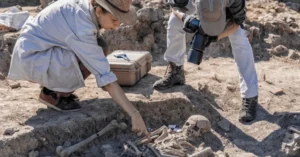
Archaeometry is a set of scientific techniques used in archaeological investigations. It implements principles from physics
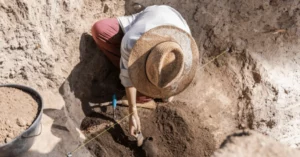
Archaeological science is the integration of scientific analysis and principles in investigating archaeological finds. Though science and archaeology have had a 200 year old relationship,
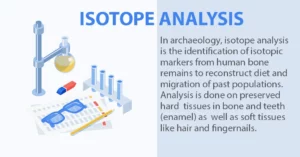
In archaeology, isotope analysis is the identification of isotopic markers from human bone remains to reconstruct diet and migration of past populations.

Protohistory is the cultural process between history and prehistory. It is marked by absence of language or script that can be deciphered.
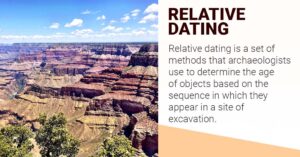
Relative dating is a set of methods that archaeologists use to determine the age of objects based on the sequence in which they appear in a site of excavation.

Absolute dating is the technique by which researchers calculate the exact age of any specimen using a wide range of scientific principles and phenomena. Since archaeological material is found in geological contexts like mounds, valleys, exposed sections of river etc. both fields utilise absolute dating during research.