
AI Answer Evaluation Platform Live Now. Try Free Answer Evaluation Now

B.S. Guha
Baidyanath Saraswati Guha (commonly known as B.S. Guha) was one of the pioneering figures of Indian anthropology and physical anthropology in particular. Often regarded as the “Father of Physical Anthropology in India,” he played a crucial role in institutionalizing the discipline in the country during the early and mid-20th century. His work bridged Western anthropological methods with Indian realities, laying the foundation for anthropological surveys, racial classification studies, and applied anthropology in India.
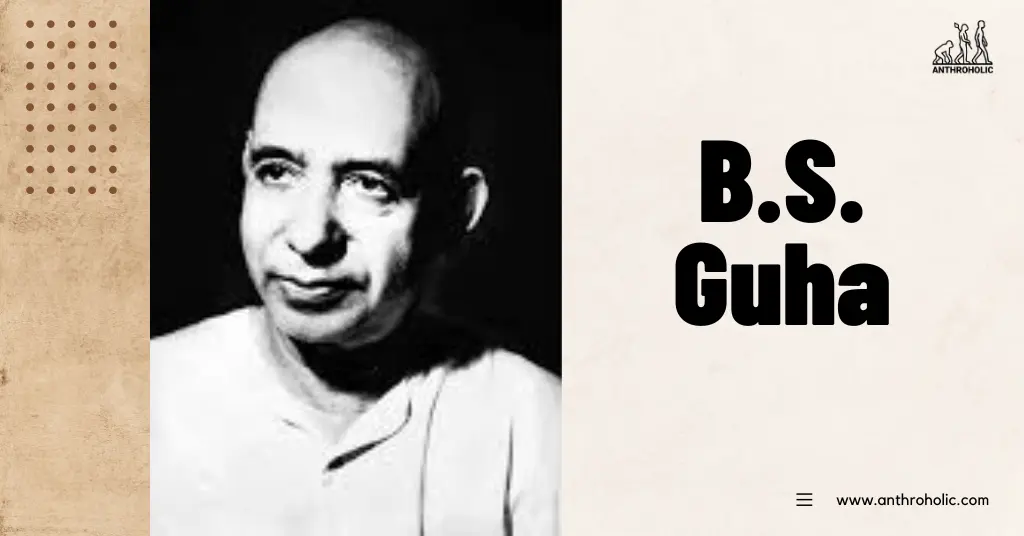
As the first Director of the Anthropological Survey of India (ASI), Guha spearheaded systematic studies of India’s diverse populations, emphasizing physical anthropology, demography, and ethnography. His contributions went beyond academia he helped shape anthropology as a tool for understanding India’s complex cultural and biological diversity, which was particularly significant during the transition from colonial rule to independent nation-building.
Guha’s legacy rests on his efforts to define anthropology in India as both a scientific and applied discipline, blending physical measurements with cultural and social studies to provide a holistic understanding of human variation.
Early Life & Education
Baidyanath Saraswati Guha was born in 1894 in India, at a time when anthropology as a formal discipline had not yet taken deep roots in the country. He grew up during the late colonial period, which exposed him to both Indian cultural traditions and the growing influence of Western scientific education.
Guha pursued higher education at Calcutta University, which was one of the earliest centers for anthropological and ethnological studies in India. He showed a strong inclination towards the study of human variation and biology, leading him to specialize in physical anthropology. Recognizing his potential, he went abroad for advanced training, where he studied under leading anthropologists of the time in Europe.
He later earned a Ph.D. in Anthropology from the University of Cambridge, where he was deeply influenced by the traditions of European physical anthropology, racial classification methods, and human biology research. This exposure equipped him with both theoretical and methodological tools that he would later apply in the Indian context.
His educational journey bridging Indian and Western institutions enabled him to emerge as one of the first professionally trained anthropologists of India, uniquely positioned to build the foundations of the subject within the country.
Major Works & Contributions
B.S. Guha’s career was marked by a wide range of pioneering contributions, particularly in physical anthropology, demographic studies, and institutional development. His work gave Indian anthropology a strong scientific foundation and expanded its scope beyond academic inquiry to practical application.
a) Racial Classification of Indian Populations
Guha is best known for his attempt to classify the Indian population into distinct racial and ethnic groups. Using anthropometric surveys (especially cephalic index, nasal index, and stature measurements), he identified several racial strains in India, such as Negrito, Proto-Australoid, Mongoloid, Mediterranean, and Nordic. His racial typology became a reference point in Indian anthropology for decades, though it has since been revised and critiqued.
b) Role in Census and Demographic Studies
Guha made a landmark contribution by serving as the Superintendent of Census Operations (1931). He introduced anthropological perspectives into demographic data, using anthropometry to study India’s biological diversity. This census included extensive anthropological observations, marking one of the first systematic efforts to link population statistics with physical anthropology.
c) Establishment of Anthropological Survey of India (ASI)
In 1945, Guha became the first Director of the Anthropological Survey of India, which was separated from the Zoological Survey. Under his leadership, ASI became the premier institution for anthropological research in India. He encouraged studies on tribal communities, caste groups, and the integration of physical, cultural, and social anthropology.
d) Contributions to Applied Anthropology
Guha believed anthropology should not remain a purely academic subject but should serve the needs of a developing society. He worked on tribal welfare policies, race relations, and practical aspects of anthropology in health, nutrition, and social planning. His approach made anthropology relevant to India’s challenges in nation-building after independence.
e) Key Publications
- Racial Elements in the Indian Population (1935) His most influential work, outlining his racial classification of India.
- Census Reports (1931) Integrating anthropological data into official statistics.
- Numerous research papers on racial types, tribal studies, and applied anthropology.
Through these contributions, B.S. Guha firmly established himself as the leading physical anthropologist of India and one of the key figures in shaping the discipline during its formative years.
Role in Indian/World Anthropology
B.S. Guha played a foundational role in the growth of anthropology in India, while also making his presence felt in global scholarly circles. His contributions can be understood at two levels:
a) Role in Indian Anthropology
- Institution Builder: By establishing and leading the Anthropological Survey of India (ASI), Guha institutionalized anthropology as a discipline in India. ASI became the hub for systematic ethnographic, linguistic, and physical studies of India’s diverse communities.
- Promoter of Physical Anthropology: Guha emphasized anthropometry, racial classification, and biological studies, making physical anthropology the dominant branch in early Indian anthropology. His classification of racial elements in India guided academic debates for decades.
- Link with Policy and Governance: His involvement in the 1931 Census and later in tribal welfare programs demonstrated how anthropology could serve governance and planning, aligning the discipline with the nation’s developmental needs.
- Mentorship and Teaching: Guha nurtured a generation of Indian anthropologists, including Irawati Karve, S.C. Roy, N.K. Bose, and others, who expanded the discipline into cultural, social, and applied domains.
b) Role in World Anthropology
- Cross-Cultural Dialogue: Trained in Cambridge and exposed to Western traditions of anthropology, Guha introduced global concepts into Indian scholarship while also presenting India’s diversity to the world.
- Comparative Studies: His racial classification of India placed Indian anthropology within the broader debates on race and human variation in the early 20th century.
- Participation in International Forums: Guha was involved in several anthropological conferences and was recognized internationally as a representative of non-Western anthropology. His works appeared in global journals, contributing to discussions on race, culture, and human variation.
Overall, Guha’s role was to bridge Western scientific traditions with Indian realities, ensuring that anthropology in India developed both as a global discipline and as a locally grounded science.
Critical Evaluation
B.S. Guha’s contributions were pioneering, but like many early anthropologists, his work reflects both strengths and limitations.
Strengths
- Pioneering Figure: As the first trained professional anthropologist of India and the founder of the ASI, Guha laid the structural and institutional foundations of the discipline.
- Systematic Physical Studies: His racial classification of Indian populations was the most comprehensive attempt of its time, using anthropometric data from across the subcontinent.
- Applied Relevance: Unlike some of his contemporaries, Guha argued that anthropology must serve practical purposes, particularly in the welfare of tribal and marginalized populations.
- Nation-Building Role: By linking anthropology with census operations and development planning, Guha helped embed the subject into India’s socio-political framework.
Limitations
- Overemphasis on Racial Typology: His racial classification, based on physical traits, is now considered outdated and reductionist. Modern anthropology recognizes cultural diversity, genetic complexity, and rejects rigid racial categories.
- Colonial Influence: Guha’s reliance on European racial theories, shaped during his training in Cambridge, reflected colonial scientific biases. His work, though Indianized, sometimes reproduced Eurocentric frameworks.
- Neglect of Cultural/Social Dimensions: While Guha valued cultural studies, his primary focus remained on physical anthropology. This overshadowed the rise of social anthropology in India until later scholars like N.K. Bose and D.N. Majumdar shifted focus.
- Static Model of Race: His racial elements approach underestimated the dynamic processes of gene flow, cultural assimilation, and historical change, which are central to modern anthropology.
Conclusion & Legacy
B.S. Guha occupies a foundational place in Indian anthropology, remembered as the Father of Physical Anthropology in India and as the first Director of the Anthropological Survey of India. His career marked the transition of anthropology in India from a marginal subject to a structured academic and institutional discipline.
His racial classification of the Indian population, though now scientifically outdated, represented one of the earliest systematic efforts to understand India’s biological diversity. More importantly, his insistence that anthropology should have applied value in tribal welfare, policy-making, and nation-building made the discipline socially relevant in independent India.
Guha’s legacy continues in three major ways:
- Institutional: The Anthropological Survey of India, which he founded and led, remains a central body for anthropological research in India.
- Intellectual: His concept of “racial elements” shaped early debates in Indian anthropology, even if later generations moved beyond it.
- Inspirational: By mentoring younger anthropologists and embedding anthropology in India’s developmental framework, he ensured that the discipline became both scientifically respected and socially significant.
At the same time, his work is a cautionary reminder of how early anthropology was influenced by colonial racial theories. Modern anthropology, with its emphasis on genetics, cultural relativism, and multidirectional change, has moved past many of his frameworks.
Nonetheless, B.S. Guha’s name remains inseparable from the story of Indian anthropology. His contributions reflect both the promise and limitations of the discipline in its formative years, and his legacy endures as the scholar who laid the groundwork for generations of anthropologists in India.
References
- “Social Anthropology of B.S. Guha: An Exploration” (JSTOR article by A. Guha) — examines Guha’s work, especially his contributions in social (cultural) anthropology beyond physical anthropology JSTOR
- “Social-Cultural Anthropology in the Oldest Department” — mentions Guha’s place in Indian anthropology and critiques of how his social anthropology is undervalued Qeios
- Education & Census / Institutional History — “Nation-Building in Indian Anthropology” (ResearchGate) — gives details on his founding role in the Anthropological Survey of India and his holistic vision ResearchGate
- Guha’s social work / refugee studies — “Social Tensions among the Refugees” (Frontier Weekly) — describes his work on refugees from East Pakistan (now Bangladesh) and how Guha applied anthropology to social problems frontierweekly.com
- Anthropometric / Racial Typology Studies
• “B. S. Guha’s Anthropometric Classification of Indian Races” — overview of his racial classification scheme Anthropology Institute
• “Development of typological classification and its …” (IAS / JBSc article) — discusses Guha’s classification in historical perspective Indian Academy of Sciences
• “The racial affinities of the peoples …” (Guha, 1935) referenced in a historical-scientific evaluation context SCIRP - Historical / Contemporary Critiques — “Indian Anthropology – Accuracy and Absurdity” (Academia) — general critique of Indian anthropology including early typological work Academia

Related Posts