AI Answer Evaluation Platform Live Now. Try Free Answer Evaluation Now
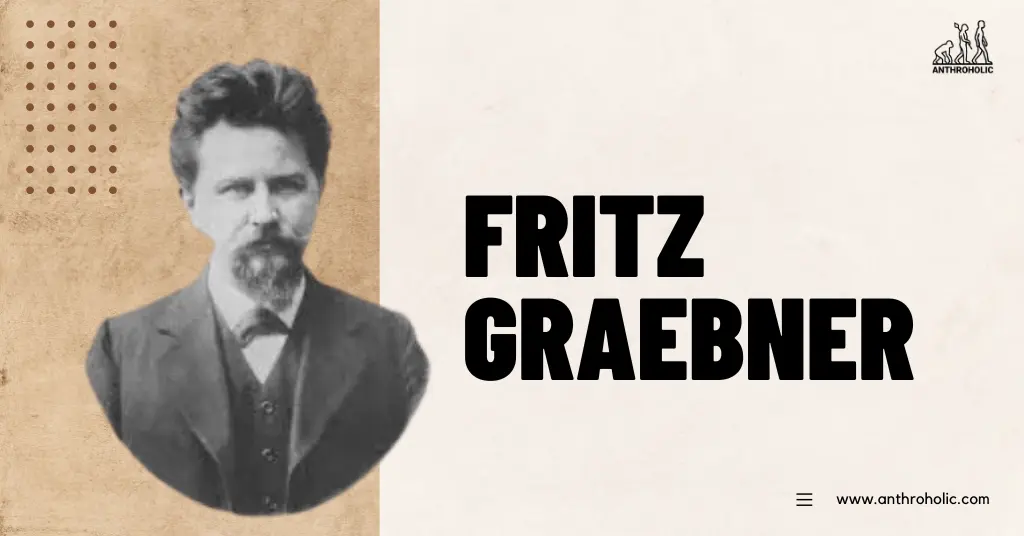
Fritz Graebner
Fritz Graebner was a central, if controversial, figure in early 20th-century anthropology. As one of the leading theorists of cultural diffusionism, he challenged the dominant narrative of unilinear evolution and argued instead that cultures spread from historical centers through contact and transmission. His most influential work, Methode der Ethnologie (1911), laid the foundation for the Kulturkreis (culture circle) theory, which became the hallmark of the so-called Vienna School of ethnology.
Working primarily from museum collections rather than immersive fieldwork, Graebner developed a comparative historical method that sought to map patterns of cultural traits-pottery styles, kinship structures, myths-across vast regions. He believed these patterns could be traced back to origin points, or “culture circles,” that diffused over time through human migration and interaction.
Graebner’s ideas were both innovative and divisive. While his diffusionist model influenced generations of German and Austrian ethnologists, it came under heavy criticism from Boasian anthropologists in the U.S. and structural-functionalists in the U.K., who emphasized cultural particularism and synchronic analysis.
Early Life and Education
Fritz Graebner was born on March 4, 1877, in Berlin, Germany, during a period of growing academic interest in world cultures and historical processes. He was raised in a culturally rich environment and pursued higher education in history, ethnology, geography, and classical philology at universities in Berlin and Bonn. From the start, Graebner’s intellectual path reflected the deep influence of German historicism, an academic tradition emphasizing the uniqueness and historical development of individual cultures.
During his student years, he encountered the work of Adolf Bastian, who argued that “elementary ideas” were shared across all humanity, while “folk ideas” were culture-specific. Bastian’s comparative approach would significantly shape Graebner’s method. Graebner also became increasingly interested in tracing how cultural similarities across distant regions might result from historical diffusion rather than independent invention.
Early Career and Museum Work
In 1904, Graebner began working at the Ethnological Museum of Berlin (then one of the world’s leading centers for comparative anthropology and ethnographic collections). There, he joined an elite group of scholars responsible for cataloging and interpreting vast collections of artifacts from Asia, Oceania, Africa, and the Americas.
Rather than conducting long-term ethnographic fieldwork himself-a common limitation among early diffusionists-Graebner relied heavily on museum specimens, explorers’ notes, and missionary reports. He took a meticulous comparative approach, analyzing patterns in tools, pottery, religious objects, and kinship systems. These were not just curiosities to him-they were evidence of cultural transmission.
His work particularly focused on Oceania, a region that he and others in the Kulturkreis school believed demonstrated clear evidence of cultural layering from successive waves of diffusion. He sought to identify geographical and temporal origins for cultural complexes by comparing the distributions of traits across islands and continents.
By the end of the 1900s, Graebner had developed a systematic method to study how cultural traits spread through contact, interaction, and migration-laying the groundwork for what would become one of the most debated theories in early anthropology.
Kulturkreis Theory and Major Works
In 1911, Fritz Graebner published his most influential work: Methode der Ethnologie (Method of Ethnology). In this landmark text, he laid out a clear and systematic approach to cultural diffusionism. Rejecting unilinear evolutionary theories that proposed societies progress through the same fixed stages, Graebner argued that similarities between cultures arise not from parallel development, but from contact and transmission.
His core concept was the Kulturkreis, or “culture circle.” A Kulturkreis referred to a coherent complex of cultural traits-such as myth systems, agricultural practices, or kinship models-that originated in a particular place and time, and then spread outward through migration or influence. According to Graebner, multiple overlapping culture circles had shaped the world’s cultural diversity.
This theory was developed further in collaboration with Wilhelm Schmidt and the Vienna School of ethnology, and it became particularly influential in Germany, Austria, and parts of Scandinavia. Together, they created a model that treated human history as a palimpsest of cultural influences, not a linear evolutionary ladder.
Graebner’s diffusionist method emphasized trait analysis and distribution mapping, offering a new toolkit for historical reconstruction. His approach was especially applied to Oceania and Southeast Asia, where he proposed the existence of ancient centers of innovation that had radiated outward.
Criticism and Theoretical Legacy
Despite its initial impact, Graebner’s Kulturkreis theory soon met serious criticism, particularly from the American Boasian school and the British structural-functionalists. Scholars like Franz Boas rejected Graebner’s broad, often speculative comparisons and his reliance on secondhand sources. Boas emphasized historical particularism and intensive fieldwork, arguing that cultures had to be understood in their local, lived contexts-not as products of abstract historical circles.
Moreover, structural-functionalists such as Bronisław Malinowski and A.R. Radcliffe-Brown opposed the Kulturkreis model because it focused on cultural origins rather than function and social cohesion.
Even within Germany, critics noted the limitations of tracing trait distributions without strong archaeological or linguistic support. Nevertheless, Graebner’s ideas endured longer in Central European anthropology, and his work helped fuel renewed debates in later decades about cultural contact, hybridity, and diffusion-especially in postcolonial contexts.
Later Years and Political Context
In the 1920s and early 1930s, Graebner continued to teach and publish in German academia, serving as director of the Rautenstrauch-Joest Museum in Cologne. However, the rise of Nazism brought both institutional disruption and personal hardship.
Despite his earlier support for German cultural nationalism, Graebner was imprisoned by the Nazis in the early 1930s, likely due to political disagreements and internal conflicts within the ethnological community. His career never fully recovered from this episode. Some later critics noted the ambiguity of his position—neither fully complicit with, nor openly resistant to, the rising authoritarian regime.
Graebner died in 1934, relatively isolated and intellectually sidelined at a time when anthropology was rapidly evolving in new directions.
Conclusion
Fritz Graebner was a key architect of early 20th-century diffusionist anthropology, a school of thought that sought to explain cultural similarities through patterns of historical contact, migration, and borrowing. In a period dominated by evolutionary models and typologies, Graebner offered a historical and relational vision of culture-one that recognized the complexity of human interactions across time and space.
His concept of the Kulturkreis, or culture circle, helped shift the focus from isolated cultural traits to bundled systems of meaning and practice that spread across regions. Though his reliance on museum collections and secondhand data drew criticism, his methodological rigor and comparative logic were groundbreaking for their time.
Graebner’s legacy is double-edged. On the one hand, his work influenced generations of German and Austrian ethnologists, offering tools for historical reconstruction and cultural mapping. On the other hand, his ideas were eclipsed by the rise of fieldwork-based anthropology, particularly under the influence of Boas, Malinowski, and their intellectual descendants.
Today, Graebner is rarely cited directly in mainstream anthropology, yet the core questions he asked-How do cultures move? How are identities constructed and transmitted? What can artifacts and traditions tell us about historical relationships?-remain central to the field.
While no longer at the center of anthropological theory, Graebner occupies an enduring place in its intellectual history, as a scholar who tried to chart the deep currents of cultural diffusion in an increasingly global world.
References
- Fritz Graebner | Cultural Anthropology, Primitive … – Britannica
Overview of Graebner’s work on Kulturkreis theory and his influence on cultural anthropology.
https://www.britannica.com/biography/Fritz-Graebner - Kulturkreis | Cultural Diffusion, Ethnicity & Identity – Britannica
Explanation of the Kulturkreis concept and its role in early 20th-century anthropology.
https://www.britannica.com/science/Kulturkreis - Fritz Graebner – New World Encyclopedia
Detailed account of Graebner’s life, work, and legacy in the field of ethnology.
https://www.newworldencyclopedia.org/entry/Fritz_Graebner - Graebner, Fritz – Encyclopedia.com
Summary of Graebner’s academic background and contributions to anthropology.
https://www.encyclopedia.com/environment/encyclopedias-almanacs-transcripts-and-maps/graebner-fritz - Sage Reference – Graebner, Fritz
Entry discussing Graebner’s theoretical perspectives and their impact on social and cultural anthropology.
https://sk.sagepub.com/ency/edvol/theory-in-social-and-cultural-anthropology/chpt/graebner-fritz - Fritz Graebner – German Anthropology
Short portrait highlighting Graebner’s career and theoretical contributions.
https://www.germananthropology.com/short-portrait/fritz-graebner/198 - Fritz Graebner – Routledge Encyclopedia of Modernism
Article discussing Graebner’s role in launching the culture-historical approach to ethnology.
https://www.rem.routledge.com/articles/graebner-fritz-1877-1934 - Diffusionism and Acculturation – Anthropology
Overview of diffusionist theories in anthropology, including Graebner’s contributions.
https://anthropology.ua.edu/theory/diffusionism-and-acculturation/

Related Posts