AI Answer Evaluation Platform Live Now. Try Free Answer Evaluation Now

Michel Foucault
Michel Foucault was a French philosopher, historian of ideas, social theorist, and critic whose work profoundly reshaped twentieth-century thought across the humanities and social sciences. Born in Poitiers, France, on 15 October 1926, and dying in Paris on 25 June 1984, Foucault’s intellectual legacy endures as one of the most radical analyses of modernity, knowledge, and power.
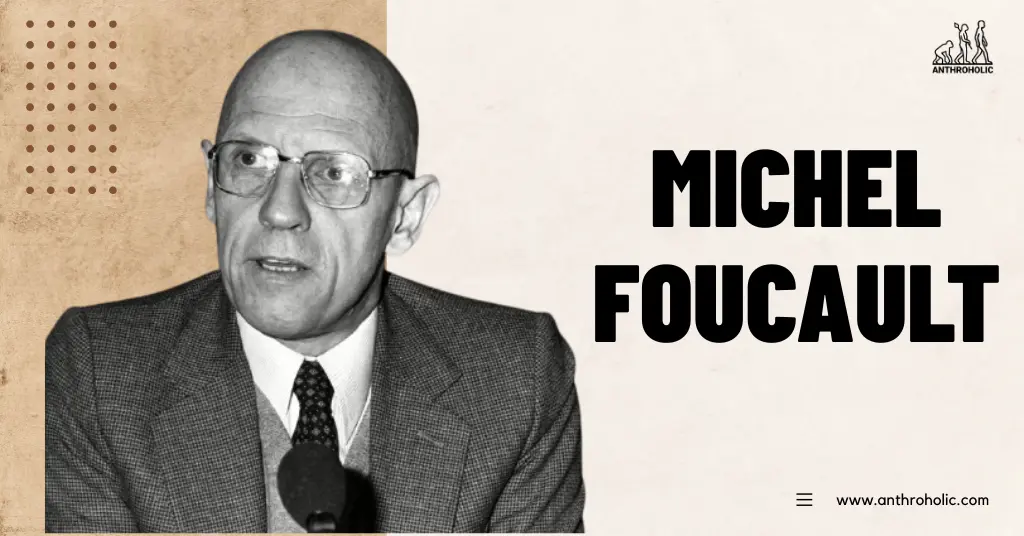
Rejecting universalist and humanist assumptions, Foucault examined how discourses, institutions, and practices produce “truths” that govern human behavior. His work traversed psychiatry, medicine, penal systems, sexuality, and ethics, exposing how the structures of power and knowledge shape human subjectivity. Through his innovative archaeological and genealogical methods, he questioned the neutrality of science, the objectivity of history, and the autonomy of the subject.
Foucault’s relevance to anthropology lies in his critique of the way modern institutions define and discipline the human body, categorize deviance, and regulate populations insights that have become fundamental for political anthropology, medical anthropology, and studies of social control. His theories of power/knowledge, discourse, governmentality, and biopower continue to influence anthropological thought and ethnographic practice.
Early Life and Education
Michel Paul Foucault was born into a well-to-do bourgeois family in Poitiers. His father, Dr. Paul Foucault, was a respected surgeon who hoped his son would follow in his medical footsteps. However, young Michel displayed early resistance to authority and a strong interest in literature and philosophy rather than medicine.
Foucault’s formal education began at the Collège Saint-Stanislas, followed by preparatory classes at the Lycée Henri-IV in Paris, where he studied philosophy under Jean Hyppolite, an eminent Hegelian scholar. In 1946, he was admitted to the École Normale Supérieure (ENS) the most prestigious institution in France for higher studies in philosophy.
At ENS, Foucault’s contemporaries included Louis Althusser, Jacques Derrida, and Pierre Bourdieu. He studied philosophy and psychology, earning the agrégation in philosophy in 1951. Deeply influenced by phenomenology, existentialism, and psychoanalysis, Foucault also became acquainted with the works of Nietzsche and Heidegger, which later formed the philosophical core of his critique of reason and the modern subject.
His early experiences with depression and his exposure to mental hospitals while studying psychology left a profound impression, shaping his first major research interest the history of madness.
Foucault’s academic career began with teaching positions in psychology and philosophy at the University of Lille and later as a cultural attaché in Sweden, Poland, and Germany between 1955 and 1960. These years abroad were crucial for developing his comparative understanding of European institutions and the sociology of knowledge.
Returning to France, Foucault completed his doctoral thesis in 1961, titled Folie et déraison: Histoire de la folie à l’âge classique (Madness and Civilization), under the supervision of philosopher Georges Canguilhem. The thesis marked his formal entry into the intellectual debates surrounding the history of reason, science, and exclusion.
Major Works and Contributions
Foucault’s intellectual trajectory evolved through distinct yet interrelated phases archaeology, genealogy, and ethics each introducing seminal concepts that transformed the study of knowledge and power.
A. Archaeological Phase (1961–1969)
During this period, Foucault sought to uncover the underlying structures that determine the formation of knowledge in different epochs.
- Madness and Civilization (1961) – Explores how Western society constructed the notion of “madness,” arguing that confinement and the asylum system were not humanitarian progress but mechanisms of social exclusion. He traced the historical silencing of the mad and the institutionalization of reason as a tool of control.
- The Birth of the Clinic (1963) – Examines the emergence of modern medicine, showing how the medical gaze redefined the human body as an object of observation, diagnosis, and control.
- The Order of Things (1966) – Introduces the concept of the episteme, the underlying system of thought that shapes knowledge in a given era. Foucault identifies shifts in Western knowledge from the Renaissance to the modern human sciences, famously declaring “man is an invention of recent date.”
- The Archaeology of Knowledge (1969) – A methodological work where Foucault refines his analytical framework. He rejects the notion of linear intellectual progress and instead examines how discursive formations define what can be said, thought, and known.
This “archaeology” does not seek truth behind discourses but analyzes their internal rules and conditions of possibility offering a powerful alternative to structuralism and historicism.
B. Genealogical Phase (1970–1979)
The 1970s marked Foucault’s shift from the archaeology of knowledge to the genealogy of power, drawing inspiration from Friedrich Nietzsche’s genealogical critique of morality.
- Discipline and Punish: The Birth of the Prison (1975) – Perhaps his most influential work, it explores how penal systems transformed from public executions to disciplinary regimes of surveillance and normalization. The Panopticon, inspired by Jeremy Bentham, symbolizes modern society’s internalized surveillance, where individuals regulate their own behavior.
- The History of Sexuality (Vol. 1, 1976) – Challenges the “repression hypothesis,” arguing that modern societies did not silence sex but rather produced an entire discourse around it. He introduces biopower a form of power that manages populations through health, reproduction, and sexuality.
Foucault’s genealogical approach showed that power operates not merely through coercion but through capillary mechanisms embedded in everyday practices, institutions, and knowledge systems. Power is productive, generating forms of identity, truth, and social order rather than simply repressing them.
C. Ethical Phase (1980–1984)
In his later years, Foucault turned toward the ethics of self-formation, exploring how individuals actively constitute themselves as moral subjects.
- The Use of Pleasure (1984) and The Care of the Self (1984) – These volumes of The History of Sexuality analyze ancient Greek and Roman practices of self-discipline and freedom, coining the concept of technologies of the self ways individuals shape their behavior, conduct, and identity.
- His lectures at the Collège de France, particularly on governmentality, parrhesia (truth-telling), and the hermeneutics of the subject, further elaborate his late interest in the relationship between power, truth, and ethics.
Through these stages, Foucault moved from analyzing institutions and discourses to exploring subjectivity and resistance, completing his intellectual circle from the “death of man” to the “care of the self.”
Role in Anthropology and Social Theory
While not trained as an anthropologist, Foucault’s impact on anthropology is profound and enduring. His theories offer analytical frameworks for understanding how power, discourse, and knowledge intersect in cultural systems.
- Power/Knowledge Nexus – Foucault demonstrated that knowledge is never neutral; it is intertwined with power structures that define what counts as truth. Anthropologists have adopted this insight to study colonialism, development, and governance as systems that produce cultural and scientific knowledge with political effects.
- Biopower and Governmentality – His notions of biopower (the management of life and population) and governmentality (the rationality of governance) are central to political anthropology, influencing studies of public health, surveillance, and the state.
- Discourse and Cultural Construction – By emphasizing how language and discourse construct reality, Foucault shifted attention from material culture to symbolic systems of meaning and control, anticipating the post-structuralist turn in anthropology.
- Institutional Analysis – His work on prisons, asylums, and clinics provides a model for the anthropological study of institutions as sites where social order and deviance are negotiated.
- Reflexivity and the Ethnographic Gaze – Foucault’s critique of the “regimes of truth” parallels anthropology’s later concern with reflexivity the recognition that the ethnographer’s own knowledge is historically and politically situated.
Through these contributions, Foucault helped transform anthropology from a discipline concerned with static cultures to one attentive to power, discourse, and subject formation in both Western and non-Western contexts.
Critical Evaluation
Foucault’s scholarship has generated immense influence and equally significant controversy.
Strengths
- Interdisciplinary Reach: His integration of philosophy, history, and sociology created new cross-disciplinary fields particularly historical anthropology, cultural studies, and critical theory.
- Innovative Methodology: The archaeological and genealogical methods revolutionized how historians and anthropologists conceptualize social change and the evolution of knowledge systems.
- Power as Productive: By defining power not merely as domination but as productive and relational, Foucault offered a dynamic framework for understanding everyday forms of control and resistance.
- Ethical Turn: His later focus on subjectivity and self-care reintroduced agency and moral freedom into his analysis, countering earlier criticisms of determinism.
Criticisms
- Obscurity and Style: Critics have found his writing overly abstract and elusive, often lacking empirical verification.
- Neglect of Economy and Class: Marxist scholars such as Jürgen Habermas argue that Foucault underplays economic structures and ideology in favor of diffuse power relations.
- Eurocentrism: Postcolonial theorists note his limited engagement with colonial and racial dimensions of power.
- Ambiguous Politics: Foucault’s reluctance to prescribe normative political programs has been seen as politically evasive.
- Historical Selectivity: Some historians accuse him of selective use of archival sources to support sweeping claims.
Despite these critiques, most scholars agree that Foucault’s frameworks remain indispensable for contemporary social analysis. His concepts have been extended by thinkers such as Judith Butler (gender and performativity), Nikolas Rose (governmentality), and Paul Rabinow (anthropology of biomedicine).
Conclusion and Legacy
Michel Foucault’s death in 1984 from complications related to HIV/AIDS cut short one of the most innovative intellectual journeys of the modern age. Yet his legacy endures, influencing disciplines as varied as anthropology, sociology, gender studies, political science, and cultural history.
His insistence that power is everywhere, that knowledge constructs rather than merely discovers truth, and that subjectivity is a historical product continues to reshape academic inquiry. Foucault’s analysis of how human sciences discipline bodies and regulate life has become foundational to critical anthropology, offering tools to examine how institutions from the clinic to the prison create moral and political order.
For anthropology, Foucault bridges philosophy and ethnography: his ideas enable anthropologists to interrogate their own categories of analysis and to expose the hidden power relations within cultural knowledge production. He remains, therefore, a central figure in the anthropology of modernity, institutions, and governance.
In essence, Michel Foucault’s intellectual legacy lies in his relentless questioning of how we come to know, govern, and define ourselves. His work stands as a call for continuous critique a reminder that the task of thought is not to accept truths but to expose how truths are made.
References
- Encyclopaedia Britannica – Michel Foucault.
https://www.britannica.com/biography/Michel-Foucault - Stanford Encyclopedia of Philosophy – Michel Foucault.
https://plato.stanford.edu/entries/foucault/ - Internet Encyclopedia of Philosophy – Michel Foucault (1926–1984).
https://iep.utm.edu/foucault/ - Collège de France – Michel Foucault: Chair of History of Systems of Thought (1970–1984).
https://www.college-de-france.fr/en/chair/michel-foucault-history-of-systems-of-thought-statutory-chair/biography - EBSCO Research Starters – Michel Foucault.
https://www.ebsco.com/research-starters/history/michel-foucault - Study.com – Michel Foucault: Discipline and Punish Biography & Summary.
https://study.com/academy/lesson/michel-foucault-discipline-and-punish-biography.html - Contemporary Thinkers – Michel Foucault Biography.
https://contemporarythinkers.org/michel-foucault/biography/ - The Foucault Society.
https://foucaultsociety.org/about-foucault/ - Internet Archive – Michel Foucault: Power/Knowledge (1980).
https://archive.org/details/powerknowledge00fouc - Duke University Press – Michel Foucault and Anthropology: Knowledge, Power, and the Self.
https://read.dukeupress.edu/books/book/2248/chapter/244888

Related Posts