AI Answer Evaluation Platform Live Now. Try Free Answer Evaluation Now
The Manchester School of Thought
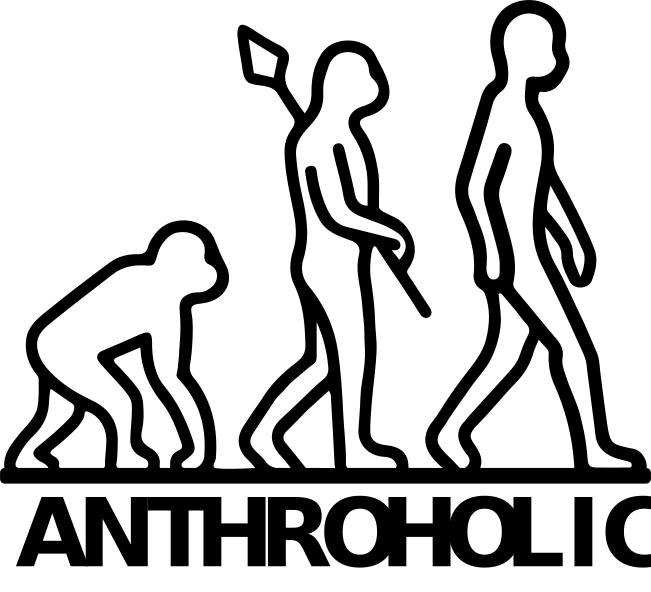
The Manchester School of Thought represents a revolutionary departure in the history of social anthropology, shifting the discipline’s focus from the search for social “equilibrium” to the rigorous study of conflict, process, and change. Emerging in the late 1940s and 1950s at the University of Manchester under the leadership of Max Gluckman, this school challenged the then-dominant British Structural-Functionalism. While earlier anthropologists like Radcliffe-Brown viewed society as a stable machine, the Manchester School saw it as a turbulent arena where individuals constantly negotiate power, rules, and identities.
In 2025, the Manchester School’s influence is more relevant than ever. Its methodological innovations, particularly the Extended Case Method, are now standard tools for anthropologists studying global urban crises, digital warfare, and the “lived experience” of social displacement.
The Genesis: Breaking the “Equilibrium” Myth
Before the Manchester School, British anthropology was dominated by the idea that societies were self-regulating systems that naturally sought stability. Max Gluckman (1911–1975), a South African-born scholar, found this model insufficient for explaining the realities of colonial Africa.
Gluckman argued that conflict is not a sign of social breakdown; rather, it is an inherent part of the social process. He famously proposed that social systems are “integrated through conflict.” By fighting within the rules of a system, people actually reinforce the system’s existence. This “Dynamic Functionalism” allowed anthropologists to study societies undergoing rapid colonization, industrialization, and urban migration without dismissing these changes as “noise.”
Key Methodological Innovations
The Manchester School is perhaps most famous for its unique toolkit, which moved anthropology from “snapshot” descriptions to “cinematic” analyses of social life.
The Extended Case Method (Situational Analysis)
Developed primarily by Gluckman and later refined by Bruce Kapferer, this method involves the deep, longitudinal study of a single event or a “social drama.” Instead of asking general questions about kinship, the researcher follows a specific dispute (like a land trial or a ritual failure) over weeks or months. This reveals how people manipulate social rules for their own ends.
Social Network Analysis (SNA)
Long before the advent of Facebook, the Manchester School pioneered the study of Social Networks. Scholars like Elizabeth Bott and Clyde Mitchell moved away from rigid “tribal” categories to see how individuals in urban environments (like London or the Copperbelt in Zambia) maintained diverse connections across class and ethnic lines. They were the first to map the “web” of human relationships that exists outside of formal institutions.
The “Social Drama” and Victor Turner
While Gluckman founded the school, Victor Turner took its ideas into the realm of symbols and rituals. Turner developed the concept of the Social Drama to describe the process by which a community deals with a breach of its norms.
According to a 2024 analysis of political protests, Turner’s four-stage model (Breach, Crisis, Redress, and Reintegration) remains the most effective way to understand how social movements move from a single “viral” incident to a systemic change in policy. This proves that the Manchester School’s focus on “crisis” was not just about tribal warfare, but about the very mechanics of social evolution.
Key Figures of the Manchester School
The school was a powerhouse of intellectual talent, each contributing a different angle to the study of social dynamics:
- Max Gluckman: The founder; focused on law, politics, and the “peace in the feud.”
- Victor Turner: Focused on ritual, liminality, and the symbolic “redress” of social conflict.
- Elizabeth Bott: Famous for her study of “Family and Social Network,” linking household roles to the density of outside friendships.
- Clyde Mitchell: A pioneer in urban anthropology and the mathematical modeling of social networks.
- A.L. Epstein: Studied the “politics of the urban” and how new identities are formed in mining towns.
The Manchester School in 2025
The Manchester School is currently undergoing a massive “digital renaissance.” Because our modern world is defined by constant conflict, shifting networks, and rapid urban change, their “processual” approach is a perfect fit for the 21st century.
Digital Anthropology and Conflict
In 2025, researchers are applying the Extended Case Method to “online social dramas.” By following a specific “cancel culture” event or a digital disinformation campaign from its breach to its redress, anthropologists can see how digital platforms enforce (or destroy) social norms.
Urban Crisis and Migration
As global cities face unprecedented migration, the school’s work on Urban Networks is being used to help NGOs and governments understand how “informal” social networks provide survival support for refugees. Rather than seeing migrants as a “mass,” anthropologists use Manchester methods to see them as skilled “networkers” navigating a new social drama.
“The Manchester School taught us that society is not a thing we inhabit, but a performance we are constantly negotiating through our disagreements.”
Significance for the UPSC/Academic Aspirant
For students of anthropology, the Manchester School is a critical bridge between Structural-Functionalism and Modern Conflict Theory. In exams, it is essential to emphasize that the school did not “reject” the idea of social structure; rather, it argued that structure is only visible through the lens of conflict and change.
Key terms to remember: Redressive mechanisms, Situational Analysis, Multiplex relationships, and Schismogenesis.
Conclusion
The Manchester School of Thought fundamentally changed anthropology by proving that the “messiness” of human life the arguments, the rebellions, and the shifting loyalties are where the real social structure lives. By focusing on Process over Product, Gluckman and his colleagues gave us a way to study a world that never stands still.
In an age of global uncertainty, the school’s insistence on looking at the “Social Drama” provides the clarity needed to understand how we break apart and, ultimately, how we put ourselves back together.
Frequently Asked Questions (FAQs)
1. Is the Manchester School still active today? While the original group of scholars has passed on, the “Manchester tradition” is a core part of the Anthropology department at the University of Manchester and many other global institutions. Its methods are foundational to Urban Anthropology and Political Anthropology.
2. What is the “Peace in the Feud”? This is a famous concept by Gluckman. It suggests that because people have “multiplex” (overlapping) relationships being someone’s neighbor, cousin, and business partner all at once they are pressured to resolve conflicts quickly to keep the peace in their other relationships.
3. How did the Manchester School view “Tribalism”? Unlike earlier anthropologists who saw “tribalism” as a primitive survival, the Manchester School viewed it as a modern political strategy. They showed how people in urban areas use ethnic identities to build networks and gain resources in the city.
4. What is the difference between Turner and Gluckman? Gluckman was more focused on the legal and political aspects of conflict. Turner was more interested in the psychological and symbolic aspects how ritual allows people to process the emotions of a crisis.
References
- Gluckman, M. (1955). Custom and Conflict in Africa. Oxford University Press. https://archive.org/details/customconflicti000gluc
- Turner, V. (1957). Schism and Continuity in an African Society. Manchester University Press. https://www.manchesteruniversitypress.co.uk/9780719002236/
- Kapferer, B. (2024). The Extended Case Method: From Manchester to the Digital Age. Berghahn Books. https://www.berghahnbooks.com/title/KapfererExtended
- Mitchell, J. C. (1969). Social Networks in Urban Situations. Manchester University Press. https://archive.org/details/socialnetworksi000mitc
- Werbner, R. (2025). Manchester School Legacies in Modern Ethnography. Annual Review of Anthropology, 54(1). https://www.annualreviews.org/journal/anthro

Related Posts