AI Answer Evaluation Platform Live Now. Try Free Answer Evaluation Now
Great Chain of Being
The "Great Chain of Being" is the term used in medieval culture to describe the hierarchical order of the natural world.
+91-7303290503, +91-9557169661 | MON to SUN 10:00 AM - 6:00 PM
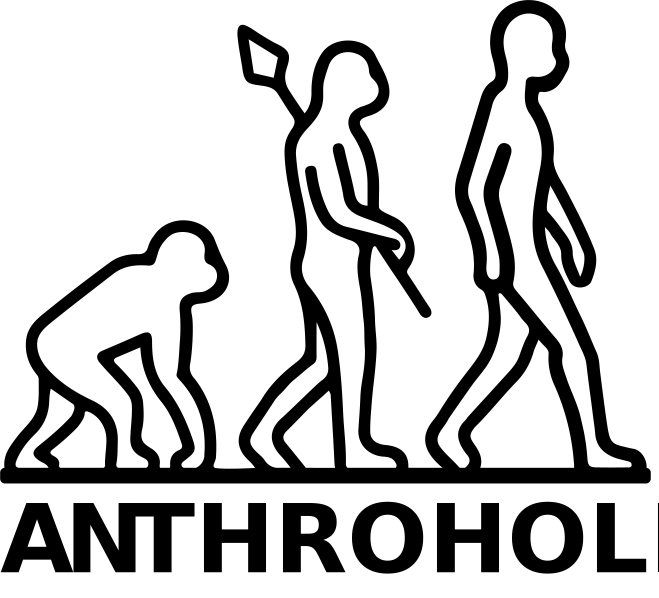
Anthropology is the scientific study of humanity, including human biology, culture, and society. This broad field encompasses several sub-disciplines, including cultural anthropology, linguistic anthropology, and archaeology. From exploring the diversity of human cultures to understanding the biological and evolutionary foundations of our species, anthropology provides a comprehensive understanding of what it means to be human.

The "Great Chain of Being" is the term used in medieval culture to describe the hierarchical order of the natural world.

The modern synthetic theory of evolution is founded on the idea of genes, which are hereditary in nature and aid in passing down traits from one generation to the next. It combines the ideas of Mendelian genetics with Darwinian evolution.

The ‘theory of use and disuse’ refers to the concept that all organisms physically adjust to their environment in ways that these new physical characteristics could be inherited by their offspring.

"Literariness" refers to the qualities or traits that separate literary works from other forms of writing, such as technical manuals, journalistic articles, or ordinary speech.

August Weismann an evolutionary biologist gave the theory of continuity of germplasm in 1892 wherein he proposed in his book Die Kontinuitdt des Keimplasmas

Forensic Ballistic is the branch of forensic science that deals with the study of projectiles in motion and its application in the field of forensics for administration of justice in the court of law.

Microevolution is the study of small-scale changes in the genetic makeup of populations over time.

The Oparin-Haldane Hypothesis, also known as the primordial soup theory, proposes that life on Earth originated from simple organic compounds that formed in the atmosphere and oceans of the early Earth.

Theories of evolution attempt to explain how species have changed over time and how new species arise.

The Theory of Epigenesis is a scientific concept that seeks to explain the origin and development of organisms through the gradual differentiation of cells.

Macroevolution refers to the long-term patterns and processes of evolution that occur over geological time scales, typically involving the formation of new species and the diversification of entire groups of organisms.

Paleopathology is the discipline that investigates ancient diseases based on human or animal remains.