
AI Answer Evaluation Platform Live Now. Try Free Answer Evaluation Now


Battlefield Archaeology
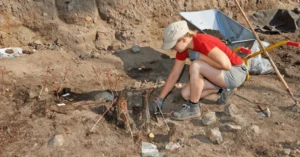
Battlefield archaeology is necessary for every conflict, but it is particularly important for the Revolutionary War.

Battlefield archaeology is necessary for every conflict, but it is particularly important for the Revolutionary War.

When artificial impacts on natural selection have caused a species' color to change, it is known as industrial melanism.

Cultural pluralism has been proposed as a goal and a set of social behaviors for properly managing modern society's rising variety and connection.

How ancient civilizations "used these occurrences and what role the sky played in their society" is the subject of archaeoastronomy research (often spelled archeoastronomy).

In-depth inquiries into the ancestry of Homo sapiens, or modern humans, have been done throughout history. One method is the "multi-regional hypothesis of human evolution".

Chronological age is an order that has been devised in archaeology, one of which can date different periods with sophisticated chronometric dating technologies like radiocarbon and luminescence.

Scientists have sought to fathom the chronology of the Earth in order to pinpoint the exact dates of each key event in our geological, biological, and cultural history since far earlier than the Age of Enlightenment.

According to Colin Renfrew, the application of molecular population genetics approaches to the study of human evolution is referred to as "archaeogenetics."

Computational archaeology provides computer-based analytical approaches that may be used to analyze long-term human behavior and behavioral evolution.

In order to confront archaeological issues, the field of research known as geoarchaeology incorporates methods from the Earth sciences. Even when material remains are buried

Zooarchaeology, a branch of archaeology, is the study of animal artefacts that have been discovered in remote areas in the past. The word's less attractive sibling, archaeozoology, is not as lovable in English as it is in other languages.
In the late 1970s, evident in the emergence of the field of bioarchaeology—the study of human remains from ancient cultures—had become a significant area of study for the social sciences.